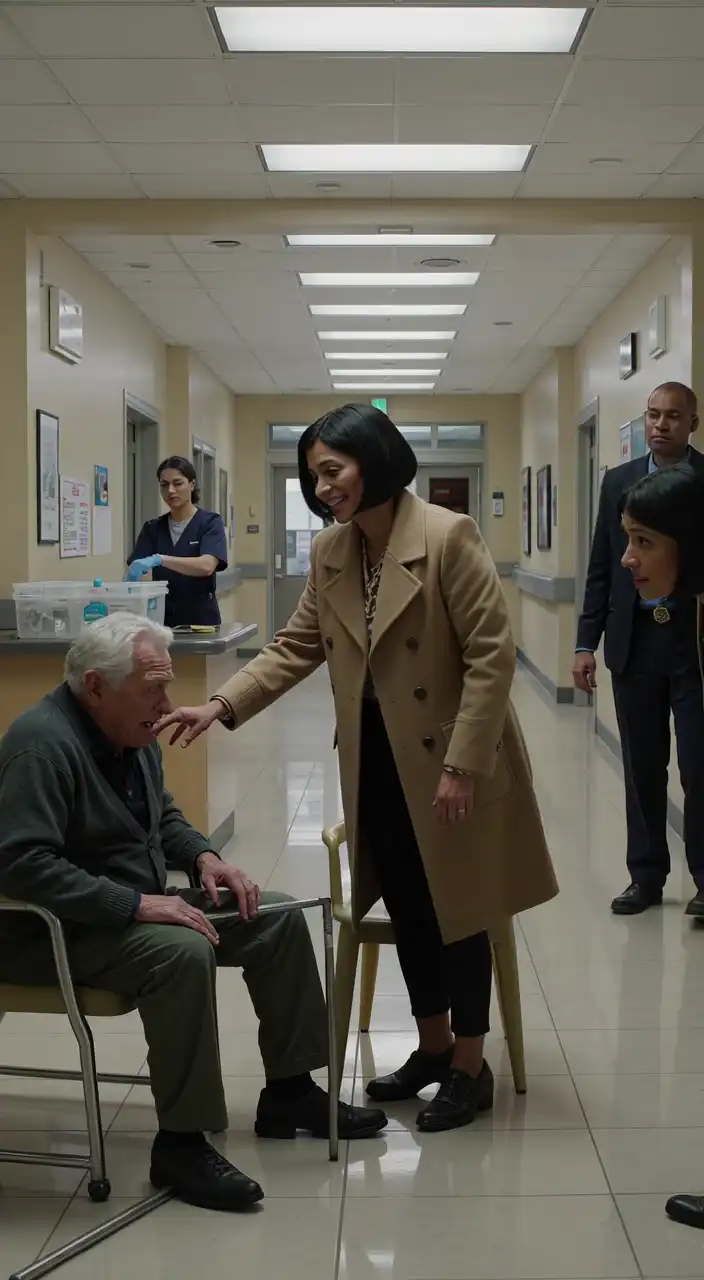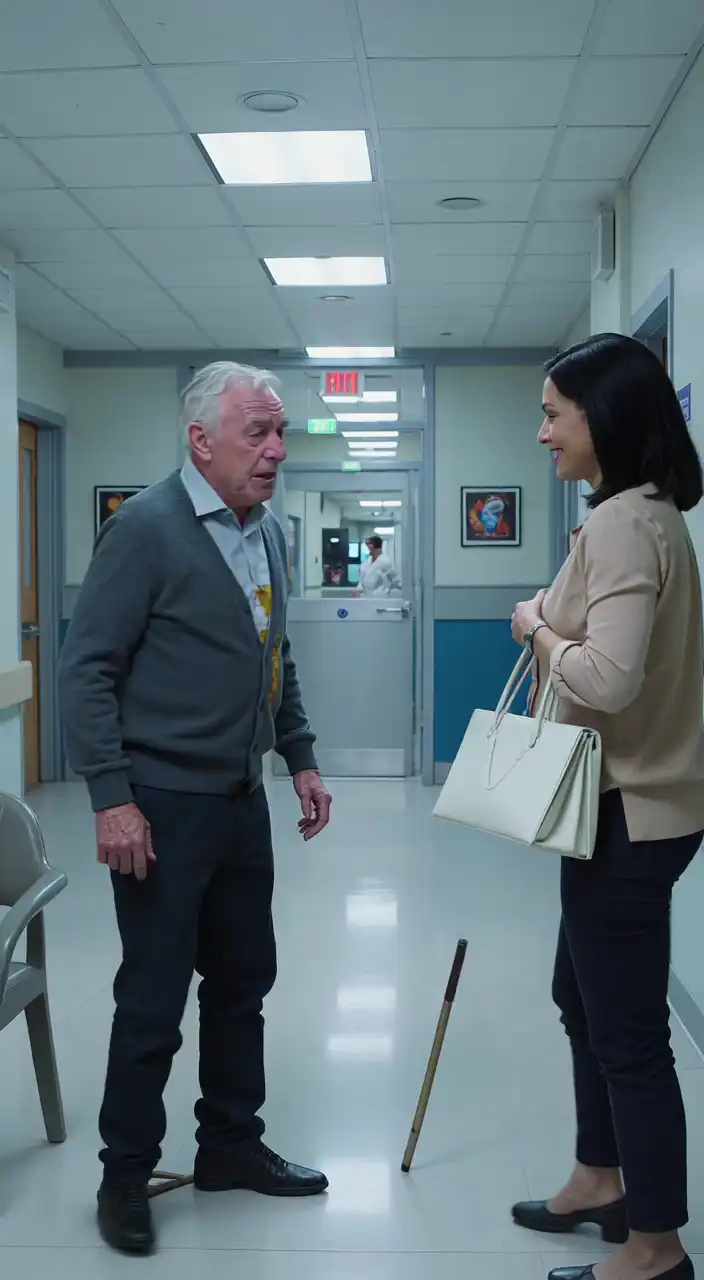
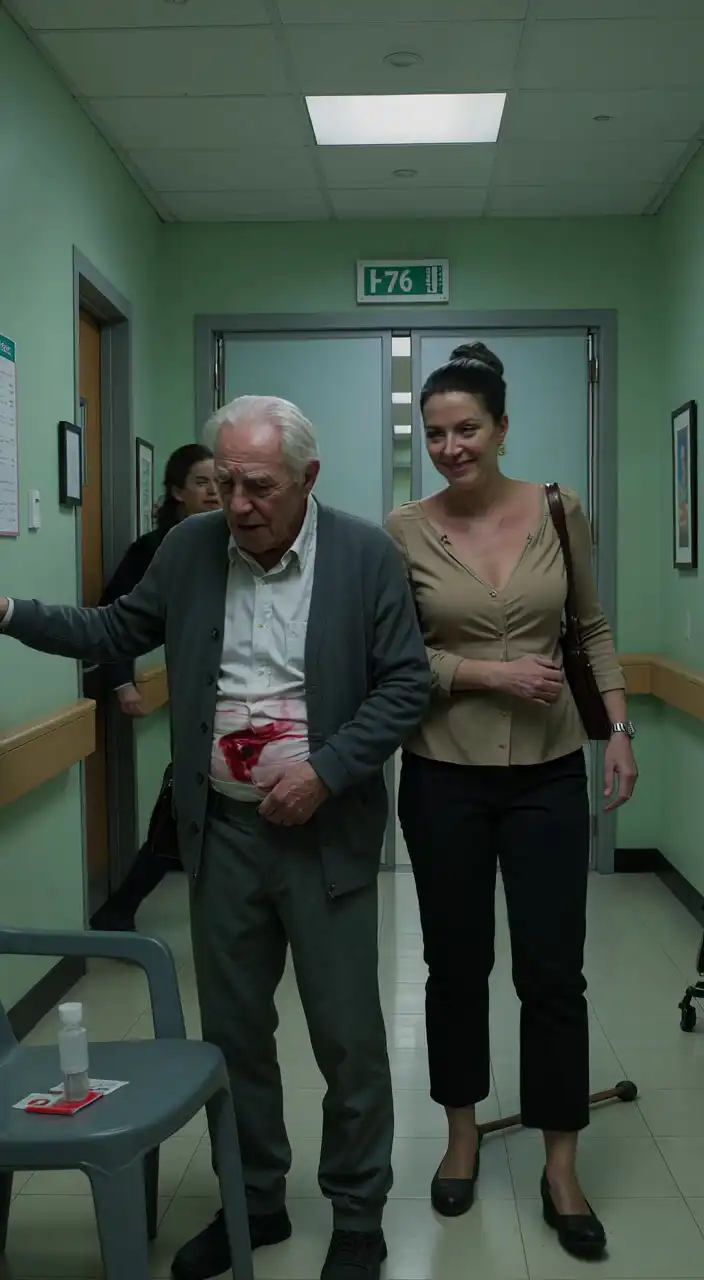
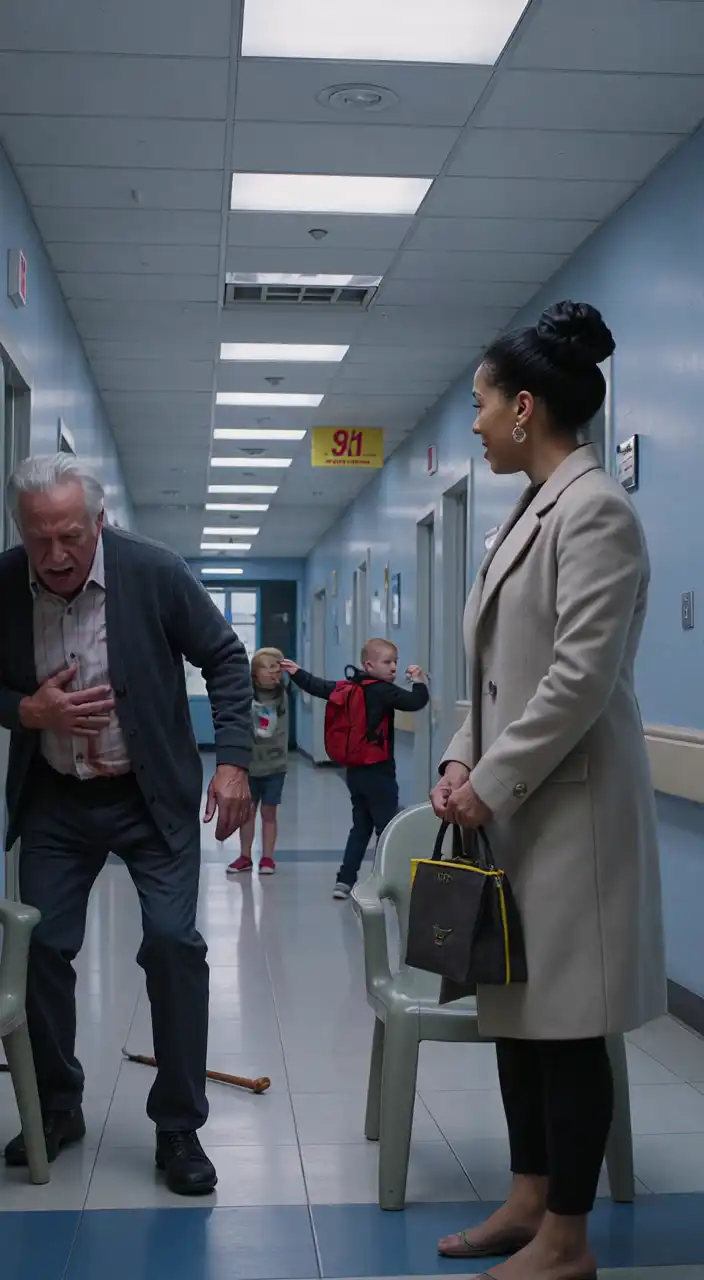

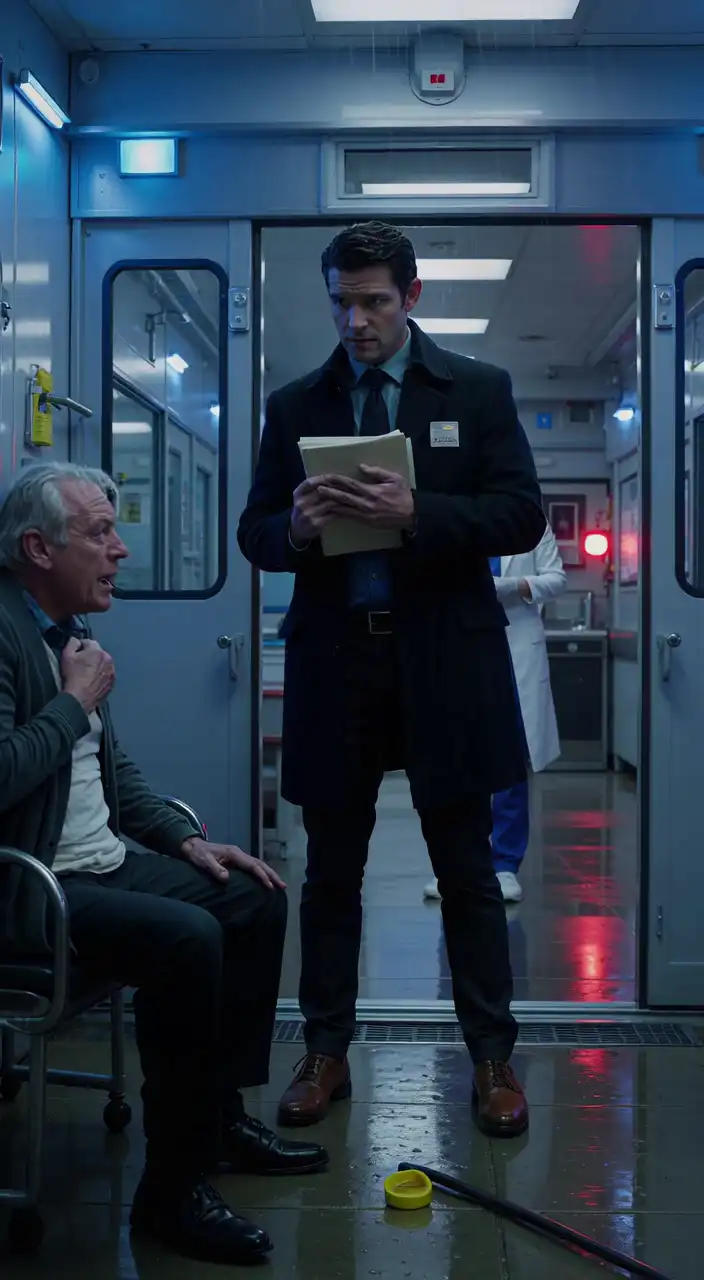
Under the cuff, the skin around Noah's IV bruise was sticky and yellowed, and the smell rising off his sleeve was not antiseptic.
Dr. Amelia leaned closer, eyes narrowing in the hard fluorescent wash over the ambulance bay. "That is not iodine," she said, more to herself than to anyone else. Her gloved fingers turned Noah's wrist, exposing the hospital bracelet they had not even cut off when he left. The barcode was damp, but intact. "What time was he discharged?"
Ethan kept his body squared to the doorway. "Six-thirty. He has his instructions. This is an outpatient complication issue. We need family consent and billing review if he wants to be seen again."
Noah made a small choking sound, halfway between a cough and a groan. He pressed one hand to the bandage on his abdomen and bent forward as if his own body had suddenly become too heavy to hold upright.
Amelia snapped her head toward the glass doors. "Gurney. Now."
A nurse just inside hesitated because Ethan was technically administration and because hospitals teach people a hundred invisible ways to wait for permission. Amelia's voice sharpened into steel. "If he falls out here because someone wants to discuss paperwork, all of you will remember this shift forever. Bring me a gurney."
The nurse moved.
Ethan lowered his voice, trying to reclaim the scene with composure. "Doctor, the family already had concerns about confusion after anesthesia. There are competency notes in the discharge file. We were told the son would bring him back tomorrow if needed."
Noah lifted his face, wet with rain and sweat. "I didn't say tomorrow." His teeth clicked together. "I said now."
Amelia glanced at me. "Did anyone give him anything in the last hour? Medicine, tea, pain pills, liquid meds, anything yellow?"
I pointed to the baseboard. "That cap was there when he started slipping off the chair."
The nurse arrived with the gurney, another orderly behind her. Ethan shifted again, but this time Amelia turned on him fully. She was a woman in her sixties, compact, with a trauma badge clipped to her coat and the kind of posture that made panic lose its balance. "Mr. Ethan, if you interfere with emergency evaluation one more time, I will have security remove you from this threshold. He is febrile, post-op, altered, and unstable on his feet. I do not need your permission."
"It's administrator Patel," he said automatically, a reflex more than a choice.
She held his gaze. "Then act like one."
They moved Noah onto the gurney. He hissed through his teeth when the orderly's hands touched the dressing. A dark wet bloom had spread through the compression bandage under his cardigan. The yellow stain ran from the cuff almost to the elbow now, diluted by rain. Amelia touched the bandage once and then looked straight at the sliding doors as if calculating minutes in blood pressure and bacterial load. "Triage room two. CBC, CMP, lactate, cultures, abdominal exam, and page surgery. I want tox screening added. Someone get that bottle cap bagged."
Ethan's calm cracked by a degree. "Tox? On what basis?"
Amelia answered while pushing the gurney herself. "On the basis that I know the smell of liquid digoxin and concentrated metoclopramide, and I know the look of a post-op patient whose story does not match his chemistry."
That made Ethan go still.
It made me still too, because Noah had whispered one thing during the drive over, when his head had thudded against the passenger window and I asked if he had taken his evening meds. He had said, "He kept changing cups."
Inside triage, the storm noise dropped to a muffled roar. Monitors beeped. A tech cut away Noah's bandage while Amelia examined his abdomen. The incision line was angry and red, heat rising from it, but the deeper alarm came from his whole body: tremor, dehydration, fever, confusion, weakness. He tried once to swat away the blood pressure cuff, not because he did not want help, but because he was embarrassed by how little control he had left.
"I can answer," he muttered when Amelia asked orientation questions. "I'm not gone. I'm right here."
"I know you are," she said. "Tell me who brought you home."
"My son. Daniel."
"And who brought you back tonight?"
I opened my mouth and then stopped because the answer was complicated. Noah answered first anyway. "Nobody brought me. I asked to come. They kept talking. Then I stood up and he said if I made trouble, I'd lose my place with the surgeon."
Amelia looked up. "Who said that?"
Noah swallowed. "Not my son."
The nurse clipped a pulse ox onto his finger. His oxygen was acceptable, but his pulse was running too fast, his pressure was soft, and his temperature was high enough that everyone in the room started moving with the clipped quiet urgency that means the debate phase is over.
Security arrived at the doorway. Ethan was still outside, speaking into his phone now, one hand pressed to his other ear against the rain-thick noise. Amelia stepped out to the hall for less than a minute. Through the gap, I heard enough.
"He is not your decision point," she said.
Then Ethan, low but angry: "You don't understand what family this is attached to."
Amelia answered, "I understand exactly what emergency medicine is attached to."
When she came back in, she asked me my name, how I knew Noah, and whether I had seen him discharged. I told her I had been at the pharmacy pickup line because my own mother was upstairs on telemetry, and I recognized Noah because he had dropped his cane while trying to fold papers with one shaking hand. I had helped him to the curb where a silver SUV waited. His son Daniel had thanked me too quickly and taken the envelope from Noah before he could look at it. Forty minutes later, when I ran back through the ambulance bay after getting a text about my mother, I saw Noah again in the rain with the same cardigan, no envelope, no son, and Ethan at the doorway like a bouncer guarding a nightclub.
"Did you see who left him?" Amelia asked.
"No. Just the SUV pulling away."
Noah stirred. "Daniel said he'd circle." His eyes fluttered, then focused on the ceiling light. "He didn't circle."
Amelia's expression did not change, but she absorbed everything. "All right."
A lab tech came for blood. The surgical resident arrived, young, wary, trying to understand why a post-op discharge had boomeranged into emergency triage with security outside the door. Amelia gave a tight summary, ending with, "And I want the discharge packet located now."
The resident glanced toward the hall. "Administration has a hold on some records after-hours if family requests-"
Amelia cut him off. "A family request does not erase a physician's chart. Find it."
Noah grabbed weakly at her sleeve as she turned. "Don't call Daniel yet."
She paused.
His eyes were clearer for one brutal second. "If he hears tox, he'll say I'm confused. He always says confused when I remember too much."
That line landed in the room like a dropped instrument.
Amelia crouched so he would not have to strain upward. "Then tell me what you remember."
Noah licked dry lips. "At home he gave me soup. Then pills. Then another cup because he said the first one didn't go down. I told him I only take heart medicine at night if the bottle says so. He said the doctor changed it. I asked for the paper. He said he had it." He shut his eyes tight, trying to hold the thread. "Then I vomited in the sink. Yellow. He got mad because I hit the dish towel."
The nurse and I exchanged a look. Yellow stain on the sleeve. Yellow cap on the floor. Folded papers missing. A son who "would circle" and never came back.
Amelia stood. "Page social work and house supervisor. Quietly. And ask security to hold anyone asking for Noah Lang's chart or belongings."
The first reversal came less than ten minutes later. The nurse returned, not with the discharge packet, but with a printout from the electronic record. "There is no daughter listed on today's discharge acknowledgment," she said. "The signature is from a family representative. Daniel Lang. Scanned by after-hours admin."
Amelia looked toward the hall again.
Noah gave a broken laugh that almost became a sob. "He said if I made a scene, they'd never take me back because the account was already in trouble."
"What account?" I asked.
But his face had gone gray. The monitor tone changed pitch. He curled around his abdomen and whispered, "Cold."
Everything accelerated.
Amelia barked for fluids and broad-spectrum antibiotics, and the surgical resident's uncertainty evaporated under numbers and symptoms. They rolled Noah for imaging. As the gurney moved, a transport aide handed Amelia a clear evidence bag.
Inside it was the yellow bottle cap.
A tiny embossed letter glinted through the plastic under the triage light.
Amelia stared at it for half a second too long.
Then she said, "That cap didn't come from anything prescribed to him."
By the time she turned toward the hall again, Ethan was gone.
The CT tech had barely locked Noah's wheels when the lights flickered once under the force of the storm. Not enough to darken the corridor, just enough to make everyone glance up and think about generators and roads and all the bad timing that piles onto a human emergency.
Noah was more awake and less coherent at the same time, the dangerous middle ground that fools families into thinking someone is getting better because their eyes are open. As they slid him toward the scanner, he kept lifting one hand as if trying to catch hold of a thought moving out of reach.
"My watch," he murmured.
The nurse looked at his bare wrist. "You don't have one on."
"It clicks," he said. "Daniel hates the sound."
Amelia, walking beside the gurney, asked, "Your watch is at home?"
Noah frowned with visible effort. "No. In his car. He took it when I kept tapping the face."
The CT suite doors opened. The smell of contrast, antiseptic, and wet wool from rain-soaked coats drifted together in the hallway. Amelia stayed until the team positioned him, then stepped out with the surgical resident to review preliminary labs that had just posted on a tablet. I watched her eyes move quickly.
White count high. Lactate elevated. Signs of infection. Electrolytes off. Tox screen pending.
The resident blew out a breath. "This could still be surgical complication with dehydration and med confusion."
"Yes," Amelia said. "And med confusion doesn't explain an unauthorized hold at the door, a missing packet, a false statement about daughter consent, and an admin who leaves when I mention toxicology."
The resident nodded, chastened.
A hospital security supervisor approached with a damp radio clipped to his shoulder. "We reviewed the ambulance bay camera. Patel was here twenty-two minutes before the patient attempted reentry. He wasn't stationed for routine traffic. He came out from admin hall after a phone call."
"Do we have the phone source?" Amelia asked.
"Internal extension, then a cell number routed through the front desk transfer log. We can get records if compliance opens it."
"Open it."
The supervisor hesitated just enough to show the institutional friction beginning to rise. It was after hours. Storm staffing. Senior administrator involved. Wealthy family mentioned. A man like Ethan did not get openly challenged without somebody in a conference room tomorrow asking why people had not shown more deference.
Amelia's tone cooled. "If this patient deteriorates while records and personnel drift away from us, I will document every obstruction by name. Is that clear?"
The supervisor straightened. "Crystal clear."
Noah came back from CT worse. Not crashing, but slipping. The pain had sharpened under the fever, and his shivering was so violent the blanket trembled over his chest. A nurse tucked another warmed one around him, and he caught her wrist with surprising urgency.
"Did he call her?" Noah asked.
"Who?" she said.
"Mara."
The name meant nothing to the nurse. Amelia stepped in. "Who is Mara?"
Noah blinked. "My daughter."
The room went still again.
Amelia said carefully, "Your daughter is Mara?"
He nodded. "Chicago." He licked his lips. "Blue suitcase when she visits. Daniel says not to bother her. Says she only wants money."
That contradicted Ethan's lie about a daughter authorizing anything, but it also suggested a larger family fracture. Amelia asked for a social worker update. None yet; storm delays. Roads backing up. One worker stuck off-site. Another covering labor and delivery.
Noah's hand drifted to the blanket. "Did he call her?"
"We don't know yet," Amelia said. "Did you ask him to?"
"At home. Before the soup." His voice frayed. "He said she blocked me years ago."
Amelia looked at me briefly, then back to Noah. "Do you believe that?"
Noah's eyes filled, not with dramatic tears but with the exhausted humiliation of an old man being made to distrust his own memory. "I don't know what I believe when he talks fast."
That sentence did something to everyone listening. It turned the story from possible household confusion into a pattern.
The CT results came with another pressure point. No catastrophic internal rupture, but there was fluid collection and signs concerning for post-op infection. Enough to require admission, closer monitoring, probably intervention if the labs trended the wrong way. He should never have been standing in the rain begging to be allowed through a door.
Amelia called surgery attending directly this time, skipping layers. "He is staying. I don't care what discharge category someone buried him under. And I want pharmacy reviewing all med reconciliation from this afternoon."
When she hung up, the charge nurse entered with a clear plastic belongings bag. "Found in the lost-and-found cart by bay reception."
Inside were Noah's cane strap, a handkerchief, reading glasses, and a folded sheet gone soft with damp at the corners. Amelia pulled it out carefully.
Not the full discharge packet. A single photocopied page from the medication summary.
One line had been highlighted in yellow.
Temporary hold digoxin pending updated cardiac review.
The room seemed to contract around that sentence.
Amelia held the page by two fingers. "He was not supposed to resume his evening digoxin until a doctor cleared it."
The nurse checked the MAR on the tablet. "And the pharmacy counseling note says this was explained to patient and family rep."
Noah stared at the ceiling. "He said the yellow mark meant important, not stop."
The planted detail had become a weapon.
Amelia asked softly, "Did Daniel hand you the pills?"
"Crushed in applesauce first," Noah said. "Then in tea because I spat some."
The resident muttered, "Jesus."
Amelia did not react outwardly, but the protective focus in her face hardened into something almost maternal and almost furious. "Where is his son now?"
Security answered that one from the doorway. "We have a vehicle registration from camera pickup. Silver Lexus SUV registered to Daniel Lang. It exited the east lot forty-one minutes ago, then returned to employee parking for six minutes before leaving again."
"Employee parking?" Amelia said.
"Yes. And Patel's badge accessed the side admin entrance during that same window."
So Daniel had not simply abandoned Noah in panic. He had looped back, met with Ethan, and then left.
A plausible explanation appeared almost on cue when the house supervisor finally arrived, raincoat dripping onto the tile. She carried the polished caution of somebody used to balancing patient care against donor relations. "Let's slow down before we make allegations," she said. "Mr. Lang's family has an account with the foundation. There may be confusion around guardianship or payment guarantees. Adult children often panic after discharge."
Amelia handed her the highlighted med summary. "Adult children also sometimes ignore a temporary hold on a cardiac med and force a post-op parent to ingest it. Panic does not explain obstruction of emergency readmission."
The supervisor looked at the page and recalibrated. But not completely. "We still need to consider whether the son misunderstood instructions."
"There is misunderstanding," Amelia said. "And then there is someone telling a febrile seventy-two-year-old he cannot reenter emergency care without family permission while an administrator conceals paperwork in his coat."
The supervisor's mouth tightened. "Patel says he was trying to prevent duplicate admission until the storm staffing stabilized."
Noah turned his head on the pillow. "He told Daniel I'd cost too much if I got septic here." The last words came out slurred, but clear enough. "Said transfer was better."
That was the incomplete explanation. Money. Not just family cruelty, not random neglect, but a wealthy family account, transfer politics, a foundation relationship, and an administrator who wanted a complicated patient moved elsewhere if he worsened. It was plausible in the ugliest way: protect the account, delay the readmission, let the road narrow options, and maybe the family would accept transfer once the county route reopened tomorrow.
But the contradiction was right there too.
If it was about money, why force a held medication? Why the yellow stain, the extra cup, the altered discharge page?
Amelia knew it. I knew it. The supervisor knew it from the way she kept glancing back at the line on the page.
Noah's tox screen came back with a flagged result consistent with digoxin exposure beyond expected dosing context.
The room went quiet enough to hear rain ping against the outer windows.
Amelia looked at the supervisor. "Call risk, compliance, and law enforcement liaison. Right now. This is no longer an internal dispute."
The supervisor stepped into the hall to make the call.
Noah opened his eyes and searched the room until he found Amelia. "He'll say I forget things. He'll say I signed."
"Did you?" she asked.
He took a long time to answer. "I signed one paper in recovery. Then I slept. When I woke up, my hand hurt like I'd been squeezing something."
Amelia asked the nurse to check his right hand. Across the base of his thumb was a faint smear of yellow, almost gone after rain and sweat.
Another planted detail. Another pressure point.
Maybe he had not simply been handed the wrong medicine. Maybe his own hand had been guided across papers after.
A unit clerk hurried in. "Phone call for Mr. Lang. Woman says she's his daughter. She's insisting."
Amelia's eyes flashed. "Put it through here."
The voice that came over speaker was tight, breathless, and already afraid. "This is Mara Lang. I just got a voicemail from my father's number with a lot of static and somebody saying don't call back. Then a nurse from this hospital called my old emergency contact. What is happening?"
Noah heard her and tried to sit up through sheer instinct. "Mara?"
The sob on the line was immediate. "Dad? Dad, I'm here."
Noah covered his face with both hands and started shaking harder, but not from fever alone.
Amelia took the call. "Ms. Lang, your father needs treatment and we need information. Were you involved in his discharge today in any way?"
"No. I wasn't even told he had surgery until yesterday. My brother said it was minor and under control. He told me Dad didn't want visitors."
Amelia's voice stayed calm. "Did you block your father?"
"What? No. He thinks that because Daniel told him I changed my number after Mom died. I never did. Daniel has been screening his calls for months because he said Dad gets 'worked up' when I ask about finances."
There it was: the hidden fault line widening.
Noah whispered, "I knew your voice."
Mara was crying now, but clear. "Dad, listen to me. I am getting on the road."
Amelia glanced toward the storm-smeared windows. "What city are you in?"
"Joliet. I can be there in an hour if the roads hold."
The charge nurse muttered, "If the roads hold."
Amelia answered, "Drive carefully. The county road may close. If it does, call us from wherever you stop."
As soon as the call ended, security came back with another update. "Patel's office is locked, but maintenance opened it. We found the original discharge packet in his shred bin. Not destroyed yet because the jammed bag hadn't cycled."
The house supervisor actually went pale.
Amelia said, "Bring it."
When the packet arrived, one page near the signature line had a yellow streak across the bottom edge, as if a damp sleeve or contaminated hand had touched it.
And the signature on the family acknowledgment did not match the one Noah had made on his anesthesia consent.
The second movement ended there, with the first real proof in hand and a more dangerous question opening underneath it.
If Daniel and Ethan had coordinated the delay, then they were not just covering a billing problem.
They were trying to keep Noah from saying something before someone else got there.
By the third hour, the storm had tightened around the hospital like a fist.
Wind drove rain against the ambulance bay windows hard enough to blur the parking lot lights into smeared gold bands. The county sheriff's liaison had not arrived because a jackknifed truck was blocking part of the north approach. Social work was trapped on the far side of the river. Housekeeping carts stood abandoned in side halls where staff had been pulled to overflow. The building still worked, but with that strained after-hours rhythm where every missing person mattered.
Noah had been moved into a monitored step-down room while surgery debated whether they needed to take him back to the OR or stabilize him with antibiotics and drainage first. His fever spiked, then dipped after medication, then spiked again. He was not dying in front of us, which made everything emotionally harder. A dramatic collapse would have made the villainy obvious. Instead, there was this awful seesaw of "maybe" that people like Ethan and Daniel counted on.
Amelia stayed involved even after handing portions of care to the admitting team. She checked the monitor, re-read the record, and kept pushing every institutional door that could still close on a vulnerable patient.
The forged packet was only the beginning.
Pharmacy called with another detail: the yellow bottle cap matched a manufacturer used for concentrated liquid digoxin from a compounding supplier, not the standard tablets Noah should have had at home. A specialty order. Hospital-adjacent. Not something an ordinary family kept in a kitchen drawer by accident.
That forced Ethan into his next lie.
He came back.
Security escorted him this time, though he carried himself as if he had simply returned from an important meeting and expected everyone to be embarrassed by the fuss. His hair was damp at the temples, his spotless shoes no longer spotless. He asked to speak "for the record" with administration present.
Amelia remained in the room. The house supervisor stood beside the bed with compliance on speakerphone. Noah drifted in and out, not fully asleep but too weak to follow every word.
Ethan folded his hands. "I made a judgment call based on incomplete information. The son told me Mr. Lang had been double-dosing his medications and threatening to accuse staff if he wasn't readmitted immediately. We have to protect the hospital from manipulative repeat admissions."
Amelia said nothing.
He continued, sensing the need to fill silence. "As for the paperwork, I removed copies because the son stated there was active family conflict over financial control, and he did not want sensitive records exposed in public areas. The shred bin is regrettable, but not criminal. We were trying to de-escalate."
Compliance asked over speaker, "Did you tell anyone the patient needed daughter consent for reentry?"
Ethan's pause was too small for a layperson, but not for Amelia. "I may have misspoken under pressure."
"You lied," Amelia said.
His jaw tightened. "Doctor, with respect, you are emotionally invested in a dramatic interpretation."
That almost worked on the room because people are trained to distrust emotion in institutions, even when emotion is just conscience with a pulse. But then Noah spoke without opening his eyes.
"He told Daniel," he whispered, "if Mara gets here first, it's over."
Silence.
Ethan turned toward the bed. "Mr. Lang is febrile and confused."
Amelia stepped forward. "And yet remarkably specific whenever your interests are involved."
The house supervisor asked, "What did you mean by 'it's over'?"
Ethan's face changed then, not into guilt exactly, but into a cold, trapped calculation. "I don't know what he thinks he heard."
Amelia did not let him retreat into vagueness. "Did you know the highlighted med hold line was missing from the copied summary given to him at discharge?"
"No."
"Did you know the signature packet in your office shows a page mismatch and likely forgery?"
"No."
"Did you know the compounded liquid cap found at the bay does not match any prescribed discharge medication?"
Ethan's eyes flicked once, involuntarily, toward the evidence bag on the counter.
There. The trained eye catch. The planted detail paying off. He recognized it.
Amelia saw it too. "You know what it is."
He straightened. "I know what a bottle cap looks like."
Compliance spoke again. "Administrator Patel, do not leave campus."
He gave a humorless little laugh. "In this weather?"
But the real movement happened fifteen minutes later, not with Ethan but with the phone in Noah's belongings bag.
The charge nurse had dried it out enough to power on. It was old, with oversized text and a cracked case. The lock screen lit with a photo of two grown children flanking Noah at what looked like a backyard cookout years earlier. Mara on one side. Daniel on the other. No visible estrangement then. Just family.
There were six missed calls from "Mara Cell" over the last three months.
And every one of them had been marked as blocked.
Not unanswered. Blocked.
Noah stared at the screen as if it were evidence from another life. "I don't know how to do that."
"You didn't," Amelia said.
The unit clerk handed over another report from IT. Noah's hospital portal password had been reset twice in two weeks from an IP address associated with Daniel's home internet. Proxy forms had been uploaded. One was legitimate from last year, allowing Daniel to discuss appointments. Another, dated two days earlier, expanded access dramatically and bore a shaky digital signature.
The hidden secret was becoming dangerous in a new way. This was not just about one night's delay or one bad medication.
Someone had been gradually isolating Noah and maneuvering control.
Mara called again from the road, voice chopped by static. "I'm at the county line. GPS wants me through River Cut."
The security supervisor swore under his breath. River Cut was the road most likely to close first.
"Take Route 16 south if you still can," he told her from the speaker. "If the barricades are down, stop and wait."
"I am not waiting," she snapped.
Noah lifted his head. "Don't let her drive the cut in this rain."
The statement was pure father, urgent through the fog of his own pain. It told Amelia something else too: even now, Noah's instinct was protection, not performance.
The surgery attending arrived and ordered drainage first, surgery only if he worsened. Good medicine, measured medicine, infuriatingly dependent on hours that family betrayal had already stolen. While the team prepared, Mara texted a photo of a document she found in an old email thread: Noah's revised trust paperwork from six months earlier, attaching both children as co-notification contacts for all major medical decisions, not just Daniel.
The page also had Noah's handwritten note at the bottom: If I seem confused, call Mara too.
Amelia looked from the phone to Noah. "Did you write this because you were worried?"
He nodded once. "After Daniel started finishing my sentences in appointments."
There it was: an old fear planted before tonight, now blooming under pressure.
Daniel finally appeared in person just before midnight.
He had made the mistake of believing his father's worsening condition would keep everyone too busy to confront him. He walked onto the unit in a raincoat and expensive loafers, carrying a paper cup of coffee like he was the wronged relative summoned into chaos. He had Noah's watch in his pocket. You could hear the faint click of it when he shifted.
Noah heard it too.
His eyes opened instantly. "Give it back."
Every head in the room turned.
Daniel smiled with practiced sadness. He was handsome in the polished, plausible way that helps bad men survive institutions. "Dad, thank God. They said you got agitated."
Amelia stepped between him and the bed. "You need to answer some questions."
"I need to see my father."
"You will after security verifies your statement."
His expression chilled. "On what basis?"
Noah gathered breath like it hurt to own it. "You told me Mara left. You told me the yellow mark meant take it."
Daniel did not even look at him first. He looked at Amelia. "He is delirious."
The click came again as he adjusted his coat.
Amelia heard it. So did I. So did Noah, whose hand groped weakly across the blanket toward the sound with a kind of wounded certainty.
"That's my watch," Noah said.
Daniel pulled it out too quickly, as if surrendering a small object would make him look transparent. "He left it in the car."
But when he set it on the counter, Amelia noticed a folded slip tucked under the leather band.
She drew it free.
A valet claim ticket from employee parking. Timestamped for the six-minute return window.
Daniel had come back to meet Ethan after abandoning Noah.
His calm faltered.
Then the major reversal arrived, built from the earlier clues. The watch was not just a sentimental theft or control object. Noah had been tapping it in Daniel's car because the newer model secretly recorded short voice memos with a button press, a trick Mara had taught him because his hands shook too much to use phone notes.
Mara had set it up during her last visit.
Noah whispered, "Play... six."
The room stopped breathing.
Daniel took one step backward. Security took one step forward.
Amelia pressed the side button sequence Noah managed to recite from memory. A crackling audio file opened. Car noise. Rain. Daniel's voice.
"We are not taking him back in there. Patel said if they readmit him tonight the account review starts and Mara gets notified."
Noah's weaker voice: "I need a doctor."
Then Daniel again, low and sharp: "You need to stop talking about signatures. Take the medicine and sleep."
A second voice, muffled but distinct over speakerphone in the car.
Ethan.
"If he worsens, drive to County Mercy after the road opens. Do not go back through our ER."
The watch clicked softly in Amelia's hand as the recording ended.
No one in that room could call Noah confused after that.
Daniel's face lost all color.
And still, somehow, the night found one more way to make the rescue harder.
The north road closed.
Movement four began with the hospital no longer being a neutral shelter.
Once the recording was saved to three devices, law enforcement liaison finally reached the building, but only one deputy made it through before the county closure. The second unit was diverted to flood response. That left a single deputy, hospital security, and a compliance officer on video call trying to hold together a situation that was turning from medical neglect into likely criminal conspiracy.
Daniel asked for a lawyer.
Ethan asked for a private administrative review.
Neither request stopped Noah's infection from threatening to outrun antibiotics.
The interventional radiology team that needed to place a drain was delayed by a multi-car wreck on the freeway. Surgery could still operate if he crashed, but the safer option was stuck twenty-five minutes away and moving slower by the minute. The road closure did not just complicate family arrivals. It narrowed medicine itself.
Mara reached the barricade and had to stop.
She called from her car with windshield wipers hammering behind her. "They won't let me through."
The deputy took the phone and confirmed the closure. "Ma'am, if you try the cut, you may get trapped in water."
"I don't care."
Noah, hearing her voice on speaker, used the little strength he had to shake his head. "No. Stay lit. Stay where they can see you."
She started crying, angry at being told to live while her father lay sick. "I should have come sooner."
Amelia took the phone. "This is not on you. Listen carefully. We have proof your father was blocked from care. We need you reachable, steady, and safe."
That did not comfort her, but it anchored her. She stayed at the barricade diner with a charging outlet and bad coffee while the night deepened.
Inside the hospital, the moral center of the story widened. Nurses who had been silent in the bay began to speak. One remembered Ethan asking unusual questions during afternoon discharge about "high-balance accounts at risk of readmission." Another recalled Daniel interrupting pharmacy counseling twice, answering questions directed at Noah before Noah could speak. A transporter remembered seeing Noah try to tuck one page from his packet into his cardigan pocket, only for Daniel to remove it and say, "I got it, Dad."
Institutional pressure was turning into witness pressure. Not enough to guarantee justice, but enough that the old camouflage - confusion, procedure, family concern - was peeling off.
Amelia requested the full audio from the ambulance bay overhead call system because some emergency thresholds record ambient sound for safety. Another planted detail paid off unexpectedly: when I had threatened to call 911 outside the entrance, my phone had indeed dialed but the call had not fully connected due to dead zone interference under the storm canopy. Still, the system captured the spoken exchange around that failed attempt.
On playback, Ethan's voice was unmistakable: "Without family consent, he waits."
Then Noah's weaker answer: "I am family."
The deputy listened twice.
Daniel tried a different strategy once he realized denial was collapsing. He shifted from smooth concern to aggrieved son. "You don't understand what it's like caring for him. He forgets stove burners. He accuses people. Mara left me with everything. I handle the bills, the appointments, the house. One mistake and suddenly I'm a criminal?"
The house supervisor almost softened. Overburdened caregivers do break. Medicine does get confused. Adult children do drown under responsibility.
But Amelia did not let the frame settle there. "One mistake does not produce forged paperwork, blocked calls, altered med instructions, and an administrator at the ambulance bay."
Daniel looked at Noah then, and for the first time the mask slipped into something uglier than panic. Resentment. Old and hot. "He was supposed to sell the lake place after Mom died. He promised. Then Mara came around smiling and suddenly everything was split down the middle again."
Noah shut his eyes.
There it was, at last. Not just money in the abstract, but inheritance pressure sharpened by access and control. Daniel had become indispensable, then threatened. Ethan had protected a wealthy account not because the hospital was getting rich on Noah, but because Daniel's family foundation donations and board relationships made him worth indulging. Delay the readmission, delay outside notification, delay Mara, preserve the son who wrote checks and knew people.
The deputy asked, "Did you administer medication contrary to instructions?"
Daniel spread his hands. "I gave him what I thought he was supposed to take."
Amelia held up the highlighted page. "The line literally says hold."
Daniel's eyes flicked to Noah. "He was scaring himself into symptoms."
Noah turned his head and said, with startling clarity, "You wanted me weak enough to sign and quiet enough not to talk."
No dramatic shouting followed. Just a silence so complete it made Daniel's breath sound too loud.
Then the interventional radiologist called from the road. Delayed another forty minutes.
Noah's blood pressure softened again.
Movement four's emotional reversal came not from more evidence, but from Noah himself. In a pause between alarms and paperwork and legal language, he asked for his glasses. The nurse put them on him. He looked toward the phone where Mara was still on speaker from the diner and said, "I believed him because I was tired. Not because you were gone."
Mara broke. "Dad-"
"I need you to hear that while I can still say it right."
The room changed around that sentence. Whatever happened next medically, one lie in this family had just lost the power to own the ending.
Then the larger moral reversal arrived.
The house supervisor, who had started the hour protecting process, stepped into the hall and called the chief medical officer at home. Not because policy required it, but because conscience finally outran caution. She ordered Ethan's access suspended pending investigation and instructed security to preserve every camera angle, badge log, scan, and shred-bin record from the shift. She also authorized emergency family override contact, listing Mara alongside Daniel immediately.
Institutions rarely become brave all at once. Usually one person decides they are more afraid of the truth disappearing than of the people who benefit from its silence. Tonight, that person turned out not to be the doctor alone.
Ethan was escorted to a conference room to wait for the deputy. Daniel was told he could remain only under supervision and away from the bedside unless Noah requested otherwise.
Noah requested otherwise.
"Out," he said.
Daniel stared at him. "Dad, please. I'm the one who's been here."
Noah's hand found the watch on the blanket. Click. A tiny sound, but now it meant memory saved, not memory stolen. "That's the problem."
Daniel was led out.
For ten blessed minutes, the room quieted enough for medicine to come first. Fluids. Antibiotics. Pain control. Monitors. Plan B if radiology failed to arrive. Mara breathing over the phone from a diner booth. Rain easing, then hammering again.
Then the radiologist called once more.
The access road to the loading dock had flooded.
He could not get in.
If Noah decompensated further, surgery would have to open him urgently overnight with a skeleton team in storm conditions. The safest plan had just died.
Movement five drove everything to the edge.
Noah's infection did not care about family reckoning, deputy reports, or administrative shame. It pushed on like weather, indifferent and exacting. His fever broke briefly near two in the morning, leaving him clammy and weak, and then his heart rate climbed again. The monitor cast green light across his glasses on the bedside tray and made the room feel submarine-close, sealed off from the drowned dark outside.
The surgery attending returned with the kind of face doctors wear when all the options are real and none are clean. "We can wait for IR if the roads reopen in time, or we can take him now. Operating in this condition carries risk. Waiting carries risk."
Noah listened. Even sick and betrayed, he listened like a man trying not to be burdensome to the people saving him.
Amelia put it plainly. "The safest version of tonight was stolen from you. We pick the next safest version now."
He nodded once.
Then he asked, "Can Mara consent with me on speaker if my head slips again?"
"Yes," the attending said.
That mattered because Daniel had long been the default interpreter of events. Now Noah was choosing a different witness before his clarity could fade.
The deputy reentered with another problem. Ethan had finally agreed to unlock his hospital-issued tablet. In email, they found threads with Daniel about "readmission optics," "account sensitivity," and "family coordination." Bad enough. But one message an hour before discharge was worse:
If he starts calling the daughter again, handle tonight before she gets involved.
No explicit order to medicate. No smoking gun on poisoning. But enough to show intent to isolate and delay care.
Daniel, cornered, made his final desperate move.
He tried to invoke Noah's old proxy form, claiming medical decision priority and demanding transfer to another facility once the road reopened. He argued Noah was intermittently incompetent. He said Mara was emotionally destabilizing. He insisted the recording was taken "out of context."
The attending looked to Noah. "Mr. Lang, do you want your son making decisions for you tonight?"
Noah's lips were cracked. His voice scraped. But he answered without hesitation.
"No."
The attending documented it, had Noah repeat it, and had two nurses witness it. Clean. Clear. Hard to unwind later. Another planted fear repaid: the old note Noah had once written - If I seem confused, call Mara too - had grown into tonight's defense.
But Daniel was not done. As security tried to keep him back from the nursing station, he lunged for Noah's chart tablet. Not to destroy evidence, I think, but from the panicked instinct of a man losing control of the story. The move failed instantly. The deputy grabbed him. Coffee from his abandoned cup splashed across the floor and over the side pocket of his raincoat.
A small amber pharmacy bottle rolled out.
Everyone froze.
The cap was missing.
Amelia bent and picked up the bottle with a gloved hand. The label had been partially torn away, but the drug name was still visible enough.
Liquid digoxin.
Daniel's shoulders collapsed as if some final internal brace had given way.
"I wasn't trying to kill him," he said, and in some terrible way he may even have believed that distinction mattered. "I just needed him calmer. He gets stubborn when Mara's name comes up. He was going to change everything again."
Noah heard every word.
He did not shout. That would have been easier.
He just turned his face toward the wall and closed his eyes.
The emotional threshold was as sharp as the medical one now. The room held betrayal, proof, and a body still at risk of sepsis. Rescue had to mean more than exposure. It had to mean getting Noah through the next hours alive enough to own his tomorrow.
The storm finally gave one mercy. Around three, county emergency management reopened the service approach for hospital-authorized vehicles only. Interventional radiology made it in through the dock entrance soaked to the knees and swearing at the weather. They took Noah down immediately.
As they rolled him out, Mara's call crackled from the diner. Barricades were lifting in stages. She was fifteen minutes away if traffic moved.
Noah reached for the phone. Amelia held it to his ear.
"Don't race," he told Mara.
She laughed through tears. "I am absolutely racing."
He breathed something that might have been a laugh too. "Bossy, like your mother."
Then the doors to procedure closed, and all waiting became the old human torture it always is: too much imagination, not enough control, clocks moving both fast and not at all.
Amelia stayed. So did I, though I had become an accidental witness with no family claim and every reason to go upstairs to my own mother. But some nights you cannot walk away from a threshold once you have watched a person be denied at it.
The deputy processed Daniel. Compliance preserved devices. The house supervisor sat alone for a long time with both hands around a paper cup she never drank from. Ethan, finally stripped of his calm, asked twice whether this could be "handled internally" and was told no both times.
Mara arrived just before the procedure ended.
She came in carrying a blue suitcase she had thrown into the car by reflex, as if some part of her already knew she might need to stay. Her mascara was gone, her hair frizzed by rain, her face raw with fury and guilt and love. She looked younger than Daniel around the eyes and older around the mouth, the way grief ages siblings differently.
Amelia met her first. There was no long speech. Just the facts she needed, spoken plainly, including the part that matters most in any rescue story: "He made it through the procedure."
Mara pressed one hand to her chest and folded in half for a second as relief hit like a body blow.
"He has an abscess drain now," Amelia continued. "He is still very sick, but he is safer than he was."
Mara nodded, crying openly. "Can I see him?"
"Yes."
Noah was pale when she entered recovery, but he was awake enough to know her instantly.
The reunion was quiet. No big movie lines. No instant fixing of years. She put her forehead against his hand and said, "I should have pushed harder."
He answered, "You came."
That was enough for both of them to start with.
The rescue, once it finally moved, did not come in one dramatic burst. It came in layers.
Noah improved over the next thirty-six hours because the infection source was drained, antibiotics finally had a chance, and people stopped putting control between him and care. His confusion lifted in increments. Each hour brought back a little more dignity. He asked for his glasses. Then for oatmeal. Then for his watch. Then, two days later, for a legal pad.
On that pad he wrote, slowly and with a shaking hand, the things he wanted while the memory was still sharp.
Call my barber. Tell Ruth next door I did not forget her casserole dish. Do not let Daniel in alone. Mara gets updates every time. Find the nurse who tucked my feet in and thank her.
That last one made the charge nurse cry in the break room.
The exposure deepened as records were reviewed. The forged signatures were confirmed. Daniel had used Noah's portal repeatedly to intercept messages. Ethan had moved the discharge packet and attempted to reframe an emergency return as a payment and family authorization issue. Neither man had invented the system that enabled them, but both had trusted it to shield them. It did not, not this time.
The watch recording, the overhead bay audio, the blocked calls, the highlighted medication hold, and the bottle in Daniel's coat created a chain too tight to dismiss. Hospital counsel stopped speaking in euphemisms. Law enforcement stopped speaking in hypotheticals.
Daniel was charged. Ethan was suspended, then terminated pending broader inquiry. The foundation board, once the donor connection became public inside the institution, moved fast in the self-protective way organizations do when shame finally threatens money instead of merely conscience. But even that served the moral center. Blocked care had become exposed care. Silence had lost.
Noah's real reckoning was more intimate.
On the fourth hospital day, when he was strong enough to sit up longer, he asked Mara to open the bedside drawer. Inside was the recovered discharge packet, now evidence-cleared copies. He touched the page with the yellow highlight and shook his head.
"I saw this and trusted the wrong mouth explaining it," he said.
Mara sat beside him. "You trusted your son."
"No." He looked at her with painful honesty. "I trusted not needing to fight."
That sentence held the whole age-worn tragedy of dependency. How dignity frays not only under abuse, but under exhaustion. How vulnerable people sometimes surrender tiny decisions just to rest, and how predators learn the sound of that surrender.
Mara took his hand. "You don't have to fight alone now."
He searched her face as if relearning it in the light of no one's interference. "Did you really call all those times?"
She showed him the call log. Six missed calls blocked. Texts never delivered. Voicemails disappearing. He stared a long time.
Then he said, with surprising mildness, "I owe you tomatoes from the garden for the rest of my life."
She laughed so hard she cried again.
My own mother was discharged two floors up while all this unfolded, and before I left, Noah asked me to stop by one more time. He was standing with physical therapy, cardigan replaced by a hospital gown and a fresh blanket, one hand on the walker, the other on the rail. Still weak. Still healing. But upright.
"You saw me in the rain," he said.
"I did."
He nodded as if we had completed a contract neither of us had signed. "Thank you for not deciding it was family business."
That stayed with me more than anything else. The entire night had depended on a series of people refusing the easiest lie available: that a vulnerable person's confusion explained everything, that money concerns were procedure, that family authority was care, that someone else's threshold was none of your business.
Mara moved Noah into her home for recovery after rehab, but she did it the slow right way, with his agreement at every step. She bought a pill organizer with alarms loud enough to wake a dead phone. She put his contacts on a printed sheet by the kitchen landline. She taught him again how to use the voice memo on his watch. Noah insisted on relearning his own portal password and writing it down nowhere Daniel could ever touch because Daniel would touch nowhere again.
The lake place was sold eventually, not in secret, not through pressure, and not before Noah was strong enough to sit at the closing table. He split the proceeds exactly as the old trust intended, but he revised everything else. Not out of revenge. Out of accuracy.
When the hospital requested a formal patient-safety interview, Noah wore the neat cardigan that had dried stiff after the storm and refused to replace it until he had told the story in the same building where he was once left shivering outside. He described the cane on wet pavement, the folded papers in another man's coat, the words "without family consent, he waits." Amelia attended on her own time. So did the nurse who had fetched the gurney. So did the security supervisor.
Noah ended his statement by lifting his wrist and tapping the watch face once.
"That click," he said, "is what I use now when somebody talks over me."
The room held that line in silence because no policy memo could equal it.
Months later, when scar tissue and strength had both settled into something manageable, Mara and Noah drove back to the hospital for a follow-up. The sky was bright. Dry pavement. No storm. They passed the ambulance bay doors, and Noah stopped for just a second, not dramatically, just enough to acknowledge the place where the story might have ended differently.
Amelia came out of the clinic hallway and saw him. Her whole face changed.
"You look stubborn," she said.
"I am recovering," Noah answered.
"Same thing, usually."
Mara held up a bakery box. "We brought contraband gratitude."
Amelia laughed and took it.
Noah looked at the sliding doors, then at the doctor who had not looked away from a stained sleeve and a humiliated old man when procedure told everyone else to pause. "You said move," he told her.
She nodded. "I did."
"You were the first person that night who spoke like I belonged inside."
Amelia's answer was simple, almost impatient. "You did belong inside."
That was the truth the whole rescue had been fighting for.
Not that Noah was perfect. Not that family damage could be erased. Not that institutions suddenly become kind. But that a man in pain at a medical threshold does not stop deserving care because someone richer, louder, or more convenient says he does.
The yellow stain was long washed out by then. The bottle was evidence. The forged pages were in a file. The road had reopened. Daniel was gone from the daily mechanics of Noah's life. Ethan's badge no longer opened any hospital door.
What remained were the repaid details that had carried the truth through the storm: a hospital bracelet left on a wrist that still proved urgency, a highlighted line meant to protect but twisted into harm until someone read it honestly, a clicking watch that turned memory into witness, and one doctor who saw a medicine stain and understood that rescue was being blocked in real time.
Noah tapped the watch face once, a soft little click between them, and smiled for the first time in that building without any shadow in it.
Then he walked through the doors on his own.
Disclaimer: Mention of any brand or trademark is for identification only and does not imply partnership or endorsement
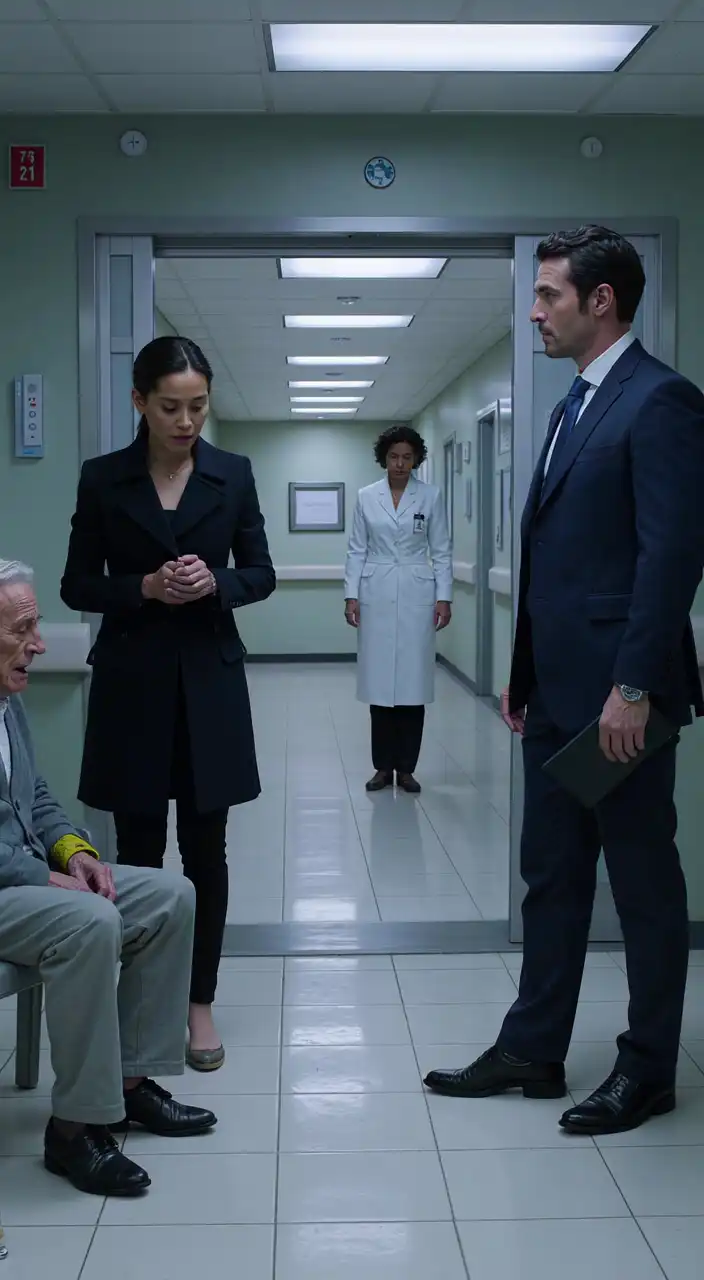
MY FATHER STARTED SHAKING OUTSIDE TRIAGE WHILE A CLINIC ADMINISTRATOR BLOCKED THE DOOR AND SAID HE NEEDED FAMILY PERMISSION FIRST.
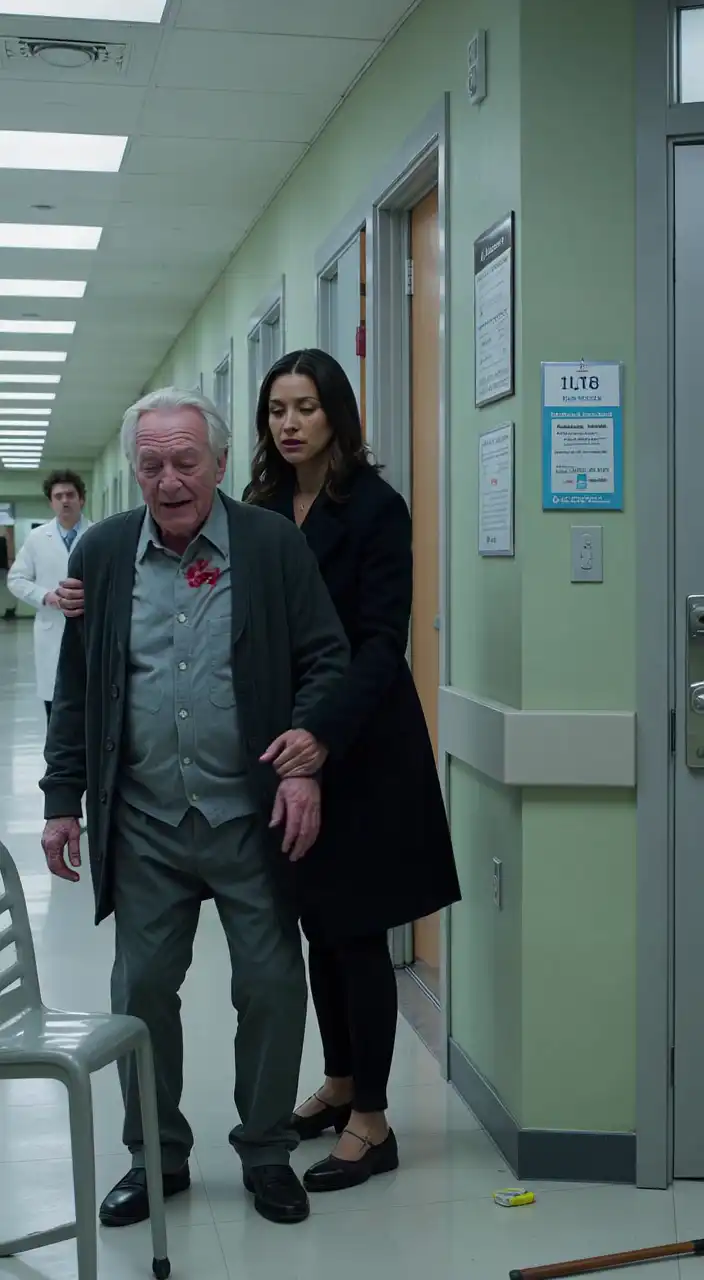
MY FATHER STARTED SHIVERING SO HARD HIS SURGICAL BANDAGE BLED THROUGH, AND THE CLINIC ADMINISTRATOR STILL BLOCKED THE TRIAGE DOOR.
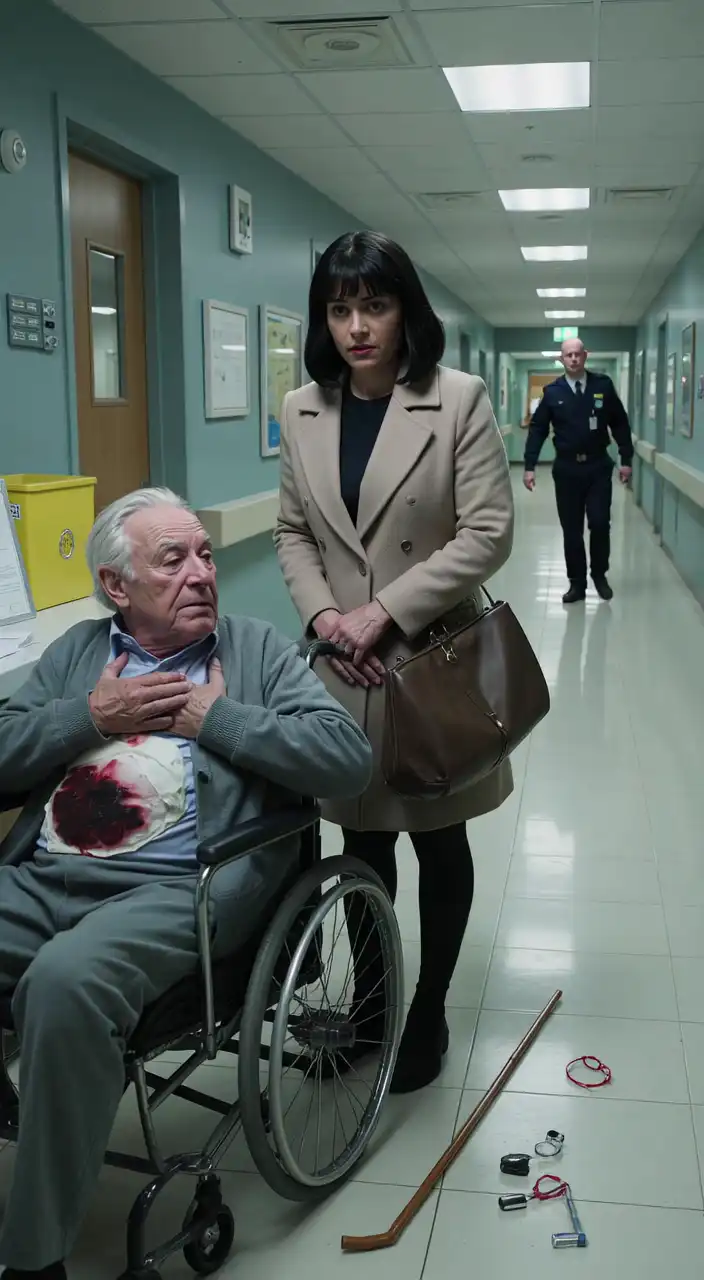
MY FATHER STARTED SHAKING IN THE HOSPITAL HALLWAY, AND THE WOMAN WHO CLAIMED TO BE HELPING HIM WOULD NOT LET TRIAGE TOUCH HIM.