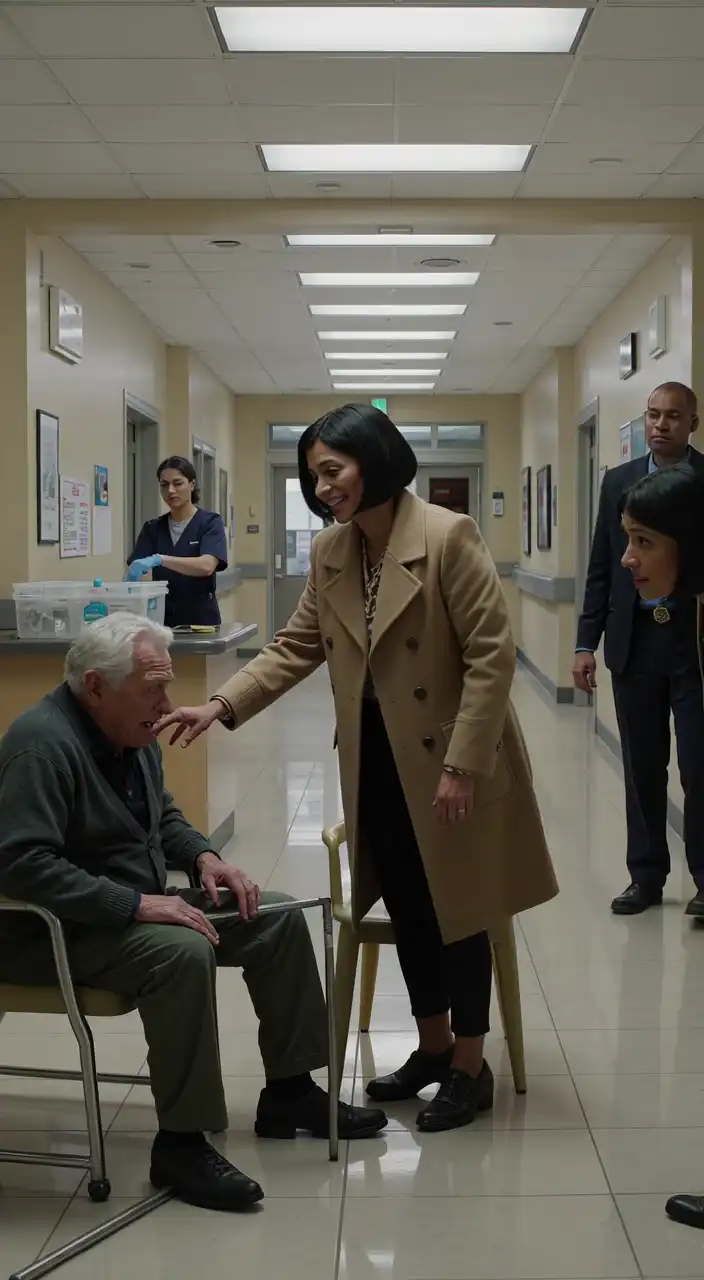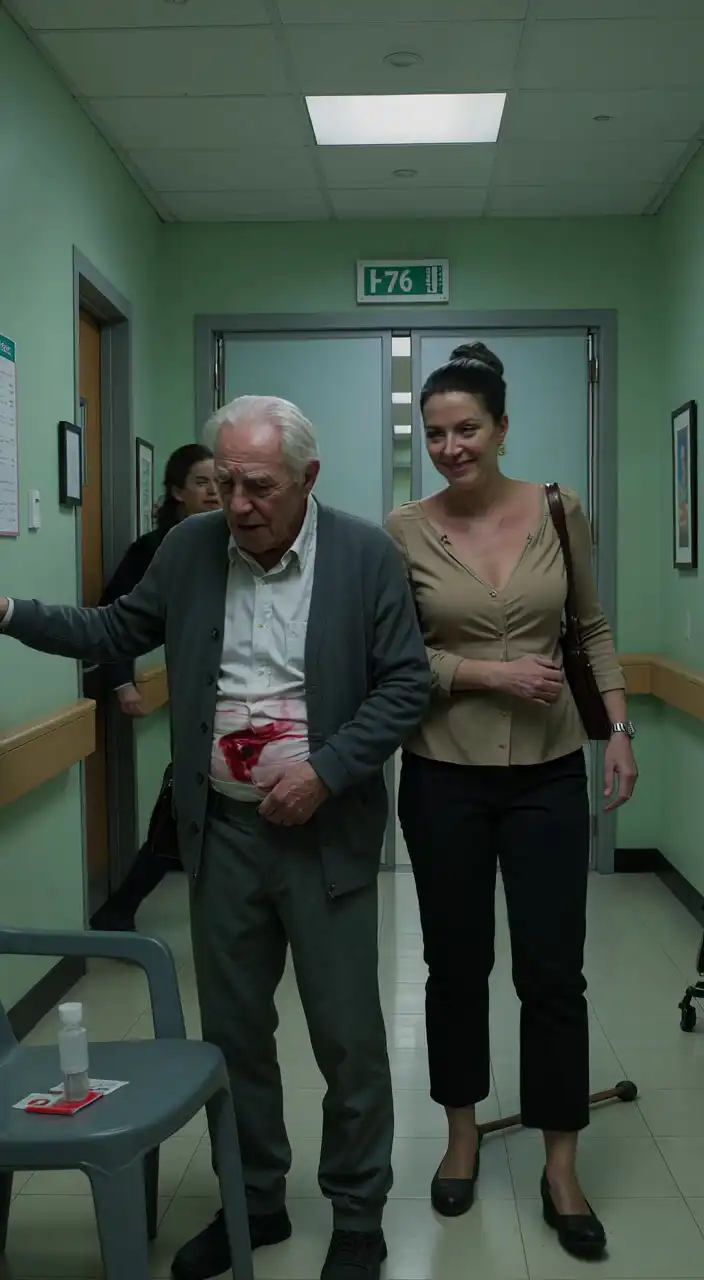
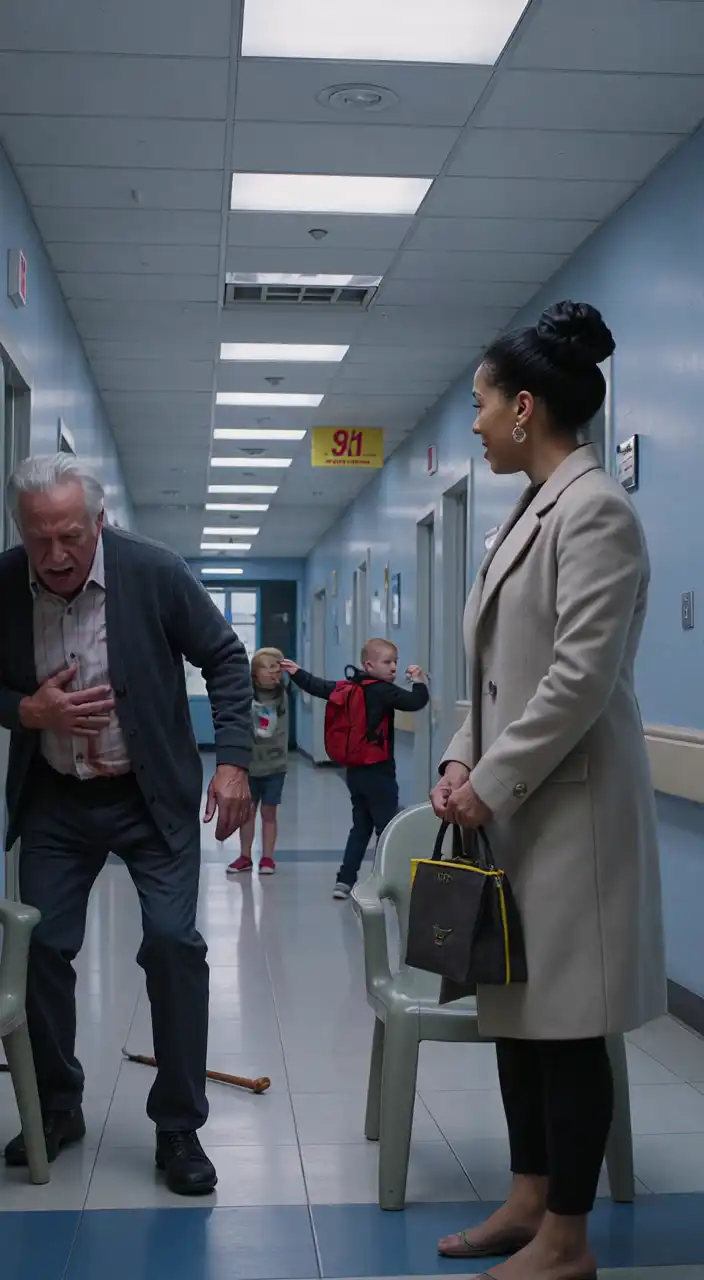
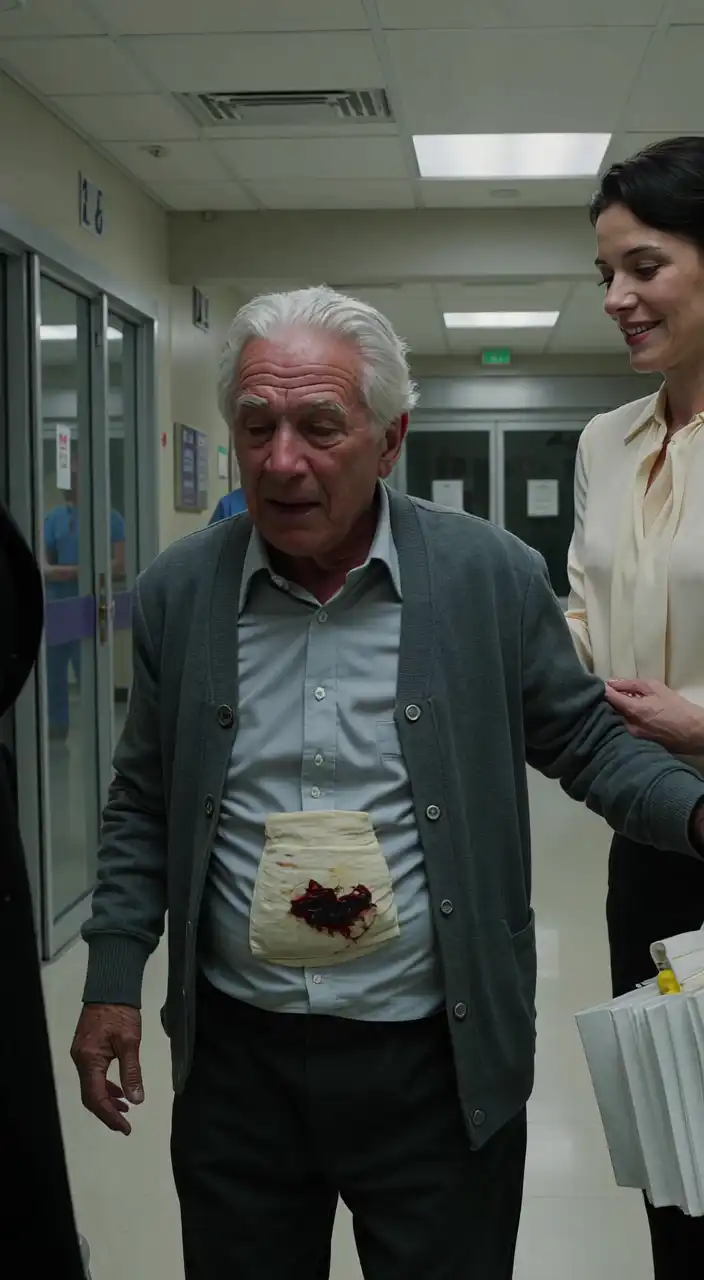

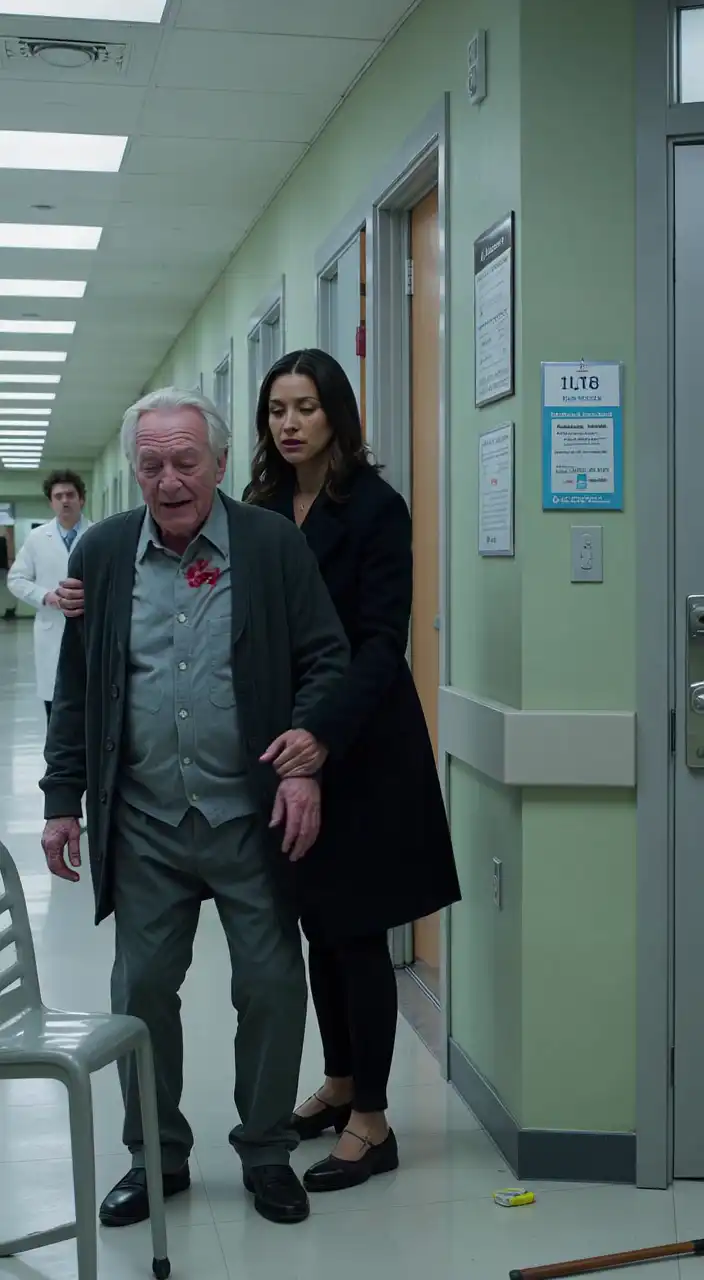
Nathan's mouth opened, but Riley was already moving.
"Wheelchair, now," she snapped over her shoulder. Her voice cut through the hallway noise so cleanly that two nurses turned at once. One left the desk at a run. The other reached for the phone clipped to the wall. My father sagged against me, his breath fluttering hot against my wrist, and for one stupid second I thought Nathan might still try to argue because men like him always believed procedure could outrank pain if they said the words calmly enough.
Instead he took half a step back and lifted both hands. "Doctor, this is a discharge dispute. The family account-"
"This is a patient with fever, tremor, wound drainage, and a medication stain that should not be there," Riley said. "If you interfere again, security will remove you."
The nurse arrived with a wheelchair. We lowered Dad into it awkwardly because his knees kept locking and he was trying not to cry out. He hated making noise in public. Even at seventy-five, even with sweat sliding down his temples and his bandage darkening by the second, he looked embarrassed, like he needed to apologize for becoming inconvenient.
"I'm sorry," he whispered.
"Stop that," I said, too sharply, then softened my grip around his shoulder. "You don't apologize for bleeding."
Riley was already walking with us as the nurse pushed him through the triage doorway. Nathan followed for two steps, then stopped when the second nurse lifted one flat palm toward him. The amber light above a portable monitor flashed again, the same alarm I had heard from the hallway, and somewhere deeper inside somebody called for a charge nurse. It all felt like the room had suddenly remembered what hospitals were for.
Inside triage, the air changed. Colder. Cleaner. Faster. My father was transferred onto a narrow bed while Riley asked clipped questions and another nurse peeled back the top of the blanket. A blood pressure cuff tightened around Dad's arm. A pulse ox went onto his finger. The monitor beeped into a rhythm that sounded almost reassuring until I saw the numbers and the nurse's mouth go flat.
"Temp one-oh-two point six."
"Heart rate one-thirty."
"Pressure dropping."
Riley touched the edge of the dressing on his abdomen and he flinched so hard the bed rattled. "Mr. Cooper, did anybody give you medicine after discharge?"
My father blinked at her. "I don't know what it was. Yellow capsule maybe. Nathan said it would settle my stomach before the ride home." He swallowed and stared at the ceiling. "I didn't want to take it. He said the Whitakers had arranged everything."
The Whitakers. Hearing that name inside an exam bay made something cold settle under my ribs. My father had worked thirty-two years as grounds supervisor for the Whitaker estate outside town. He retired last winter after the second hip replacement made stairs difficult. The family set up a "care assistance account" to cover some of his medical bills after his bowel surgery. Everyone called it generosity. I had called it control the first time a woman from their office told me not to "upset the arrangement" by asking for itemized statements.
Riley glanced at me while the nurse cut away tape. "You said discharge papers were missing?"
"Yes. He was supposed to leave with wound instructions and medication list. Nathan met us in step-down and said there'd been a paperwork delay. He walked us down himself. My father's phone disappeared too."
Dad opened his eyes. "He took it after I told Ellie to call Dr. Mendez."
"Who is Dr. Mendez?" Riley asked.
"My surgeon," Dad said.
Another nurse entered with a cart. The smell hit when the dressing came free, not graphic, just wrong: sour heat, chemical sharpness, infection riding under something medicinal. Riley leaned in and the focus in her face sharpened further. "Get blood cultures. Lactate. CBC. CMP. Start broad-spectrum antibiotics now. Page surgery and toxicology. And call security to hold that administrator in the hallway."
The nurse repeated the orders back in quick shorthand and moved.
Dad's hand searched blindly until I caught it. He squeezed weakly, then stronger when the first IV attempt stung. "I knew something wasn't right," he murmured. "They said I was slow to wake up. Too slow." His eyes shifted to Riley. "Am I dying?"
"No," she said, immediate and firm, with the kind of confidence I suspected good ER doctors learned to perform before they could fully guarantee it. "But you are sick, and we're treating you now."
That should have calmed me. It almost did. Then Riley lifted his stained sleeve again, looked at the yellow smear, and asked the nurse for a sterile swab.
"What is it?" I said.
"Rifampin can stain like this," she said. "So can a few other medications and compounds. But he should not have random residue on his cuff unless something spilled, leaked, or was handled around him. And if someone gave him an unlisted medication after surgery, I want to know why."
Dad's cardigan had always embarrassed me because he insisted on wearing it to appointments even in warm buildings, saying hospitals made him feel undressed. Now the soft beige cuff looked like evidence. The yellow streak ran across the knit and into the crease of his wrist, as if somebody with wet fingers had grabbed him there. I remembered Nathan's reflexive reach in the hallway, the way he'd lunged toward the stain instead of toward my father.
A security officer appeared in the doorway, then another behind him. Riley walked out to speak with them. Through the half-open curtain I could see Nathan in the hall, tablet tucked against his chest, talking too fast with the clipped, offended expression of a man unaccustomed to being challenged by staff he considered beneath his administrative rank. One officer took position near him. The other looked toward Riley and nodded once.
My phone buzzed. Unknown number.
I almost ignored it, then answered on instinct. "Hello?"
Silence for a breath. Then a woman's voice, low and hurried. "If your father is in the ER, do not let them send him upstairs under Nathan's authorization."
"Who is this?"
"He wasn't supposed to make it back this fast." The voice shook on that word, make. "Check his chart for the 1:14 p.m. addendum. They hid the first discharge note."
The line went dead.
I stared at the screen. No callback number. Private caller.
When Riley returned, I told her every word.
She listened without interrupting, then held out her hand. "Show me your call log."
I did. She photographed it with her hospital-issued phone, then gave mine back. "Good. Don't delete anything." She looked toward Dad, then toward the hallway again. "This just became bigger than an infection workup."
"What does that mean?"
"It means somebody may have altered or concealed medical information around a postoperative patient and tried to delay emergency reevaluation." Her jaw tightened. "And now I want his chart before anyone else touches it."
Surgery arrived within minutes: a resident first, then the attending on call, not Dr. Mendez but a broad-shouldered woman named Dr. Patel with tired eyes and no patience for politics. She examined the wound, asked three rapid questions, and said, "He should never have been discharged with these vitals if they were trending like this." She looked at Riley. "Can you pull step-down observations?"
"Already requested."
Nathan chose that exact moment to try one last move.
He did not come in. He leaned into the doorway behind security and said, with perfect administrative smoothness, "Mr. Cooper's family representative from the Whitaker office is on the line. They'd like to clarify consent and payment before invasive treatment proceeds."
Dad's fingers tightened around mine hard enough to hurt.
Riley stepped between the bed and the doorway. "He is alert and oriented. He consents for himself."
Nathan's smile flickered. "Doctor, with respect, there are concerns about his postoperative confusion."
My father turned his head with visible effort and said, very clearly, "My name is Liam Cooper. It's Thursday. I had bowel surgery two days ago. You took my phone. Get away from me."
Silence snapped through the bay.
One of the security officers put a hand on Nathan's elbow. "Sir, step back."
Nathan's face did something I wouldn't forget: the mask didn't quite drop, but it cracked enough to show fear under the polish. Not fear for my father. Fear for himself.
As he retreated, something small slid from under his tablet and hit the floor by the threshold with a plastic tick. A bottle cap.
Bright yellow.
Riley saw it before I did. So did the officer.
And suddenly the half-hidden cap near the hallway baseboard didn't look accidental anymore.
The next hour became a blur of action so dense I could only process it in fragments.
Blood drawn. Antibiotics hung. Fluids pushed. Dad's fever climbing, then pausing, then shivering through the blankets anyway. Dr. Patel ordering imaging to rule out a leak or deeper infection. A toxicology consult called because of the stain and the capsule description. Security taking photos of the bottle cap before bagging it. Riley asking for the chain of custody like this was already half criminal.
A clerk arrived with printed chart pages because the electronic record had briefly "locked for audit," which made Riley mutter something under her breath I couldn't catch. She flipped through them standing at the foot of the bed. I watched her eyes scan. Stop. Return.
"There," she said.
Dr. Patel came to her side. "What am I looking at?"
"Original discharge note timestamped 12:41 says discharge held pending surgeon review for fever and drainage." Riley tapped lower on the page. "Addendum at 1:14 reverses that. Says patient stable, family eager to leave, instructions reviewed."
"We were never shown instructions," I said.
Dad was drifting, but he opened his eyes again. "I asked for Dr. Mendez."
Riley looked at me. "Who signed this addendum?"
I didn't understand the scribbled lines, but the typed name under the electronic signature box was plain enough.
Nathan Wu, Administrative Care Coordinator.
Dr. Patel actually laughed once, a hard disbelieving sound. "An administrator amended a discharge decision?"
"Looks like he entered a coordination note that overrode the hold in the packet sent downstairs," Riley said. "Not supposed to happen. Not even close."
Then she turned the page and froze again.
"What now?" I asked.
She held the paper so I could see a scanned consent form attached behind the addendum. At the bottom, in shaky pen, was my father's name.
Only the spelling was wrong.
Lian Cooper.
Dad's eyes went to it and widened. "I didn't sign that."
There are moments when the body knows danger before the mind sorts the details. Mine knew. Not because of the forged signature alone, but because of what it meant: somebody had planned enough to create paperwork, remove a phone, supply a mystery pill, and block our return long enough for whatever was wrong to keep worsening.
Riley laid the paper flat and spoke to the charge nurse. "I need risk management and hospital administration now. Not his chain. Above it."
The charge nurse nodded and left at a near run.
Dad's monitor alarm chirped again, longer this time. His pressure had dipped despite fluids. The nurse adjusted the cuff and looked at Riley.
Dr. Patel didn't wait. "We're taking him to CT now. If there's a postoperative complication and delayed sepsis, I won't lose time in this bay because somebody played accountant with a man in crisis."
As they unlocked the bed, Dad caught my sleeve. His voice was thin, almost lost under the beeps. "Ellie."
"I'm here."
"In my cardigan pocket."
I felt inside the inside pocket he always used for cough drops and receipts. My fingers found folded paper, damp with sweat.
Not a receipt. A discharge wristband, cut off and stuffed away.
The triage band from his first release was printed with his name, date, and a note in bold red at the bottom: OBS HOLD - SURG REVIEW.
He had hidden it before Nathan took the rest.
Riley stared at the wristband, then at my father.
And for the first time since we entered that hallway, I saw her expression shift from urgent concern into something colder and more personal.
"Do not let anybody from that office near this patient," she said. "Not one more time."
CT showed no catastrophic leak, which should have felt like relief. It was relief, but only in the thin way you feel relief when one disaster is ruled out and three others remain on the table. Dr. Patel explained that the wound looked infected and there were signs consistent with systemic infection, maybe from improper postoperative management, maybe from contamination, maybe from something introduced when it never should have been. The antibiotics kept running. More cultures were sent. Dad was admitted under surgery and medicine jointly, not step-down, not observation, a full monitored bed.
Nathan was gone from the hallway by then.
Not released. Gone.
Security had been told he was no longer at the door. A staff member said he got a call and asked to use the restroom while an officer was redirected to another disturbance near radiology. When they checked, he had disappeared through the staff corridor.
That should not have been possible. Somehow it happened.
The disappearance hit Riley harder than the chart fraud had. "He ran before formal questioning," she said. "That tells me he knows exactly how bad this is."
It also meant the story the private caller hinted at was still moving somewhere beyond my sight. A missing administrator could be a coward. A missing administrator tied to a wealthy family office, forged consent, concealed hold order, and a postoperative patient with mystery medication was something else.
Dad was settled in a monitored room just before evening. The room was small, with one recliner that unfolded badly and a window facing a brick wall. I stayed anyway. A nurse named Cass helped clean the dried sweat from Dad's face and changed his bandage with a gentleness that made my throat ache. She found another faint yellow smudge near the IV bruising on his forearm and called Riley back up to look at it.
"Could have transferred from the sleeve," Cass said.
"Could have," Riley answered, though her tone said she doubted that.
Dad was more lucid once the fever eased a fraction. He sipped ice water and looked ashamed again when he caught me watching him.
"I should've told you earlier," he said.
"Told me what?"
"That they'd been talking to me before surgery. Not the doctors. The office people."
I pulled the recliner closer. "What office people?"
"The Whitaker family office. A woman named Denise. Then Nathan started showing up. Friendly at first. They said the account was generous but complicated. They wanted to 'streamline decisions' so billing wouldn't scare me." He rubbed at the blanket with trembling fingers. "Then they asked whether I'd signed the old land release."
I frowned. "What land release?"
His gaze shifted to the window. "The maintenance access strip behind the east wall of the estate. I told them years ago there was a drainage issue under the lower greenhouse. They wanted me to sign something after I retired, saying I never raised safety concerns. I didn't sign it."
A new thread slid into place, ugly and unexpected. "What does that have to do with your surgery?"
"I don't know." He closed his eyes. "But after I refused, they got less kind."
Riley, who had come in silently during the last sentence, spoke from the doorway. "Maybe they were afraid of what you'd say if somebody looked closely at records. Or maybe they wanted leverage over a man recovering from surgery."
Dad looked stricken. "You think they did this?"
"I think someone with access and motive interfered with your care," Riley said. "I'm not narrowing it any further yet."
Behind her stood a woman in a navy suit with a clipped badge that read Risk Management, and beside that woman a hospital vice president whose smile kept failing every few seconds. They asked permission to speak. Riley stayed. So did Cass, under the excuse of checking the IV.
The vice president started with the usual language about concern and review. I cut her off faster than I normally would have. "Who authorized Nathan to touch my father's discharge?"
Her expression tightened. "We're determining role boundaries now."
"He forged a consent form."
"That is an allegation under review."
Riley stepped in before I could say something reckless. "Then review this quickly. Because if your employee altered a hold order and obstructed emergency reevaluation, you have patient safety exposure beyond internal discipline."
The risk manager held out her hand. "May I see the wristband?"
I gave it to her. She examined the red print and inhaled once, sharply. "This should have remained in the discharge packet or been documented in removal."
Dad spoke with more force than he'd shown in hours. "He took the papers."
The vice president finally stopped trying to sound polished. "Mr. Cooper, did anyone from the Whitaker office speak to you directly about your hospitalization?"
"Yes."
"Names?"
"Denise Elwood. And Nathan. Maybe another man on speaker. I don't know." He touched his throat. "I was groggy."
The risk manager asked if we would consent to preserving all relevant records and surveillance footage immediately. Riley answered before I could. "Yes, and include the staff hallway outside triage, step-down discharge corridor, elevator bay, and any medication dispensing logs linked to Mr. Cooper's account."
The vice president looked surprised. Riley looked unsurprised by her surprise.
Then my phone buzzed again.
A text from an unknown number this time, not blocked.
Do not trust Denise. Check the yellow cap lot number. He wasn't the first.
I stood so fast the recliner banged the wall.
Riley held out a hand. "Let me photograph it."
I did. The message vanished as soon as she finished. Not deleted. One of those disappearing-text apps. My stomach twisted.
"He wasn't the first what?" I whispered.
No one answered because no one knew.
But the shape of the danger changed. Up to that point, I had been clinging to the idea that this was a targeted act against my father because of money or some document he refused to sign. That text suggested a wider pattern. A yellow cap. A lot number. More than one patient.
Riley called toxicology again from the room. This time she requested a specific check for medication identity if residue could be lifted from the sleeve or cap. She also asked pharmacy to review whether anything with a yellow cap matching that size should have been anywhere near step-down. While she talked, Cass quietly asked Dad whether he remembered the taste of the capsule. Bitter? Sweet? Chalky? Metallic? Dad frowned and said, "Coated. Slid down too easy."
Cass's eyes met mine. That answer bothered her too.
By nine o'clock, the room had become a crossroads of people who wanted different versions of the truth. Surgery wanted source control and stabilization. Toxicology wanted samples and timing. Risk wanted documentation preserved. Administration wanted to stop the bleeding in every sense. And somewhere outside the room, I knew the Whitaker office was already deciding whether my father was still useful, still controllable, or suddenly dangerous.
The major contradiction came from pharmacy.
A pharmacist named Jonah arrived with a binder and a face like he hated being right. "We don't stock rifampin in postoperative discharge kits for bowel surgery. And the yellow caps on our inpatient meds don't match this cap dimension." He pointed to the bagged cap photo on Riley's phone. "This is from a compounding bottle, probably not from our unit standard. Could be outside medication. Could be transferred from another service. But if he was dosed on site with something from that bottle, it wouldn't be routine."
Riley asked, "Any medication on his record that could explain the staining?"
Jonah shook his head. "Not what I've seen. Also..." He hesitated.
"Also what?" I said.
He looked at the vice president before answering. "There were two chart access entries from a family liaison terminal this afternoon under a temporary override credential. That terminal is in the donor relations office, not on the surgical floor."
The vice president went still. "Donor relations?"
"Yes."
Everyone in the room understood what that meant. Wealth. Influence. Access points that should never intersect with clinical decision-making and somehow had.
The Whitakers funded the cardiac wing. Their name was on a wall three floors down.
Dad turned his head slowly toward me. "Ellie... the greenhouse drainage. There was more than water."
I felt the room focus.
He swallowed. "Years ago, drums came in at night. I reported the smell to Mr. Whitaker's brother. He told me to forget it. Later some plants died along the runoff edge. I kept notes."
"Where?" I asked.
His lips trembled. "At home. In the blue tackle box under the workbench."
Riley's eyes sharpened again. A planted detail I had not known existed now suddenly mattered like a siren. Notes. A land release. A family office interfering with postoperative care. Maybe it was all one ugly chain, maybe not, but none of it felt accidental.
The mini-hook came a few minutes later when a deputy from hospital police arrived to take an initial statement and casually mentioned that another older patient from a Whitaker-sponsored assisted living facility had suffered an unexplained medication event last month.
It had been written off as confusion.
Riley looked at the yellow-stained sleeve bagged on the counter.
And I realized my father might not have stumbled into a personal feud at all.
He might have become the one patient who lived long enough to connect a pattern.
By midnight, the story had split into two emergencies running beside each other.
One was inside my father's body. His fever held high despite fluids. The antibiotics started to help, but not fast enough to calm anyone. His blood pressure wavered whenever he slept too deeply. The surgical team believed the wound infection was real and dangerous, yet still couldn't explain the strange medication residue or why he deteriorated so sharply between discharge prep and our return to the ER. Toxicology said preliminary screening would take time. Time was the one thing Nathan had tried to steal.
The other emergency was outside his body, in hallways and computer systems and whispered phone calls. Evidence was beginning to move, and once evidence moves, people either help it or try to stop it.
I was standing at the sink rinsing a paper cup when Denise Elwood walked into the room as if she belonged there.
She was in her fifties, elegant in the severe way rich people's assistants often are, every line pressed, every strand of hair controlled. She held a leather folio at her side and sorrow on her face, both equally polished.
"There you are," she said softly, as if we were relatives meeting under unfortunate circumstances. "Mr. Cooper, the Whitaker family is deeply concerned."
Riley had left five minutes earlier to review surveillance stills with security. Cass was charting at the station. The vice president and risk manager were gone. For one awful instant, Denise had found the only gap in the wall around us.
My father recoiled so visibly that the heart monitor sped up. "No."
She ignored him and looked at me. "You must be Eleanor. I know this is frightening. Nathan exceeded his role. The family is appalled. We want to make sure your father gets the best care without any misunderstanding over coverage."
The word coverage made me sick.
"Get out," I said.
Her expression did not change. "Please don't let anger complicate treatment. There are authorizations only our office can expedite."
Dad's voice cracked. "She said I should sign before surgery. Said it was routine."
Denise turned to him with a practiced smile. "Liam, you were anxious and in pain. We all say things under stress."
I hit the call button.
She lowered her voice. "If you escalate this carelessly, you may expose your father to bills you can't manage and questions from agencies that freeze accounts during investigations. Think practically."
There it was. Not sympathy. Not concern. The real lever.
"You think we're still afraid of paperwork?" I said.
I expected her to deny everything, but instead she glanced at Dad's cardigan folded on the chair and narrowed her eyes for one quick involuntary second. At the pocket.
Then she smiled again, too late.
Riley came through the door at that exact moment with two security officers behind her.
Denise recovered instantly. "Doctor, thank goodness. I was just checking on him."
Riley didn't buy a syllable. "You were not authorized to enter this room."
Denise spread her hands. "The family pays for-"
"The patient does not belong to the family," Riley said.
Security stepped closer. Denise's expression finally sharpened. "You are making a serious mistake. There are institutional relationships here you don't understand."
Riley answered, "What I understand is that an elderly postoperative patient with a concealed discharge hold, forged consent, missing phone, unauthorized medication exposure, and a fleeing administrator does not need one more unsupervised visit from donor relations."
Denise's mask slipped at the last phrase. Donor relations.
So it was true. She had the donor terminal access Jonah flagged.
As security escorted her out, she looked over her shoulder at me and said one sentence that hit like ice water.
"If he kept the notes, you are all in danger."
The room stayed silent after she left except for the monitor.
Dad closed his eyes. "Blue tackle box," he whispered again.
I understood then that the notes under the workbench were not side evidence anymore. They might be the reason my father had been pressured before surgery, manipulated after it, and nearly kept from care long enough to fail.
Riley turned to me. "Do you have someone you trust who can go to the house right now?"
"My brother's in Ohio. My neighbor Carmen has a key."
"Call Carmen. Tell her not to go alone. Have her wait outside until law enforcement gets there."
Law enforcement. The word felt excessive a day ago. It felt overdue now.
I made the call with shaking hands. Carmen answered half asleep, then fully awake by the second sentence. She promised to drive over and wait in her car. Riley stepped into the hall to find the deputy. When she came back, she had a new tension in her face.
"Security just confirmed something from the step-down footage," she said. "Nathan didn't take your father straight to discharge. He diverted him into an empty consult room for eleven minutes first."
"Doing what?" I asked.
"We don't know yet. There's no camera inside."
Dad's hand moved weakly toward his sleeve.
The yellow stain suddenly seemed less like a spill and more like a mark left during whatever happened in that room.
That was the incomplete explanation I had been clinging to breaking apart. It wasn't enough to say he got infected and someone tried to avoid a costly readmission. Something active had happened in that eleven-minute gap. A pill, a signature, a call, a threat, maybe all of it.
Then toxicology called back with the first meaningful result.
Not definitive compound identification yet, but the residue swab from the cuff was consistent with contact transfer from a reconstituted antibiotic suspension not prescribed to my father, mixed at unusually high concentration. Toxicology added one more line that turned the room colder: the substance could have caused severe gastrointestinal distress and masked or muddied the presentation of postoperative complications if administered orally.
Not poison in the cinematic sense.
Something smarter. Something deniable.
Something that could make a vulnerable patient look confused, unstable, unreliable, too messy to sort out fast.
Riley said it aloud. "Enough to worsen him, confuse the picture, and buy delay."
Dad stared at the ceiling. "They wanted me discredited."
The second pressure point hit before dawn. Carmen called from outside our house, whispering. She wasn't alone anymore. A patrol officer had arrived. The garage side door was open.
"It wasn't like that when I checked earlier this evening," she said. "And Ellie, your workbench drawers are pulled out."
Someone had gone for the blue tackle box.
When the deputy put her on speaker, the officer at the house said, "We found the box in the driveway. Empty."
My father made a sound I had never heard from him, not quite grief, not quite fear. The sound a person makes when a private warning they carried for years becomes real in public.
Then he looked at me with sudden clarity. "Check the false bottom."
I blinked. "What?"
He swallowed. "I built one after the second flood. Under the tray. Notes and a flash drive."
The officer heard him over speaker. "We'll recheck now."
We waited through ninety raw seconds of silence. The monitor kept time with us.
Then the officer came back on. "Mr. Cooper, we found a compartment. There are papers in a freezer bag and a USB drive wrapped in electrician's tape."
Riley let out a breath she had been holding.
Outside the room, footsteps approached fast. A nurse appeared, face pale. "Dr. Riley? Security says Nathan just badged into the east staff stairwell using a deactivated pass and may be headed to this floor."
The doctor turned so quickly her coat snapped.
And for the first time, the danger wasn't just in the chart or the missing notes or the strange medicine.
It was coming back toward my father's room.
Riley's first order was simple.
"Lock this unit down."
The nurse ran. One security officer stayed outside Dad's room while the other headed toward the stairwell with two more guards coming from the elevators. I expected shouting, alarms, some dramatic chase. Hospitals are too practical for that. What happened instead was worse. Quiet movement. Rapid radios. Doors clicking shut in sequence. A heavy sense that too many vulnerable people lay behind too many thin curtains for anyone to risk a loud confrontation.
Dad heard enough to understand. "He came back."
"Maybe not for you," I lied.
Riley was already dialing someone from the corner. "Hospital police, east med-surg, possible unauthorized staff access by subject tied to patient interference. Keep him away from room 614 and records access points." She listened, then lowered her voice. "Yes, I'm aware administration wants discretion. They can want whatever they like."
Cass came in carrying fresh saline and pain medication, but her hands were tighter than before. "Should I transfer him to ICU?"
"Not yet," Riley said. "Movement increases risk unless he crashes. We hold here with security at both ends."
The hidden notes from the garage should have been enough to make me feel safer. Instead they made everything feel hotter. If Nathan came back after learning the box wasn't empty, then whatever was on that flash drive mattered more than his job, more than plausible deniability, maybe more than the Whitakers' polished public reputation. Dad watched all of us with that awful old-worker instinct, the instinct to minimize his own fear so nobody would think him troublesome.
"He's just scared," Dad murmured. "That's why men like him come back."
"What did you keep on the drive?" Riley asked.
He wet his lips. "Photos. Drainage trenches behind the greenhouse. Labels on barrels. Voice memos after meetings. Dates. A copy of a maintenance incident log I wasn't supposed to duplicate."
Cass stopped priming the IV tubing and looked up. "You copied donor family records?"
"Not financial. Grounds records. Chemical runoff concerns. One of the younger gardeners got sick two summers ago. Nosebleeds, rashes. They said pesticide sensitivity." Dad closed his eyes. "I didn't believe them."
The puzzle kept widening but still held one emotional center: he needed care, now, while dangerous people tried to turn him into noise. That center mattered. Stories like this can drift into conspiracy if you let every clue eclipse the body on the bed. Riley never let that happen. Every ten minutes she looked at the monitor, asked about pain, checked mental status, pushed for lab updates. She kept the rescue first even while the exposure grew around it.
The first reversal of the night arrived wearing a deputy's badge and carrying a sealed evidence bag.
He had come from our house with the retrieved papers and drive, but before he could speak to us privately he asked Riley, "Is there a staff member named Marta Silva on this floor?"
Cass nodded. "Night environmental services. Why?"
"Because a woman by that name turned herself in downstairs an hour ago asking to speak about the Cooper patient."
I braced for another ally too late, another secret witness trying to save herself after the fact. Instead the deputy said, "She admits she cleaned the consult room Nathan used before discharge. She found a paper medication cup and a sticky residue on the chair arm. Says Nathan told her to dump it and forget it. She didn't. She wrapped the cup in a glove and took it home because she thought something was wrong."
Cass stared. "She took hospital waste home?"
"Because," the deputy said, "her own mother died after a delayed transfer at a Whitaker-affiliated facility, and she didn't trust what she'd be blamed for if she reported it internally."
Riley's face softened for half a second at the motive, then hardened again around the implication. "Where is she now?"
"Interview room with hospital police. She also says Nathan made her re-enter the consult room later to wipe a yellow spill off the floor."
There it was. The planted stain, the cap, the eleven-minute gap, all snapping into a fair and terrible shape. Not random contamination. Deliberate administration of something off-record in a closed room.
"Can she identify the bottle?" I asked.
The deputy lifted the sealed bag. Inside was a photograph printout of the cup and another image from Marta's phone. A bottle on a counter, blurry but visible, with a bright yellow cap and a partial label.
Jonah the pharmacist was called back up. He studied the image under the room light and said, "This looks like compounded rifaximin suspension or something packaged similarly, but the concentration notation is wrong for standard prep. Could be custom mixed. Could also be relabeled. I'd need the actual source."
"Would it make him this sick?" I asked.
"Not alone, probably not like this," Jonah said. "But if somebody used it to trigger severe GI upset, obscure symptoms, or interfere with absorption while he's already medically fragile, it could complicate everything. And if the bottle was mislabeled, all bets are off."
A major reversal should feel both surprising and earned. This one did. The mystery medicine was no longer just a possible poison clue pointing toward harm. It was also a manipulation tool, something designed to make my father's real surgical decline look messy, self-created, or cognitively unreliable. Enough to justify a false narrative: confused old man, anxious daughter, unnecessary readmission, family drama.
Enough to let him deteriorate while the "hold" disappeared.
The deputy then gave us the other part of the reversal. "Marta also says Nathan wasn't acting alone. Denise met him outside the consult room and handed him a folder before your father was brought in."
Dad turned his face away.
I thought that was the hardest part to hear, until the deputy added, "And according to Marta, your father said one sentence loud enough for her to remember. He said, 'I won't sign away the runoff.'"
Riley and I looked at each other.
The surgery, the donor office, the altered discharge, the false consent, the frantic trip to our house, the yellow-capped bottle - the motive was no longer vague. Someone had tied medical dependency to pressure over environmental records and legal liability.
It got worse.
The papers from the false bottom included notes in Dad's blocky handwriting dating back six years. Weather conditions. Barrel deliveries after midnight. Drainage overflow near the east greenhouse. Employee complaints. A photocopy of a maintenance map with a route marked in red. Taped to one page was a business card: Denise Elwood, Family Office Director. On the back, in my father's pen, he had written, "Asked me to say smell was fertilizer."
The flash drive couldn't be opened on the unit, but the deputy said investigators would mirror it immediately.
A second mini-hook landed when Carmen texted a photo from outside my house. A black SUV had slowed twice near the curb while police were still there, then sped off when the patrol lights shifted.
Somebody else knew the notes had been recovered.
Inside the hospital, the pressure tightened. A code gray was called softly over the staff channel: combative visitor or security threat. Not our floor. East stairwell level below. Then another radio squawk. "Subject moving toward old rehab wing." Nathan, probably. The deactivated pass meant he knew the building well enough to use forgotten corridors.
Riley rubbed a hand over her forehead. "He is either trying to reach a records station or leave without hitting the main lobby."
Dad startled awake from a doze, grimacing. "My phone."
"What about it?" I asked.
"He put it in the folder. With the papers." He was breathing faster now, not from infection alone but urgency. "He said no calls unless I signed. Denise told him not to leave anything with my number on it."
The folder Marta saw.
If Nathan still had it, then my father's phone might contain missed calls, voicemails, maybe even recordings if he had accidentally captured anything before it was taken.
Riley heard the same possibility I did. She stepped into the hall and spoke to the deputy again. "Tell security if they locate him, recover any folder, patient phone, or paper packet before he dumps it."
Cass adjusted Dad's oxygen tubing and said quietly, "You need to rest."
He shook his head. "No. If I sleep, they move pieces."
That sentence nearly broke me because it told me how long he had already felt handled instead of helped.
Around three in the morning, Dr. Patel returned with better news from the body side of the crisis. Dad's repeat pressure had stabilized somewhat. His lactate was improving. The antibiotics were starting to bite. "He's not out of danger," she said, "but he's responding enough that I can say the immediate spiral is slowing."
Relief hit so hard my knees weakened. I sat before I fell. Dad noticed and squeezed my hand with more strength than he had in hours.
The emotional pressure point that followed came from Riley, not the labs. She crouched by my chair so Dad could still hear. "This next part may feel ugly. The more he stabilizes, the more people will switch from delaying care to controlling narrative. You will hear words like misunderstanding, protocol drift, unauthorized courtesy, donor confusion. Don't let anybody shrink what happened to a paperwork problem."
I nodded.
She added, "And if Nathan appears, do not speak to him alone."
As if summoned by warning, a nurse from the station rushed in. "They found a folder in a linen cart near the old rehab wing. No Nathan. But there is a phone inside."
My father's face drained.
The phone was his. Cheap case, cracked lower corner, saints sticker peeling from the back. When the deputy powered it on under evidence protocol, the battery icon flashed red, then the lock screen lit. Three voicemails. Seven missed calls, all from me. One unsent audio file queued in his messages.
My pulse kicked.
"Can we play it?" I asked.
The deputy looked to Riley. Riley looked to Dad. Dad nodded.
The file was only twenty-one seconds long. Mostly rustle, chair scrape, muffled voices. Then Denise, unmistakable now that I had heard her in the room, saying, "You sign, you go home quiet, and the family covers everything." Another voice, Nathan's: "If he gets back to Riley, we're exposed." Then my father, strained and furious, "I won't lie about the barrels."
The file cut off with a thud.
No smoking gun solves a story by itself, but that recording changed the moral geometry of the room. It was not speculation anymore. It was pressure linked to care. It was an administrator and donor office operative tying treatment logistics to silence. The deputy's whole posture changed when he heard it. Cass pressed her lips together so hard they went white. Riley closed her eyes for one second, then opened them with a look I had only seen on people who decide they are done being diplomatic.
"Preserve that immediately," she said.
The final obstacle rose before dawn, exactly when exhaustion makes every adult more vulnerable to manipulation. Hospital administration requested a "temporary media and law enforcement containment recommendation" pending internal review. Translation: keep it quiet. Risk management wanted us not to discuss details outside designated interviews. A private attorney claiming to represent the Whitaker family called the unit demanding to know whether defamatory allegations were being made against donors. The vice president came back with an even tighter smile and suggested that, for patient comfort, Dad could be transferred to a partner facility once stable.
Riley actually laughed. "Absolutely not."
Dad heard enough to understand the move. "They still want me moved."
"Not happening," I said.
The vice president tried again, softer. "Mr. Cooper may feel safer in a lower-profile setting."
Dad lifted his bandaged hand and pointed weakly toward the door. "I feel safer where Dr. Riley can see me."
That should have ended it. It didn't, because pressure never leaves all at once. The attorney called again. The deputy got pulled away to another statement. Shift change was coming, which meant new staff, new chances for information to blur. And Nathan was still missing inside or just beyond the hospital.
Then the final threshold landed physically.
Dad's monitor alarm changed tone. Not the little warning chirp. A harder, faster alert.
Cass looked up. "Pressure dropping again."
Dr. Patel was paged. Fluids opened wide. Dad's skin went ashy and damp. He gripped the rails, gasping that the pain was spreading into his back. For one awful minute the whole investigation vanished and there was only the original truth again: a sick man at the edge of what his body could tolerate, while the world argued around him.
Riley shoved the legal folder off the overbed table to make room. "Focus. Liam, stay with me. Look at me."
He tried. His eyes fluttered.
"Could be sepsis swing, could be bleed, could be reaction, could be clot," Dr. Patel said as she came in already gloving. "We re-image now. Move."
The vice president stepped back so fast she nearly hit the wall. No one cared about donor relations at that moment. No one cared about narrative. Rescue stripped the room back to essentials.
As they rolled him out, Dad reached for me. I ran alongside until the nurse told me to stop at the doors. He was breathing fast, frightened, but still conscious.
"Ellie," he said.
"I'm here."
"If anything happens, blue box copy in church locker B."
It took me half a beat to understand. Another backup. Another plant from the kind of cautious working man who expects institutions to fail him and prepares in silence.
"Nothing's happening," I said, even though we both heard the urgency in the wheels and alarms.
The doors swung shut on him.
Riley stayed with the bed. I stayed in the corridor with Cass for maybe six minutes that felt like winter. Then hospital police radioed from downstairs: Nathan had been spotted on an exterior camera trying to enter the loading dock office. He wasn't fleeing empty-handed.
He had a hard drive case and a stack of printed charts.
The nurse station television was muted, morning local news already rolling weather graphics, as if the city had the right to continue being ordinary.
When Riley finally came back through the doors, she had blood on one glove cuff and determination in every line of her body.
"He needs a return procedure," she said. "There is an abscess pocket and contamination around the wound site. That's the immediate crisis. We can treat it. But he goes now."
I grabbed the counter edge. "Will he make it?"
"Yes, if no one delays him again."
Then she glanced at the deputy charging up the hall with two more officers and heard the update about Nathan at the loading dock.
Her answer changed shape.
"Get me that audio file mirrored to law enforcement before surgery starts," she said. "Because once your father disappears behind those OR doors, somebody is going to make one last push to say none of this happened."
The rescue path finally opened in a straight line after that, though nothing about it felt easy.
Dad went to surgery just after sunrise. Dr. Patel found and drained the infected pocket, revised part of the wound closure, and sent more cultures. Later she explained that the complication was serious but treatable, and that the delay in reevaluation had absolutely increased his risk. She said it plainly, not because she enjoyed conflict, but because some truths should enter a chart in language too direct to be softened later.
While he was in the OR, the law enforcement side moved faster than I would have believed possible the night before. Nathan was caught in the loading dock office when he tried to dump printed records into a locked shred bin and access a desktop terminal with the deactivated badge. In the hard drive case officers found a donor-relations backup drive, my father's missing discharge packet, and a folder containing copies of maintenance maps from the Whitaker estate.
Most important, they found a second phone. Burner style. Recent messages linked it to Denise.
Denise did not stay available for long. She tried to leave town before noon and was stopped on the interstate after hospital police shared the audio recording, the forged consent, and the evidence of unauthorized record access with county investigators. I didn't watch the arrest footage later when people sent links. I didn't need the satisfaction of seeing her in the shoulder light. The only thing that mattered to me was that she no longer had reach into my father's room.
The flash drive from the false bottom widened everything. It held timestamped photographs of stained runoff ditches, voice memos describing chemical odors after midnight deliveries, and scans of correspondence in which Dad documented safety complaints that were never formally logged. It also contained one file none of us expected: a clipped photo of a medication shelf in a Whitaker-sponsored assisted living unit taken during a volunteer grounds visit months earlier. On the back-end metadata, investigators later found it had been uploaded the same week as an internal complaint about off-label "comfort dosing" for difficult residents.
That was the second major reversal. What looked like a single family's pressure campaign over environmental liability was entangled with a broader habit of using money and access to steer care around inconvenient people. Not a giant criminal empire, not melodrama, just something more common and uglier: institutional arrogance learning it could cross lines because no one poor, old, or dependent could fight fast enough.
Marta's saved paper cup became critical. The residue testing, compared with the cuff swabs and cap, supported that an off-record compounded mixture had been handled in the consult room before discharge. Investigators never claimed it alone caused the infection. They didn't need to. It was enough that it had been used to interfere with presentation, pressure compliance, and justify delay in an already dangerous postoperative situation. Combined with the hidden hold order, the forged signature, the audio recording, and the missing phone, the pattern was undeniable.
Dad woke from surgery groggy but alive. That was the real center of the ending and I refuse to pretend otherwise. Exposures matter. Accountability matters. But if he had not opened his eyes, none of it would have felt like victory.
He looked at me, then at Riley standing near the monitor, and asked in a hoarse whisper, "Did they stop him?"
"Yes," I said.
Riley stepped closer. "And we kept your notes."
His lower lip shook once. Not fear this time. Relief. He had carried those notes for years like a private burden, maybe half ashamed of his own caution, maybe half certain no one powerful would ever care. To have someone in authority say we kept them felt bigger to him than hearing any charge list.
Recovery was not quick. It should not have been. He spent three more days on monitored antibiotics, then another four on the surgical floor learning how to move without reopening the revised wound. Fever broke for good on day two. His appetite returned on day four, though he complained the broth tasted like old envelopes. Cass laughed and smuggled him better coffee from the staff lounge. Riley visited off-shift once just to check on him, which told me the case had gotten under her skin in a human way, not only a professional one.
There were interviews. So many interviews. County investigators. State health department. Hospital legal. A patient safety panel. A detective who spoke gently and wrote everything down. They all wanted the chain of events. The consult room. The yellow stain. The hidden wristband. The call from the private number. The tackle box. The church locker B backup Dad had actually created years ago with duplicate notes and a second flash drive inside a plastic rosary case. He had not been joking in the corridor before surgery. He really had prepared for this possibility in the way only someone long ignored prepares: redundantly.
Carmen became part of the story too, bringing clean clothes and sitting with Dad when I went home to shower. My brother arrived from Ohio furious and guilty in equal measure, then redirected most of that fury toward helping law enforcement catalog the estate maps. Marta, after lawyers finally promised she would not be scapegoated for preserving the cup, gave a full statement that helped connect Denise physically to the consult room window before discharge. Jonah from pharmacy flagged other unusual override patterns from donor-relations terminals. Small brave acts kept stacking where polished authority had tried to erase them.
The Whitaker family moved into public damage control within a week. Statements about concern. Suspension of charitable initiatives pending review. Distance from "rogue individuals." I learned quickly how institutions try to turn moral choices into personnel problems. Some of the family may genuinely have known less than Denise did. Some may not. Investigations kept that part moving long after our personal crisis eased. What mattered immediately was that donor-relations access was frozen, Nathan was terminated and charged, Denise was charged, and the hospital announced a formal external audit of discharge overrides and donor-linked chart access. A bland sentence on paper. But I had watched the vice president's face in the room. I knew it cost them to write it.
Dad's old maintenance notes turned out to be good enough that state environmental investigators reopened the runoff complaints around the east greenhouse. That was another story growing beside ours, and not one I can finish neatly because systems take longer to untangle than bodies do. But the reopening mattered to him almost as much as the medical case. He had not imagined the smell, or the dying plants, or the rashes. He had written the truth in block letters on legal pads and hidden them under a false bottom because that was the only power he thought he had.
On the day he was finally discharged correctly, with real instructions and a surgeon who looked him in the eye, he wore the same cardigan. I offered another sweater. He refused.
"It still fits," he said.
The yellow stain had been cut away as evidence from one cuff. The edge was neatly mended by a volunteer from the hospital sewing guild. A tiny repair, visible if you looked close. He liked that. "No point pretending it didn't happen," he said.
Riley met us in the hallway before we left. Fluorescent lights, plastic chairs, the same cold tile where he had almost collapsed the first time. The place looked ordinary again, which is always unsettling after crisis. She handed Dad a copy of the formal patient advocate contact sheet and, separately, her own card with a number written on the back.
"If anyone connected to this case contacts you directly, call that number first," she said.
Dad took it carefully. "You saved my life."
Riley shook her head once. "You got yourself back to the door. That's what started this."
He looked down at the card. "I almost let him turn me around."
"But you didn't," I said.
That was the emotional truth of the whole thing. Rescue sometimes begins with a doctor noticing a stain or a nurse hearing the wrong tremor in a voice. But sometimes it begins with a sick old man hiding a wristband in his cardigan pocket because some part of him knows the record is being stolen from him and decides to keep one scrap of proof alive.
As we passed the triage doorway, Dad slowed. For a second I thought he was dizzy. Instead he looked toward the hall where Nathan had once blocked us and said, very quietly, "No more quiet."
He kept that promise.
Months later, after the criminal hearings had started and the environmental inquiry had made the local paper, Dad agreed to give a statement to a patient safety forum at the hospital. Not the news. Not some viral spectacle. A room of nurses, residents, social workers, transport staff, and two administrators who had the good sense to look uncomfortable. He stood with his cane, cardigan buttoned crooked, and told them exactly how it felt to be treated like a billing obstacle while your body was failing.
He spoke about humiliation more than pain.
"Pain is pain," he said. "You can survive pain if someone believes it. The dangerous part is when a person with a badge talks over you until you start hearing your own emergency in their voice instead of yours."
No one moved while he said it.
Then Marta spoke. Then Cass. Then Jonah. Riley closed the session by announcing a new policy package: no non-clinical override notes in discharge holds, mandatory second-clinician verification for postoperative release changes, locked audit trails for donor-linked access terminals, and expanded escalation power for bedside staff who suspect administrative interference. Procedural language, yes. But this time it came from scene-level truth, not a press office.
At home, the blue tackle box sits on a shelf in Dad's garage with the false bottom removed. He says there is no point hiding things the same way after they finally see daylight. Sometimes he still wakes at night thinking he hears hallway alarms. Sometimes I still jump when an unknown number calls. Healing doesn't erase the body memory of being blocked at the threshold.
But he gardens again, slowly. Tomatoes first, because he trusts visible growth. Then beans. Then marigolds along the fence because, as he says, something bright ought to survive where poison once tried to pass for care.
The best ending I can offer is not dramatic. It is this: when he had his follow-up appointment six weeks later, we walked back through the same entrance without anyone stopping us. The registration clerk smiled, checked him in, and called transport when she saw him tire. A nurse recognized him and touched his shoulder gently. No one asked for donor permission. No one spoke over him. When the surgeon came in, Dad asked every question he had written down on an index card, and every answer was given to him directly.
On the way out, he patted the repaired cuff of his cardigan and said, "Funny thing about stains. Sometimes they finally show people where to look."
He was still weak. He was still healing. But he was walking under his own name, carrying his own phone, with his records no longer hidden from him.
Blocked care had become exposed care.
And that was enough to let both of us breathe.
Disclaimer: Mention of any brand or trademark is for identification only and does not imply partnership or endorsement
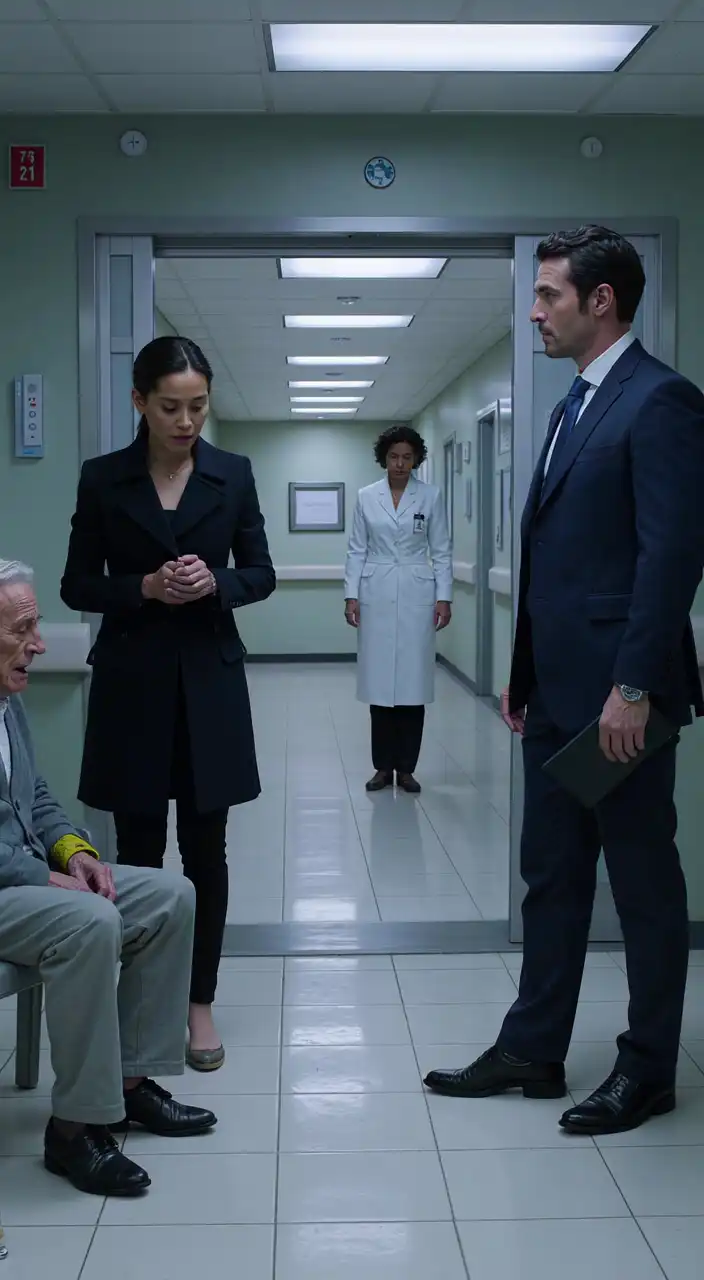
MY FATHER STARTED SHAKING OUTSIDE TRIAGE WHILE A CLINIC ADMINISTRATOR BLOCKED THE DOOR AND SAID HE NEEDED FAMILY PERMISSION FIRST.
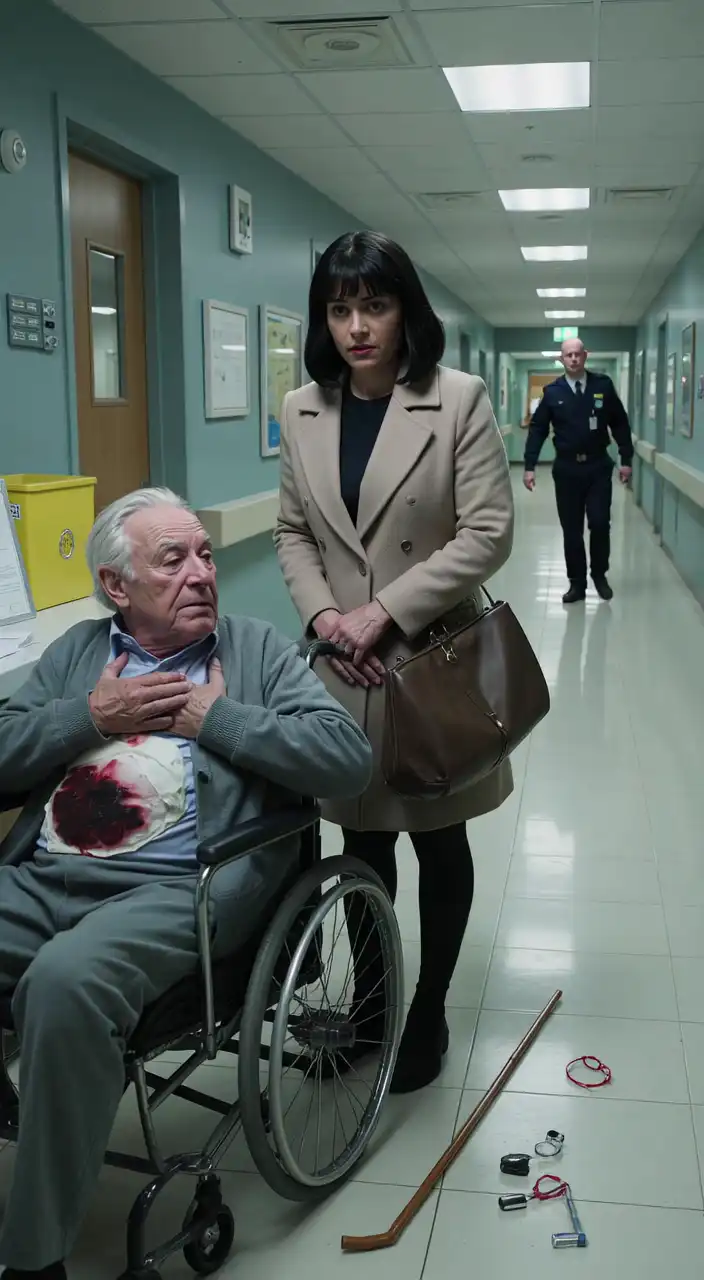
MY FATHER STARTED SHAKING IN THE HOSPITAL HALLWAY, AND THE WOMAN WHO CLAIMED TO BE HELPING HIM WOULD NOT LET TRIAGE TOUCH HIM.
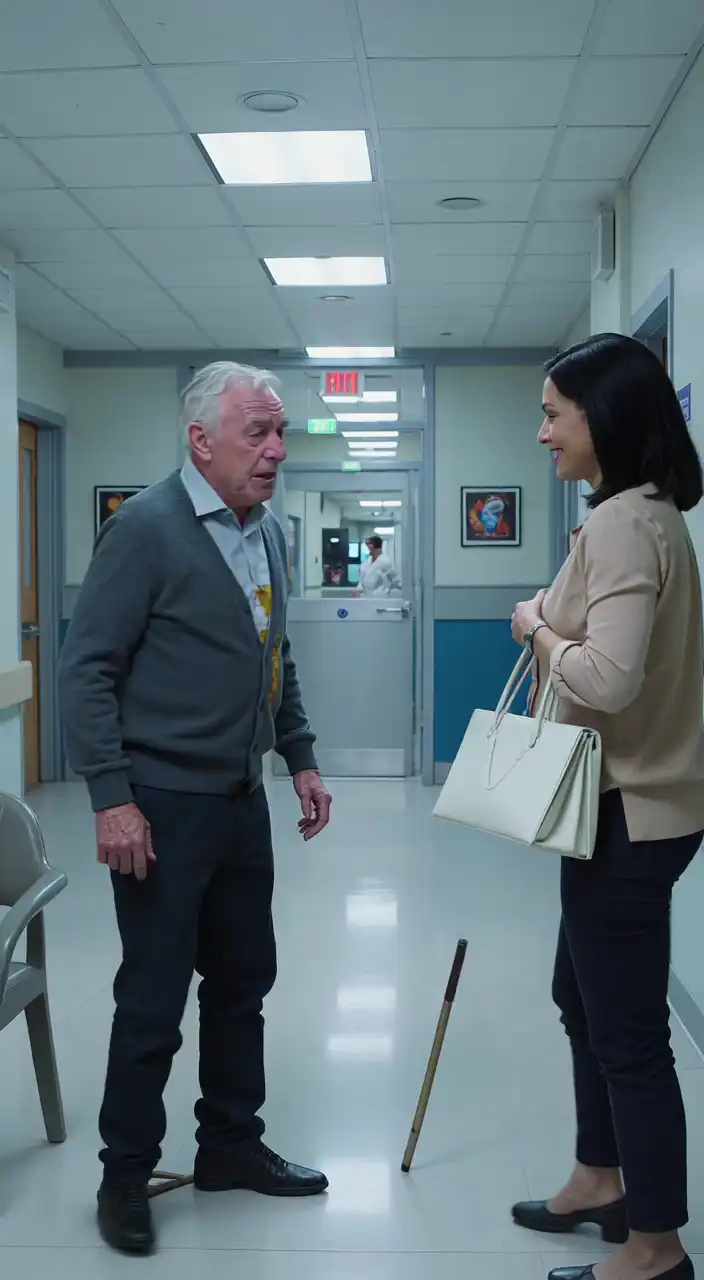
VICTOR STARTED SHAKING IN THE HOSPITAL HALLWAY, AND CAROLINE STILL WOULD NOT LET ANYONE TAKE HIM BACK TO TRIAGE.