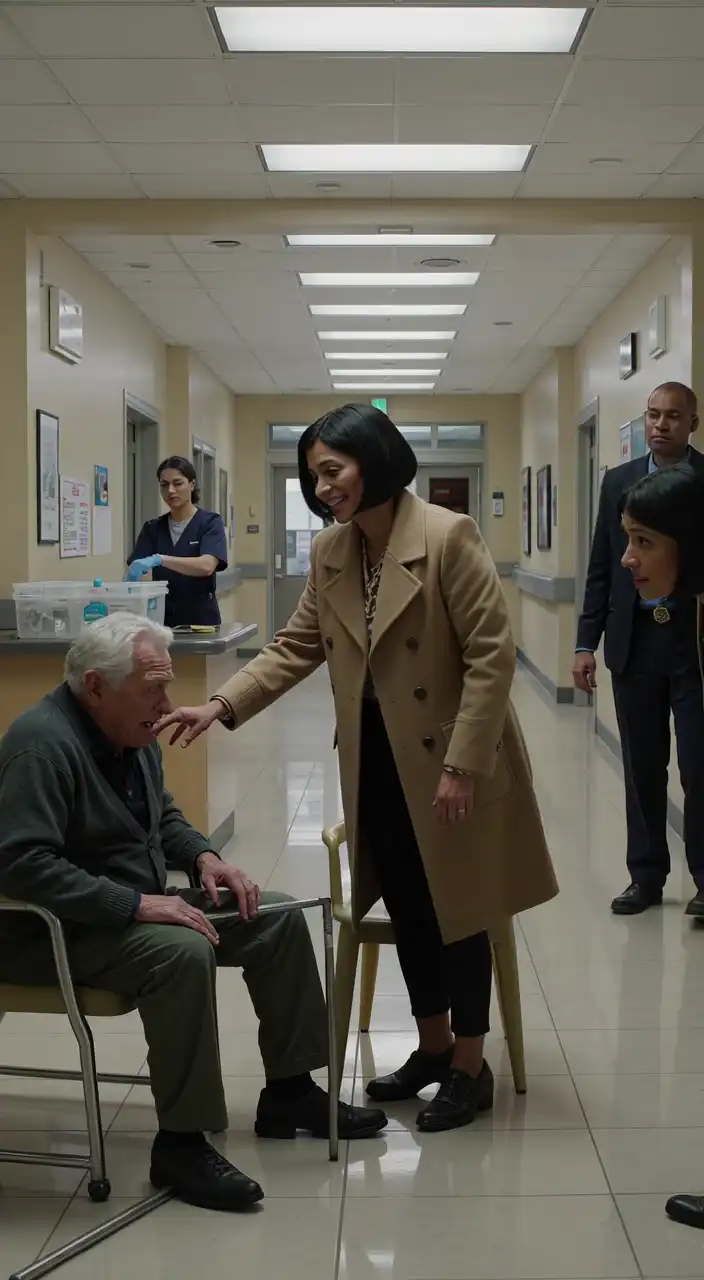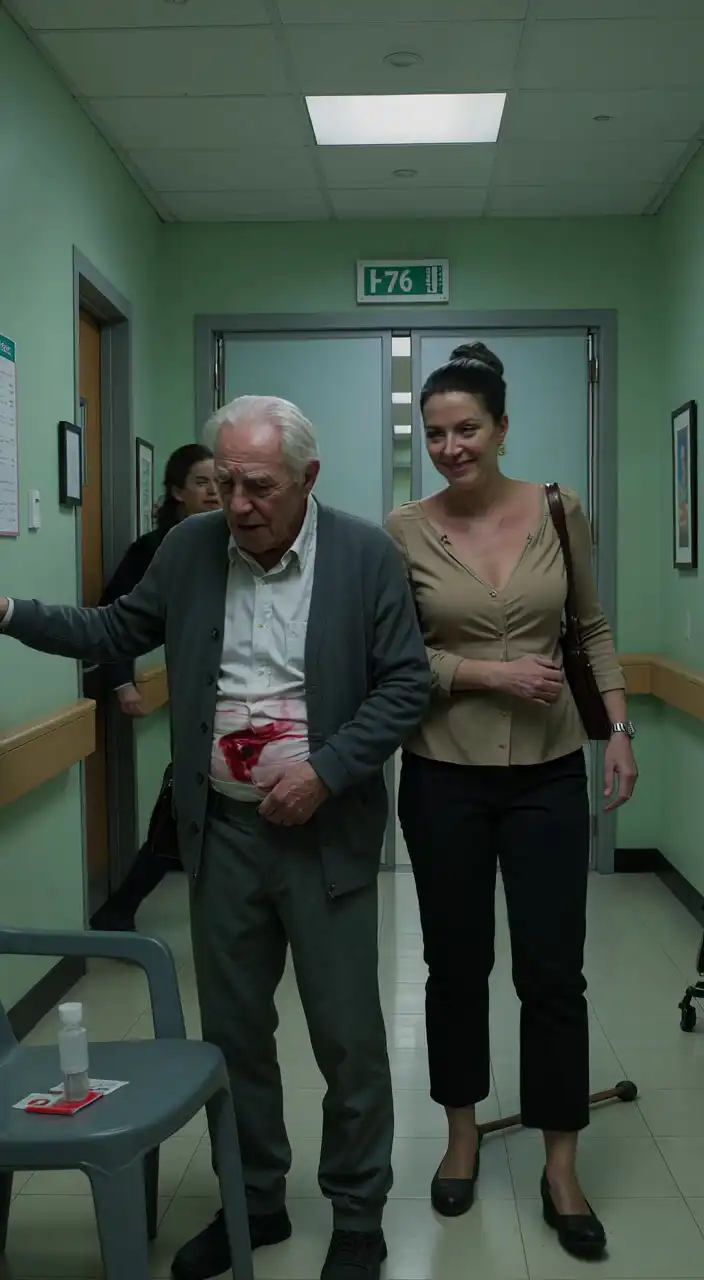
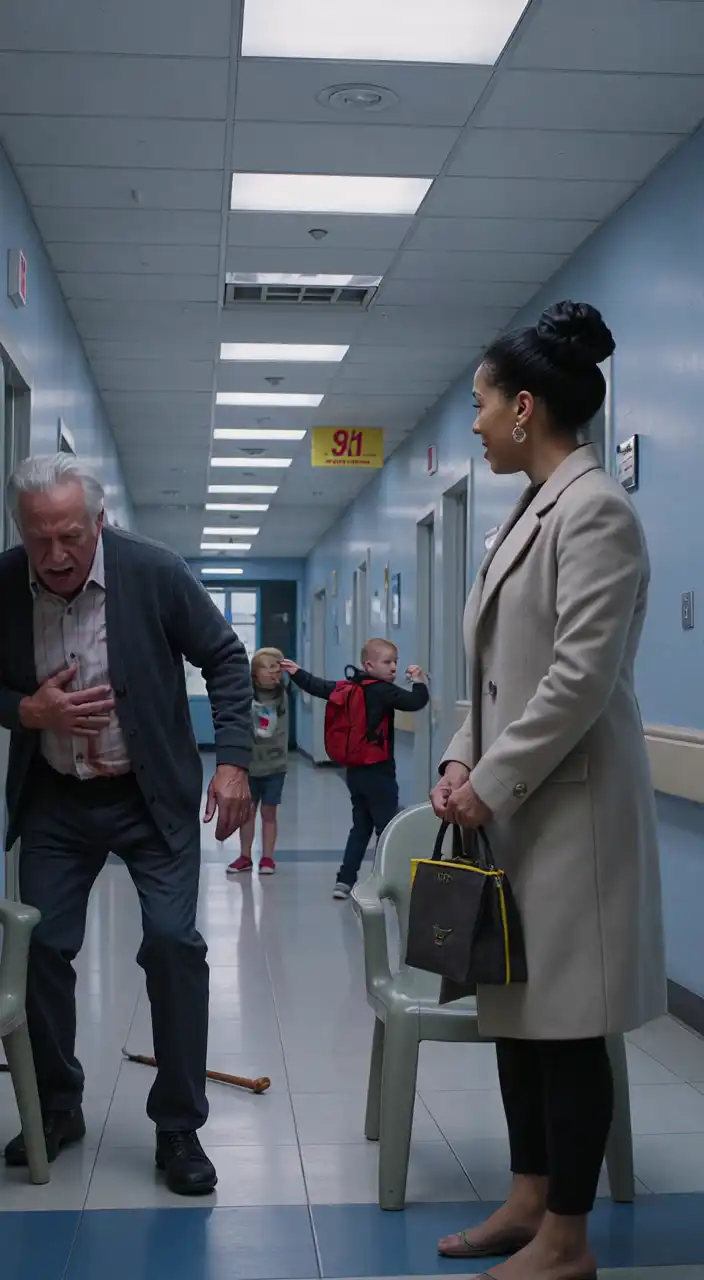
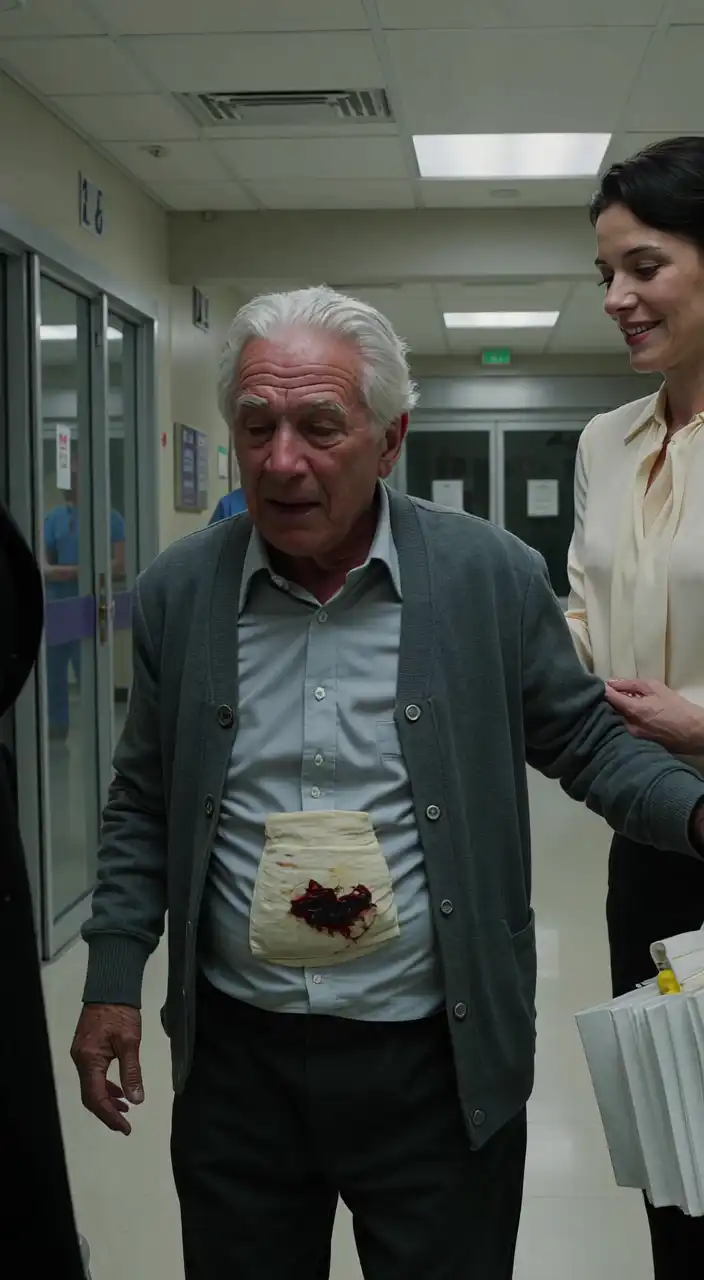

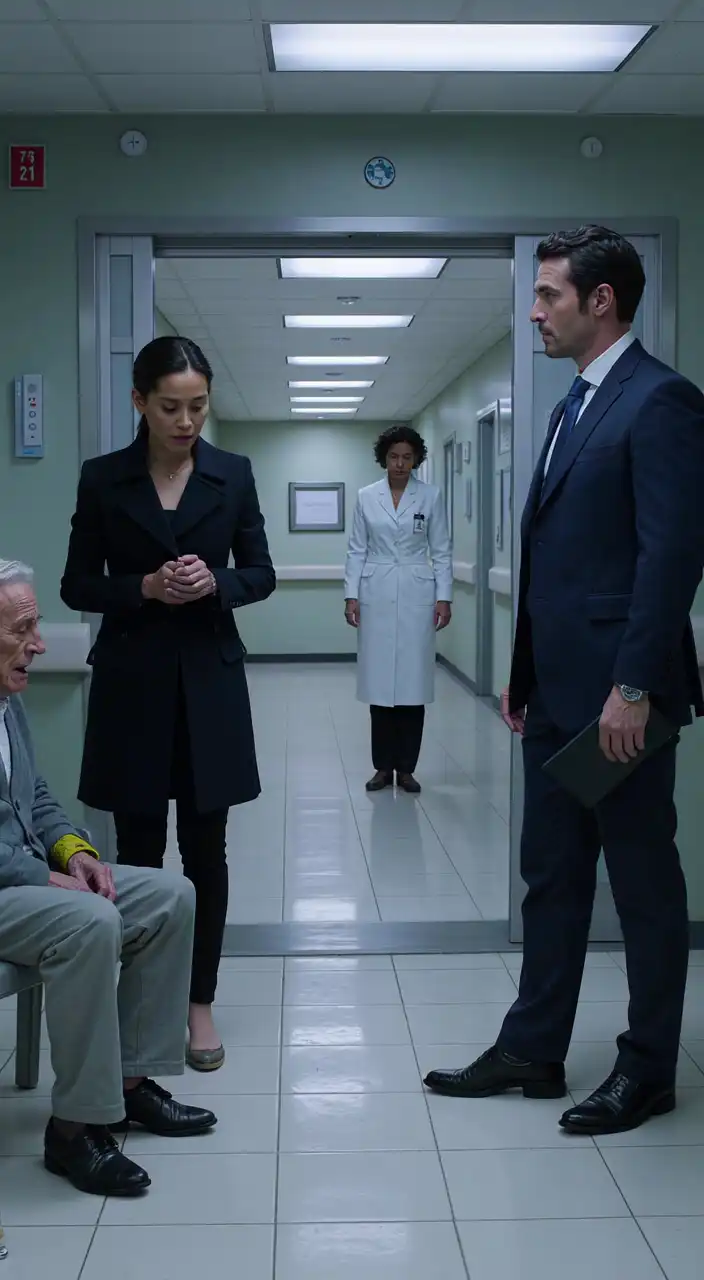
"Dad, what did they give you?" I asked, but his lips were so dry the words scraped out.
"Not my pills," he whispered. "Sweet... yellow..."
The doctor looked at me, then at the stain again. "Get him on a stretcher now," she called over her shoulder. Her voice cut through the hallway noise hard enough that two nurses at the triage desk turned at once. One grabbed a wheelchair, but the doctor shook her head. "No. Stretcher. Full set of vitals. Sepsis workup. Bring me his discharge summary if anyone has it."
James stepped forward, tablet held against his chest like a shield. "Doctor, this patient has not been cleared for emergency intake through-"
She stood so fast he took half a step back.
"I am Dr. Natalie Brooks," she said. "If you obstruct emergency evaluation one more second, I will have security move you physically. Do you understand me?"
People in hall chairs looked up. The sliding doors opened behind her and a tech pushed through with a stretcher. My father flinched when they lifted him, one hand going to his abdomen. The smell hit me then, under the disinfectant and stale coffee in the corridor. Something medicinal and syrupy, wrong for a post-surgery dressing.
James tried once more. "The family office reported drug-seeking behavior and incapacity. There are liability concerns."
My father opened his eyes and looked straight at him. The humiliation in that look hurt worse than panic. "I signed my own discharge," he whispered. "He knows me. He knows my son."
That made Dr. Brooks' face sharpen. "Whose son?"
Before Dad could answer, the nurse at the desk called for the next patient again, then saw the blood pressure number on the portable monitor one of the techs had clipped onto Dad's finger. Her expression changed and she reached for the phone. The tech read out loud, "Temp 102.8. Heart rate 128. Pressure dropping."
Everything moved at once after that. The stretcher rolled through the triage doors. I started after it, but James moved in front of me, not touching me, just stepping into my path the way he had stepped into my father's. "Family can wait in the lobby until identity and responsibility are verified."
I didn't even have time to answer because Dr. Brooks turned in the doorway and said, "She comes with me. You stay exactly where you are."
Her tone did what mine couldn't. He stopped. One of the nurses held the triage door open and I followed the stretcher into the bright cold of the ER. The doors swung shut behind us with James on the other side, his badge lanyard still visible through the narrow glass strip.
Inside, the room swallowed us in alarms and movement. A nurse cut away my father's stained cardigan sleeve and the yellow mark spread brighter under the overhead lights. Dr. Brooks leaned close, smelling the fabric, then looked at the dressing over his abdomen. "When was this changed?"
"I don't know," I said. "He was discharged around noon. My brother told me he had home nursing arranged, but when I got to Dad's apartment he was alone."
"What brother?" she asked without looking up.
"Mark. My older brother."
My father's fingers twitched on the blanket. "Not nurse," he said. "Mark brought soup."
Dr. Brooks looked at me. "Did he take his prescribed medication in front of you?"
"No. I found him already shaking. He could barely stand. The discharge bag was open on the counter, and his paperwork was gone."
That got another glance from her. Then she peeled back the edge of the abdominal dressing and everyone in the room changed speed. The skin around the incision was angry red and warm. The gauze beneath had more drainage than there should have been. Dad hissed and tried to curl around the pain.
"Get blood cultures, lactate, CBC, CMP. Start broad-spectrum antibiotics now. Fluids wide open," Dr. Brooks said. "And page surgery."
A nurse slipped a plastic band around my father's wrist. It was a plain white hospital bracelet, newer than the one I'd expected from the morning discharge. There was another faint mark under it, the sticky shadow where something else had been removed. I remembered Mark on the phone telling me, too casually, "Dad took that bracelet off. He hates them." At the time I'd been too focused on getting across town.
"Dad," I said, keeping my voice low while the IV line was placed. "What happened after they sent you home?"
His eyelids fluttered. "Mark said meds made me sleepy. Said no need... no need to bother with papers. He crushed something."
"What did he crush?"
He swallowed hard. "In applesauce."
Dr. Brooks heard that. She didn't interrupt what she was doing, but I saw her jaw tighten. "Do you know the medication name?"
My father shook his head once. "Yellow cap."
The bottle cap by the baseboard outside flashed in my head.
A charge nurse walked in then, older, efficient, carrying a clipboard and concern in equal measure. "Security has the administrator outside triage asking to speak with someone from risk."
Dr. Brooks didn't miss a beat. "He can wait. Also, notify social work and document possible medication tampering and delayed emergency presentation. Patient reports being given an unknown crushed substance after discharge."
That sentence landed heavier than the monitors. Medication tampering. Delayed presentation. For the first time since we'd rushed in, my fear shifted shape. It was still about Dad's body and the numbers dropping on the screen, but now there was a line leading backward through the afternoon, and someone had arranged it.
A surgical resident arrived and pressed gently along Dad's abdomen. The pain made him cry out. I'd never heard him make a sound like that. My father was eighty-one and proud to the point of stubbornness. He had once reset a loose porch board himself three days after a tooth extraction because he didn't want to "make a production" over a handyman. Hearing him cry out in front of strangers made me hate whoever had made him wait in that hallway.
The resident looked at Dr. Brooks. "Possible post-op infection. Maybe leak, maybe aspiration if he's been oversedated. We need imaging as soon as he's stable enough."
Dr. Brooks nodded. "And tox screen."
My head snapped up. "You think somebody poisoned him?"
"I think an elderly man with a fresh abdominal surgery, fever, hypotension, and a sweet yellow stain on his sleeve who says someone crushed him an unknown medication deserves every answer we can get."
A social worker named Elena came in and took me aside while Dad was wheeled for CT. She had a calm face that somehow never looked detached. "I need you to tell me exactly what happened from the moment he left the hospital this morning."
I told her. Mark had insisted on handling discharge because he "understood the hospital systems better." He worked in finance for a family office and liked saying things in a tone that made normal concerns sound naive. He'd texted me around two saying Dad was resting. At five I'd called and heard Dad sounding fuzzy and slow. Mark had laughed softly and said, "Pain meds. He's fine." At six-thirty, a neighbor from Dad's building called because she found him in the hallway near the elevator, sweating and trying to steady himself with the wall. When I got there, Dad's cane was on the floor, the discharge folder was nowhere, and there was a yellow drip dried on his sweater cuff. Mark was gone.
Elena asked, "Who usually handles your father's finances and medical decisions?"
"My father. He still does. Or did. He let Mark help more after surgery was scheduled."
"Is there a power of attorney?"
"Not that I know of."
She wrote that down. "Did your father ever say he was afraid of your brother?"
The question hit me with more force than I expected. "Not afraid exactly. Embarrassed, maybe. Mark talks to him like he's already incompetent whenever money comes up."
Elena nodded slowly. "And the administrator outside, James. Did you know him before tonight?"
I did, and once she asked, a small ugly memory came free. "He was at pre-op check-in two weeks ago. Mark knew him by first name. Said they had mutual people through donors."
A planted thought settled where panic had been: James wasn't random. He wasn't just a bad employee behind a policy wall. He knew my brother.
Elena's eyes changed. "Thank you. Stay available."
When they brought Dad back from CT, he was more alert for a minute, enough to catch my wrist. His hand was cold, but his grip still had that old signal in it: listen.
"Folder," he whispered.
"What folder?"
"Blue. Mark took it."
"What was in it?"
His breathing turned shallow. "Bill. Changes. House."
Then the nurse needed me to step back for a central line placement, and whatever Dad had pushed through the fever to tell me vanished into sedation and oxygen masks.
I stood by the wall while Dr. Brooks reviewed images on a screen with the surgery team. I couldn't hear every word, but I heard enough: fluid collection, concern for infection, possible return to OR if he didn't respond, monitor closely. Then I heard another sentence.
"His tox results may explain the altered mental status."
May. Not would. Not definitely. A partial answer, not a full one.
The first small reversal came an hour later. Security came to speak with me, and I expected they had finally removed James. Instead, the officer said, almost apologetically, "Ma'am, the administrator states your brother is listed as responsible family contact on an internal account note, and he claims you are estranged from the patient."
I stared at him. "My father just told your doctor my brother took his papers."
The officer shifted. "I'm not saying we believe him. I'm saying he's still in the building, and your brother is on his way."
That was the moment I understood this wasn't only a race against my father's body. It was also a race against a story already being written around him. And Mark was coming to finish it before Dad could speak for himself.
By the time the officer finished speaking, my mouth had gone dry.
"Do not let him in alone with my father," I said.
The officer gave a careful nod, the kind that meant he could not promise more than his authority covered. "For now, no one goes in without staff approval."
For now. In that ER, every sentence seemed to come with an expiration date.
I found Dr. Brooks near the workstation, scanning labs on a monitor while a nurse hung another bag of fluids. "Security says my brother is coming."
She looked up immediately. "Then we lock this down properly."
She turned to the charge nurse. "Flag the chart for restricted visitors until capacity is assessed. No medication information released by phone except through attending or social work. I want a note in the record about possible coercion and document dispute over surrogate decision-making."
The charge nurse was already moving before Dr. Brooks finished. There was something fierce and practical about watching competent people decide a vulnerable person would not be left undefended. It nearly broke me with relief.
"Can he still make his own decisions?" I asked.
"Maybe intermittently," Dr. Brooks said. "Fever, low pressure, infection, possible sedating substance, pain. Capacity can fluctuate. If he clears enough, we ask direct questions fast and document his answers. Until then, we protect him."
That should have comforted me. Instead I heard the clock inside it. If Dad cleared enough. If he got another lucid window. If the next drop in his pressure did not take speech away again.
A nurse beckoned me over. "He is asking for you."
Dad's eyes were half open when I got to the bedside. Oxygen hissed softly at his face. His skin looked waxy under the lights, but he seemed more present than ten minutes earlier.
"Dad, I am here."
His gaze found me, then drifted toward the curtain as if checking whether someone was listening. "Do not let Mark sign."
"What did he want you to sign?"
Dad licked cracked lips. "Said temporary. For bills. House if rehab."
A pulse of cold went through me. "Did you sign anything?"
He shut his eyes, fighting for memory. "Not... after surgery. Before... maybe packet. Too many papers." His hand moved weakly over the blanket. "Blue folder. Not discharge. Deed copy."
My mind jumped back over the last month. Mark had insisted he was helping Dad organize estate documents "in case recovery gets messy." I had believed, uneasily but not urgently, that this was another one of his control habits. Hearing Dad say deed copy turned the unease into shape.
A nurse stepped in to check his blood pressure. The number made her mouth flatten. "Doctor."
Dr. Brooks came over. "Mr. Heller, can you tell me your full name?"
Dad did.
"Do you know where you are?"
"Hospital."
"Who is your daughter?"
He turned his eyes toward me. "Claire."
"Good. Do you want your daughter involved in your care right now?"
His answer was immediate, stronger than anything else he had said. "Yes."
"Do you want your son Mark making decisions for you tonight?"
Dad's jaw trembled with pain and effort. "No."
Dr. Brooks looked to the nurse. "Document that word for word with time stamp."
The nurse wrote it down as Dad's blood pressure cycled again. Then he lost the thread and began shivering harder, teeth clicking under the oxygen mask. The lucid opening closed as quickly as it had come.
That should have been enough. It felt enormous to me. But twenty minutes later Mark arrived anyway and proved that direct truth did not stop people who were used to manufacturing procedure around it.
I heard his voice before I saw him. Confident, lowered, already irritated. "This is ridiculous. I'm his son. I manage his affairs."
I stepped out into the corridor bay as security and Elena tried to hold the line. Mark looked immaculate, expensive coat folded over one arm, phone in hand, face arranged into concern for anyone who did not know him. He saw me and his eyes sharpened.
"You made a scene," he said.
"You drugged him."
His expression changed not at all. "That is insane. He was agitated. I gave him what the discharge instructions allowed."
"Then where are the instructions?" I said. "Where is the folder?"
Elena stepped between us before he could answer. "Sir, the patient is under active evaluation. Visitor access is restricted."
Mark smiled at her like she was an intern delaying a meeting. "My father becomes paranoid after anesthesia. My sister feeds it. I already spoke with administration."
At the edge of the bay, James appeared as if summoned by the phrase. He was no longer standing in a doorway, but the effect was the same. Tablet in hand, badge visible, shoes still spotless. I suddenly understood why those shoes had stayed in my memory. He had been willing to let my father sink while staying untouched by any part of him.
"Risk management needs accurate family history before access decisions are made," James said.
Dr. Brooks came through the curtain at exactly that moment. "And medicine needs all nonessential personnel to stop interfering with a septic postoperative patient."
Mark turned to her smoothly. "Doctor, thank God. My father misuses medication when confused. I warned them. He can become dramatic and manipulative."
I saw it then, the method I had missed for years because it always came dressed as competence. Mark never denied a problem directly if he could redefine the person reporting it. He did not need to prove Dad was fine. He only needed to make Dad look unreliable.
Dr. Brooks was not fooled. "Your father just identified his daughter, stated clearly that he wants her involved, and stated clearly that he does not want you making decisions tonight."
For the first time, a fracture crossed Mark's face. Tiny, but real. "He said that while septic? Then by your own standard he lacks capacity."
"Capacity is decision specific and assessed clinically, not by whichever answer you dislike," she said. "Also, this is not a debate in my treatment area."
James jumped in before Mark could recover. "Doctor, there are financial and liability concerns attached to this account. If the family office-"
She cut him off so sharply he actually stopped talking mid-sentence. "Say account one more time while my patient is being worked up for possible poisoning and post-surgical complication."
The nearby nurse froze. Security took one step closer.
Mark adjusted course at once, voice gentler. "Possible poisoning is exactly why you need context. My father has a history of taking extra pills. I gave him applesauce because he was nauseated. The yellow stain is soup. I told James to prevent another unnecessary admission because my father panics and my sister weaponizes it."
It was plausible enough to make me feel briefly insane. That was his real talent. He could say something monstrous in a tone built from concern and invoicing, and suddenly everyone else had to spend energy proving ordinary reality.
Then Dad moaned inside the curtain and a monitor alarm changed pitch.
Everyone moved at once. Dr. Brooks spun back toward the bedside. The nurse ducked in. A second later she called, "Pressure falling again."
I tried to follow, but security held the path while staff flooded the room. Mark used the distraction to angle toward James and say something under his breath. I only caught two words.
"Phone him."
James hesitated. That tiny hesitation mattered. It was not confusion. It was calculation.
Elena saw it too. "Who are you calling, Mr. Lin?"
James' face reset. "Risk."
"On speaker," she said.
He did not comply. Instead he held the tablet tighter and said, "This isn't social work's domain."
That was the clue. Not the words themselves but the fear under them. A clinic administrator protecting donors would not be sweating over a call unless the person on the other end could expose why he had crossed from billing into clinical obstruction.
I stepped closer. "Who is him?"
Mark's eyes flashed toward me, then away. "Stop performing."
Inside the bay the alarm pitch rose again. A resident burst through the curtain and headed toward the medication station. "Starting pressors if this next bolus doesn't hold. Surgery wants him upstairs if the abdomen worsens."
The room tilted for a second. Pressors. Upstairs. Things had not stabilized. They were escalating.
Dr. Brooks came back out long enough to say, "Claire, stay where I can find you. Social work, I need this documented now. Security, no private conversations in this area. If either man obstructs care again, remove them."
Mark spread his hands. "I am trying to help."
"No," Dr. Brooks said. "You are trying to control access to a man who may have been medically compromised after discharge. Different thing."
That should have ended it. Instead James made his move.
"My duty," he said, voice suddenly formal, "is to report that the family account representative informed us there may be a standing directive regarding this patient's placement and readmission status through private postoperative recovery arrangements."
The sentence was nonsense wrapped in polished language, but it did one dangerous thing. It implied there might be documentation somewhere bigger than what we had in the bay.
Dr. Brooks stared at him. "Produce it."
"It may be in administrative files."
"Then produce it now."
He looked at Mark. Not for long. Just long enough. But all of us saw it.
Mark realized he had overplayed his hand. "Doctor, with respect, this hostility is unnecessary. My father's resources allow for alternate care pathways. He does not need to be mixed into general emergency chaos every time-"
"Every time?" I said. "How many times have you stopped him from getting help?"
He ignored me, which was answer enough.
Elena lifted her hospital phone. "I am contacting patient advocacy and legal on call."
James actually stepped toward her. "That is premature."
"Trying to block legal while a doctor orders records is what is premature," she said.
Security shifted to cut him off.
The reversal came from a place I did not expect. The neighbor who had called me, Mrs. Alvarez from Dad's building, appeared at the ER entrance clutching her purse and looking like she had marched there on pure anger. She spotted me, then Mark, and her whole face hardened.
"There he is," she said, loud enough to carry.
Mark closed his eyes for one fraction of a second, as if a fly had landed on him.
Security intercepted her gently. She pointed at him. "He took a bag from the apartment and dropped something in the trash room."
Every head turned.
"What bag?" Elena asked.
"A blue folder and a little pharmacy sack. I asked if he needed help because his father was bent over by the elevator. He told me not to interfere."
Mark's composure thinned. "This woman is a busybody tenant. She has no idea what she saw."
Mrs. Alvarez drew herself up. "I know I saw you throw away papers and a bottle in the bin by the service door. Then you drove off while your father was still trying to stand."
That hit like a thrown brick. Evidence movement. Not abstract suspicion anymore. A location. A bag. A bottle.
Elena turned to security. "Send someone with her now. Preserve anything in that trash room if it is still there. Chain of custody starts now. Call hospital police."
James spoke too quickly. "That is outside hospital jurisdiction."
Dr. Brooks emerged from the bay again, heard the last line, and said, "Not when a discharged patient returns with possible tampering connected to this facility. Call them."
This time no one argued. One of the officers went with Mrs. Alvarez immediately.
Mark looked around and realized the room had shifted away from him. He changed tactics so suddenly it was almost impressive. His shoulders lowered. His face broke into grief.
"Claire," he said softly, "Dad was delirious. I panicked. I thought if he slept, the pain would settle. I was trying to avoid another traumatic admission."
It would have worked on people who had not lived beside him. The confession without detail. The partial fault offered to control the frame. I almost hated myself for the split second of old reflex when I wanted to make him feel understood.
Then I remembered Dad's hand on mine in the hallway and how small it had felt.
"What did you give him?" I said.
He looked at me as if I were the cruel one. "Half of one anti-nausea pill."
"Yellow cap?" I said.
No answer.
Dr. Brooks said, "Name the medication."
Mark lifted his chin. "I do not recall the manufacturer."
"That is not what I asked."
He finally gave a tiny shrug. "It was in an unmarked organizer."
That did it. Elena said quietly, "Hospital police are definitely being called."
The next hook came almost immediately. A nurse hurried over with a printed lab slip. "Doctor, preliminary tox is back. Benzodiazepine positive. Not on his discharge med list."
Mark's face went blank.
I heard my own voice as if from farther away. "You sedated him."
He looked at me then, truly looked, and what flashed there was not guilt but anger that the story had escaped him.
"He was climbing the walls," he snapped. "He could have torn his stitches. You have no idea what it took to keep him manageable."
Manageable. Not safe. Not comfortable. Manageable.
Security stepped in at last. "Sir, you need to come with us."
Mark tried to recover again. "For helping my father take medication?"
Dr. Brooks answered without mercy. "For introducing an unprescribed sedative to a febrile postoperative patient and then contributing to delay in emergency evaluation if these facts hold."
James took one silent step backward. It was the first openly frightened movement I had seen from him.
Elena saw him too. "And you. Do not leave."
His voice came out brittle. "I have not done anything criminal."
Dr. Brooks gave him a level look. "Then you should be comfortable waiting for people who determine that."
Inside the bay, another alarm sounded, lower and more urgent. The resident stuck his head through the curtain. "We need consent for possible return to OR if he crashes before surgery attending gets here."
"I can sign," Mark said instantly.
"No," I said.
The resident looked between us. Dr. Brooks said, "Patient refused son as decision-maker on the record. Daughter is present. Proceed accordingly if patient loses capacity."
That was another reversal. A crucial one. The machinery had almost gone his way. Now it moved around him.
I signed with a shaking hand while Mark stared at me as if I had stolen something that belonged to him.
They pushed Dad toward a higher acuity room for closer monitoring. I walked beside the stretcher until the doors to that section stopped me. He was conscious just enough to murmur through the mask.
"Claire."
"I am here."
He blinked hard, trying to pull one thought through fever. "Desk... drawer. Not Mark."
"What drawer?"
"Study. Bottom."
Then he was through the doors and gone from sight.
The words lodged in me immediately. Blue folder. House. Desk drawer. Not Mark. Dad had been trying to move evidence before he lost the chance.
Hospital police arrived within fifteen minutes. Two officers, one older and one younger, both with that guarded expression people wear when they know medical scenes can turn in a breath. They took statements separately. Mine, Mrs. Alvarez's over speakerphone from the building, Elena's, the nurse's regarding Dad's statement, Dr. Brooks' regarding clinical findings. They also took James and Mark one by one into a consult room that had once been intended for family discussions and now felt like a trap turned inside out.
I was giving timeline details when the younger officer came back from the trash room recovery team with a clear evidence bag.
Inside was a crumpled pharmacy sack, damp coffee grounds stuck to one side, and a prescription bottle with a yellow lid.
Not cap. Lid. The yellow flash my father had seen while sedated.
The label was smeared but not destroyed. Enough remained to read the medication class. Lorazepam. Prescribed not to Dad, but to Mark.
For anxiety, the officer said.
I laughed once, a sharp broken sound, because somehow that tiny ordinary note made everything uglier. He had not used some exotic poison. He had used his own routine pills, crushed and fed to a man fresh out of surgery, then built an administrative wall around the consequences.
The older officer asked, "Would your father knowingly take his son's medication?"
"No."
"Did your brother ever mention giving him lorazepam before?"
"Never."
He wrote that down. "We also recovered torn papers."
My heart jumped. "What papers?"
"Looks like portions of discharge instructions and maybe property documents. Hard to tell yet. Some pieces are wet."
He did not show them to me yet, but he did say one phrase I have never forgotten. "Whoever threw these away was in a hurry."
The suspense shifted again when legal on call finally arrived. Not a dramatic courtroom type, just a tired woman in a navy suit with a badge clipped to her lapel. She listened to Dr. Brooks, reviewed the chart note about Dad refusing Mark as decision-maker, and then asked James directly, "On what authority did you attempt to delay emergency intake?"
James' answer was immediate. "I did not delay care. I sought verification due to a flagged account."
She held out her hand. "Show me the flag."
He unlocked the tablet with fingers that were no longer steady. She read in silence for maybe ten seconds, then her eyes narrowed.
"This note is not a medical directive," she said.
James said nothing.
She rotated the tablet so the officers could see. I caught pieces from where I stood. VIP account. Coordinate with family office representative Mark Heller on placement and billing. Use discretion to avoid unsanctioned readmission complications.
Unsanctioned readmission complications. It was coded language, but the meaning was plain. Mark had built a private bypass around his father and handed James the vocabulary to enforce it.
Legal looked at James. "Who entered this?"
He hesitated too long. "I did, after communication with authorized family contact."
"Was the patient consulted?"
"This was administrative."
"That is not an answer."
Mark's consult-room door opened then because he had apparently decided waiting was beneath him. "My attorney will handle this."
Hospital police immediately moved him back. "Sit down, sir."
He looked at me over their shoulders. "You are blowing up Dad's life over one misunderstanding."
For the first time that night, I did not feel fear when he said my name. I felt clarity.
"No," I said. "You did that when you chose to make him manageable."
Another conflict hit before anyone could respond. A surgical fellow came out quickly. "Claire? We need to talk now."
Everything in me seized.
He led me aside. "The CT suggests an intra-abdominal collection concerning for leak or severe infection. His pressure is unstable. We are taking him to the OR urgently unless he turns around in the next few minutes, and I do not think he will."
The hallway sounds blurred. "Is he going to die?"
"We are doing this because we think surgery gives him the best chance," he said carefully. "But he is very sick."
Best chance. The phrase doctors use when certainty would be dishonest.
I signed again. This time there was no fight from Mark because hospital police had him contained. James, however, tried one last maneuver.
"If there are questions around decision hierarchy," he said to legal, "we should pause major interventions pending documentation review."
Even the legal officer stared at him in disbelief. "A surgeon is telling you the patient may die without intervention."
James opened his mouth.
She cut him off. "You are suspended pending investigation. Hand over the tablet."
He went white. That was the instant his authority finally left him. Not loudly. Not with handcuffs. Just a demand for the device that had let him turn polished sentences into barriers. He passed it over, and with it went whatever fiction remained that he had simply been following neutral policy.
Dad was wheeled past on the way to the OR, pale under warming blankets, lines everywhere, eyes barely open. I walked beside him as far as they let me. His hand twitched when I touched it.
"They found the bottle," I told him, because on some level I needed him to know his whispered clue had landed somewhere real. "I am here. Mark cannot sign anything."
His eyelids fluttered. For one second they opened fully enough that I knew he heard me. There was terror there, and relief, and something like apology. I hated that he felt he owed that to anyone.
Then the doors closed and surgery took him.
Waiting during emergency surgery has no normal scale. Minutes become storylines. Every person coming through a swinging door becomes a prophecy. Elena stayed with me longer than she had to. Mrs. Alvarez arrived in person after talking to the officers at the building and sat beside me like a tiny armored saint, muttering that no son worth the name leaves an old man by an elevator.
Hospital police continued working while I waited. The younger officer came back with updates in pieces, each one another movement of evidence.
The bottle recovered from the trash had a count inconsistent with Mark's last refill date.
The torn papers included portions of Dad's discharge instructions warning against non-prescribed sedatives and advising immediate return for fever, increasing pain, or drainage.
One damp page fragment appeared to be from a quitclaim deed packet.
A receptionist from the surgical floor remembered Mark asking earlier that morning whether "temporary incapacity forms" could be signed preemptively in recovery if a patient was groggy.
That detail stunned even the officer. "He was setting channels before discharge," he said.
I thought of Dad saying too many papers. Before surgery. Before pain and fever made him easy to frame. The emotional reversal was so sharp it almost made me sick. For hours I had been focused on the possibility that Mark panicked after things went wrong. Now it looked more like he had prepared to benefit from things going wrong.
Near midnight, legal returned with another development. "We contacted records and admissions archives. There is no valid power of attorney on file naming your brother. There is, however, a scanned copy of a general information release entered this afternoon that appears to bear your father's signature."
"Appears?"
"Signature timing and context are questionable. We are preserving metadata."
I almost laughed at how modern evil sounded. Not forged in smoke-filled rooms. Scanned, uploaded, time-stamped, pushed into systems by people who trusted documents more than trembling bodies in hallways.
"Can I see it?" I asked.
She hesitated, then showed me from a secure screen. The signature did look like Dad's, but shaky, elongated, wrong in the middle stroke the way his signature got when he was half awake. Beneath it, in standard form language, was permission for care coordination and release of information to Mark.
"It could have been signed in good faith," she said.
"Or under sedation."
"Yes."
The hook at that point was not whether wrongdoing had occurred. It was how wide it ran. One brother and one administrator? Or a network of accommodation around wealthy accounts and vulnerable patients too tired to fight paperwork?
At one in the morning, the older hospital police officer came out of the consult room with Mark. My brother's tie was gone. His face looked less polished, more ordinary and much meaner.
He saw me and said, "Tell them Dad wanted me to handle things."
"No."
"He did. He knew you would blow every crisis into a morality play."
The officer warned him to keep moving, but he twisted enough to say one more thing. "You think this saves him? Surgery at his age?"
I stood up. "You left him outside care."
His expression flickered, and for the first time all night I saw strain under the contempt. "I did what was practical."
There it was again. Practical. Manageable. Unsanctioned complications. Every euphemism in his world meant the same thing. A person's suffering was acceptable if it protected assets and control.
They took him away after that, not formally booked in front of me, but detained for further questioning pending toxicology and records review. It was not the cinematic arrest some part of me wanted. It was colder. Administrative, legal, stepwise. Maybe fitting.
James was escorted separately. He would not look at anyone.
Then came the longest stretch. Two hours with no update except "they're still operating." Mrs. Alvarez finally dozed in the chair. Elena had gone, but she left me her card with two numbers written on the back and the words Call regardless of hour. I kept replaying details, trying to hold onto facts because facts felt like rails over a drop.
The yellow stain.
The yellow lid.
The missing bracelet.
The blue folder.
The account note.
The torn deed papers.
The phrase do not let Mark sign.
At around three-thirty, Dr. Brooks found me in the waiting area though technically her shift should have ended. She had changed gloves and washed away the visible work, but exhaustion sat around her eyes.
"I was checking before I leave," she said.
I stood immediately. "Is there news?"
"Not from surgery yet. I also wanted you to know the lorazepam result is being confirmed quantitatively, and risk has frozen access changes on your father's account pending investigation."
That second detail hit me harder than expected. Some practical gate had finally closed in the right direction.
"Thank you," I said, and because shock strips everything down, I added, "You saw him."
She understood. "He should have been seen the moment he arrived."
The simple justice of that almost undid me.
She paused, then said, "One more thing. A nurse from post-op called back after hearing there was an incident. She remembered your father asking twice for his discharge paperwork before he left. She says your brother answered for him both times."
Another clue moved into place. Not random disappearance. Immediate control. Start at discharge, carry through the apartment, block the return. A chain.
At four-oh-seven the surgeon came out.
You learn a face before you hear the words. His was serious but not closed. That was enough for my knees to weaken.
"We found a leak and significant infection," he said. "We washed out the abdomen, repaired what we could, placed drains, and he is going to ICU. He is not out of danger. The next twenty-four to forty-eight hours are critical."
Not out of danger. Critical. But alive.
I sat down so suddenly the chair squealed on the floor. Mrs. Alvarez woke with a start and grabbed my arm. I heard myself asking the standard questions people ask because they need handholds: Was he stable now? Was he intubated? Would he wake? The surgeon answered each one carefully. Stable enough for transfer. Yes, still ventilated. Maybe later, depending on blood pressure and sedation.
Then he added something that changed the emotional current again.
"There was also evidence he likely aspirated before surgery," he said. "That fits with sedation and vomiting or depressed protective reflexes. It made everything more dangerous."
So the unprescribed pill had not just blurred his speech. It may have pushed his body one step closer to disaster in more than one way.
When they finally let me see him in ICU, dawn was beginning to gray the edge of the windows. Machines breathed and measured where his own body could not manage alone. His face looked older, stripped of all his usual stubborn animation. I stood at the bedside and put two fingers against the back of his hand where tape did not cover skin.
"You are not alone," I said.
Hours later, after statements, after calls, after legal forms to restrict access and appoint temporary protective contact through the hospital until Dad could speak for himself, I went to his house with an officer and a locksmith. Not because I wanted to invade his space, but because he had told me where to look.
Study. Bottom drawer.
The house still smelled faintly of starch and cedar and the soup Mark had left in the sink. On the desk was a neat stack of envelopes, a reading lamp, and one drawer locked though the others were open. The locksmith opened it in seconds.
Inside was another blue folder.
Not the one from the trash. This one was thicker. Deed copies. Bank statements. A handwritten note in Dad's careful block print. If anything happens during surgery, do not let Mark change title before I review with attorney. Claire knows concerns.
I had to sit down on the floor.
There were also printouts of recent withdrawals, copies of checks Dad had questioned, and an appointment card for an elder law attorney scheduled for the following week. He had known enough to be worried. He had been trying, quietly and maybe shamefully, to protect himself from his own son without igniting a war he was too tired to fight before surgery.
The officer photographed everything. "This matters," he said.
On the kitchen counter, under a supermarket circular, we found the original discharge medication list. No benzodiazepines. No anti-nausea pill matching Mark's story. Clear fever return precautions highlighted in yellow by the hospital itself. Another bitter little irony.
By noon the consequences had begun to spread beyond our family. Patient advocacy interviewed me. Risk management asked for every detail of the hallway block. Hospital police requested surveillance from triage, discharge, and the main entrance. A local detective from adult protective services called because the combination of elder financial exploitation and medical endangerment crossed into their lane. What had felt, in the first terrible hour, like a private nightmare was becoming visible to systems that could not easily stuff it back into a donor-friendly drawer.
That visibility came with pressure. A vice president from the hospital requested a meeting and opened with words like regrettable and review process. I stopped him and said, "My father nearly died in your hallway while your administrator cited an account note created by my brother." The man swallowed and changed tone. Good.
By afternoon an internal email had gone out preserving all communications tied to James, Mark's account notes, and any discharge access from that morning. I only knew because legal told me, perhaps to reassure me, perhaps because they realized opacity would now look like complicity.
In ICU, Dad remained critical. But near evening they lightened sedation briefly, and he surfaced enough to open his eyes. The breathing tube was still in, so he could not talk. I leaned close anyway.
"They found your folder," I said. "The one in the drawer. And the bottle from the trash."
His eyes filled immediately. Shame, rage, vindication, all trapped by tape and plastic. I shook my head.
"No shame," I told him. "Do you hear me? None."
He blinked hard once. Yes.
The nurse asked if he could follow commands. He squeezed my hand. Then she asked if he knew this was his daughter. He squeezed again. Then I did something Dr. Brooks had taught me by example. I used the lucid window for what mattered most.
"Dad, if you understand me, do you want Mark making any medical or financial decisions for you?"
He squeezed so hard the pulse oximeter trembled on his finger.
The nurse documented it.
A small act, maybe, but it mattered. In these cases, truth survives by being pinned down before someone stronger can blur it.
That night, the detective from adult protective services met me in the family consult room and laid out the likely paths. Toxicology confirmation. Review of financial records. Potential charges ranging from neglect and obstruction to unlawful administration of medication, maybe more depending on intent and resulting harm. She was careful not to promise a clean arc. Cases involving families and institutions rarely moved cleanly. But she also said something I needed.
"Your father's first rescue was medical," she said. "The second is documentary. Keep everything."
So I did.
Texts from Mark.
Voicemails.
The neighbor's statements.
Photos of the yellow stain on the discarded cardigan sleeve that nursing had bagged.
Copies of the account note once legal released them through proper channels.
The discharge instructions.
Dad's handwritten warning.
The story that had nearly been told over him was now pinned to objects, timestamps, witnesses, and chart notes.
And because no crisis rests, another hook arrived before midnight. The detective called my cell while I was in ICU.
"We reviewed early camera footage," she said. "Your brother wasn't alone at discharge."
I stepped into the hallway. "Who was with him?"
"We're not fully sure yet. But James met them at the elevator bank before your father was wheeled out. They exchanged a folder."
I closed my eyes.
Not panic after the fact. Coordination before the collapse.
"Can you identify the third person?" I asked.
"Maybe. We are enhancing the frame. Also, there is audio from one corridor camera, low quality but useful. We think your father says, 'I want my papers,' and someone answers, 'I'll keep them safe.'"
My throat tightened so hard I could barely speak. "That sounds like Mark."
"It may be. We need cleaner review."
I looked back through the ICU glass at Dad under the web of lines and monitors. Rescue had come, but not before exposure had widened into something uglier than one blocked doorway. There was a trail now from surgery discharge to hallway obstruction to trash-bin evidence to property papers, and every step of that trail had nearly cost him his life.
The detective continued, "One more thing. The system note James entered? He created it twenty-three minutes before your father arrived at triage."
So James had known he was coming back. Or had been told to expect him.
The hallway outside ICU suddenly felt like the same threshold as before, only larger. Not just one pair of spotless shoes, but an entire structure that could be prepped in advance if the right family account asked for it.
I went back to Dad's bedside and took his hand again.
"They are seeing it now," I said. "All of it."
His eyes were closed, but the monitor marked a small change in his heart rate when I spoke. Maybe coincidence. Maybe not. In a night built from institutions and evidence, I still clung to the possibility that some part of him could feel the wall finally breaking on the right side.
And for the first time since the hallway, I believed rescue might mean more than surviving the immediate crisis. It might mean the exposure itself. It might mean the things done in polished language and private notes would no longer stay hidden once daylight fully reached them.
Disclaimer: Mention of any brand or trademark is for identification only and does not imply partnership or endorsement
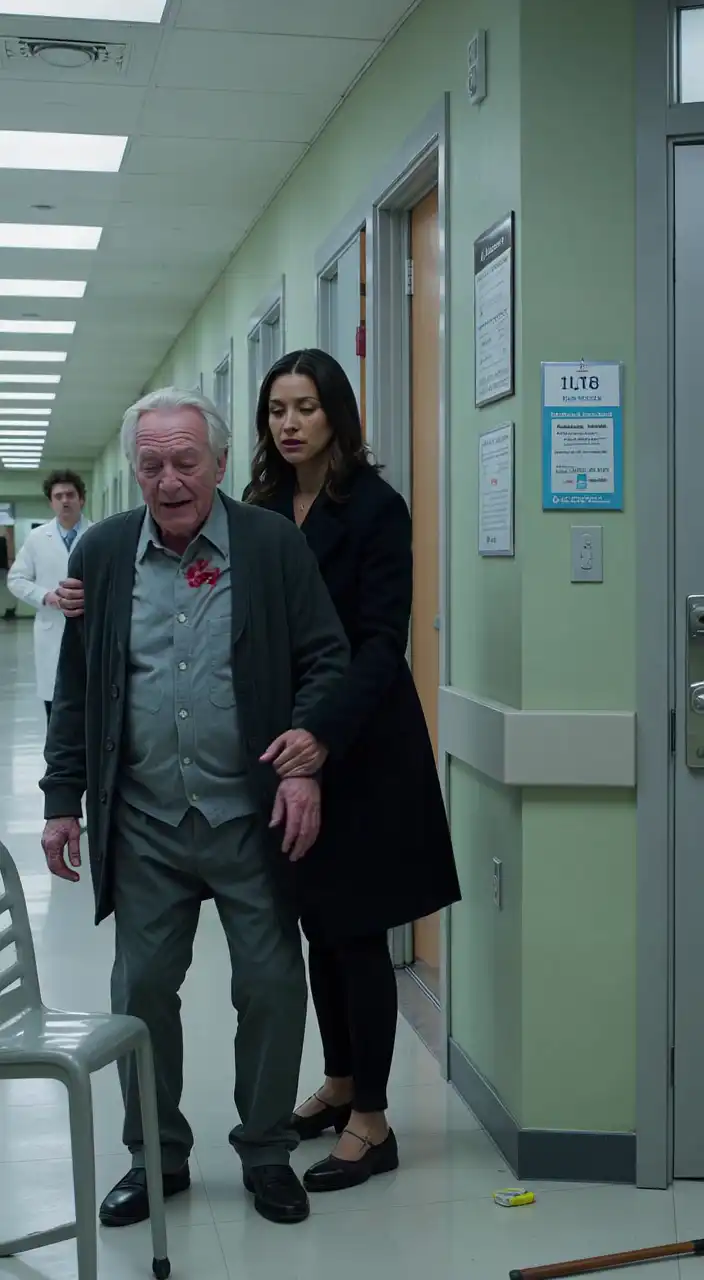
MY FATHER STARTED SHIVERING SO HARD HIS SURGICAL BANDAGE BLED THROUGH, AND THE CLINIC ADMINISTRATOR STILL BLOCKED THE TRIAGE DOOR.
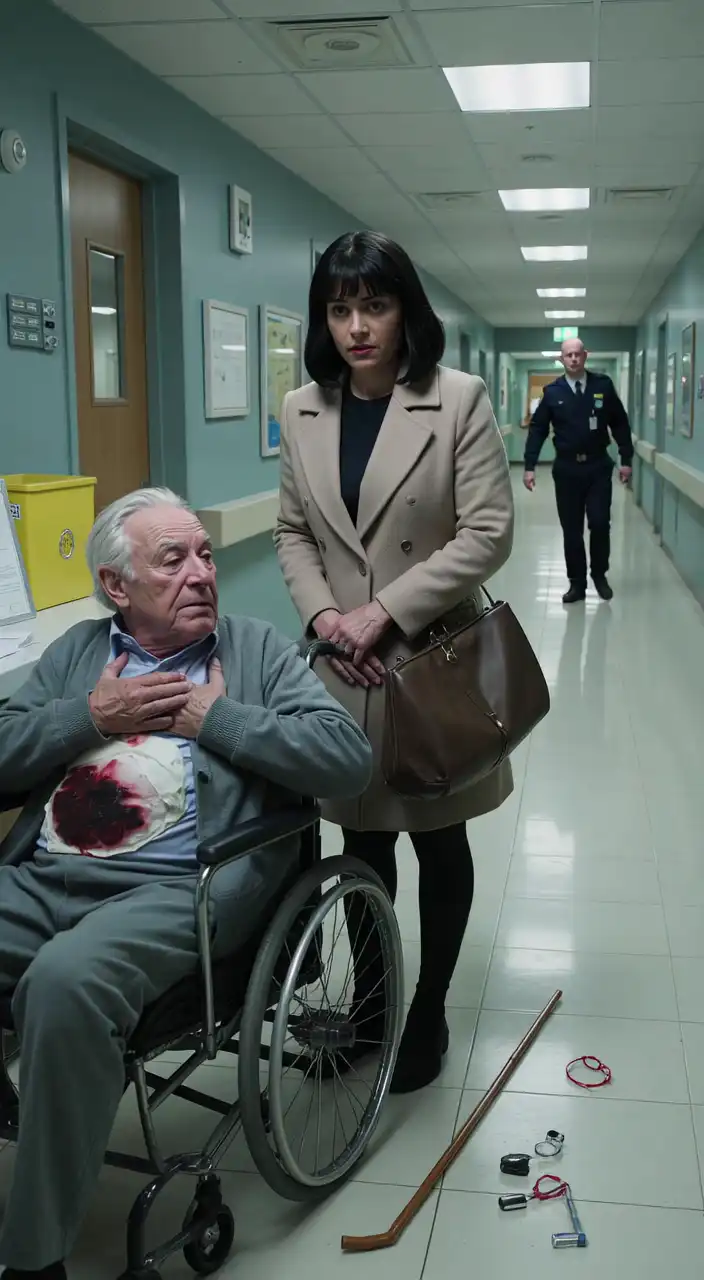
MY FATHER STARTED SHAKING IN THE HOSPITAL HALLWAY, AND THE WOMAN WHO CLAIMED TO BE HELPING HIM WOULD NOT LET TRIAGE TOUCH HIM.
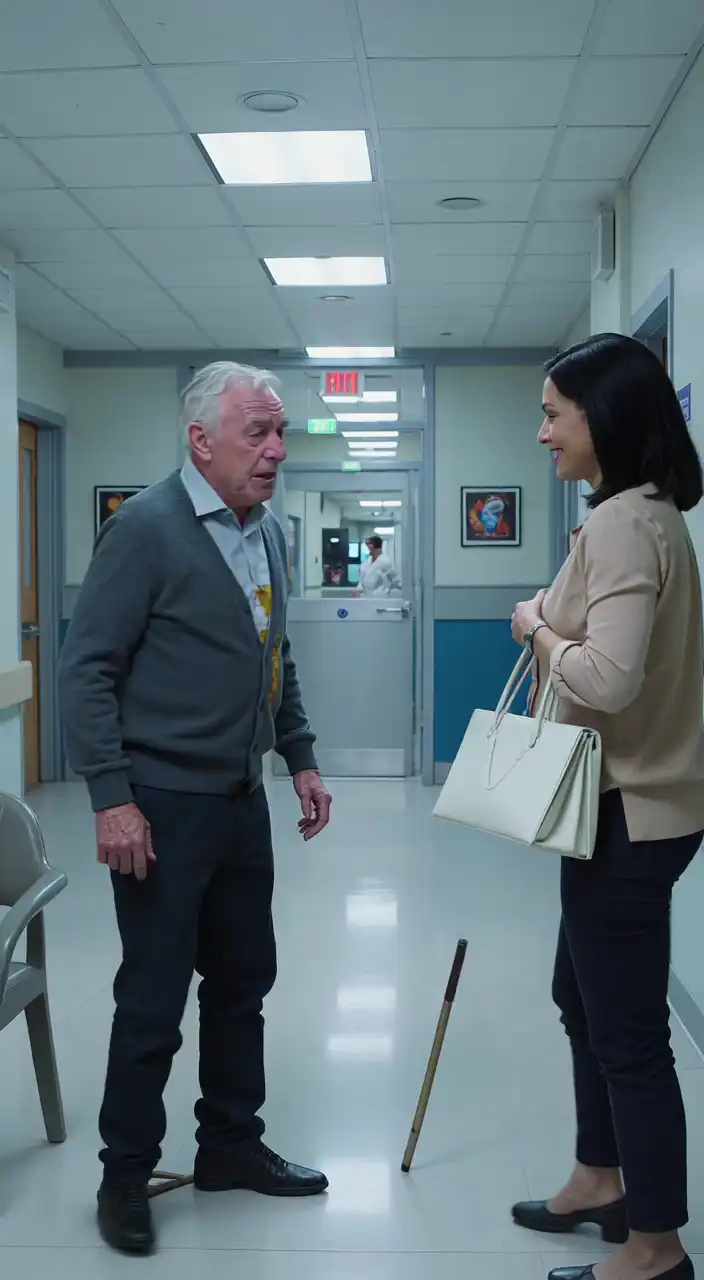
VICTOR STARTED SHAKING IN THE HOSPITAL HALLWAY, AND CAROLINE STILL WOULD NOT LET ANYONE TAKE HIM BACK TO TRIAGE.