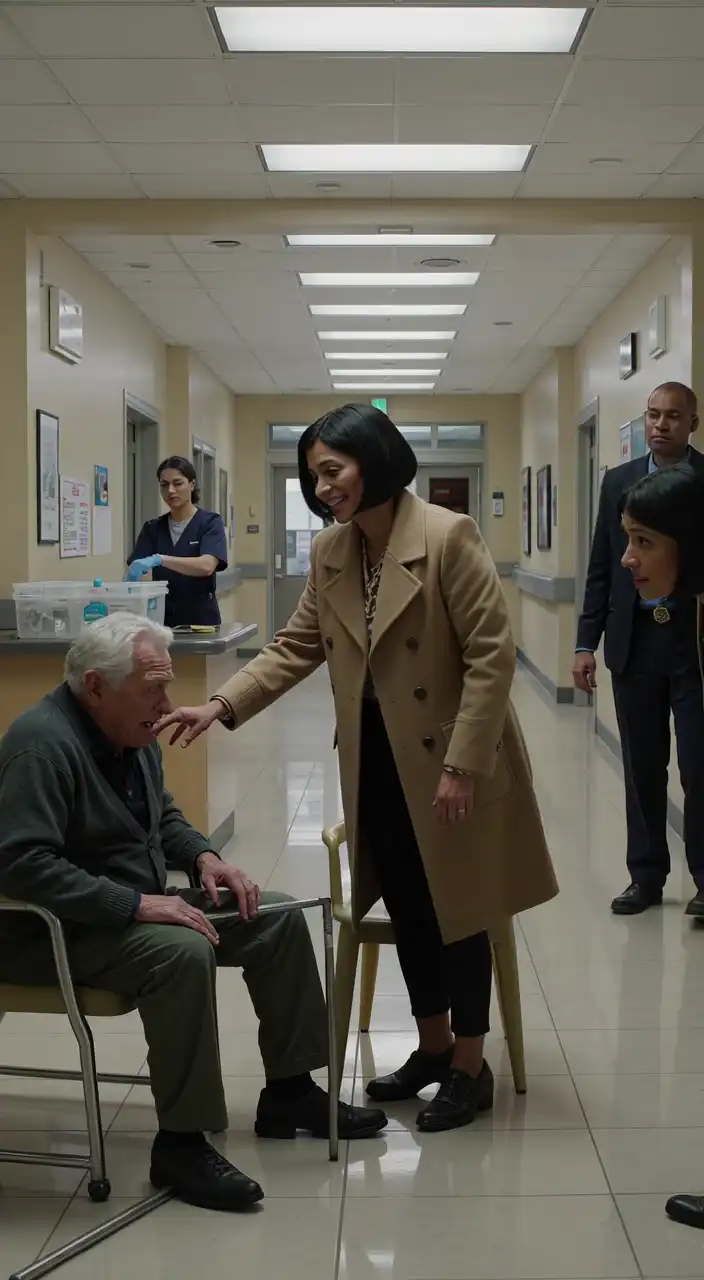

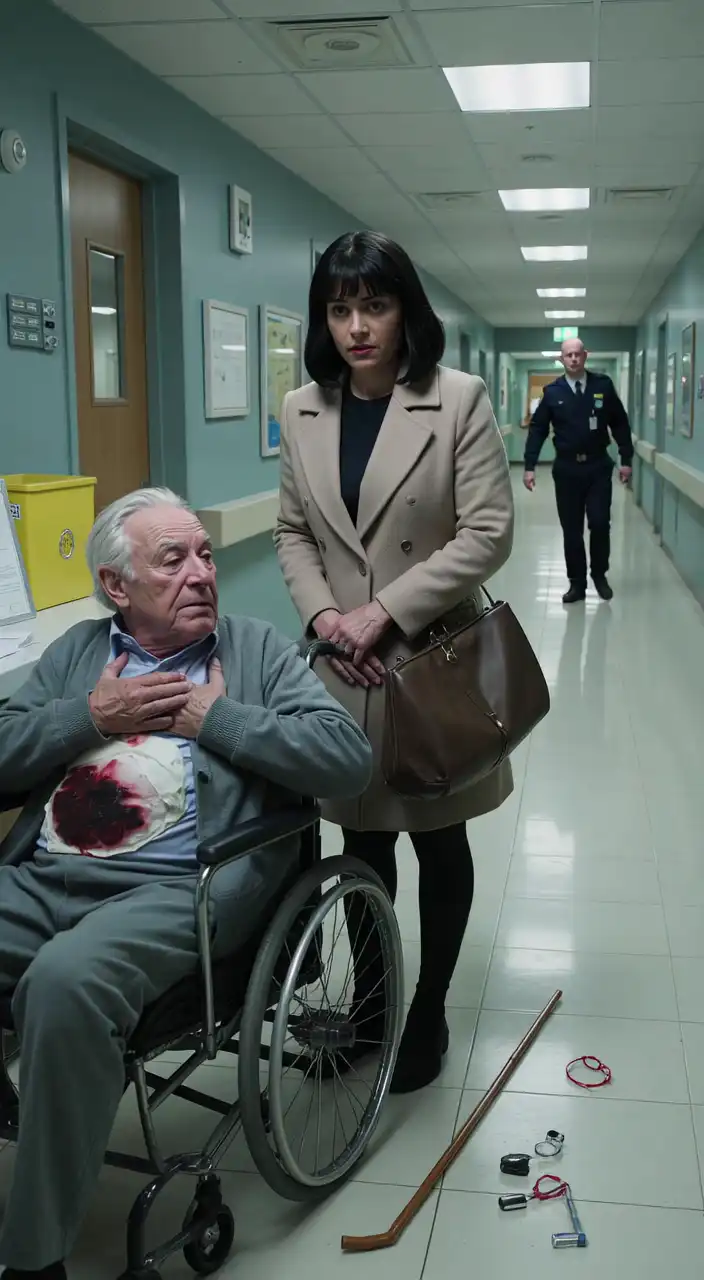
Oliver did not raise his voice. That was what made the moment land so hard.
"Ma'am," he said, one hand already out toward the wheelchair handles, "step back from the patient."
Chloe gave him a bright, offended smile that would have worked on anyone looking from ten feet away. Up close it looked thin and frantic. "I'm his caregiver. He's overreacting. We were actually leaving."
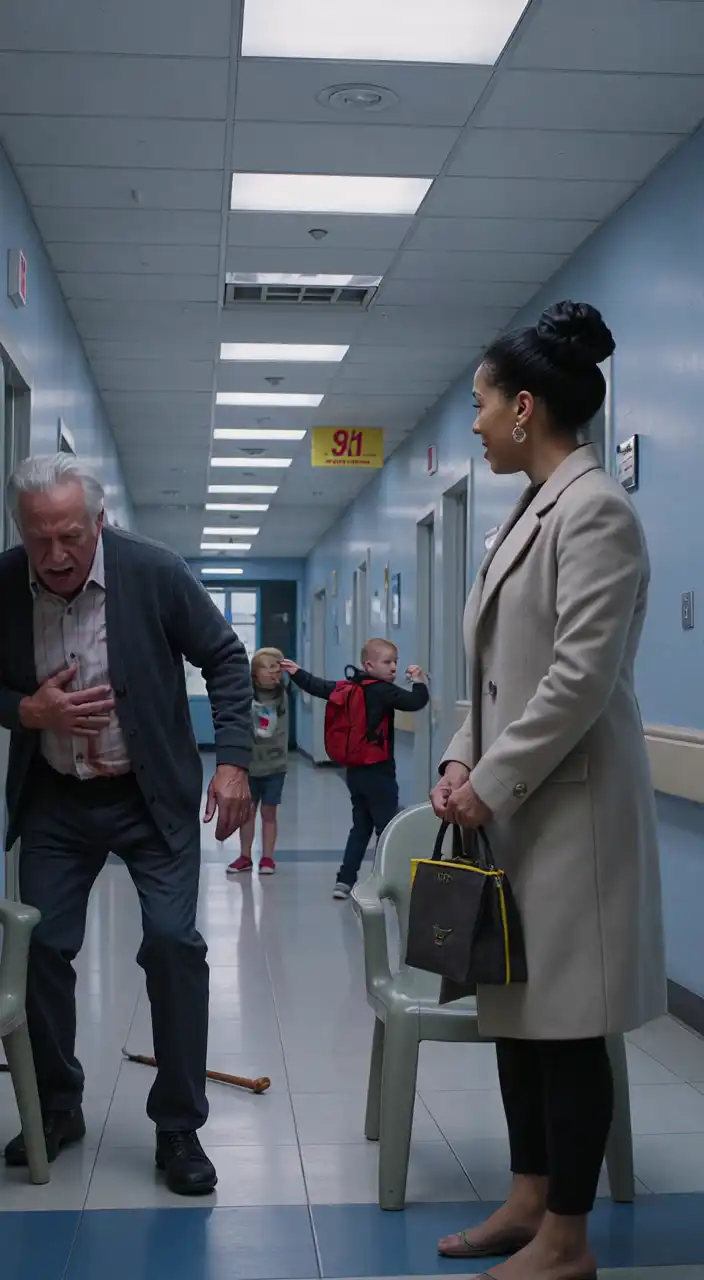
My father made a broken sound in his throat and folded forward. The triage nurse caught his shoulder before he slid from the chair. Another nurse appeared from inside with a portable monitor, moving fast now that the alarm had drawn eyes down the hallway. The amber light flashed as she clipped a pulse ox onto his finger.
"Oxygen's low," she said. "Sir, can you hear me? Mr. Hale?"
Chloe stepped sideways as if she could still insert herself between him and everyone else. "He has panic attacks after anesthesia. His surgeon told us to keep him home and calm."
"I didn't ask what his surgeon told you," Oliver said. "I asked you to step back."
She looked at me then, searching for weakness, some family hesitation she could use. "You know how he gets," she said, as if we were allies against his embarrassment. "Tell them. He refuses to follow instructions and then blames me."
I stared at her. My father had lived through forty years of construction work, a widowhood that almost hollowed him out, and a knee replacement last year without once using the word helpless. Tonight he looked exactly that. He was trying to reach inside his cardigan pocket, and his hand kept slipping.
"I don't know what she's talking about," I said. "I just know he asked me to meet him here because he said she wouldn't bring him back. Dad, can you hear me?"
His eyelids fluttered. "Papers," he whispered again. "Bag."
The nurse with the monitor looked at Oliver. He gave one small nod. "Ma'am, set your handbag on the chair."
Chloe hugged it closer. "Absolutely not. It has my wallet, medication, private items. You can't search me because an old man is confused."
The triage nurse had already turned the clinic chart toward herself. "His discharge note says he was to return immediately for fever over one hundred one, breathing difficulty, increased drainage, or confusion. Who signed him out this morning?"
"I did, because he couldn't hold the pen," Chloe said quickly.
I leaned in. "Morning? He was discharged yesterday afternoon."
That was the first crack that made everyone's attention sharpen. It was a simple thing, easy to miss if she had not said it with such confidence. But the nurse's eyes lifted from the chart to Chloe's face.
"Yesterday at 3:18 p.m.," she said. "Not this morning."
Chloe recovered fast. "Fine. Yesterday. I've been up all night taking care of him. Excuse me if I'm tired."
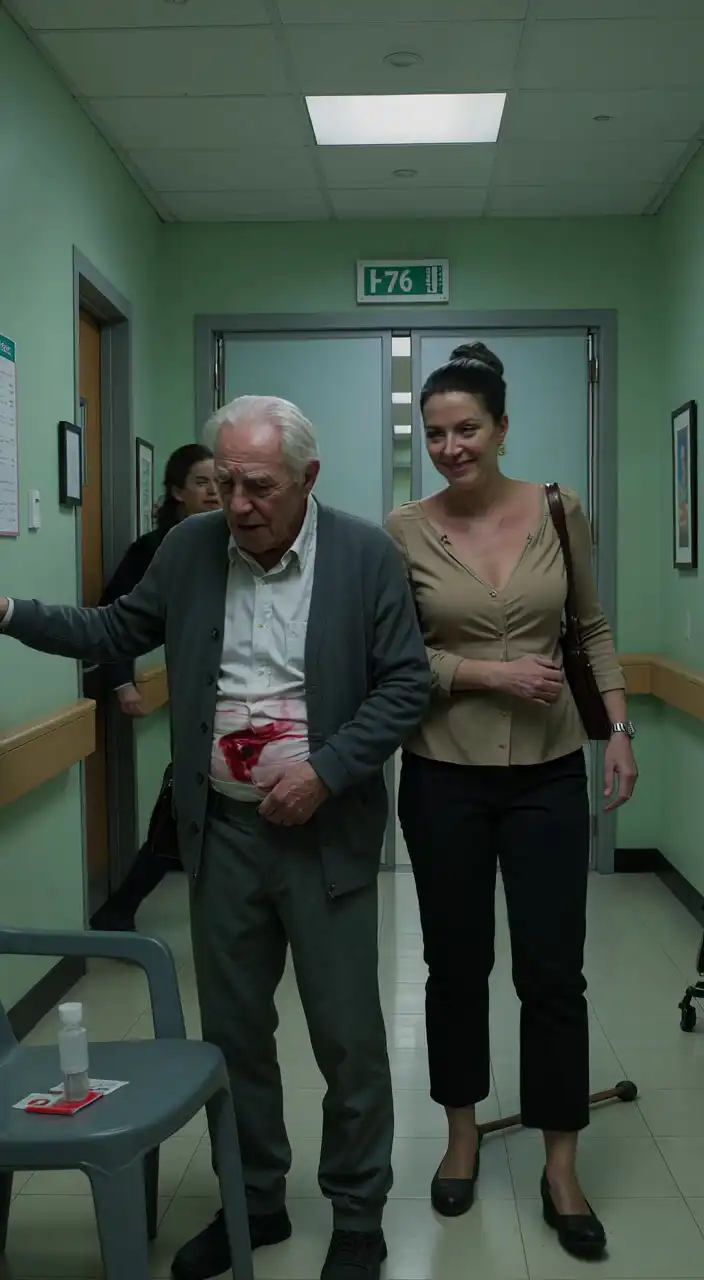
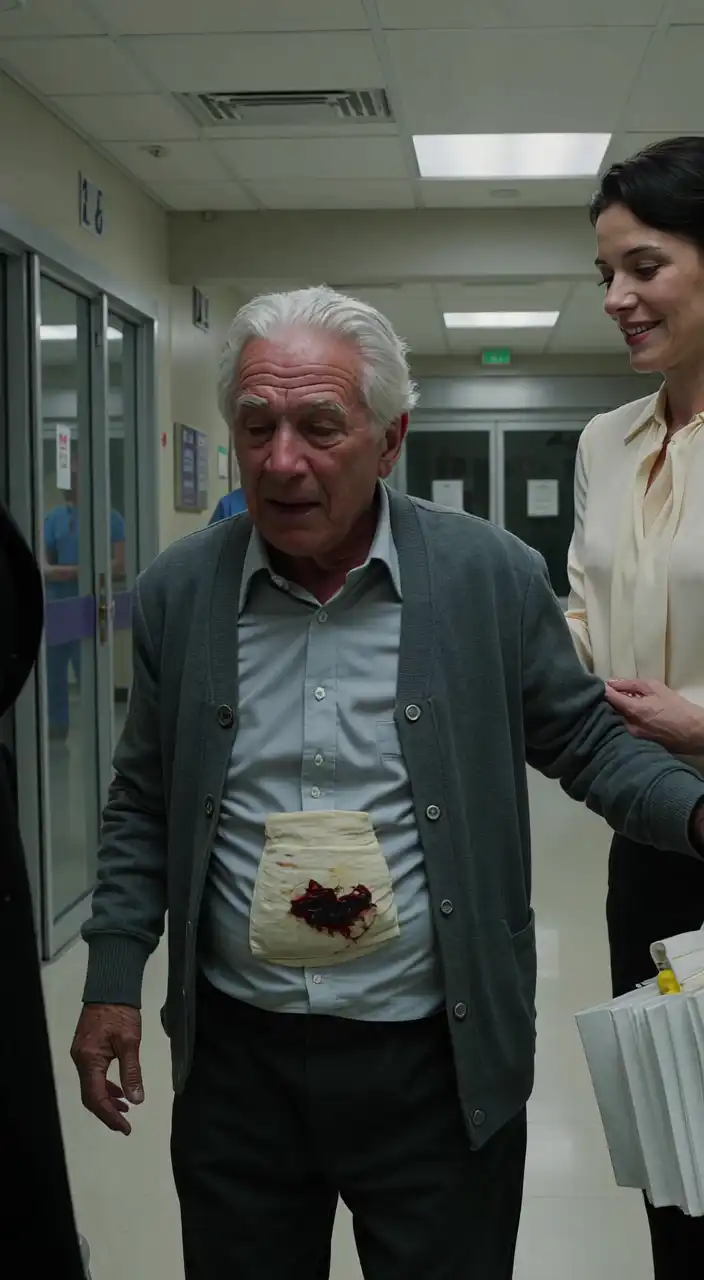
My father jerked hard with a chill. The pulse ox beeped faster. One of the nurses touched the bandage on his side and immediately pulled her hand back to look at the stain on her glove. Not fresh blood. Thin, watery, tinged with something yellow-brown.
"Infection concern," she said. "We need him in a room now."
Chloe moved again, this time not toward him but toward the exit. Oliver shifted just enough to block the path without ever touching her. "You can wait right here while they assess him."
"I said I'm his caregiver."
"And I said you can wait right here."
For a second I thought she would bolt. Instead she planted her shoes and let outrage replace panic. "This is ridiculous. He gets dramatic and now I'm being treated like some criminal because I kept his things organized."
"Dad," I said, because I could not think where else to put my fear, "what papers?"
His fingers finally got inside the cardigan pocket. He dragged out a folded adhesive hospital wristband, not the one on his wrist but another one, peeled and crumpled. On the inside someone had written in blue pen: BACK TO ER IF FEVER OR SHORTNESS OF BREATH. He tried to hand it to me and missed. It dropped into my lap.
The triage nurse took it. "This was from discharge instruction reinforcement," she said softly, more to herself than anyone else. "We only write notes on spare bands when patients say they won't remember."
Oliver's expression changed. It was no longer general caution. It was focus.
The nurse inside called for a room. They began rolling my father toward triage. Chloe surged forward, finally losing the polished tone. "No, wait, he needs his home meds first. I have them in my purse."
"No," the nurse said. "Nothing from home until pharmacy review."
That landed harder than Oliver's command had. Chloe's mouth parted. Her fingers tightened around the bag strap until her knuckles paled.
The empty inhaler spacer on the floor had not made sense to me before. It clicked then, ugly and cold. "Whose spacer is that?" I asked.
No one answered right away.
My father opened his eyes for one second and looked straight at me. "Not mine," he whispered.
The nurse rolling him toward triage repeated, "Room now."
As they pushed him through the double doors, Oliver held out his hand to me. "Sir, if you're family, stay close. I need to ask a few questions, and I need you to tell me whether he ever uses inhalers, breathing treatments, or any home respiratory medication."
"He doesn't," I said. "Never."
Oliver looked down at Chloe's locked purse, then at the spare wristband in the triage nurse's hand. "That's what I thought."
He keyed his radio. "Possible vulnerable adult obstruction at triage. Hold departure on female caregiver in black cardigan. Clinical review requested for concealed meds and discharge documents."
Chloe laughed, but it was the wrong laugh. "Concealed? This is insane."
Oliver did not look at her when he answered. "Then opening the purse should clear it up."
The second crack came from the far end of the hall when a unit clerk hurried over with a clear plastic belongings bag and asked, "Who removed the patient's medication packet from inventory? It's listed on his transfer sheet, but it never made triage."
Chloe's face went still.
I saw it then, not as stress or defensiveness but as the exact instant a lie starts looking for a second lie to survive it.
Oliver's radio hissed back. "Supervisor en route."
He turned to me. "Did your father ask for you before tonight?"
"Three times," I said. "Missed calls. Then a text that only said 'hospital please.'"
Chloe snapped toward me. "He was delirious."
Maybe he was. But delirious people do not hide warning notes inside cardigans. Delirious people do not save a spare bracelet like evidence.
Oliver finally addressed her again. "You can sit down now, Ms. Chloe, or I can have staff sit you down another way. Your choice."
She stayed standing, clutching the bag with both hands while the triage doors swung shut behind my father.
And then, through the narrow glass pane, I saw two nurses freeze over his chart at the exact same moment one of them lifted a folded packet from under the blanket on his lap and stared at the signature line.
Whatever papers Chloe had hidden, my father had managed to smuggle at least one piece of them back in with him.
Oliver saw my face and followed my gaze. "What did they find?" I asked.
He did not answer.
He was already moving toward the doors just as Chloe said, too fast and too loud, "Those are old papers. They don't matter."
That was the first time she said something no one had asked about.
Oliver stopped, slowly turned back to her, and said, "Then you won't mind telling me how you knew what they were before anyone unfolded them."
The hallway went silent except for the monitor alarm still chirping from inside triage.
Chloe did not answer. She just shifted her purse behind her hip, one inch at a time, toward the exit.
Oliver caught the movement and said into his radio, "Make that immediate."
Within two minutes the hallway filled with the kind of controlled urgency that never looks dramatic until you realize every person in it has already decided something is badly wrong. A second security officer came from the elevators. A charge nurse stepped out of triage with the folded packet in her hand and a face gone flat with professional anger.
"Who is Chloe?" she asked.
Chloe tried the smile again. "I'm his caregiver and his emergency contact."
The charge nurse unfolded the packet just enough to glance at the top page. "Then why is the consent refusal signed with his name in block print when his chart shows he signs in cursive, and why does the witness line list a nurse who wasn't on shift?"
Every instinct in me wanted to rush through the triage doors after my father. Instead I stood rooted on that bright ugly tile and watched Chloe's composure fail by degrees. Not collapse. Not confession. Just fail. A blink too long. A breath caught in the throat. The purse strap digging into her shoulder because she could not let go of whatever was inside.
"I signed where he told me to sign," she said at last. "He was exhausted. I was helping."
The charge nurse looked at Oliver. "This was a refusal of readmission recommendation. Yesterday evening. He should never have left if he had fever and drainage. We called the listed contact twice when his lab flags came back. No answer."
My stomach dropped. "I answered one call from an unknown number and it hung up."
Chloe snapped, "Because they kept calling during dinner and upsetting him."
The nurse's eyes narrowed. "The number on file ends in 4912. Is that yours?"
Chloe said nothing.
I reached for my own phone with shaking hands. My father's text was still there. hospital please. Under it were screenshots he had sent by accident or desperation, blurry and half-cropped. At the time I had thought they were random. Now I saw one showed the corner of a discharge packet. Another showed the edge of a prescription label. Another showed the lock screen of a phone with a missed call from St. Anne's Surgical Unit.
Oliver asked quietly, "Can I see that?"
I handed him the phone. He scrolled once, then stopped on the prescription image and enlarged it. "This says albuterol nebulizer solution."
"What?" I said.
"Dad doesn't use that."
"Exactly," the charge nurse said. "Why would he be discharged with a respiratory medication unless he developed breathing complications or had another patient packet mixed in?"
The empty spacer on the floor came back to all of us at once. The nurse who had first spotted it bent, picked it up with a gloved hand, and read the sticker attached to the side.
Not my father's name.
A child's name.
Everyone stared.
The label was partly peeled, but enough remained for the charge nurse to frown. "This belongs to pediatric urgent care."
Oliver's controlled anger sharpened. "How does a pediatric spacer end up beside a post-op adult whose medication packet is missing and whose caregiver won't release her purse?"
Chloe's answer came so fast it tripped over itself. "I picked up my niece earlier. It must've gotten mixed in."
"Today?" Oliver asked.
She hesitated. "Yes."
The charge nurse looked at the sticker date. "This was dispensed five days ago."
Silence again.
That should have been enough to break things open, but lies can survive longer than common sense. Chloe drew herself up and changed tactics completely. Tears, sudden and practiced, filled her eyes. "Do you know what it's like taking care of someone who won't listen? He kept saying he couldn't breathe, couldn't breathe, but every time I offered the breathing medicine he refused because he said it wasn't his. He was agitated. He scared me. I was trying to calm him down."
The words were almost clever because they wrapped the contradiction inside a confession-shaped package. Yes, there was breathing medicine. But only because she had tried to help. Yes, she had control of it. But because he was difficult. The problem was, she forgot the first lie she had chosen. Pain meds. Drama. No emergency.
The charge nurse heard it too. "You just said he only needed calm and rest at home. Now you're saying he had enough breathing distress that you repeatedly offered nebulizer medication prescribed to someone else?"
Chloe's tears stopped as abruptly as they had arrived.
Oliver held out his hand once more. "Bag. Now."
"No."
The second security officer moved up beside him. "Ma'am."
Before they could take another step, a voice came from triage, weak but loud enough to carry through the doors. My father. "Don't let her leave."
Everything in the hallway paused around that one line.
I turned and saw him through the glass, propped halfway upright on a stretcher, oxygen at his face, one hand gripping a nurse's wrist like he was hanging onto the only fixed point in the room. The monitor alarm had changed tone, steadier now but insistent. A physician was at his bedside pressing gently around the dressing while another nurse cut away the outer bandage.
"Dad!" I started toward the doors, but the charge nurse stopped me with a hand to my arm.
"Give them ten seconds," she said.
Inside, the physician said something I could not hear. One nurse reached under the stretcher blanket and produced another folded paper. Not discharge instructions this time. A pathology callback notice, bright yellow. Even from the hallway I could see the red stamp: URGENT CONTACT NEEDED.
My father's hand trembled toward the glass, toward Chloe.
The doctor looked up and signaled to the charge nurse. She crossed to the doors, slipped inside, spoke to him, then came back out with the yellow notice and one sentence that changed the whole shape of the night.
"He had a positive post-op blood culture flagged after discharge," she said. "Someone at home was told to bring him back immediately. Someone signed a refusal instead."
Chloe whispered, "I didn't understand."
But this time no one believed misunderstanding. Not with the forged witness line. Not with the hidden calls. Not with the missing medication packet and the locked purse and the pediatric spacer that did not belong in this story at all.
Or maybe did.
Oliver's jaw tightened. "Who is the child?" he asked.
Chloe blinked. "What child?"
He lifted the spacer sticker between two fingers. "The one whose breathing equipment you've been carrying around while blocking emergency care for an infected post-op patient."
For the first time, Chloe looked not angry or cornered but briefly devastated. It passed in an instant, but I saw it.
Then she did the worst possible thing.
She ran.
Not far. Two strides toward the elevator, purse bouncing against her side. Oliver and the other officer caught up immediately, one on each side, not tackling, not dragging, just stopping forward momentum with trained force and clear commands. "Stop resisting. Stop pulling. You are being detained pending clinical and law enforcement review."
"I didn't poison him!" she shouted.
No one had said poison.
The words hit me like ice water.
Oliver froze for half a beat before tightening his grip. The charge nurse's eyes flicked to the stain on my father's bandage, then to the purse, then to me. The physician inside triage said sharply, "Get toxicology consult on standby. And pharmacy now."
Chloe sagged the moment she realized what she had blurted out. "That's not what I meant."
But it was already in the air, impossible to take back.
And from inside the room, over the beeping monitor and the rustle of hurried hands, my father said one more sentence through the oxygen mask.
"Check the tea."
That was how the next layer opened, not with a dramatic confession, but with a frail old man remembering the one ordinary thing he had swallowed every night since surgery because the woman caring for him insisted it would help him sleep.
The toxicology resident arrived before any police officer did, a thin young woman with a clipped badge and the kind of calm that makes panic feel almost rude. By then my father had been moved from the triage stretcher into an exam bay just inside the emergency area, curtain half-open, monitor leads attached, oxygen still hissing softly at his face. The doctor had exposed the incision enough to assess the drainage and ordered bloodwork, imaging, IV fluids, broad-spectrum antibiotics. Everything happened with that brisk medical rhythm that leaves family members standing useless with their hands open.
I stayed at the threshold until the nurse finally waved me in.
My father's skin looked gray under the fluorescent lights. The neat cardigan was gone, cut away at one sleeve to place the blood pressure cuff and IV. His wrist still wore the original discharge bracelet, edges damp with sweat. I took his hand and found it colder than it should have been.
"You did good," I said, because I had no better words.
He frowned with effort. "Not yet."
The doctor, Dr. Patel, turned from the chart. She was maybe forty, sharp-eyed, not unkind. "I'm going to ask him a few questions while he's alert enough to answer. You can stay. But I need direct answers from him if he can manage them."
My father nodded once.
"Do you know where you are?"
"St. Anne's."
"Why did you come back tonight?"
He swallowed. "Fever. Hard to breathe. Shaking." He glanced toward the hall. "She said no."
Dr. Patel looked at me, then back to him. "Who said no?"
"Chloe." His voice rasped. "Kept papers."
"What papers?"
"Discharge. Calls. Yellow notice." He drew one breath too quickly and coughed. "Said I was fine. Said they'd keep me if I came back."
The nurse made a note. Dr. Patel stayed steady. "You also said check the tea. Tell me what that means."
My father closed his eyes, gathering breath. "At home. Every night after surgery. She made tea in a blue mug. Said it would help me sleep. After tea..." He opened his eyes again and confusion crossed his face, not because he had forgotten but because he had remembered too clearly. "Everything got thick. Couldn't think right. Could hear. Couldn't move good."
I felt my stomach knot.
Dr. Patel did not jump to conclusions. "Did she give you any pills with the tea? Any liquid medicine? Anything she said was from your surgeon?"
"Little white pills first night. Then said tea was enough."
"Do you know the pill name?"
He shook his head. "Not bottle. She kept."
The toxicology resident stepped closer. "Mr. Hale, did the tea taste bitter? Sweet? Different from normal?"
He breathed shallowly. "Sweet. Too sweet." His eyes drifted to me. "You remember your mother's bracelet? Kitchen hook."
I did remember. My mother's silver charm bracelet had hung for years on a hook beside the stove because she took it off to wash dishes and forgot it there after she got sick. After she died, Dad left it hanging. He touched it absentmindedly whenever he made tea.
"What about it?" I asked.
"Gone," he whispered. "Asked Chloe. She said I misplaced it."
A nurse glanced up from the IV pump, probably wondering why a bracelet mattered while his temperature climbed and his blood pressure sagged. But I knew my father. If he was surfacing that detail through fever and fear, it mattered.
Dr. Patel nodded to the toxicology resident. "Add sedation screen if possible. We may be delayed because he's post-op and symptomatic, but let's get what we can."
She turned back to my father. "Did anyone from the hospital call you after discharge?"
He licked dry lips. "Phone rang. Chloe answered. Took it to porch. Came back smiling. Said surgeon's office just checking on me. Then later..." He coughed again. "Later she said they made mistake on labs but didn't matter."
That was the plausible but incomplete explanation arriving all at once. She had not necessarily needed poison to create danger. She could have obstructed return care, withheld information, and sedated him enough to stop him from calling for help. It was enough to make me furious. It was also not enough to explain the words she had blurted in the hallway.
The charge nurse entered with a clear evidence bag. Inside were the contents of Chloe's purse laid out in separate smaller bags: a ring of keys, cosmetics, a folded scarf, my father's discharge packet, the urgent callback notice, two phones, and an unlabeled amber pill bottle with three tablets left.
"Security found these after she was detained," the nurse said. "Police are on their way. She says one phone is hers and one belongs to her niece."
The toxicology resident held up the pill bottle. "No pharmacy label?"
"Removed," the nurse said.
Dr. Patel's face hardened. "Send that to pharmacy now."
I stared at the second phone. The lock screen was cracked, childish stickers on the case. A faded cloud, a cartoon dinosaur, half peeled away. It did not look like anything Chloe would carry for herself.
"The child," I said.
The charge nurse nodded. "We're trying to identify whose it is."
My father tightened his fingers weakly around mine. "Boy," he whispered.
Dr. Patel looked at him. "What boy?"
"Apartment upstairs. Wheezing." He stopped to breathe. "Heard him two nights. Asked Chloe. She said neighbor kid catches colds."
The empty pediatric spacer on the floor. The albuterol prescription image on my phone. The second phone with stickers. Each one slid toward the others, forming a shape none of us wanted.
Oliver appeared at the curtain edge. He kept his voice low for my father's sake. "Police are here. Also social work. We need to know if the patient can state whether Chloe is a relative, paid caregiver, or live-in partner."
"Not partner," my father said immediately, with more force than he had shown all night. "Daughter of my old tenant. Needed work. Started helping after surgery."
I looked at Oliver. "He hired her for recovery?"
My father gave a tiny nod. "Temporary."
That mattered. Not just emotionally, but logistically. It meant she did not have default medical authority. It meant some of the forms she signed carried even less legitimacy than we feared. It meant she had inserted herself by convenience and control, not kinship.
Oliver exhaled through his nose. "She told us she had full caregiver authorization."
"Never signed that," my father whispered.
The social worker, a woman in navy scrubs with tired kind eyes, stepped in next. "Mr. Hale, my name is Renee. I know this is hard. I need to ask whether anyone has been taking your money, your cards, or preventing you from speaking to family."
My father looked ashamed before he looked angry. "Didn't want to bother him," he said, glancing at me. "She said recovery made me needy."
That line hit harder than accusation. Neediness. The oldest lever against proud people. Make them feel like their pain is inconvenience, and they will defend the person neglecting them just to protect their own dignity.
Renee saw my face and redirected. "This isn't your fault. Right now we focus on safety. Sir, has Chloe ever threatened to leave if you asked for more help?"
He shut his eyes. "Said if I went back to hospital they'd keep me and seize the apartment till bills paid. Said my son couldn't afford it. Said I'd lose the house."
There it was: motive rooted in fear, not just cruelty. A rehearsed false medical story wrapped around financial panic and control.
But there was still the child.
A nurse entered with lab labels; another adjusted the monitor. The amber light blinked, then steadied. My father's fever was climbing despite the room's cold air. Dr. Patel listened to his lungs, frowned, and ordered a chest x-ray and abdominal imaging to rule out postoperative complications. She was all medicine, all consequence. Yet even she looked once toward the evidence bag containing the cracked phone and the unlabeled pills.
Oliver left to speak with police, then returned ten minutes later with an officer and a new complication. "She wants to make a statement," he said. "But she keeps asking whether the boy is all right."
Renee spoke first. "What boy?"
"She won't name him."
Dr. Patel glanced sharply up. "If there is a child with missing respiratory medication, this is not optional."
The officer, a deputy with a county patch and a notebook already open, nodded. "We're trying to establish probable location. Her addresses don't match. One current, one old, one mail drop. We found a car seat in her trunk but no child in the car."
My chest tightened. "Did she take somebody's inhaler to sedate my father? Is that what this is?"
The toxicology resident shook her head. "Albuterol wouldn't sedate him. But if she was giving him another medication while also hiding his breathing distress, the borrowed respiratory supplies may point to a second neglect situation, not the cause here."
A reversal, then: the inhaler clue was not proof of what she had done to my father. It was evidence of someone else in danger.
My father stirred. "She said don't call 911," he muttered.
Renee bent close. "When did she say that?"
"Last night. Boy upstairs was crying. Coughing. Then quiet. She went out with purse and came back with spacer. Said neighbors don't deserve trouble."
The social worker and deputy exchanged a look.
Dr. Patel said, "Deputy, if there is a child with respiratory compromise and possibly a missing caregiver, you need welfare check now."
"It's already being dispatched," he said. "Problem is we don't have unit number."
My father's eyes opened. For a second they sharpened with the old practical intelligence I grew up trusting. "Laundry room door. Blue paint. Number scratched on frame. Three-B maybe. Could be eight. Wore hearing aids, grandmother did. Boy named Mateo. She yelled it once."
Oliver keyed his radio before the deputy could even finish writing. "Relay all of that."
The hallway outside the bay thickened with purpose. One team for my father. One forming, invisibly, around a child we had not yet seen.
Then pharmacy called back about the unlabeled pills.
The charge nurse answered, listened, and slowly turned toward Dr. Patel. "They're trazodone. High dose tablets. Not prescribed to this patient."
My father gave a tiny, miserable nod. "Sleep tea."
The plausible explanation became darker. She had not needed anything cinematic. Just enough unauthorized sedative to fog him, enough fear to isolate him, enough forged paperwork to delay return care until infection and breathing trouble did the rest.
But when Renee asked the deputy whether that supported charges, he only said, "It supports a lot of questions."
Questions were not enough for me. Not while my father shivered under warmed blankets, not while some child named Mateo might be upstairs in another building without his inhaler, not while Chloe sat somewhere insisting she had been helping everyone.
Renee must have sensed I was winding tight because she drew me aside while the x-ray tech wheeled equipment in. "Listen to me. These cases can look messy at first because neglect hides inside routine. Caregiver says the patient was confused. Family says the patient was proud. Paperwork is missing. Calls were missed. People start doubting themselves. Don't. He came back. He hid evidence because he knew he wasn't safe."
I looked through the curtain gap at my father as the technician lifted him carefully and he flinched in pain. "He almost didn't."
"But he did."
The deputy's radio cracked. He listened, expression changing. "We may have the apartment," he said. "Neighbor reports a child with asthma and an elderly woman who hasn't answered the door since yesterday."
Oliver's controlled anger shifted into something colder. "And Chloe was carrying the child's phone."
The deputy nodded grimly. "And maybe more than that."
My father reached for me again as they repositioned him after the x-ray. I took his hand. He swallowed and said the next piece as if confessing a weakness he hated.
"I tried to call you from that phone," he said. "Mine was gone."
I stared at the cracked case in the evidence bag.
"You stole a child's phone?" I asked, not because I judged him, but because I couldn't make the puzzle fit.
He managed the ghost of a smile. "Borrowed. From hall table. For pictures. Papers. Calls. She found me before texting more."
That paid off the blurry screenshots sitting in my own phone all along. Not random. Evidence captured with the only device he could get. The child phone had become his lifeline for exactly long enough.
Dr. Patel checked his latest vitals and made a decision. "We're admitting him. Possible sepsis, post-op complication, impaired judgment from unauthorized medication, and vulnerable adult concern. He is not leaving with that caregiver under any circumstance."
At that exact moment, the deputy's radio erupted again, louder this time, and he stepped into the hall to answer. He came back thirty seconds later with his face set.
"They forced entry," he said. "The grandmother is down but conscious. The boy is alive. Severe wheezing. No rescue inhaler in the apartment."
Relief hit me so hard it almost dropped me.
Then he added, "They also found a kettle on the stove and a row of medication bottles with labels peeled off."
Dr. Patel looked at the toxicology resident. "Get that information to responding medics and child ER. Cross-check pill counts if they can."
Oliver spoke quietly. "This just became bigger than one patient."
My father closed his eyes, tears slipping out despite him. Not for himself, I realized. For the boy.
Renee put a hand on his shoulder. "You helped us find him."
But he shook his head weakly. "Too late if..." He could not finish.
"Not too late," I said, though I had no right to promise anything. "Not tonight."
The deputy's next question should have been simple. It wasn't. He looked from my father to me and asked, "Did Chloe ever mention why she was spending time in that apartment?"
My father hesitated.
That hesitation was the contradiction we had not reached yet, the thing he did not want to expose because it would reveal something shameful and complicated, something that made Chloe's motive more personal than money.
When he finally answered, his voice was barely audible.
"She said she was helping the grandmother," he whispered. "But I saw her taking checks from the kitchen drawer."
The deputy wrote that down.
Then my father added, "And she called the boy her son once. Then told me never to repeat it."
Everything in the room seemed to stop around that sentence.
Because if Mateo was Chloe's son, then the missing inhaler, the hidden phone, the old woman's silence, and Chloe's desperation in the hallway were no longer separate pieces of collateral neglect.
They were one house of lies collapsing in every direction at once.
The police interview with Chloe did not happen in front of us, but the effects of it kept rippling back through the emergency department like aftershocks. Doors opened, clipped conversations passed the curtain, radios hissed. Every ten minutes someone new arrived to ask for a copy of a note, a screenshot, a description of a mug, a time line of when my father had first called me. The night stopped feeling like an isolated medical crisis and started feeling like the point where several hidden emergencies had collided.
My father had been moved upstairs to a monitored bed by then. The antibiotics were running. His temperature had finally nudged down a fraction. The surgeon on call had come through and explained that the incision drainage and fever were concerning but caught in time if treatment held. The chest imaging suggested early pneumonia or aspiration after surgery, complicated by delayed return. He needed observation, cultures, likely several days of inpatient care. All of that should have been enough. It wasn't. Because every time he drifted toward sleep, he jolted back awake and checked whether I was still in the chair by the bed.
"I'm here," I kept telling him.
Around three in the morning, Oliver came up to the floor with two cups of stale coffee and a thin file tucked under his arm. Security supervisors do not usually make personal rounds to inpatient rooms after an incident unless the incident is sticking with them. He set one coffee near me and stood at the doorway until my father noticed him.
"Mr. Hale," Oliver said, "the deputy asked me to let you know the child made it to pediatric emergency. He is getting breathing treatments. The grandmother was dehydrated and disoriented, but she's alive."
My father let out a breath I think he had been holding for hours.
"Thank God," he said.
Oliver nodded, but his face stayed grave. "There's more."
I had expected that. There was always more.
He opened the file just enough to show me copied forms, incident notes, and a photo of the peeled spare wristband with the handwritten warning on the inside. "The refusal of readmission form was definitely falsified. Signature mismatch, fake witness, and wrong time. But that's not the only issue. Her second phone wasn't registered to her niece. It appears to belong to the grandmother's apartment line replacement account. She had control of their communications too."
Renee, the social worker, entered behind him carrying her own notes. "And we just learned Chloe had been presenting herself to the apartment complex as a home aide for the grandmother in 3B. No agency affiliation. No family verification. She'd been collecting deliveries and intercepting pharmacy pickups."
That made me sit forward. "For how long?"
"At least six weeks," Renee said.
My father turned his face toward us. "She moved fast after surgery," he murmured. "Started with groceries. Then rides. Then said she'd stay nights."
The pattern was visible now: find weak points, offer convenience, become indispensable, then control access. Not one dramatic act. A ladder.
Oliver continued, "The larger emotional reversal here is that your father may not have been the primary target at first. He was vulnerable and nearby, but the apartment records suggest Chloe's foothold was the grandmother and the child. Once your father had surgery and needed help, she widened the same control pattern onto him."
A second fair reversal. The child clue had not merely exposed another victim. It had exposed that my father had been folded into an existing web.
Renee sat beside the bed. "Mr. Hale, I know this may be difficult, but did you ever give Chloe money to help the grandmother or the boy?"
My father stared at the blanket. "A few times."
"How much?"
"Cash. Maybe eight hundred over two weeks. She said the boy's inhaler wasn't covered. Said the grandmother skipped meals to buy medicine."
My jaw tightened. "And you believed her."
He looked ashamed again. "I wanted to."
Of course he did. He had lost my mother to years of illness and hated seeing anyone choose between medicine and groceries. Chloe had not exploited greed. She had exploited mercy. It made me hate her in a more complicated way.
Renee touched the rail of the bed. "That doesn't make you foolish. It makes you reachable."
Oliver took out one more sheet. "There's a problem, though. In her initial statement, Chloe claims your father asked her not to bring him back because he couldn't afford another hospital stay. She says he begged her to help him sign whatever was necessary so he could recover at home. She is framing herself as overwhelmed, not malicious."
"That's a lie," I said.
"It is," Oliver said. "But it is the kind of lie that can survive if frightened older patients start minimizing to avoid trouble."
My father looked from him to me. He knew exactly what that meant. If he softened now out of shame or pity, the whole thing would blur. He swallowed hard.
"I won't protect her," he said.
Renee gave a small nod. "Good. Because she did not just make a bad choice. She isolated you from care."
There was a knock at the half-open door. A woman in plain clothes stepped in, county badge on her belt. Detective Morales. She introduced herself with the weary directness of someone who has already been awake too long and still has several ugly hours ahead.
"I need ten minutes if he's alert," she said. "This isn't a formal statement for court. I need enough to support emergency protective actions before morning."
Dr. Patel had approved brief questioning if my father could tolerate it. He insisted he could. So Morales pulled a chair near the bed and began not with accusations but with sequence.
"When did Chloe first begin helping you?"
"After surgery consult," he said. "She heard from old tenant I lived alone."
"Did she ever tell you she had medical training?"
"Only said she'd done caregiving work."
"Did she ever show paperwork giving her authority over your medical decisions?"
"No."
"Did she take possession of your phone, wallet, or mail?"
"Phone after first night home. Said I should rest. Wallet for pharmacy run. Mail from porch. I asked later. She said junk."
Morales wrote quickly. "Did she ever tell you not to contact your son?"
My father hesitated just long enough to hurt me. "She said he was busy. Said I should stop making him anxious."
I looked away.
Morales noticed, but did not indulge family emotion. "Mr. Hale, I need exact language if you remember it."
He closed his eyes. "She said, 'If you keep panicking, they'll think you can't live alone and your son will put you somewhere.'"
There it was. The phrase. The quiet coercion underneath all the practical obstruction.
Morales underlined something in her notes. "Did she say similar things about returning to the hospital?"
"Yes. Said they'd keep me. Said bills would take the house. Said surgeon would be angry I wasted their time."
Every line was believable because every line had a grain of social truth. Hospitals are expensive. Older people fear losing independence. Families do get overwhelmed. She had built her false story from common anxieties and then weaponized them.
Morales asked about the tea, the pills, the hidden papers, the phone calls. When she reached the child, my father's eyes filled again.
"I heard him wheeze through ceiling," he said. "Asked if they needed help. Chloe said his grandmother was overreacting. Then one night she came back with that little plastic chamber and set it in my kitchen by the chart. I thought she was taking medicine upstairs. Later it was gone."
"Did you ever see her use it with the boy?"
"No."
"Did you ever hear the boy ask for his mother?"
A beat of silence.
Then my father said, "He asked, 'When are you coming back this time?'"
Morales sat back slightly. That line mattered. It suggested intermittent abandonment, not just one chaotic night.
After she left, I stood at the window and looked down at the parking lot glowing under sodium lights. Dawn was still far off. I could feel exhaustion behind my eyes, but adrenaline kept refusing to let me sit.
My father spoke before I turned back. "You're angry."
"Yes."
"At her?"
"At everything."
He nodded once. "I should've called sooner."
I almost told him that was the least of it, but it wasn't. It was exactly the point. She had delayed care by making him doubt his right to ask for it. That was the wound under the infection.
"I got your text," I said. "I should've come faster."
He gave me the faintest old half-smile. "You came."
Before either of us could say more, Detective Morales returned with a new pressure point. "We found surveillance from the pharmacy drive-through across from your apartment complex," she said. "It shows Chloe picking up medications using both your name and the grandmother's address. We need you to identify whether this mug is yours."
She held up a still image on her tablet. It showed the passenger seat of Chloe's car under the pharmacy window light. A blue ceramic mug with a chipped handle sat in the cup holder.
My father stared. "Mine."
The blue mug from the tea.
Morales zoomed in. Beside it sat a zip bag containing crushed tablet residue. Not enough to tell what it was from the photo, but enough to tie the ordinary object to the fear that had begun in his kitchen.
"She went there the afternoon after your discharge," Morales said. "Then to a check-cashing place."
Renee, who had stayed near the door, muttered under her breath, "Of course."
Morales continued, "The grandmother's account shows two checks cashed with shaky signatures. We think Chloe was draining both households while keeping both vulnerable adults unstable and isolated. But I need one more thing from your father before we push for emergency guardianship hold and child protective placement."
My father looked tired enough to disappear into the pillow. "What?"
Morales held up a printed still from the apartment complex laundry room camera. Chloe, carrying grocery bags, talking to a small boy in a puffer jacket. The boy's face was turned away. In her free hand she held a key ring with a silver charm dangling from it.
I knew the charm before my father did.
My mother's bracelet.
He stared as if someone had reached into his chest. "That's hers."
Morales nodded. "We recovered it from Chloe's belongings. We think she was using it on the key ring."
A planted detail repaid in the worst and best way at once. The missing bracelet had not simply disappeared. It had become proof she moved through his home as if what was his was already hers.
My father's mouth trembled. "She took that to the boy?"
"Looks like she used it as house keys."
He shut his eyes. "I should've known."
"No," I said, harder than I meant to. "She counted on you not wanting to think the worst."
That was the moral reversal of the night. The shame belonged to her. Not to the people she manipulated.
Morales lowered the tablet. "The final obstacle is this: the grandmother in 3B is refusing to say Chloe harmed anyone. She keeps insisting Chloe was helping with Mateo because his mother wasn't stable enough. If Chloe is the mother, and if the grandmother is protecting her, this gets messy fast. Child welfare can act on immediate medical neglect, but longer-term removal or supervised conditions need stronger cooperation."
Renee folded her arms. "Medical neglect, forged medical documents, unauthorized medication, financial exploitation, and obstruction of emergency care are stronger cooperation."
"Agreed," Morales said. "But at dawn every story gets retold by relatives who are embarrassed, frightened, or dependent. I need Mr. Hale on the record before that starts."
My father was quiet for several seconds. Then he asked, "How old is the boy?"
"Seven," Morales said.
"Does he know she was here tonight?"
"We don't know."
My father looked at me, then at the IV running into his arm, then at the bracelet photo on the tablet. I saw him measuring one thing against another: his own humiliation, the child's future, the cost of naming what happened plainly.
"I'll say it clear," he said finally. "She kept me from the hospital. She hid the papers. She drugged me without telling me. And if she did that to me, she should not have that boy."
Morales exhaled, almost imperceptibly. "That's what I needed."
After she left, the room settled for maybe fifteen minutes. Nurses changed shifts. The sky outside the window thinned toward dark blue. My father dozed. I answered texts from my wife with one hand and rubbed my temples with the other. I thought the worst of the night had passed.
Then Dr. Patel came back with a new look on her face.
"The blood pressure dip wasn't just sepsis," she said. "His hemoglobin dropped more than we expected. Imaging shows a pocket near the surgical site that may need intervention. Interventional radiology is evaluating whether he needs drainage this morning. He's not crashing, but we are not out of danger."
Relief and terror, arriving together. The theme of the whole night folded back onto itself. Exposing Chloe would mean nothing if my father still tipped over the edge because we had reached care too late.
He woke enough to catch the word "intervention" and squeezed my fingers. "No more home," he muttered.
"No more home with her," I said.
He stared at me until I understood the fuller meaning. No more minimizing. No more handling it quietly. No more protecting pride over safety.
Renee returned one last time before dawn and placed a simple sheet on the bedside table. Emergency no-contact request. Temporary alternate contact authorization. Secure belongings inventory. Practical, unglamorous paper walls against a person who had entered through missing ones.
My father signed each in his looping cursive, shaky but unmistakably his.
Then a pediatric nurse I'd never met stopped at the door with a message from downstairs.
"Mateo asked who found his phone," she said. "He says a nice old man borrowed it because he was scared."
My father covered his eyes with the back of his hand.
The nurse smiled gently. "He wanted me to tell you he isn't mad."
That was the closest thing to grace the night had given us so far.
But before we could hold onto it, Oliver stepped in one last time and said, "Police just learned Chloe wasn't using her real last name with either household."
I stared at him. "Who is she, then?"
He looked from me to my father and answered, "That's what she's still trying not to say."
By seven in the morning, sunlight had stripped the hospital of some of its nighttime drama and replaced it with the harsher feeling of consequences. Everything looked more ordinary than it should have: carts rolling, coffee cups on charting desks, volunteers at the front entrance, families asking for parking validation. But on the surgical floor, in a room that smelled faintly of antiseptic and warmed blankets, the night had turned into a chain of decisions that could no longer be softened by daylight.
Interventional radiology confirmed they could drain the fluid collection near my father's incision without taking him back into full surgery unless things worsened. That should have calmed him. Instead he grew agitated when transport came with the stretcher.
"You're not sending me home after, are you?" he asked the nurse, voice catching.
"No," she said firmly. "You are admitted. You are staying."
It took that direct reassurance for him to unclench his jaw.
The nurse, Carla, had taken over at shift change and somehow already knew exactly which tone to use with him. Not pitying. Not falsely cheerful. Just clear. "Your son is listed as primary contact now. Chloe is blocked. Security has her information at all entrances."
He nodded, but his eyes still moved to the doorway every few seconds. Trauma doesn't always look dramatic. Sometimes it looks like an old man checking whether the person who controlled his medicine and phone can still walk into the room.
Before they rolled him downstairs, Detective Morales returned with the final missing piece of Chloe's identity. "Her legal name is not Chloe Baines," she said. "It's Chloe Mercer. There are prior fraud complaints in another county involving elder assistance arrangements, none prosecuted. Different versions of the same story. Temporary caregiving, intercepted checks, signed forms, medication confusion."
Rage went through me so fast I had to grip the bed rail. "And she was still out free to do this again?"
"Yes," Morales said. No excuses. Just the fact. "People withdrew complaints. Families settled losses privately. Victims second-guessed themselves. Some didn't want court. Some were deemed poor witnesses because they were sick."
My father looked at the ceiling. "I almost did that too."
"No," I said. "You almost died doing that."
He closed his eyes.
Morales wasn't finished. "There is also confirmation now that Mateo is her son. The grandmother is his maternal grandmother. Chloe had been leaving him there for stretches while claiming she was working overnight caregiving shifts. She collected his inhaler refills but skipped follow-up appointments. The grandmother thought Chloe was handling his medical care. Chloe told providers the grandmother was forgetful and dramatic. Same script, different victim."
The pattern was so clean it made me sick.
Carla adjusted my father's blanket. "And now?"
"Now child protective services is petitioning for emergency custody placement with monitored family review," Morales said. "The grandmother may still be part of that if she stabilizes and if investigators determine she was manipulated rather than complicit."
"Was she?" I asked.
Morales hesitated. "Both can be true. She covered for Chloe. But she was also medically neglected herself. Sometimes vulnerable adults protect the person controlling them because they fear losing the child more than they fear the danger."
That line stayed with me. It made the story harder, not cleaner. There was no cartoon villain standing alone. There was a practiced manipulator, yes, but also a network of fear, dependency, and shame around her. Exactly the kind of mess emergencies hide in until someone refuses to leave the hallway.
They took my father for the drainage procedure. The forty-five minutes he was gone felt longer than the whole night. I walked the waiting area twice, called my wife, called my sister in Arizona, answered the same question from both: "How bad is it?" I still didn't know how to answer. Medically? Better because he had finally gotten care. Emotionally? Worse because of everything it had revealed.
When Carla came to find me after the procedure, her shoulders had dropped a little. Good sign.
"He did well," she said. "They drained infected fluid. He'll need continued IV antibiotics, but this should help. His breathing is also improving. You can see him in ten minutes."
I sat down so suddenly I nearly missed the chair.
That was the physical threshold. We had reached it. Not safety, not full recovery, but the point where rescue stopped being theoretical. Care had finally overtaken obstruction.
When I went back in, my father was groggy but clearer. The trembling had eased. The color in his face was still bad, but less frightening. He opened one eye and said, "Did they get it?"
"The infection pocket, yes."
He managed a weak nod. "Good."
Then, because shame likes to make one last appearance even after the danger turns, he said, "I feel stupid."
I pulled the chair close. "You don't get to say that today."
He gave a breath that might have been a laugh. "Bossy."
"Learned from you."
He looked at me for a long moment, and some of the vigilance in his face softened.
Around noon, Renee returned with an update from pediatric. Mateo was stable after steroids and breathing treatments. His lungs still sounded tight, but he had improved enough to ask for cereal and complain about hospital socks. The grandmother had accepted fluids and treatment. CPS had arranged supervised contact only, no unsupervised release to Chloe. The hospital had flagged both cases for vulnerable adult and child protection follow-through.
"And Chloe?" I asked.
Renee's expression was careful. "She asked twice whether Mr. Hale was alive. Then once whether Mateo was asking for her. Then she asked for a lawyer."
I didn't know what to do with the fact that she had asked if he was alive. Human concern and calculated self-interest can sound identical in the mouth of someone like that. Maybe she had cared in flashes. Maybe she hadn't. It no longer mattered more than what she had done.
The next meaningful scene came from an unexpected direction. Early afternoon, a small envelope arrived through security for my father. No return name. Oliver had it screened before bringing it up. Inside was my mother's silver bracelet and a torn note written in a slanted hand that wasn't Chloe's.
He read it aloud only after asking whether my father wanted to hear it. The note said: She told me she borrowed this from upstairs to keep your keys together. I should have sent it back sooner. I am sorry about the boy and about you. - L
"The grandmother," Renee said quietly.
My father took the bracelet in both hands like it might break. He didn't cry then. He just pressed the cool metal against his palm and closed his fingers.
A planted detail turned, finally, toward healing.
Later, Detective Morales returned with paperwork for signatures and one final explanation that made the social-justice center of the whole thing painfully clear. "The reason her lies worked so often," she said, "is because she chose people already worried they would not be believed at full value. Older post-op patient. Tired grandmother. Child with chronic asthma and missed appointments. She counted on hospitals hearing 'confused' and 'dramatic' and moving on."
Oliver, standing near the door, said, "That triage nurse noticing the spacer changed everything."
It had. One small object carrying panic. One contradiction no one ignored.
I asked whether the nurse knew. Morales smiled faintly. "She knows. She also documented every word."
By evening, my father was asking for ice chips and complaining about the television volume. Progress. Real progress. My sister was booking a flight. My wife had already started talking about temporary bed rails at our house if he wanted to recover with us after discharge. For the first time since the hallway, the future existed beyond the next ten minutes.
When Oliver stopped by at the end of his shift, my father asked him to come in.
"I don't remember everything from last night," Dad said, "but I remember you stopping her from wheeling me out."
Oliver shrugged like security supervisors are trained not to wear gratitude comfortably. "You did most of the work yourself. You kept the note. You hid the papers. You got the text out."
My father looked at the bracelet on the tray table, then at me. "I almost gave up."
Oliver answered with more feeling than he usually showed. "A lot of people do when someone keeps telling them they are a burden. That doesn't mean they wanted the harm."
After he left, my father was quiet.
Then he said, "You know the worst part? I was more embarrassed than scared."
I knew exactly what he meant. The hallway. The shaking. Being spoken over in public. Looking needy. Looking old. Looking like the kind of patient people dismiss. That was the wall Chloe had used.
"You don't owe embarrassment your life," I said.
He looked at me and nodded once. "I know that now."
Three days later he was still in the hospital, but the fever had broken, the drainage was controlled, and the oxygen was gone. Mateo was transferred out of pediatric observation to a monitored room and then discharged into temporary kinship placement with a maternal aunt from another county who showed up carrying two inhalers, school forms, and enough quiet fury to light the hallway. The grandmother remained admitted for stabilization and assessment. She asked twice whether my father hated her. He sent back a message through Renee: I don't. Tell the truth.
Chloe was charged initially with vulnerable adult abuse, obstruction of emergency medical care, forgery-related counts, and child neglect charges pending fuller review. More would likely come with the financial records. None of that felt cinematic. It felt slow and administrative and deeply necessary.
The moment that stayed with me happened on my father's discharge day, a week after the hallway. He stood carefully by the hospital window in a clean cardigan my wife had brought, his new discharge papers clipped inside a bright red folder the nurse insisted he keep in plain sight. His wrist carried a fresh bracelet, and in his pocket was my mother's silver one. He wasn't going home alone. That was settled.
As we waited for transport, the triage nurse from that first night stopped by. She was on another unit run and almost passed our door before recognizing him.
"Mr. Hale," she said, smiling. "You look better."
He straightened a little, old manners resurfacing. "Because you paid attention."
She shook her head. "Because you came back."
After she left, he looked down at the red folder and said, "I'm keeping every paper this time."
"Good."
"And if I say I can't breathe, nobody gets to call me dramatic."
"Especially not that."
He smiled then. A real one. Tired, but real.
On the way out, we passed the same fluorescent stretch of hallway outside triage. The same plastic chairs. The same cold tile where his cane had fallen. It looked smaller in daylight. Less like a trap, more like a place where one person finally stopped pretending a delay was harmless.
My father paused there, not long, just enough to grip the cane properly in his right hand and the folder in his left.
Then he said, "Let's go home the safe way."
And this time, when the doors opened, no one stood between him and care.
Disclaimer: Mention of any brand or trademark is for identification only and does not imply partnership or endorsement
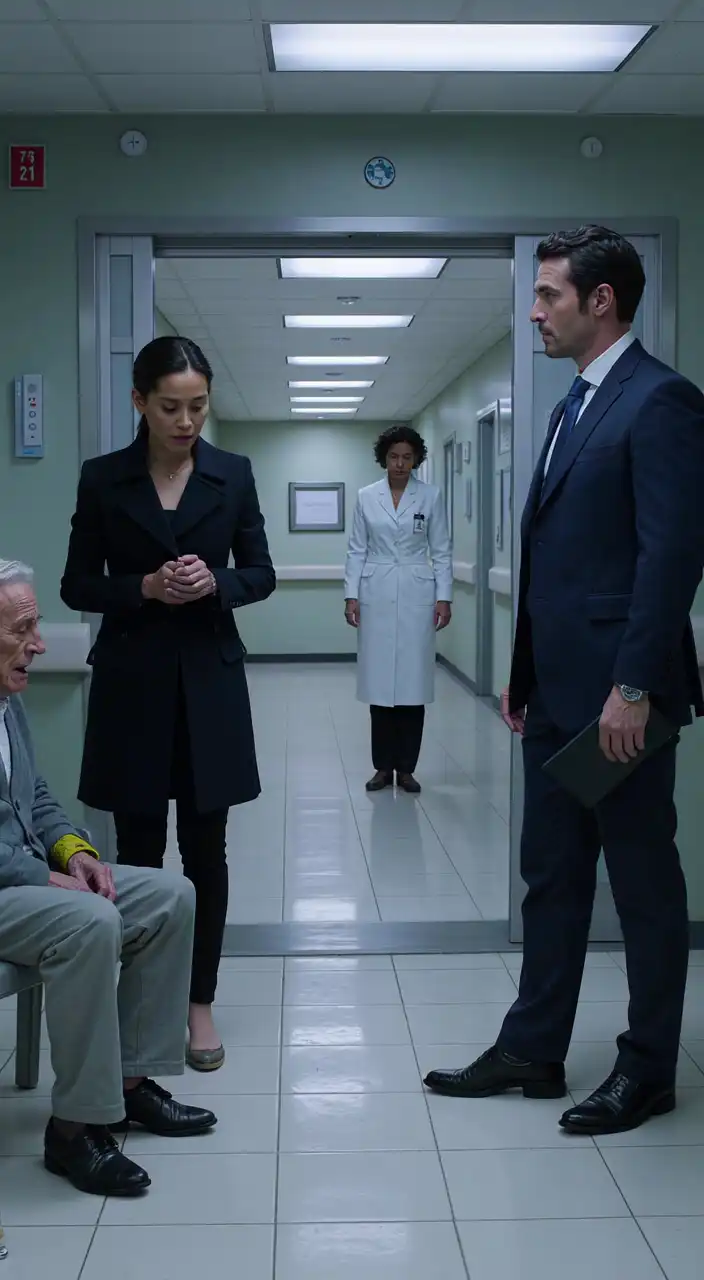
MY FATHER STARTED SHAKING OUTSIDE TRIAGE WHILE A CLINIC ADMINISTRATOR BLOCKED THE DOOR AND SAID HE NEEDED FAMILY PERMISSION FIRST.
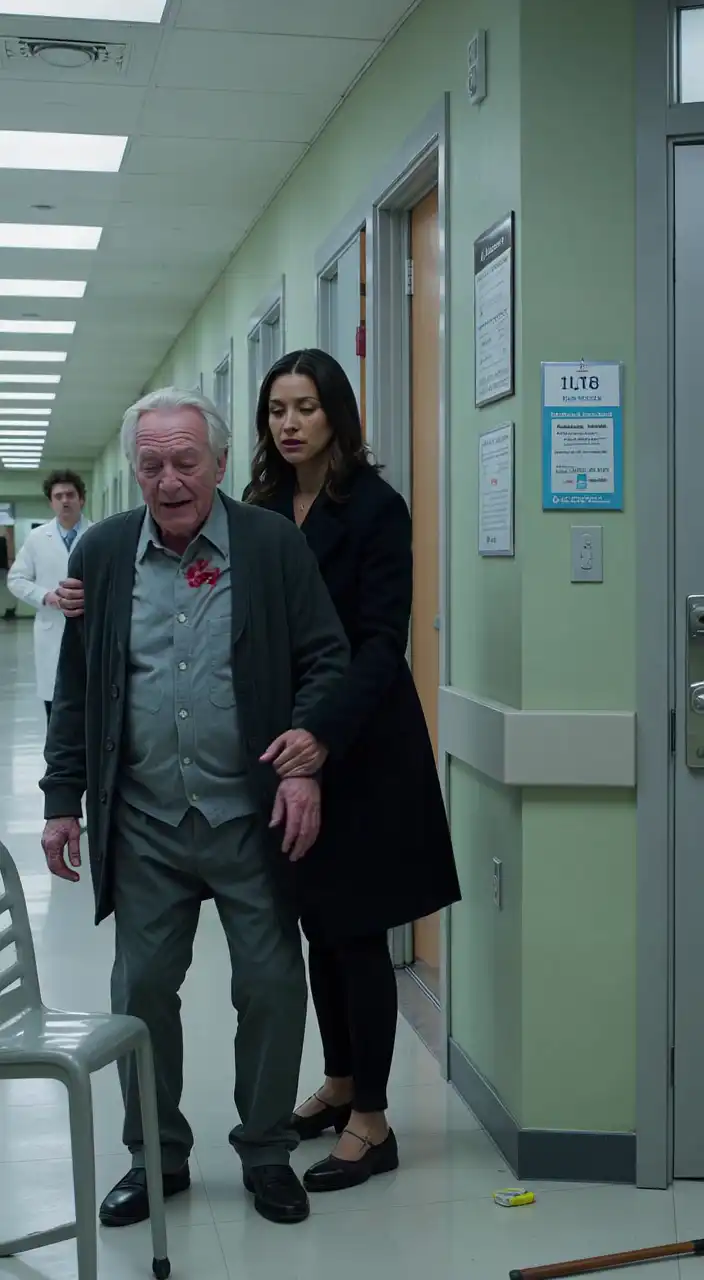
MY FATHER STARTED SHIVERING SO HARD HIS SURGICAL BANDAGE BLED THROUGH, AND THE CLINIC ADMINISTRATOR STILL BLOCKED THE TRIAGE DOOR.
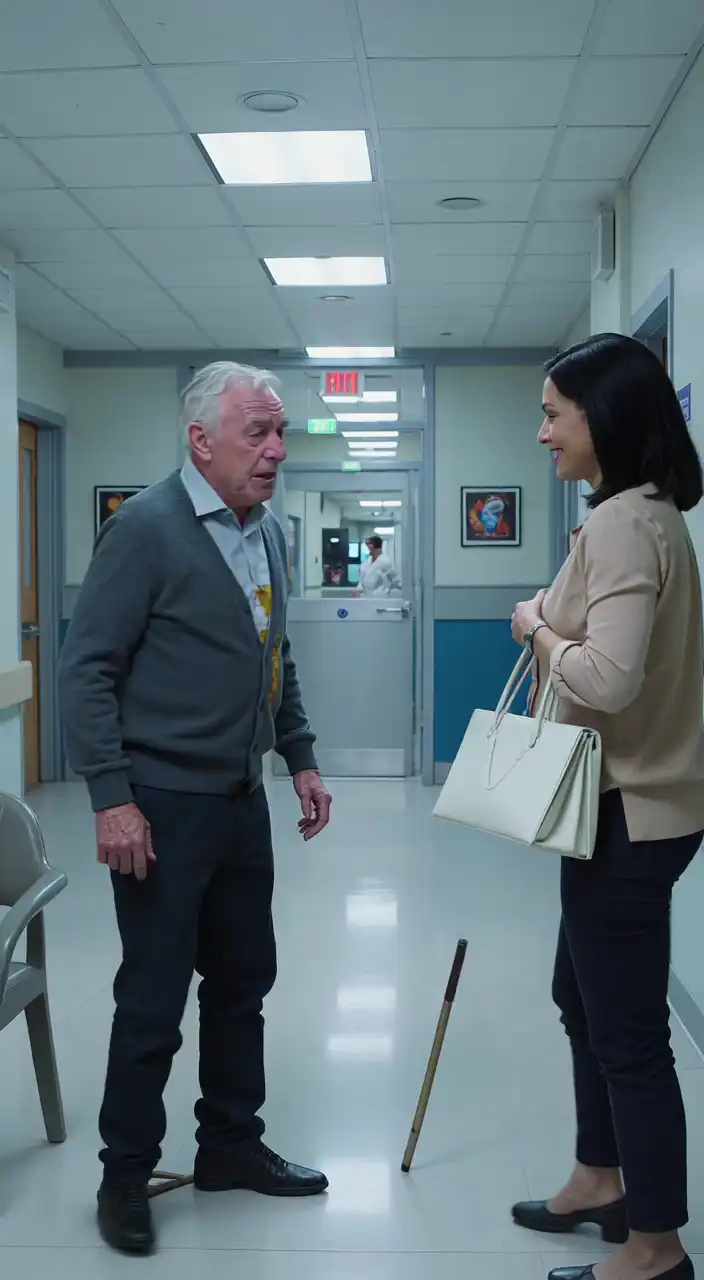
VICTOR STARTED SHAKING IN THE HOSPITAL HALLWAY, AND CAROLINE STILL WOULD NOT LET ANYONE TAKE HIM BACK TO TRIAGE.