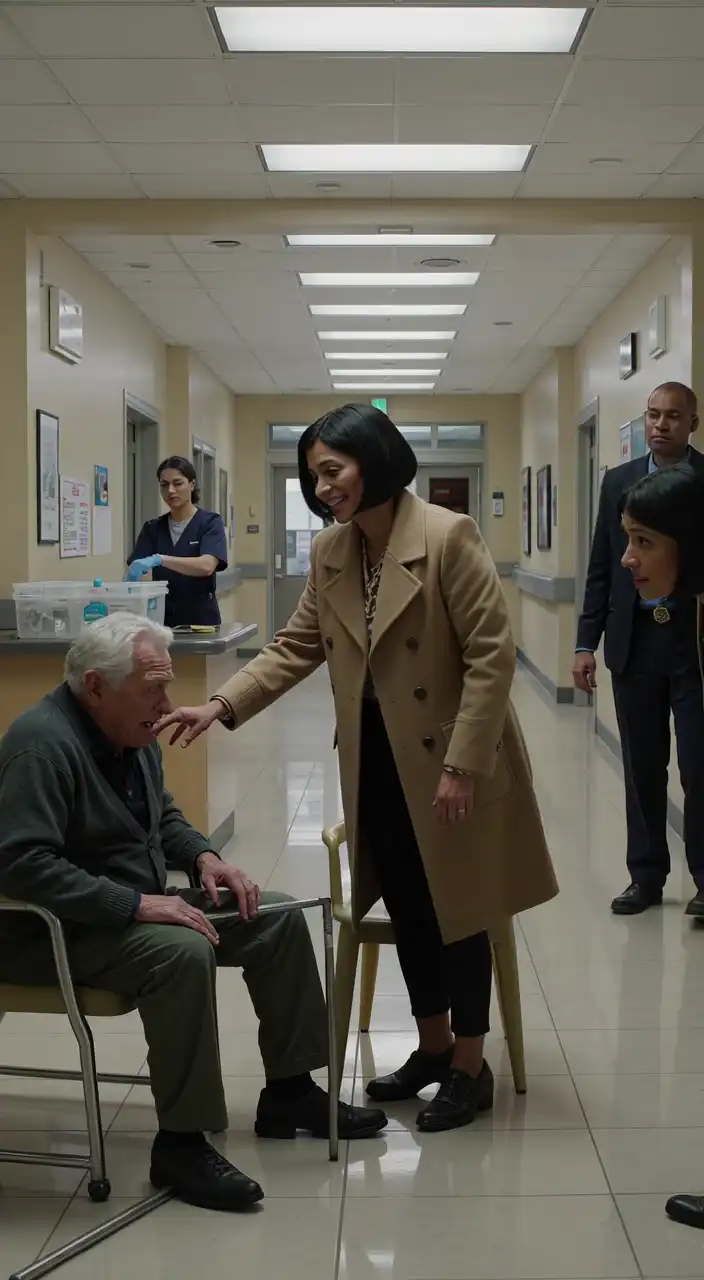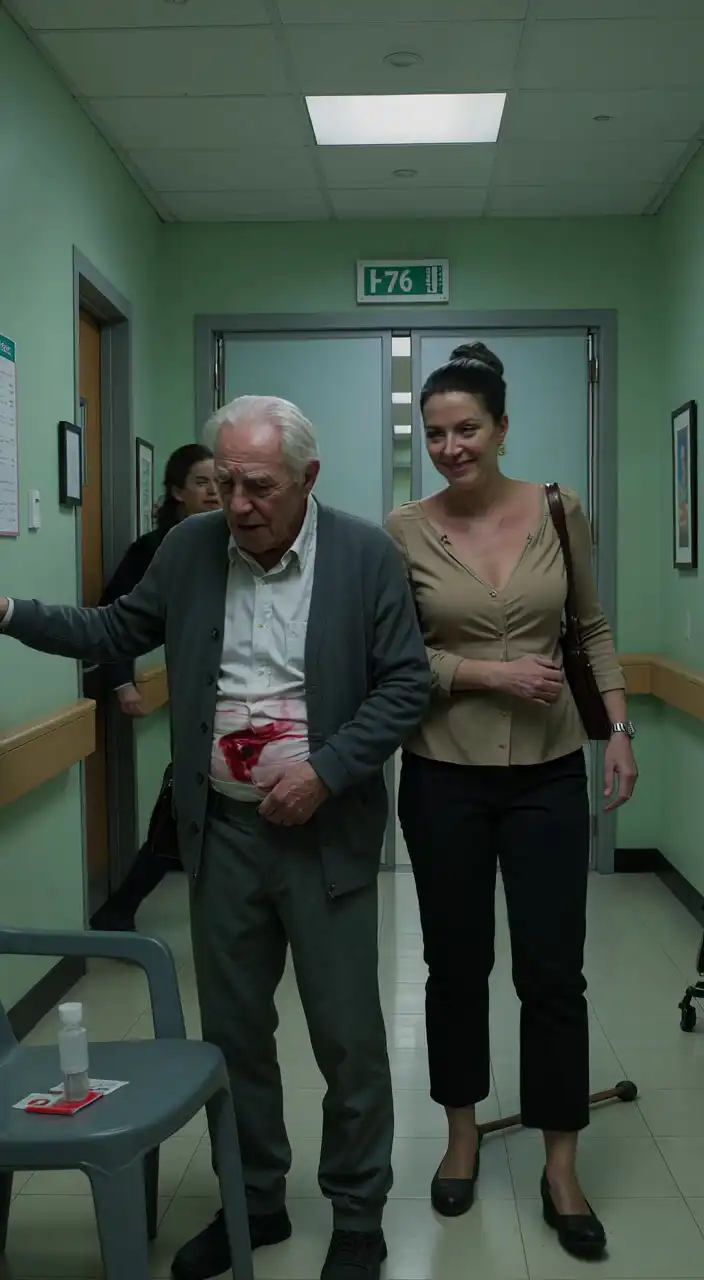
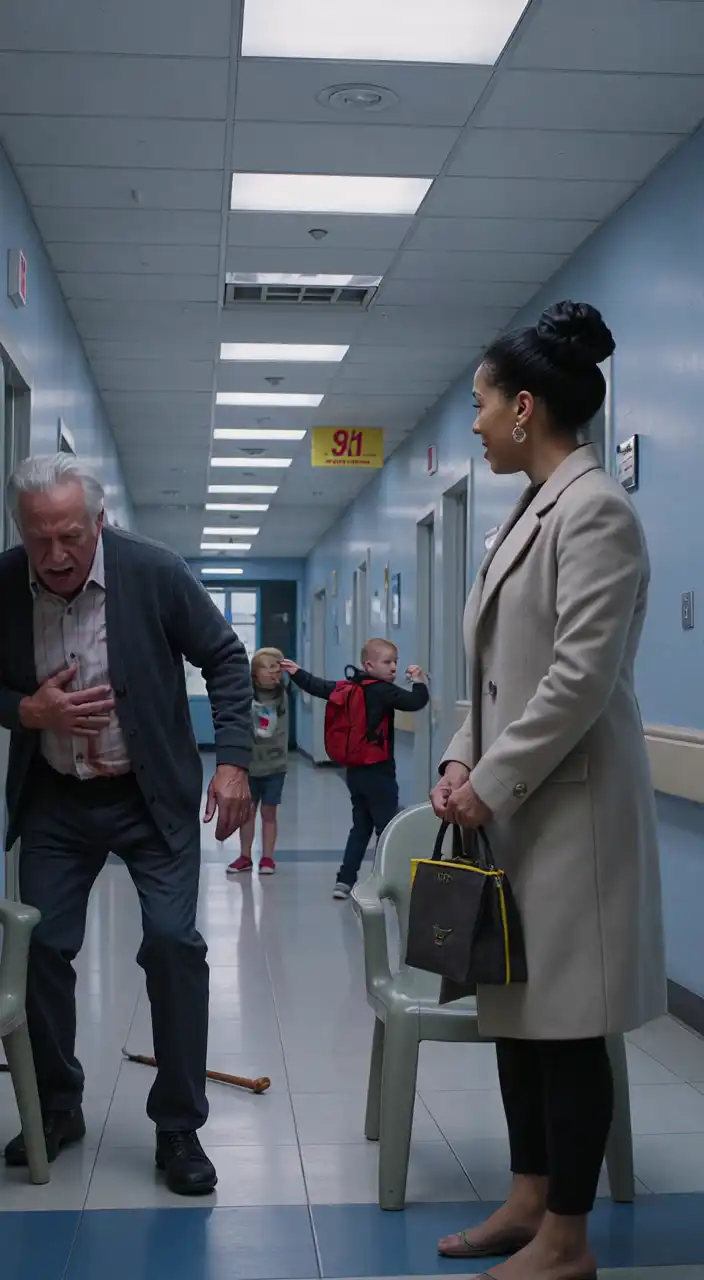
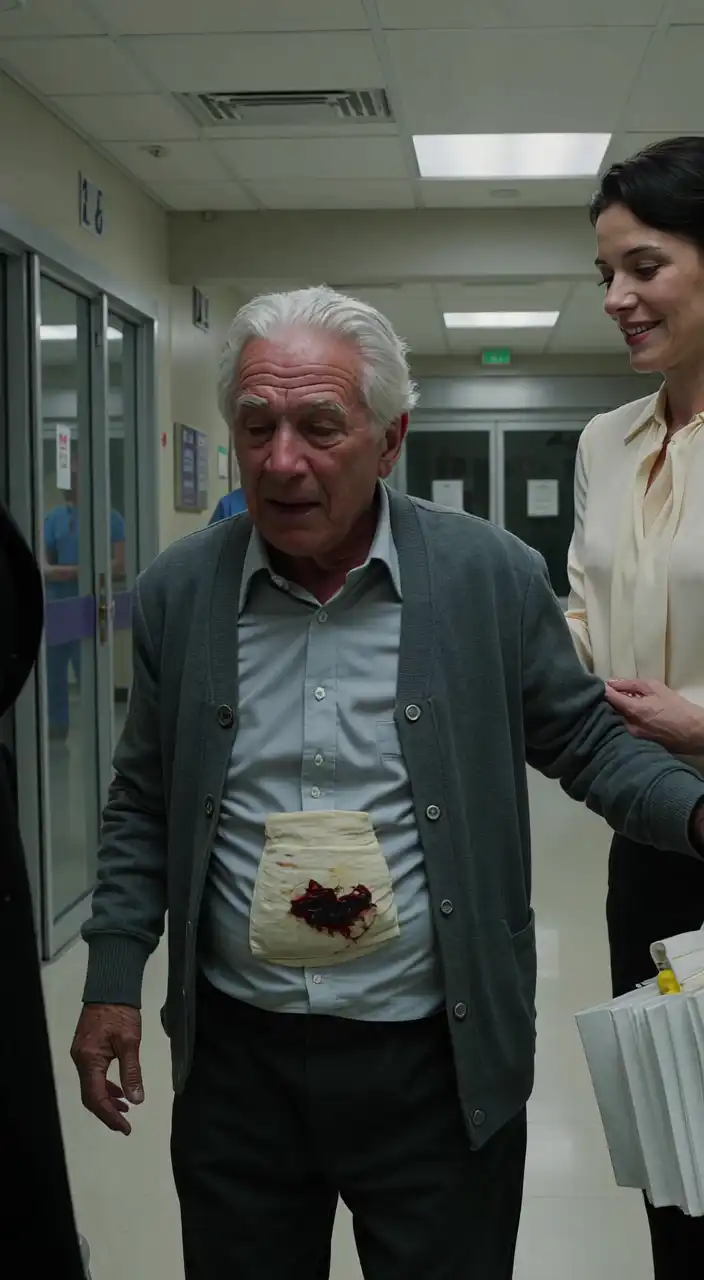

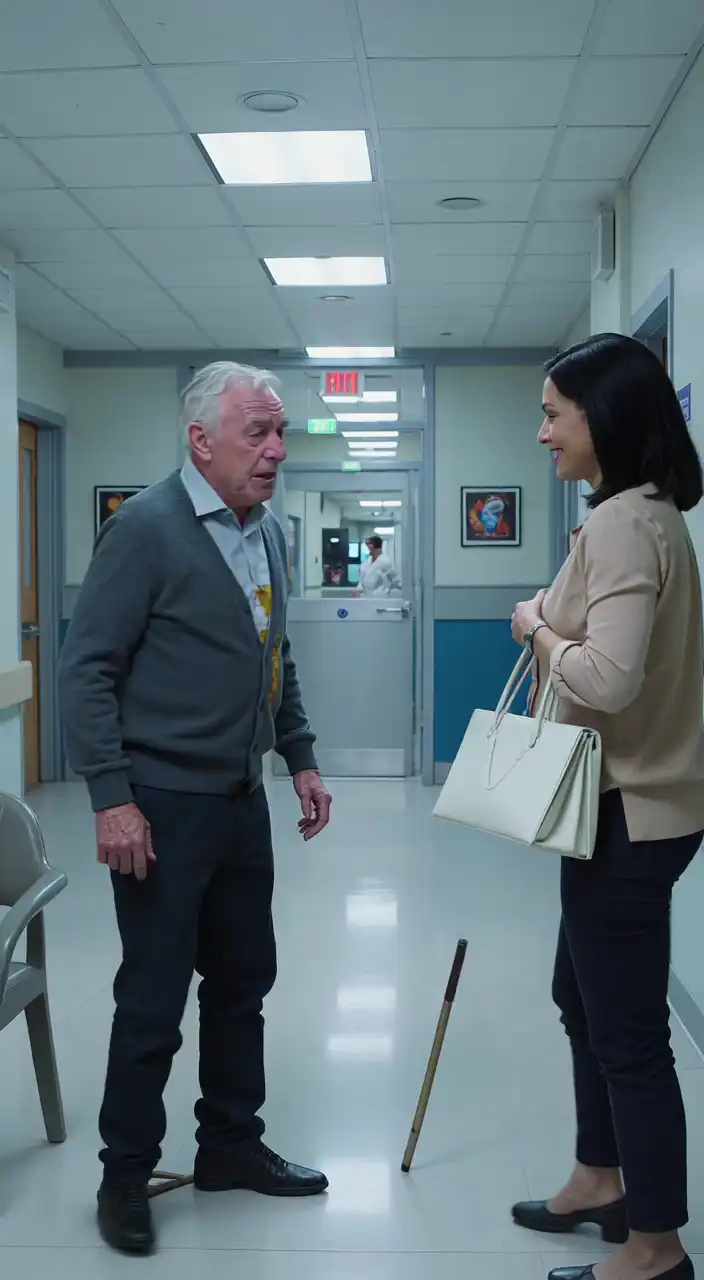
Dr. Isabella did not slow down for the explanation.
"Sir, look at me." She crouched in front of Victor as the amber monitor kept chirping from the doorway. "Can you tell me your name?"
Victor's lips moved twice before sound came out. "Victor Lane."
"Good. Victor, do you know where you are?"
"County Memorial." His voice was thin and frayed. "Cold. I feel cold."
That answer was enough for Isabella. She rose in one motion and snapped to the triage nurse at the desk. "Get a wheelchair now. Possible post-op infection, altered status, uncontrolled tremors. We are not waiting in this hallway."
Caroline's polite mask cracked around the edges. "Doctor, I am his caregiver. You cannot just override-"
"I can when a post-surgical patient is unstable and deteriorating in front of me." Isabella held out her hand without looking at Caroline. "And I need the discharge papers, medication list, and the surgery date."
For half a second nobody moved. Then the nurse at the desk pushed back her chair so hard it rolled into the wall, and another staff member came running with a wheelchair. Victor sagged when they touched him, like he had been holding himself upright out of pure stubbornness. His cardigan slipped open. The dressing stain was bigger than it had looked from a distance, the edges crusted, the center damp.
Caroline grabbed the wheelchair handle before they could turn it toward the ER doors. "He signed out yesterday. He has post-op anxiety. He panics around hospitals and starts making accusations. I have all the paperwork in my car."
Victor's hand shot out and caught Isabella's sleeve with surprising force. "No car," he whispered. "Bag."
Isabella's gaze went straight to Caroline's handbag.
It was a stiff leather purse, too formal for the ER, locked with a little gold twist clasp. Caroline tucked it closer under her arm.
"Ma'am," Isabella said, voice flattening, "if you have his medications or discharge instructions, hand them over now."
"I said they're in the car."
Victor shook his head weakly. "No."
That small contradiction changed the temperature in the hall. The triage nurse stopped pretending this was routine. A registration clerk looked up. A security officer farther down the corridor turned his head.
Caroline laughed once, sharp and offended. "He has a fever. He's confused. You're taking the word of a delirious man over mine?"
"I'm taking his vital signs over yours," Isabella said. "And if he is confused, that is even more reason to separate him from the argument and evaluate him immediately."
The wheelchair was angled toward the doors. Caroline shifted to block it again.
That was when Victor's gaze snagged on the empty inhaler spacer sitting on the chair. His face changed. The tremor in his jaw sharpened into fear.
"Tommy," he breathed.
Isabella caught it. "Who is Tommy?"
Caroline answered too fast. "My grandson. He isn't here."
Victor tried to lift his arm and pointed at the locked purse. "His inhaler."
The nurse nearest the chair looked from the spacer to the bag. "Ma'am, does a child need that inhaler right now?"
"No." Caroline's answer came flat and immediate. "It was left in my purse by accident."
Victor's eyes filled, not from pain this time but urgency. "She wouldn't... she wouldn't let me call."
Isabella's attention sharpened to a blade. "Call who?"
Victor's mouth worked. "His mother."
Caroline snapped, "Because his mother is unstable and abandons him every other week. Do not let him start that family drama while he's septic and confused."
The word septic landed hard. She had said it without thinking, and the staff heard it.
Isabella heard it too. "Interesting," she said quietly. "You just told me he was dramatic and anxious. Now you're explaining his symptoms with a diagnosis no one has made in this hallway."
A flush climbed Caroline's neck. "I meant infected. Obviously."
The security officer had started walking toward them. Not fast, but directly.
Isabella gave the order without raising her voice. "Take Victor back. Now."
The nurses moved. Caroline planted her body in front of the chair. "You need his consent. He refuses procedures unless I am present."
Victor looked straight at Isabella, dug his nails into the armrest, and forced out the clearest sentence yet. "Help me get away from her."
That did it.
The security officer stepped in. "Ma'am, I need you to move aside."
Caroline's eyes flashed. "This is elder abuse. You are separating a vulnerable patient from his lawful caregiver."
"Then you'll have a chance to explain that at the desk," Isabella said. "Right now, he asked for help."
The wheelchair rolled. Caroline reached for Victor's shoulder again, and for one second it looked like she might physically yank him back. Instead she tightened both hands around the locked purse and said in a low, furious voice, "Victor, think very carefully before you embarrass yourself with lies."
Victor flinched at the word embarrass, and that one tiny reaction told more than any accusation could have.
Isabella walked beside the chair into triage. "Keep her outside until registration confirms relationship and legal authority," she told security. "And if she tries to leave, stop her. I want that bag."
Caroline's control wavered for the first time. "You can't detain me over a purse."
"No," Isabella said. "But I can ask why a post-op patient says you took his papers, why you knew to mention sepsis before assessment, and why a missing child inhaler is sitting next to his chart while you insist no child needs it."
The amber monitor alarm stopped as they crossed the threshold and connected Victor to a bay monitor inside. A louder, steadier set of beeps replaced it. A nurse cut away the outer tape of his dressing while Isabella asked him questions in quick sequence: surgery date, pain level, medications, allergies, last time he urinated, last meal, last antibiotic. Victor answered what he could and shook through what he couldn't.
When the dressing lifted, the smell hit first.
Not dramatic. Not overwhelming. Just wrong.
Infection had set in around the incision. The skin was angry and swollen, and there was enough drainage for the nurse to inhale through her teeth.
"Blood pressure's dropping," the nurse said. "Temp 103.1."
Isabella was already ordering labs, cultures, fluids, broad-spectrum antibiotics, imaging. "Victor, stay with me. Who did your surgery?"
He told her. She nodded to another nurse. "Call for the discharge summary from St. Anne's surgical floor. I want every note."
Outside the curtain, voices rose. Caroline was arguing with security, then with registration, then with someone on the phone.
Victor stared toward the sound and whispered, "She'll leave. Don't let her leave. Tommy-"
"Tell me about Tommy," Isabella said.
Victor swallowed. "Seven. Asthma. Stays with her. He had an attack last night. She locked his medicine up because she said he was faking for attention." His breath hitched. "I tried to call his mother. She took my phone. Took my discharge papers too. Said if I went back to the hospital they would ask questions."
"Questions about what?"
He closed his eyes, and for a moment Isabella thought he was fading. Then he said, "She gave me the wrong pills."
The nurse hanging fluids froze. Isabella leaned closer. "Wrong how?"
"Not my pain pills. Made me sleep. Could not get up." His hand twitched against the blanket. "I heard him wheezing. Heard him crying in the hall."
The details came in torn strips. Caroline had moved in "to help" after Victor's abdominal surgery. She managed his medications, his follow-up appointments, his phone. Her grandson Tommy had been staying with her because Tommy's mother, Lena, worked nights and had agreed to temporary help after a housing problem. Last night Tommy had started coughing and wheezing. Victor heard the child ask for his inhaler. Caroline said no, that he was "playing sick." Victor objected. They argued. He tried to stand, tore at his incision, nearly fell, and demanded his phone. Caroline took it, then later gave him tablets from an unlabeled pill organizer that knocked him out.
When he woke in the morning, he had fever, wet dressing, no paperwork, and no phone. Caroline told him the hospital had warned against readmission and that Lena had "already picked the boy up." But on the drive to the hospital for a "routine dressing check," Caroline kept the locked purse on her lap the whole time. Victor had heard the rattle inside. Inhaler spacer plastic.
"He said he couldn't breathe," Victor whispered. "I could hear him from my room last night."
"And now?" Isabella asked.
Victor's face tightened with dread. "I don't know where he is."
That became the new emergency.
Isabella stepped out from behind the curtain. Security was still holding Caroline at the desk. She looked immaculate from a distance, but the smile was gone. She saw Isabella and straightened.
"Doctor," she said crisply, "I would like to file a complaint for how your staff is treating our family."
"Before you do that," Isabella said, "where is Tommy?"
Caroline blinked once. "At school."
"It's after four."
"After-school care, then."
"Which one?"
Caroline crossed her arms. "I don't see how that's relevant to Victor's surgery."
"It became relevant when his inhaler became part of your purse and his guardian reports he had respiratory distress last night."
"His mother is not his guardian," Caroline snapped.
A lie can reveal itself by reaching too far. Registration had not said mother. Victor had not used the word. Caroline had.
Isabella saw it register in the security officer's face too.
"Interesting," Isabella said again. "Then let's start with this. Hand over the bag."
Caroline hugged it tighter. "No."
The officer took one step closer. "Ma'am, if there's medication in there needed by a child, you need to surrender it."
"It's my property."
"And his prescribed rescue inhaler?" Isabella asked.
Caroline's composure broke into contempt. "You people hear one trembling old man mumble and suddenly I'm a criminal. Tommy has behavior problems. Every time discipline starts, he acts like he can't breathe. His mother taught him that trick."
A silence opened around her.
The triage nurse who had first moved the wheelchair spoke under her breath. "Oh my God."
Because now everyone understood this was not confusion. It was a belief system. A pattern.
Isabella held the officer's gaze. "Call pediatric charge. Call social work. And call local police for a welfare check on a minor with a withheld asthma medication. If she tries to leave before officers arrive, I want it documented."
Caroline went white. "This is absurd."
"No," Isabella said. "Absurd is hearing a child wheeze and locking up his inhaler. This is an emergency."
Behind them, from Victor's bay, a second monitor alarm started to sound. Louder this time. Faster. And before Isabella could turn back, a nurse shouted, "Doctor, his pressure just crashed."
Isabella pivoted and ran back through the curtain.
Victor's skin had gone a grayish color under the fluorescent lights. His eyes were half-open but unfocused, his chin rattling with a fresh wave of tremors. The blood pressure numbers on the monitor were dropping so fast the nurse was already cycling another reading manually, as if a second try could make the machine tell a kinder story.
"Victor, can you hear me?" Isabella put a hand against his shoulder and got only a weak groan.
"Pressure seventy-eight over forty-six," the nurse said. "Heart rate one-thirty."
"Push the fluids wide open. Second line now. Draw lactate if the first tube hemolyzed. I want him on oxygen." Isabella looked at the incision again and then at Victor's face. "Call surgery. Tell them probable post-op sepsis with hypotension. If they don't answer, page overhead."
Another nurse was already spiking the antibiotic bag. The curtain beside the bay jerked as a respiratory tech came in with oxygen tubing. The room shrank around sound: monitor beeps, tape tearing, metal rail clacking, shoe soles squeaking on tile.
Victor's fingers found Isabella's sleeve again. "Tommy," he said, barely audible.
"We're working on it," she said. "You stay here with me."
He tried to nod and failed.
Outside the bay, Caroline raised her voice, trying to cut through the medical noise with a different kind of emergency. "You're overreacting! He always drops his pressure when he gets upset. He did this at home too."
Isabella turned her head sharply toward the opening in the curtain. "You saw hypotension at home and still delayed care?"
"I said he gets faint. Not septic. Don't twist my words."
That answer was useful even through the crisis. Isabella filed it away. Another spontaneous admission. Another piece.
The nurse hanging antibiotics muttered, "Cultures first," and another snapped, "Done," holding up labeled tubes. It was orderly chaos, the kind built from repetition and urgency. A resident skidded into the bay, then the surgical PA right behind him, breathless and irritated until one look at the wound changed his expression.
"When was the surgery?" the PA asked.
"Yesterday's discharge from St. Anne's, according to the caregiver," Isabella said. "Actual paperwork hidden. Fever one-oh-three. Wound draining. Altered, hypotensive, concern for medication interference at home."
The PA leaned in, examined the incision, and swore softly. "This needs imaging and probably return to OR if there's collection or dehiscence. Who let him go home like this?"
"Let's keep him alive first," Isabella said.
The blood pressure cycled again. Seventy-four over forty-two.
"He's not keeping up," the resident said.
"I know." Isabella looked to the nurse. "Start vasopressor prep. We may need ICU. Where's lab on stat lactate?"
"Pending. White count from the first CBC is already up. Very up."
Victor's mouth moved. The oxygen cannula shifted with his shallow breaths. Isabella bent close enough to hear.
"She said... if I made trouble... she'd tell them I'm senile."
The statement landed harder than the monitor alarm. Humiliation had not just silenced him. It had been weaponized.
Isabella kept her voice level. "You are not in trouble. Do you understand me? You are sick, and we're treating you."
His eyes watered. "I tried to write it down."
"Write what down?"
"On the papers."
"Which papers?"
He licked cracked lips. "Discharge packet. Med list. I wrote... wrong pills. Tommy no inhaler. She saw."
Isabella straightened. There it was: evidence movement. He had tried to leave a trail. "Did she take that packet after you wrote on it?"
A tiny nod.
The nurse at the computer looked up. "Doctor, security says police dispatch wants details for the welfare check. They need name, age, possible location."
Isabella stepped half out of the bay and raised her voice just enough. "Caroline, how old is Tommy?"
Caroline glared. "I'm not helping you harass my family."
"Then we use what we have," Isabella said.
From the bed, Victor summoned a ragged burst of strength. "Thomas Reed. Seven. Blue backpack. Spider-Man tag. Sleeps at her apartment on Marlowe. Unit 3B."
Everyone within earshot turned.
Caroline's face changed in a way that exposed more than anger. For one naked second it was fear, not for Victor, not for Tommy, but for control. "He doesn't know what he's saying."
Victor coughed and winced, one hand clamping over his abdomen. "School called Lena. Told her aftercare closed early. Caroline picked him up."
The registration clerk, who had been quietly documenting everything, looked up sharply. "Closed early? Today? My niece's school district did have an HVAC shutdown."
Isabella pointed toward the desk. "Give dispatch the address now. Tell them child with asthma, inhaler believed withheld, location uncertain but likely that apartment."
The clerk picked up the line at once.
Caroline lunged one step toward the desk. Security moved in front of her.
"Don't you dare send police to my home over a manipulative child," she said.
"Ma'am, stop," the officer warned.
She held the locked handbag so tightly her knuckles blanched. "You people always do this. One accusation and suddenly a woman trying to manage chaos becomes the villain."
The triage nurse answered before Isabella could. "No. A child without an inhaler is the emergency. An infected man blocked from treatment is the emergency."
That should have ended it. It did not. Caroline drew herself taller and changed tactics. Her voice went soft, wounded, almost elegant. "Doctor, if you escalate this and you're wrong, you've just destroyed a family arrangement. Tommy's mother is unstable. Victor's surgery made him paranoid. I have been doing all the work. I got him fed. I changed his dressing. I drove him here. Without me he would be lying in that house alone."
It was the closest thing to a human confession she had offered. In it lived resentment, martyrdom, and ownership.
Isabella studied her for one second too long to be accidental. "If you changed his dressing, why is there drainage crusted under old tape? If you fed him, why did he nearly collapse from weakness? If you drove him here for help, why did you block triage?"
Caroline opened her mouth, but there was no smooth answer left.
Inside the bay, the monitor gave a harsh tone and the nurse said, "Doctor, his mental status is slipping."
Isabella went back to Victor. "Victor, I need you to stay with me. Did you see what pills she gave you?"
He blinked slowly. "Small. white. not bottle. box in purse."
"How many?"
"Two night. one morning." He dragged in a breath. "Not my labels."
The resident glanced over. "Could be sedatives. Could explain suppression and fall risk."
"Add tox screen if we can," Isabella said. "Document patient's statement exactly. Chain of custody if any meds recovered."
The surgical PA was on the phone with his attending now, speaking in tight clipped fragments: "Post-op day one, probable abdominal wound infection, hypotensive, possible neglect or tampering, yes ER bay three."
Conflict had become system-wide. Every department entering the case would now leave a trace. That mattered.
A paramedic from internal transport appeared at the curtain with a stretcher for CT. He took one look at the drips and shook his head. "He stable enough?"
"No," Isabella said. "And maybe not before we need pressors. We do bedside ultrasound first."
The resident moved in with the machine while Isabella reviewed the chart that was finally populating from St. Anne's records. Allergy list. Procedure note. Discharge meds. One line made her stop.
"Hold on," she said. "Discharge prescription includes oral antibiotic. Was it ever filled?"
The nurse working the outside line checked the pharmacy database. "No pick-up recorded."
Victor had gone home from surgery with an antibiotic that, as far as the system could tell, never reached him.
Isabella looked toward Caroline again. "Did you fill his discharge prescriptions?"
Caroline's reply came from beyond the curtain, cold and immediate. "Yes."
The nurse at the terminal called out, "Pharmacy says no claim processed under his insurance or discount file."
"I paid cash," Caroline shot back.
"Which pharmacy?" Isabella asked.
No answer.
"There are cameras in hospital and retail pharmacies," Isabella said. "Now would be the time to tell the truth."
Caroline laughed, but it cracked in the middle. "Listen to yourselves. Over a receipt."
"Over whether he got the antibiotic he was prescribed after surgery," Isabella said. "Over whether you substituted unidentified pills from your purse. Over whether you prevented a child from using a rescue inhaler. Over whether you took his phone and discharge documents."
Each over landed like a count in an indictment.
The bedside ultrasound showed free fluid that made the PA grimace. "This is bad."
"How bad?" Isabella asked.
"Bad enough that surgery is coming down in person."
The lactate result popped up high. Very high.
The resident exhaled through his teeth. "Septic shock."
There was no more room for hallway arguments. This had crossed the threshold fully. Isabella ordered vasopressors. Another nurse called ICU. The bed began to transform around Victor with the terrible efficiency of modern rescue: more tubing, more numbers, more hands.
Still, beyond the curtain, the case with Tommy kept moving.
The desk clerk raised a hand. "Police have officers en route to Marlowe. They want to know if there are any other probable locations."
Victor heard that through the haze. He forced his eyes open. "Basement church day room. She takes him there if she doesn't want school notes."
"Which church?" Isabella asked.
He swallowed. "St. Luke's old mission. Two blocks from Marlowe."
The clerk relayed it.
Caroline's restraint snapped. "Victor, stop. Stop talking."
He flinched but did not stop this time. Maybe because the room around him had finally chosen him. Maybe because he sensed he might not get another chance. "She says if he cries... no inhaler. says he needs to learn."
The triage nurse made a sound of disgust. The security officer's jaw hardened visibly.
Caroline spoke to him now, not to Isabella. "You are sick. You don't know what you're saying. Remember who pays your bills. Remember who was there after your son stopped visiting."
Emotional reversal arrived there, sharp and ugly. Up to now she had framed herself as caretaker. In one sentence she revealed the debt ledger beneath the care.
Victor stared at the ceiling for a long second. When he answered, his voice was weak but astonishingly steady. "My son died eight years ago."
Silence.
Caroline blinked.
The registration clerk stopped typing.
Even Isabella looked over.
Victor kept going, each word a climb. "You tell that lie because no one checks. You tell people family will confirm, but there is no son. Only my daughter in Oregon. You hid her number."
The reversal did more than discredit Caroline. It stripped away her invented witness. Every reference to "our family" suddenly looked like occupation, not relationship.
The security officer said, "Ma'am, place the bag on the desk. Now."
Caroline backed up one step. Then another.
The officer moved with her. "Do not make this worse."
"I want a lawyer."
"You can ask for one after you stop interfering with emergency care."
She glanced toward the exit doors. It was tiny, instinctive, but everyone saw it. The second officer who had just arrived from the front lobby shifted to block the hall. Pressure from authority closed in at last.
Caroline's eyes darted to the purse clasp. For a terrifying instant Isabella thought she might try to dump or destroy something. Instead she clutched it to her chest and said, "There is private medical information in here."
"So much the better," Isabella said. "We'll document it."
The first police officer came through the sliding entrance doors then, summoned by dispatch. He got the fast version from security while keeping his gaze on Caroline. Another officer remained on the radio, receiving updates from the welfare check units.
The first officer extended his hand. "Bag, ma'am."
"No."
His tone did not rise. "Bag. Now."
A stand-off like that can stretch time. Victor's monitor beeped. The vasopressor pump clicked. Someone in the next bay cried out. The smell of antiseptic mixed with wound drainage and stale hallway coffee. In the center of it, Caroline seemed to understand that the whole structure was tipping, but she had not yet accepted that it had already fallen.
Then the second officer on the radio put a hand to his earpiece and frowned. "Units at Marlowe. Front door locked. Neighbor says heard a child coughing in the stairwell about twenty minutes ago. No answer at apartment."
Isabella's whole body tensed. "And the church?"
The officer listened. "Checking now."
Caroline shut her eyes. It was brief. But it was not prayer. It was calculation.
Victor saw it. "Storage room," he whispered.
Isabella bent down. "What storage room?"
"Church basement. Last door. She makes him sit there if he acts up."
The officer with the radio repeated it immediately.
A full minute passed with no one speaking except staff issuing medical orders. Victor drifted and was pulled back. Surgery arrived. The attending surgeon, a square-faced woman with silver at her temples, assessed the wound and looked at Isabella with no wasted sentiment. "We are likely taking him up. I want CT if he can tolerate transport, but if he crashes further, we go on clinical picture. Consent?"
"He's still oriented enough in intervals," Isabella said. "I'm getting it now."
She leaned to Victor. "Victor, you have a serious infection after surgery. We may need emergency surgery tonight to clean the area and control the source. Do you understand?"
He stared at her, then nodded once.
"Do you consent?"
"Yes."
The surgeon added, "And we need to know what medication you actually received at home."
Victor's eyes moved to the purse beyond the curtain.
As if on cue, conflict burst again. Caroline yanked back from the officer, twisted the gold clasp, and tried to reach inside before he could stop her.
"Hands!" the officer barked.
Security grabbed her wrist. The purse slipped, hit the tile, and split partly open. Contents scattered with the ugly intimacy of secrets made public: a pharmacy bag with someone else's name torn off, a loose pill organizer, folded papers, a child's spacer, a blue rescue inhaler, two school forms, and Victor's discharge packet, creased and stained.
The entire hallway saw it at once.
No one breathed for a beat.
Then the triage nurse stepped forward and snatched up the inhaler before a foot could crush it. "Found it."
The officer crouched for the papers while another secured Caroline's arms. She did not scream. She hissed. "Don't touch my things."
"These may be evidence," he said.
The folded discharge packet had writing across the front in shaky pen, exactly where Victor said it would be. Wrong pills. No antibiotic. Tommy can't breathe. Call Lena.
Isabella saw it from six feet away.
So did the police officer.
"Photograph that before moving further," he said to his partner.
The emotional balance of the hallway flipped completely. Ten minutes earlier Victor was a trembling old man being talked over. Now his handwriting was speaking for him in black ink across hospital instructions she had hidden in her purse.
The officer looked at Caroline. "Turn around."
"What are you arresting me for?"
"At this moment? Obstruction, possible unlawful restraint, potential elder neglect, and we're not done."
She finally looked frightened in a way that was no longer strategic. "You can't arrest me because some old man writes nonsense on papers."
The officer nodded toward the inhaler and the forms. "This says Thomas Reed. Same child?" He lifted one school pickup form. "This has your name and his mother's emergency contact."
The triage clerk said, "Copy that before she says it's fake."
The second officer's radio crackled loud enough for everyone nearby to hear. "Unit at St. Luke's old mission. We have a juvenile male in basement storage room, conscious, audible wheezing, no adult present. EMS requested emergent."
The nurse holding Tommy's inhaler swore softly and covered her mouth.
Victor began to cry without sound.
Isabella put a hand over his fist. "They found him."
His chest hitched. "Alive?"
"Alive," she said. "EMS is with him now."
That news should have comforted the room. Instead it sharpened everything, because alive meant there had been just enough time. Another twenty minutes might have written a different story.
Caroline went perfectly still. No argument now. No moral lecture. The exposure had reached the point where language no longer served her.
The officer tightened cuffs around her wrists.
She found her voice only to say, very quietly, "He always wheezes when he wants attention."
The sentence was so chilling in its plainness that the younger officer looked away in disbelief. The triage nurse said, "Take her out of here."
They did.
As Caroline was led down the hallway past the plastic chairs and vending machine alcove, she twisted once to look back at Victor. It was not an apologetic glance. It was a look of grievance, as though he had broken an arrangement. He turned his face away from her for the first time since she arrived.
Then she was gone through the lobby doors with police and security around her.
The hospital atmosphere changed the second she left. It did not become calm. It became usable.
Isabella picked up the pace. She reviewed the recovered papers. The discharge antibiotic had indeed been prescribed. The home med sheet listed no sedatives. The unlabeled pill organizer was bagged by police for chain of custody. The pharmacy bag had part of a sticker left on it from an old benzodiazepine prescription in someone else's name. The school forms included Lena Reed's phone number.
"Call her," Victor whispered.
"I am," said the clerk from outside the curtain, already dialing from the scanned form.
The first call went unanswered. The second did too. The third was picked up with background road noise and a breathless, suspicious, "Who is this?"
The clerk looked at Isabella, who nodded and took the phone.
"Lena? My name is Dr. Isabella Grant. I'm at County Memorial with Victor Lane. I need you to stay on the line."
The woman on the other end went silent for a half second, then words rushed out. "Is Victor okay? Caroline told me he didn't want me around because I upset him. Where is Tommy? School said Caroline got him and then my phone died at work and-"
"Tommy has been found alive and EMS is with him now."
A strangled sob came through the speaker. "Where?"
"At St. Luke's old mission. Paramedics are bringing him in."
Lena started crying hard enough that Isabella had to repeat herself to get through the panic. "Listen carefully. Come to County Memorial now. Security and social work will meet you at the entrance. Do you understand?"
"Yes. Yes. Is he breathing? Is he scared?"
"He is breathing. We do not have his full status yet."
In the bed, Victor closed his eyes and mouthed thank you.
Isabella ended the call only because the surgeon touched her elbow. "He is not waiting much longer. We need to move."
The CT transport team had returned with more equipment. Victor was marginally more stable with fluids and vasopressors, enough to risk imaging under close watch. As they transferred him to the transport stretcher, he grabbed Isabella's wrist again.
"Don't let them... say I imagined it."
She met his eyes. "They can't. Not anymore."
He looked unconvinced.
So she told him the thing he most needed and least expected. "You left evidence. You told us where to find Tommy. You did exactly what people do when they're trying to protect someone while they're sick. That is not confusion."
The words visibly reached him. He did not smile. He simply stopped fighting the stretcher.
In the next forty minutes the hospital split into two rescue lines moving at once.
For Victor, CT showed a postoperative abdominal infection with fluid collection and concerning tissue changes that made the surgeon's face tighten. He was prepped for the OR. Consent was witnessed. ICU was alerted for postoperative critical care. Blood cultures, lactate trends, broad-spectrum antibiotics, pressor support, all of it ran in disciplined sequence.
For Tommy, EMS radioed ahead: seven-year-old male, acute asthma exacerbation, mild hypoxia improving after repeated bronchodilator treatment in transit, anxious, hoarse, no obvious trauma, possible prolonged confinement. They had found him sitting on the floor of a church storage room with dust on his jeans, coughing, trying to use a toy whistle as if it were an inhaler. That detail spread through the charge nurse station like a wave of anger nobody had time to process.
When Isabella heard it, she shut her eyes for one beat and then opened them again to work.
Tommy arrived just as Victor's stretcher was being wheeled toward the surgical elevator.
The boy was small for seven, pale under freckles, with damp hair stuck to his forehead and a nebulizer mask fogging as he breathed. His blue backpack, Spider-Man tag still attached, rode beside him on the gurney rail exactly as Victor had described. He looked terrified, overtired, and furious in the bewildered way children sometimes are when fear has gone on too long.
Lena reached the bay at almost the same time, half running, still in a food service uniform under a thin jacket, face streaked with tears. When she saw Tommy she made a broken sound and stopped only because the paramedic said, "Give us three seconds, mom, he's okay, let us park."
Tommy pulled off the mask enough to cry, "Mom."
That was enough. She was there, kissing his hair, apologizing and promising and shaking. Social work and a pediatric nurse moved around them gently, not interrupting, just shaping space.
Victor's stretcher paused at the corner because the elevator doors had not yet opened.
"Can he see him?" Isabella asked the surgeon.
"Ten seconds," the surgeon said. "Then I take him."
They angled Victor's stretcher just enough.
Tommy spotted him and sat up despite the medic's hand. "Mr. Vic?"
Victor looked wrecked, oxygen on, IVs running, lips pale. But when he saw the child alive, something in his face unclenched. "Hey, buddy."
Tommy started crying again. "She said you were sleeping. I kicked the door."
"I know." Victor's voice scraped. "You did good. They found you."
Lena looked from Tommy to Victor and understood enough to break fresh. "Oh God. Victor, I'm so sorry. I didn't know. She said she was helping both of you."
Victor lifted his fingers a fraction from the blanket. Lena took them carefully. "Not your fault," he whispered.
It was not a complete truth. People always tell themselves they missed signs because the world should have been safer than it was. But in that moment what mattered was not blame between the injured. It was that the lie network had broken.
Tommy tugged at the nebulizer mask and asked in a hoarse little voice, "Did I get you in trouble?"
The question hit every adult in earshot like a slap.
Victor, shaking with fever and pressors and exhaustion, found enough steadiness to answer. "No. You got us help."
The elevator doors opened.
The surgeon touched the rail. "We have to go now."
Lena pressed Victor's hand once more. "I'll be here."
He nodded and disappeared into the elevator with the OR team.
After that the consequences spread outward in layers.
Police photographed the purse contents and took statements from staff while memories were fresh. Security pulled hallway footage showing Caroline blocking the wheelchair, clutching the bag, and attempting to leave. The clerk printed the pharmacy check indicating Victor's antibiotic had not been filled through normal channels. St. Anne's faxed the discharge summary and confirmed the prescribed medication list. Social work interviewed Lena, then Tommy, then the neighbor from Marlowe by phone. Child protective services were called and arrived before sunset. Adult protective services received a report as well.
And because hospitals are systems built on records, each prior lie met paper. Caroline had represented herself on intake at another clinic two weeks earlier as "family caregiver and medical decision support." She had signed school pickup forms for Tommy. She had used Victor's insurance card for a ride service account. Piece by piece, control left fingerprints.
Lena's emotional state swung violently through relief, shame, rage, gratitude, and disbelief. At one point she stood outside Tommy's pediatric bay staring at the floor while a social worker spoke softly beside her. "I left him there," she whispered. "I thought he was safer with her while I worked."
The social worker answered what good ones answer. "You trusted the wrong person. That is not the same as wanting harm."
Lena shook her head hard. "He told me once she hid his inhaler when he 'acted spoiled.' I thought he meant she put it up high so he wouldn't play with it. I should have gone there. I should have-"
Tommy coughed from inside, and she went in before the sentence finished.
In his room the pediatric attending listened to his lungs and said they were improving. He would need observation, steroids, scheduled breathing treatments, and evaluation for neglect-related concerns, but he was recovering. He asked twice whether Mr. Vic was dying. No one lied to him. They told him Victor was very sick and doctors were helping him.
The conflict hook in the pediatric line came when Tommy, after an hour of treatment and his mother's constant presence, finally said one thing no one expected. "I think she gave Mr. Vic my night medicine."
Lena frowned. "What night medicine?"
Tommy pointed weakly toward the bagged belongings police had returned from his backpack. "The sleepy grape one. She says it makes me stop fake coughing."
The pediatric nurse and social worker exchanged a look.
Lena went white. "He doesn't have a prescription sleep medicine."
Tommy nodded, eyes huge. "She pours it in a spoon from a brown bottle. Last night Mr. Vic yelled and she got mad and took my inhaler and then later she gave him the spoon."
That statement changed the evidence map again. It suggested not random pill substitution but a broader pattern of sedating and suppressing symptoms. The police detective assigned to the case came back for a second round of interviews. He asked Tommy only brief, careful questions and left the detailed forensic interviewing for specialists, but the direction was set.
In the OR, Victor's operation ran long. The surgeon found a deep infection and a pocket that should have been draining but had not. Tissue was irrigated, samples sent, compromised material addressed. He was transferred to ICU intubated overnight because his blood pressure remained precarious. Isabella checked on him twice between other patients, though technically his care had moved on. Some cases do that to a doctor. They become more than a shift.
Near midnight, the detective found Isabella in the physician workroom with coffee gone cold beside a keyboard.
"We searched Caroline's apartment," he said.
She looked up. "And?"
"Found Victor's phone in a kitchen drawer. Found unopened post-op antibiotic still stapled in the pharmacy bag. Found a brown cough suppressant with sedating antihistamine in it, labeled for a child from months ago, not current. Found school notices about Tommy's asthma action plan. Also found handwritten notes about Victor's banking passwords and rent due dates."
"Financial exploitation too."
"Looks that way." He paused. "Church basement room had no adult supervision, no ventilation running, a folding chair against the outside handle."
Isabella sat back slowly. "So he was locked in."
"That is what it looks like."
By morning, local authorities had converted the case from welfare check to active criminal investigation. Charges would come later, but the shape was already visible: elder neglect, obstruction of emergency medical care, unlawful imprisonment of a child, child neglect, possible medication tampering, possible financial crimes. The district attorney's office asked for preservation of all medical records and video.
The exposure consequences did not stop at Caroline. St. Anne's risk management called County Memorial wanting an interfacility review after learning their discharged patient had returned in septic shock with evidence of unmet prescriptions and blocked follow-up. The school district requested confirmation for their own reporting because a pickup arrangement had been abused. The church mission director arrived in person, horrified, explaining that after-school overflow was never supposed to involve unsupervised basement areas and that Caroline had volunteered there enough to know the layout. Every institution she had touched had assumed she was merely competent and burdened. Now each had to ask what signs they had ignored because she sounded organized.
When Victor woke in ICU the next afternoon, extubated but weak, the first person he recognized was not a doctor. It was Lena, sitting beside him with her son's blue backpack on her lap because Tommy had insisted it stay with "Mr. Vic until he gets better."
Victor looked around, disoriented by machines and glass and the heavy ache of surgery. Then his eyes found the backpack tag and steadied.
Lena stood. "Hey. Don't try to talk yet."
He did anyway. "Tommy?"
"Breathing a lot better. Pediatric floor. Wants to see you. Keeps asking whether old people can have popsicles."
Victor's mouth twitched. It was not quite a smile, but it was the first sign of one.
She swallowed hard. "I need to tell you something before anybody else starts talking. The police know. The doctors know. I know. Nobody thinks you made it up."
He closed his eyes. Relief moved through his face like pain in reverse.
A few minutes later Isabella came in to update him. Infection source controlled for now. Cultures pending. He would be in ICU at least another day, then likely stepdown if blood pressure held and kidneys cooperated. He listened to the clinical part politely, but when she paused he asked the only thing he really needed.
"Did she hurt him bad?"
Isabella chose precision over comfort. "He had an asthma attack and was confined without his inhaler. EMS treated him in time. He is stable and improving."
Victor let out a long breath.
"And," she added, "the officers recovered your phone, your papers, and the antibiotic you were supposed to have received. They also documented your note on the discharge packet."
He stared at the blanket. "My handwriting was terrible."
"It was enough."
That mattered more than she expected. Tears slipped from the corners of his eyes into the pillow. Not dramatic. Not loud. Just the release that comes when proof survives the person who feared he would not.
Lena stepped forward with something in her hand. "Your daughter called."
Victor turned sharply. "Mara?"
"The detective contacted her because your emergency contacts were wrong in the chart Caroline gave another clinic. We got the real number from your phone. She's flying in tonight."
His face crumpled in a way age alone does not explain. "I didn't want to bother her."
Lena gave a short disbelieving laugh through tears. "Apparently she would like a word about that."
That was another reversal, gentler this time. Caroline had isolated him partly by convincing him that asking for help was a burden. Exposure restored not just safety but relationship.
Tommy was allowed a short visit later, masked because of the unit rules and carrying a paper cup with two untouched red popsicles nested inside like treasure. He walked carefully between tubes and wires, trying to be brave. Victor looked more fragile than the child had ever seen him.
"I brought backups," Tommy said, holding up the cup.
Victor's voice was rough. "For me?"
"In case old people need more sugar."
Lena covered her face, laughing and crying at the same time.
Tommy put the cup on the table and climbed onto the visitor chair. For a moment he just looked at Victor. Then he blurted, "I told the police about the grape medicine."
Victor blinked. "Okay."
"Was that bad?"
"No." He swallowed. "Telling the truth when you're scared is not bad."
Tommy looked relieved but still troubled. "I couldn't get the door open."
"You kicked it."
Tommy nodded solemnly. "A lot."
"Good."
The boy leaned closer. "I thought if I got in trouble, maybe you wouldn't have to."
Victor stared at him for a long time. "You listen to me. None of this was your job."
Tommy absorbed that slowly, the way children do when a sentence may need years to finish landing.
Outside the room, the detective waited to update Lena. Caroline had asked for counsel. She was now claiming she had withheld the inhaler only briefly "for behavioral regulation" and had delayed Victor's care because he "thrived on attention." The detective said those words with professional flatness and personal disgust. Toxicology on Victor was pending. The unlabeled pills and the sedating syrup had gone to the lab. Financial investigators were checking whether any accounts had been accessed.
"Will she get out?" Lena asked.
"Not today," he said. "And with a minor involved, probably not quickly."
The story's final consequence was not simple triumph. Rescue rarely is. Victor faced a hard recovery. Tommy would need follow-up, counseling, and a new care plan built around adults who understood that asthma is not a bargaining chip and fear is not manipulation. Lena would have to rebuild trust in her own judgment while managing work, housing, school, and now legal interviews. Mara would arrive carrying guilt for distance and anger for what had happened in that distance. Institutions would produce reports. Lawyers would ask linear questions about nonlinear dread.
But the threshold had been crossed in time.
A week later, after ICU and stepdown and a careful march through antibiotics, wound care, and the humiliating effort of standing again, Victor was discharged a second time, this one real. Mara signed papers beside him. Lena sat on the windowsill with coffee. Tommy, inhaler clipped openly to his backpack where everyone could see it, insisted on carrying Victor's cane even though it dragged the floor.
Before they left, Isabella stopped by.
Victor was in a clean cardigan now, thinner than before, but clearer. He looked at her as if trying to say too much with too little strength. "You believed me before I sounded believable."
She shrugged once. "You sounded sick. That was enough to start."
Tommy piped up, "And the bag gave her away."
"It did," Isabella said.
Mara, who had arrived all fierce love and administrative competence, held out a folder. "We've copied everything. Reports, discharge instructions, medication schedule, follow-up appointments. No one takes these out of his hands again."
Victor looked down at the folder, then at the blue backpack with the inhaler clipped on, then at the little cluster of people who had once been separated by lies and now were linked by what had been uncovered. The emotional reversal reached its quiet end there. Not safety as innocence, but safety as vigilance shared.
As they moved toward the elevator, Tommy slipped his hand into Victor's. Victor squeezed back.
The hallway outside discharge looked ordinary. Plastic chairs. Fluorescent light. Cold tile. People passing without knowing how close one man had come to disappearing inside somebody else's story, how close one child had come to becoming a cautionary absence.
At the threshold, Victor stopped and turned his head toward the ER corridor where it had all broken open. "I almost stayed quiet," he said.
Mara answered first. "But you didn't."
Lena added, "And next time, if anything feels wrong, you call me before you apologize for needing help."
Tommy lifted the cane like a staff. "And I kick doors."
Even Isabella laughed at that.
Then the elevator arrived, and they went down together into the loud ordinary day, carrying papers, medicine, evidence copies, and the kind of hard-won truth that leaves scars but also leaves witnesses.
Disclaimer: Mention of any brand or trademark is for identification only and does not imply partnership or endorsement
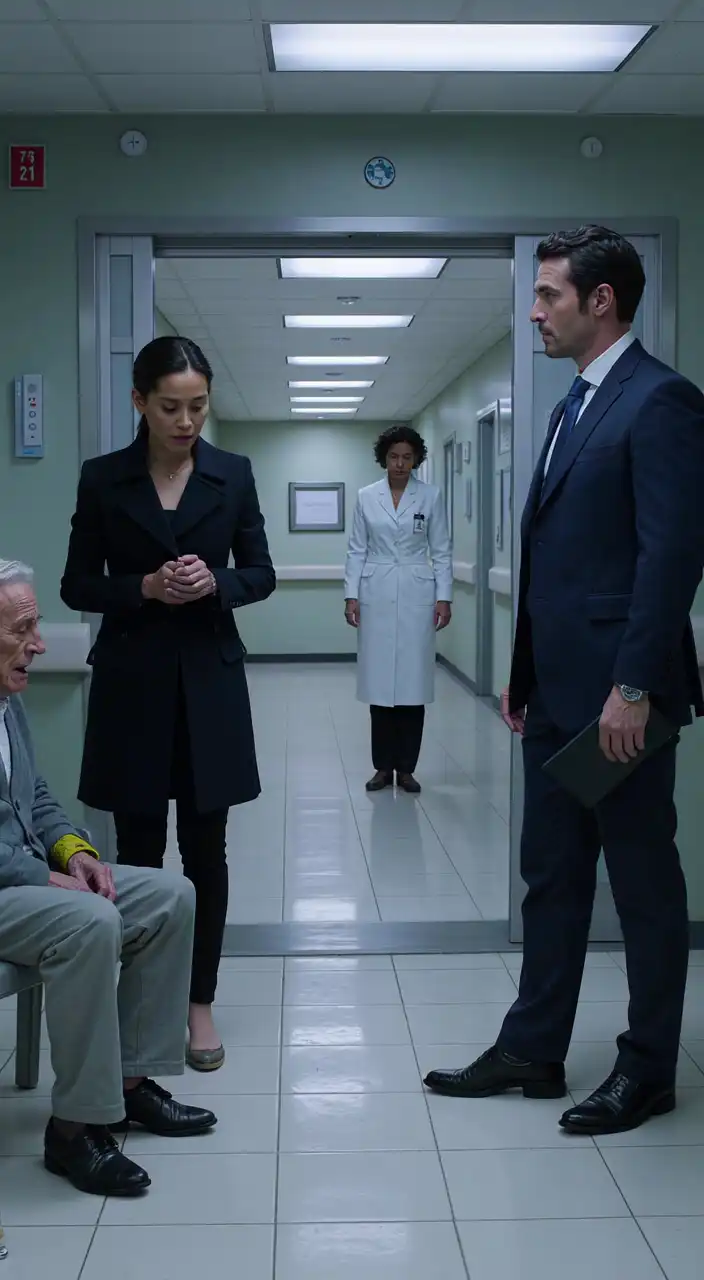
MY FATHER STARTED SHAKING OUTSIDE TRIAGE WHILE A CLINIC ADMINISTRATOR BLOCKED THE DOOR AND SAID HE NEEDED FAMILY PERMISSION FIRST.
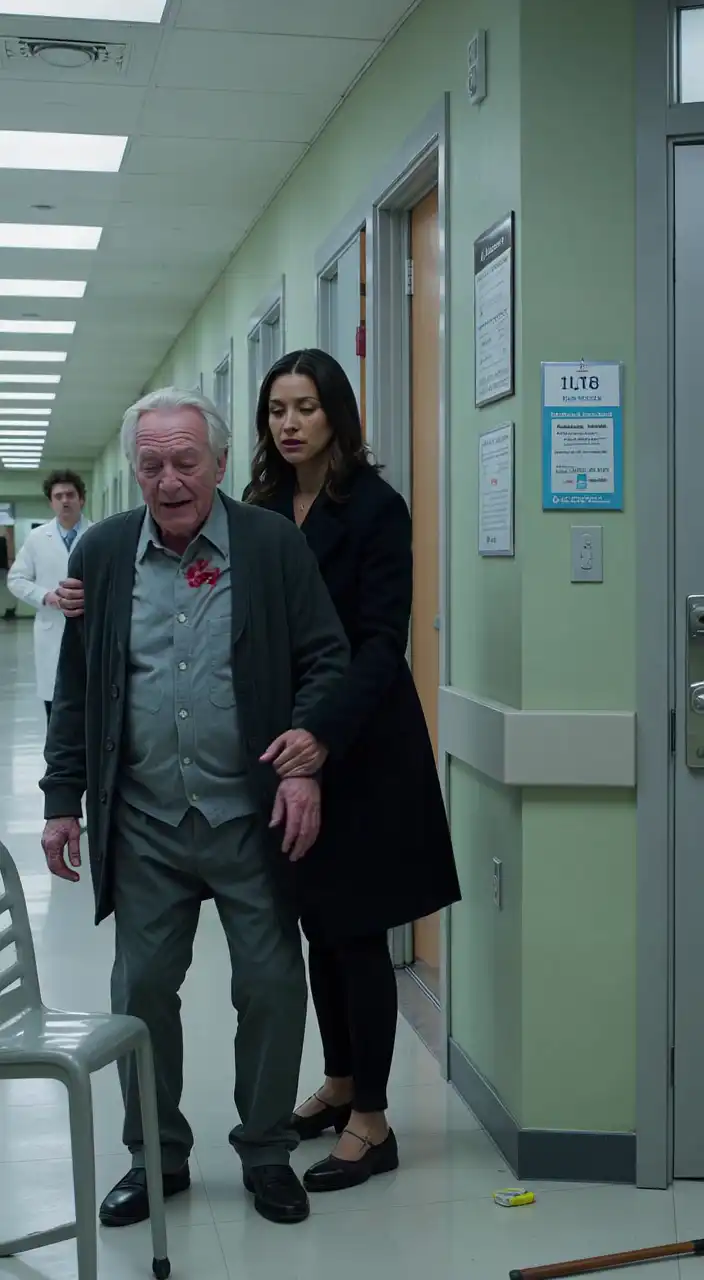
MY FATHER STARTED SHIVERING SO HARD HIS SURGICAL BANDAGE BLED THROUGH, AND THE CLINIC ADMINISTRATOR STILL BLOCKED THE TRIAGE DOOR.
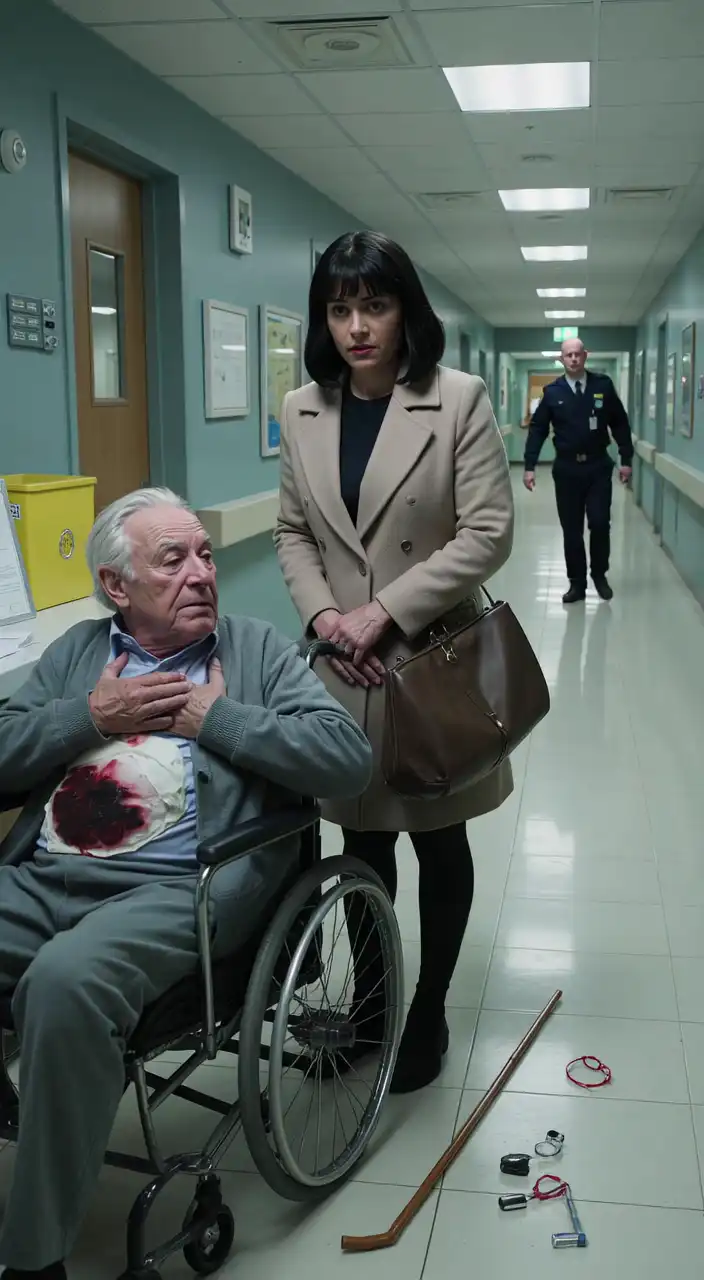
MY FATHER STARTED SHAKING IN THE HOSPITAL HALLWAY, AND THE WOMAN WHO CLAIMED TO BE HELPING HIM WOULD NOT LET TRIAGE TOUCH HIM.