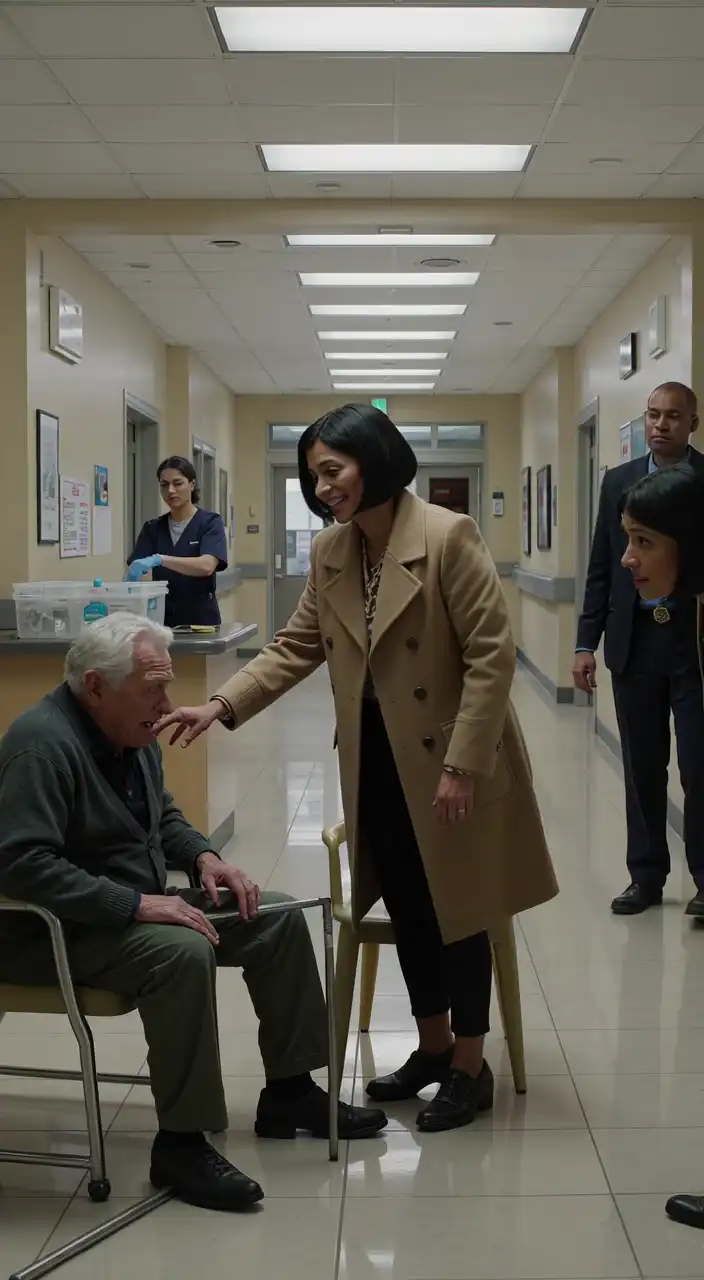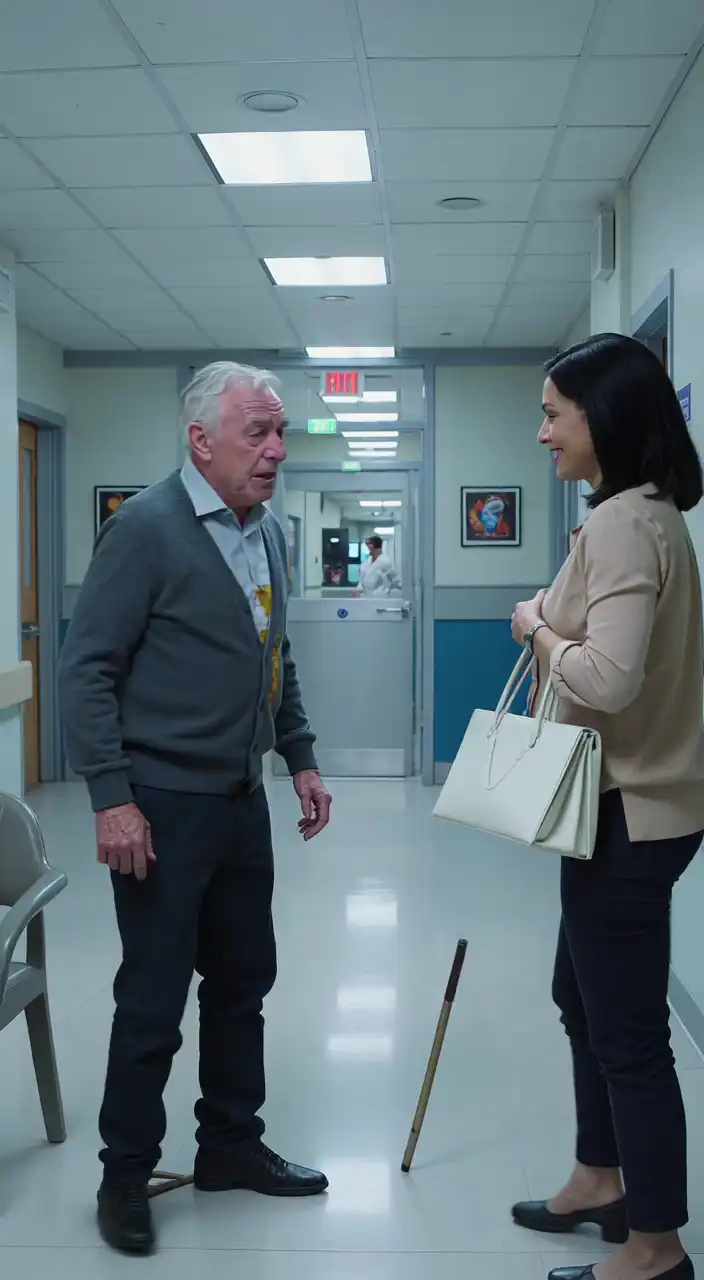
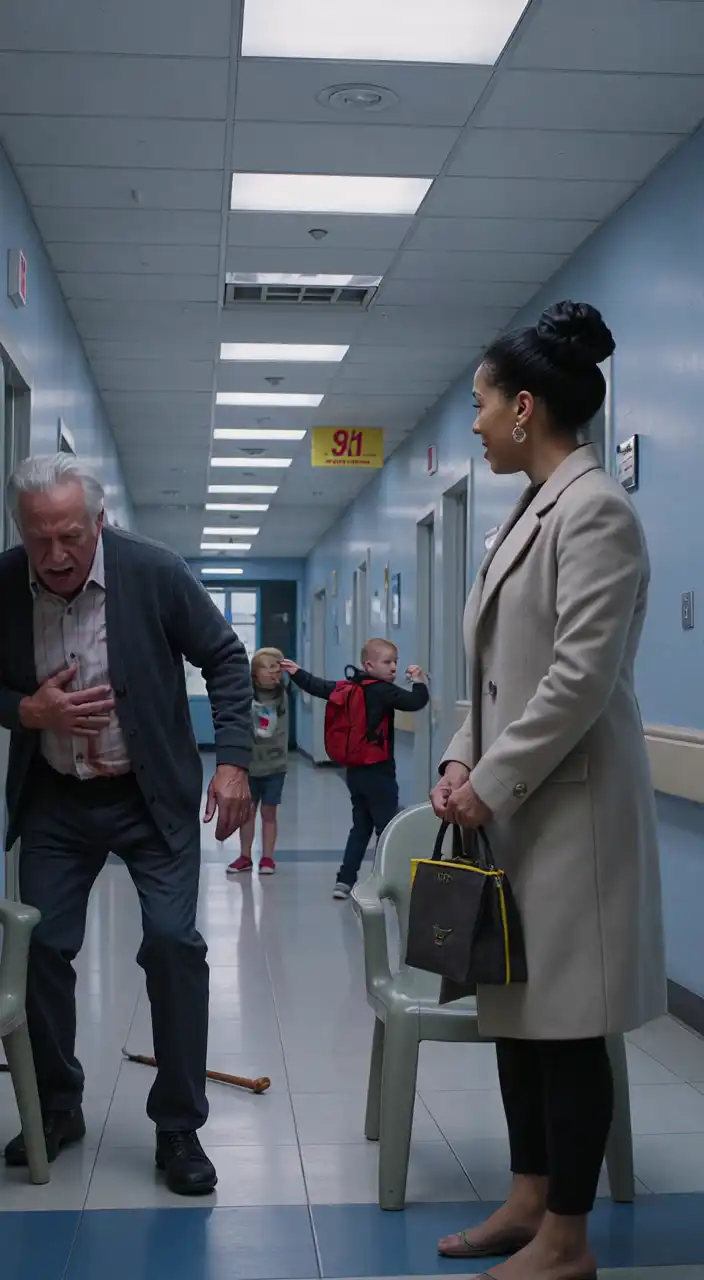

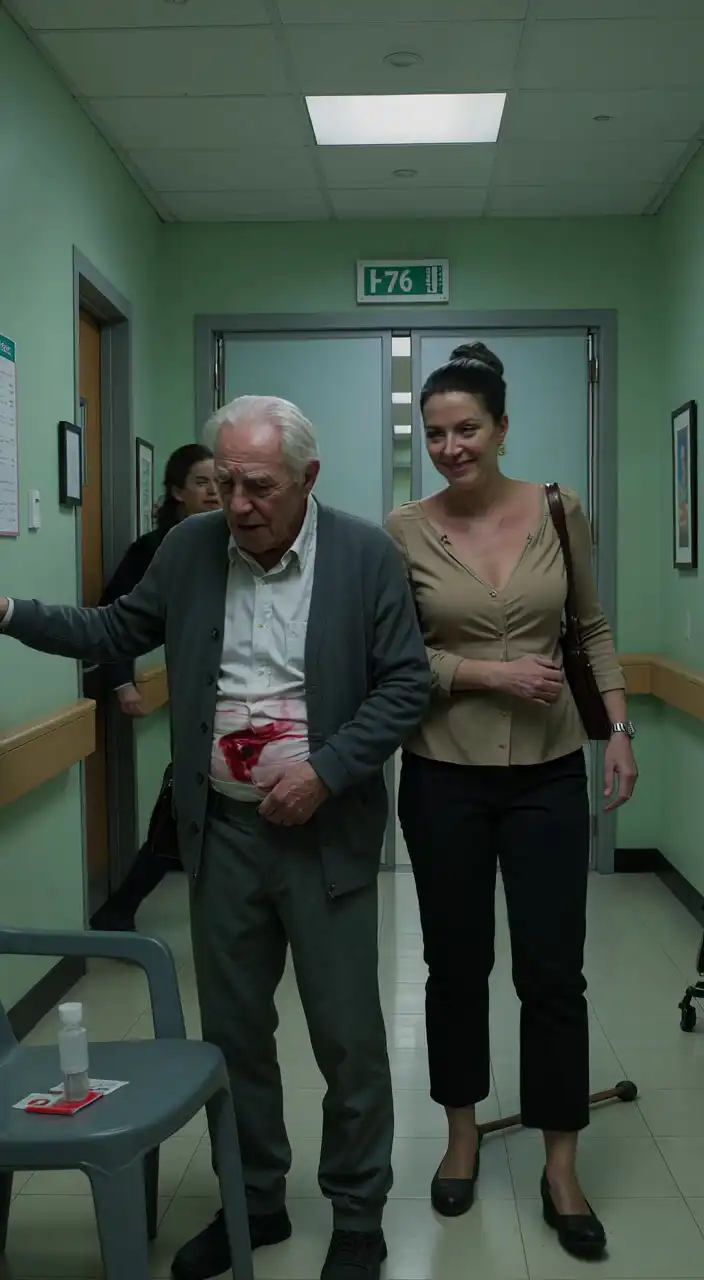
Rosa's smile held for half a second too long.
"In the car," she said. "My grandson isn't here, and this has nothing to do with him."
Peter did not move. He was one of those people whose stillness was more forceful than somebody else's shouting. He looked at the spacer on the chair, then at my father hunched over with one hand pressed to his abdomen, then toward the triage doors where the nurse had already raised two fingers at someone inside. A signal. I did not know what code they used, but I knew she had stopped seeing us as a difficult family and started seeing a blocked medical situation.
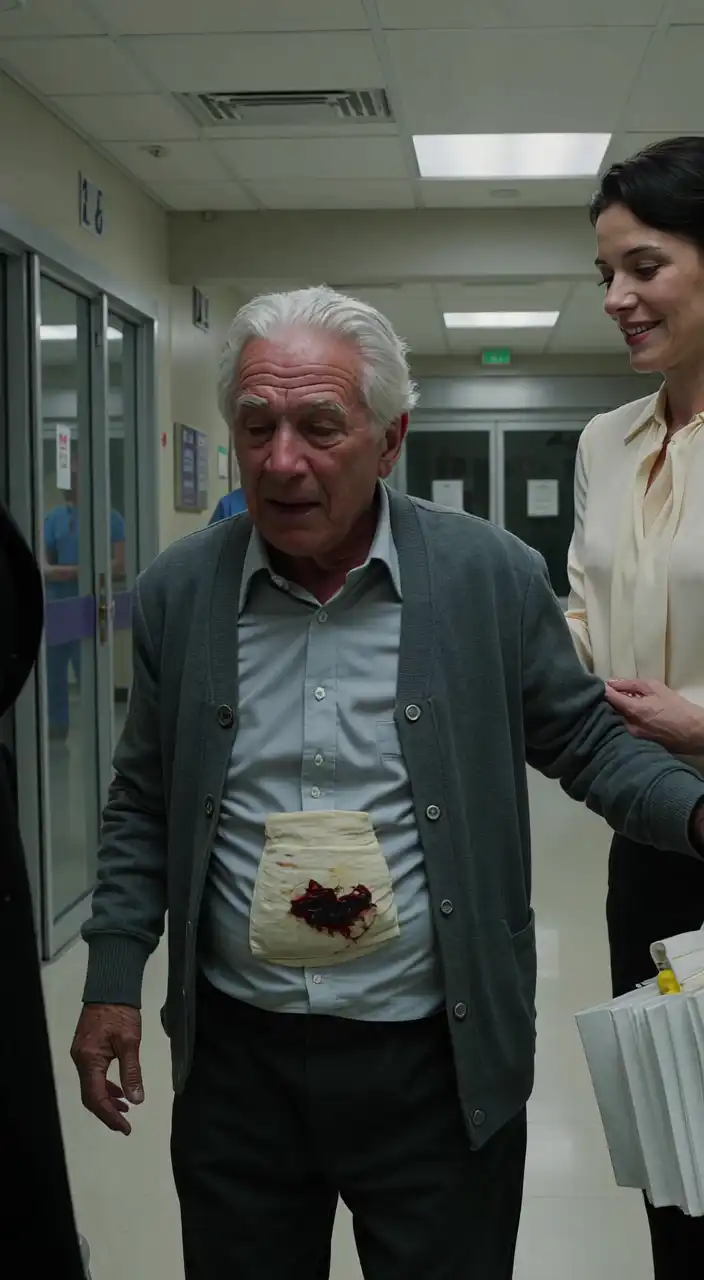
My father tried to straighten, failed, and made a low sound that scared me more than any yelling could have. His cardigan had slipped open. The edge of the dressing under his shirt was not coffee-brown. It was dark red mixed with yellow seepage. Infection. Bleeding. Something wrong enough that no decent caregiver would still be arguing in a hallway.
"Sir," Peter said to my father, not Rosa, "do you want to go into triage right now?"
Rosa answered before my father could get a breath. "He's not competent to answer that. He gets agitated. The surgeon said home rest."
That word, competent, landed with too much precision. Rehearsed. Not worried-daughter language. Not stressed caregiver language. It sounded like somebody had practiced exactly what to say if challenged.
My father lifted his head. His face had gone gray around the mouth, but his eyes were clear for one bright second. "Need doctor," he whispered.
The nurse was already moving. "Wheelchair. Now."
Rosa reached for the chair as an aide rolled it over. "No, he's fine to walk. We need a minute. Family matter."
Peter stepped between Rosa and my father so quickly that even Rosa seemed startled. He did not touch her. He just widened his stance and lowered his clipboard. "This is not a family matter anymore," he said. "Sir requested care."
That was when Rosa's calm broke at the edges. "You cannot keep us here over a misunderstanding."
Us. Not him. Us.
I bent and picked up the empty spacer. There was a jagged bite mark on the soft mouthpiece. Milo always chewed it when he was scared. My sister Elena's boy, seven years old, severe asthma every spring and every time he got a chest cold. Elena was working a double shift across town. Rosa had offered to take Milo to urgent care that morning because he was wheezing. Now the spacer was here, empty, while my father was half-collapsed outside triage.
"Milo was with you," I said.
Rosa didn't even look at me. "No."
My father dragged in a shallow breath. "Bathroom," he said, and then, more urgently, "boy... floor."
The aide and nurse got him into the wheelchair. As they turned him toward triage, his cane clattered away again. I grabbed it, and something folded out from the crook of the handle and fell against my shoe. A thin strip of white paper, tucked under the rubber grip. I snatched it up before Rosa could see.
It was not the full discharge packet. It was one page, crumpled and damp with sweat, maybe shoved there in a hurry. Across the top was my father's name, surgery date, and a bold line: Return to ER immediately for fever over 101, drainage, confusion, shortness of breath, uncontrolled pain.
At the bottom, in shaky pen, there was an extra note not printed by the hospital. Call Lena. Don't leave with Rosa.
I stared at it so hard the words blurred.
Rosa saw my face and took one step toward me. "What did he give you?"
Peter shifted slightly, blocking her line again. "Ma'am, step back."
The triage nurse took the paper from my hand, skimmed it once, and her whole posture changed. "He should never have been sitting out here." She tucked it under the clipboard on the wheelchair and nodded to the aide. "Move."
Rosa tried another angle. "You don't understand. He's been refusing his meds and accusing everybody of things. The child had a routine breathing treatment this morning. You're mixing stories."
Maybe on another day, with another family, that might have worked for a while. But now there was the soaked dressing, the hidden instruction sheet, the empty spacer, and my father's own words. Small things, but they had begun to line up.
Peter tapped his earpiece. "Pediatrics check, front corridor and parking loop. Possible child respiratory issue tied to accompanying adult. Also flag social worker and charge nurse."
Rosa's head snapped toward him. "There is no child emergency."
He finally looked directly at her. "Then finding the inhaler should be easy."
Two nurses took my father through the doors. He reached one trembling hand back toward me. "Don't let... her..."
"I won't," I said, though I had no idea how.
The doors slid shut on him.
For one sick second I thought Rosa would bolt. Her purse was clutched so tightly the leather creaked. It was one of those big structured handbags she carried like a shield. Too heavy. Too carefully closed. Peter must have thought the same thing, because his eyes dipped to the zipper and back up.
"My father needs surgery follow-up now," I said. "Where is Milo?"
Rosa's voice flattened. "At home with a nebulizer. You are making this ugly because your father likes drama."
That phrase hit me because it was one of hers. She had been saying versions of it for months. Dad likes drama. Dad gets confused. Dad forgets. At first it sounded like caregiver frustration. Then it became a wall around him. Missed calls. Rescheduled visits. Explanations that arrived too quickly. Every concern turned into his supposed weakness.
The triage doors opened again just enough for a nurse to call, "Family for Oscar?"
I moved, but Peter held out a hand without touching me. "You can go in one minute. I need a quick answer first. Does the child have a diagnosed asthma history?"
"Yes," I said. "Severe enough for school action plans. Rescue inhaler always with him. Spacer too."
Peter nodded once. "And was this caregiver authorized to manage both patients today?"
"My father, yes. Milo, temporarily. His mom asked her to take him in because Rosa said she was already driving Dad to follow-up."
Rosa made an impatient sound. "I never agreed to this interrogation."
Peter's radio crackled. A female voice said, "Supervisor, parking loop negative. Front desk says no child checked in under that caregiver's name."
Rosa turned and started walking.
Peter's hand came out, palm open. "Stop."
"I am getting fresh air."
"Not with a possible vulnerable patient still unaccounted for."
That made her whirl around. "Unaccounted for? He's at home."
"Then give us the address and the inhaler now."
There it was again, the tiny lag before she answered. Too small for anybody who wasn't watching. Too long for a grandmother with a safe child at home.
My phone was already in my hand. I called Elena. Straight to voicemail. I called again. No answer.
Peter said, "Ma'am, if there is a child in respiratory distress and you delay us, this escalates fast."
Rosa's jaw clenched. "He was breathing when I left."
When I left.
Not at home with a nebulizer. Not safe. Left.
We all heard it.
Peter heard it too. His expression did not change, but his voice got quieter in a way that was far more dangerous. "Left where?"
Rosa looked from him to me and back again. For the first time, I saw something other than control in her face. Not remorse. Fear.
Before she could answer, my phone lit up with Elena's name. I picked up so fast I nearly dropped it.
She was crying so hard I could barely understand her. "Lena, is Milo with you?" I asked.
"No," she gasped. "Rosa texted an hour ago that urgent care gave him medicine and he was sleeping at Dad's apartment. I just got there. They're both gone. His blue backpack is on the floor, and the nebulizer machine is still in the closet."
I closed my eyes.
The spacer in my hand still had Milo's bite marks.
Peter held out his hand for the phone. "Ma'am, this is hospital security. I need the child's full name, age, diagnosis, and last confirmed location."
As Elena answered through tears, Rosa did the one thing a truly innocent person never does at a hospital doorway.
She dropped her purse and lunged for the triage doors.
Peter caught the handle before she reached it, and the purse hit the tile hard enough to spill half-open. A wallet, a bottle of water, my father's prescription slip, and one small orange inhaler skidded into the fluorescent light.
For a second nobody moved.
Then Rosa whispered, "That's not what it looks like," and every person in that hallway knew it was exactly what it looked like.
Peter scooped up the inhaler without taking his eyes off Rosa. "Call pediatric ER now," he said into his radio. "And lock this corridor down."
A second guard rounded the corner at a run.
Inside triage, alarms started chirping from somewhere deeper in the unit, and I had to make a choice: go with my father or stay while they forced the truth out of Rosa.
I did not get to choose.
The triage nurse reappeared, eyes sharp. "His blood pressure's dropping. Family comes now."
I took one step toward the doors, and Peter said, "Go. We have her. But if the child calls you, answer on the first ring."
I barely made it through the doors before my phone started buzzing again with a number I didn't know.
When I answered, all I heard at first was a child trying not to cry and a thin, whistling breath.
"Aunt Lena?" Milo whispered. "Grandma locked me in the car."
The nurse led me down a narrow hall at a speed that made everything blur except the sounds: rolling wheels, monitor beeps, clipped instructions. My father was in a curtained triage bay with his shirt lifted, his surgical dressing peeled halfway back. The smell of infection hit me before the visuals made sense. A doctor was pressing gloved fingers around the incision while another nurse hung fluids. Dad's teeth were chattering hard enough to shake the bed rail.
"He has a fever of one-oh-three point two, low pressure, and likely post-op infection," the doctor said without looking up. "How long has he been like this?"
I opened my mouth and failed.
"Hours," I said finally. "Maybe all day. We don't know because she kept him away from us."
The doctor glanced at me then, quick and assessing. "Stay where he can see you. He needs imaging and labs now. Surgery is being paged."
My phone was still at my ear. Milo's breathing scratched through the speaker.
"Milo, listen to me," I said, moving closer to Dad's bed so he could see I was there. "Can you tell me what you see outside the window?"
A small pause. Air whistled in, shuddered out. "Wall."
"Any cars beside you? Trees? Shopping carts? Can you see a sign?"
"Dunno. It's hot."
It wasn't even noon yet, but the spring sun had already turned the parking lot into a box of reflected heat. I looked at the nurse. "A seven-year-old with asthma is locked in a car somewhere near here," I said. "Hospital security's on it. He has his inhaler now, but not the kid."
The nurse's face hardened in that professional way that means somebody has switched from ordinary care to emergency response. She touched the call button. "Can I get charge nurse and pediatrics line in triage three? Child welfare concern tied to active family emergency."
My father stirred. His eyes found mine. "Boy?" he whispered.
"We're finding him," I said.
He tried to lift his hand. Tape, IV tubing, tremor. I took it carefully. His fingers were burning hot.
The doctor stripped off one pair of gloves and put on another. "Sir, I'm Dr. Patel. Did someone stop you from coming back when you first felt fever and drainage?"
Dad swallowed with effort. His voice was ragged but coherent. "She said... normal. Said surgeon would be mad if we came back. Took papers."
Dr. Patel looked toward me. "Who is she?"
"Rosa," I said. "His... girlfriend, caregiver, whatever she calls herself this week."
That answer brought a flicker of irritation to my own voice, and immediately I hated it. Dad didn't need my family resentment in the room with his blood pressure falling. But Dr. Patel only nodded. He had probably heard cleaner versions of ugly dynamics every day.
"Did she give him all prescribed medications?" he asked.
"I don't know," I said. "She controlled them."
My father made a weak sound. "Blue pills... gone."
"Antibiotics?" I asked.
He nodded once.
That was the first plausible explanation and it was bad enough on its own. A caregiver missing antibiotics after surgery could lead to exactly this: fever, drainage, confusion, return to the ER. Neglect, maybe. Control, definitely. For one moment I wanted that to be the whole story because it was horrible but understandable. An overwhelmed caregiver. A selfish woman who didn't want the hassle. Something ugly but ordinary.
Then Milo coughed into the phone, and I remembered the inhaler in Rosa's purse.
"No," I whispered, more to myself than anyone else. "It isn't just that."
Charge nurse came in, took one look at Dad's charting monitor, and pivoted to me. "I'm Andrea. Security says they're searching lots A through D with local police en route because of the child call. Stay available. We may need details."
I put Milo back on speaker. "Buddy, can you unlock the door?"
"I tried." His breath hitched. "My fingers slippery."
"Did Grandma say where she was going when she left?"
"To help Grandpa not lie."
The words hit like ice water.
Dr. Patel glanced up again, clearly hearing enough to understand the shape of the situation. "Did she leave him there before coming inside with your father?"
"Sounds like it."
He muttered something under his breath that I was glad not to fully hear. Then louder: "We need blood cultures, lactic acid, and broad-spectrum antibiotics now."
The room intensified. Another nurse entered. A portable monitor rolled in. Dad's wrist got tagged. His old neat cardigan had been folded onto a chair, and I saw for the first time how carefully he had dressed this morning. He had expected a routine follow-up. Maybe he'd trusted Rosa to drive him. Maybe he had wanted peace more than caution. Quiet humiliation under urgent pain, all wrapped up in buttoned clothes and a polite voice.
"Milo," I said, forcing calm, "is your seat belt on?"
"No."
"Good. Kick the horn if you can."
A rustle, a wheeze, then a weak beep somewhere on his end. Again. Then a longer blare.
Andrea pointed at my phone. "Keep him doing that. Security can sweep for sound if they're close."
I relayed the instruction. Beep. Beep. Beeeeeep.
My father's eyes closed, then opened again. "I hid paper," he murmured. "Cane."
"I found it," I said. "You did good."
His face changed, just a little. Relief. Proof he had not imagined his own danger.
That mattered more than I had understood. Dad had been letting Rosa interpret his body to everyone around him. If he said pain, she said anxiety. If he said fever, she said stubbornness. If he asked to call me, she said I was busy. Long before today, she had started replacing his reality with hers. The missing paper in the cane wasn't just a clue. It was resistance.
Andrea leaned close to my phone. "Milo, this is Nurse Andrea at the hospital. You're doing great. Keep honking. Can you tell me if the sun is in your eyes or on the other side?"
He sniffed. "On my arm."
"Which arm?"
"Window side."
She made a quick note and stepped out to relay it.
My phone buzzed with another incoming call: Peter.
"I've got hospital cameras on your father's arrival lane," he said as soon as I answered. "Rosa parked in the overflow garage, level two, west ramp. We heard horn but lost direction. Police are entering now."
"He's on the phone with me," I said. "He says wall outside, sun on window-side arm."
"That helps." A pause. "Your caregiver just changed her story again. She now claims the child begged to stay in the car for five minutes because he was asleep."
I looked at Dad, at the fever making him tremble, at the blood pressure cuff cycling again. "She's lying."
"I know. There's more. We checked your father's discharge fill history through the pharmacy line listed in his packet. Two medications were never picked up. One was the antibiotic."
That incomplete explanation widened. Not just a missed dose. Never picked up.
"Who signed for his pain pills?" I asked.
Another pause. "Rosa did."
The contradiction opened right there. She skipped the antibiotic but collected the stronger medication. Not careless. Selective.
My father turned his head away from the light. "She said no money," he whispered.
Dr. Patel heard him. "Insurance would have covered most of it. Did she tell him otherwise?"
"Probably," I said.
Andrea came back in. "PD found the car," she said, and my knees nearly gave out before she finished. "Child's conscious. Door access in progress."
The relief was so sharp it hurt.
Then she added, "But he was alone longer than she admitted."
Of course he was.
I told Milo, "They're there, baby. They're there."
I heard a man's muffled voice through the phone, then metal, then a rush of air and chaos and adult urgency. Milo started crying for real at that point. A police officer took the phone, confirmed his name, age, inhaler status, and asked where his mother could be reached. I gave Elena's number with shaking fingers.
Dad began shivering harder. Dr. Patel swore softly at the monitor and called for another bag of fluids. "He may be going septic," he said to no one and everyone. "Get surgery to answer the page."
Peter called back again before I could process that. "One more thing," he said. "When Rosa dropped the purse, there was also your father's prescription receipt. The antibiotic was returned to stock yesterday. The note on the pharmacy stamp says 'caregiver declined due to cost.'"
"But she picked up the pain meds."
"Yes."
He let that sit.
A selective pickup, a hidden return warning, a stolen discharge sheet, an inhaler in her purse while the child was locked in the car. Those were not random failures anymore. They were choices arranged around control.
"What is she saying now?" I asked.
"That your father gets needy on narcotics and she was trying to teach him not to run back to the hospital every time he felt discomfort."
I looked at my father, sweating and shaking under fluorescent lights because he had obeyed her too long. "And Milo?"
"She says she forgot he was in the car when your father started acting up."
Forgot.
The spacer with bite marks in the hallway said otherwise. She had seen his panic. She had carried the evidence inside.
My father gripped my fingers unexpectedly hard. He was looking not at me but at my phone. "Tell... Peter..." he whispered.
I leaned down. "Tell him what?"
Dad's lips cracked over the words. "Blue backpack."
"What about it?"
His eyes shut tight as if hauling memory up through fever. "Papers."
At first I thought he meant his own papers. Then I understood. Milo's blue backpack, the one Elena found on the floor at Dad's apartment. If Rosa had staged one story there before bringing Dad here, she might have left more than a backpack behind.
I repeated it to Peter.
He was silent for two beats. "Officers are sending someone to the apartment now. If she's been hiding treatment history for either patient, we may find it there."
That was the contradiction turning into something uglier. Maybe she had not just delayed care today. Maybe she had been managing information around both of them for longer than anyone knew.
Dr. Patel pressed on Dad's abdomen and Dad cried out. The surgeon finally swept in, read the numbers, peeled back more of the dressing, and said the words I dreaded: "He may need to go back to the OR."
My father stared up at the ceiling as if he had run out of strength to be embarrassed. I stroked his forehead and kept my voice steady for him.
"You're here now," I said. "No one is taking you back out that door."
Across the room, Andrea's phone buzzed with a message. She read it, then looked at me with a kind of grim focus.
"Police found the child safe," she said. "And they found something else in that apartment. A bag in the kitchen trash with your father's full antibiotic blister pack unopened... and a pediatric clinic summary from this morning that says Milo needed immediate ER evaluation if wheezing returned."
Rosa had not forgotten. She had been told.
And she had hidden both warnings.
By the time Elena arrived at the hospital, she was carrying fury so raw it looked like collapse from a distance. A police officer walked beside her with one arm ready, not because she was dangerous but because grief makes people sway. Milo was wrapped in a cartoon hospital blanket, eyes swollen, inhaler clipped to the front of his blue backpack. The sight of that backpack nearly stopped me cold.
He saw me and reached out. I knelt and he crashed against my shoulders with the desperate force only a terrified child has. His chest still whistled a little when he breathed, but not like before.
"I'm sorry," he whispered into my neck, as if he had done something wrong.
"You did nothing wrong," I said immediately. "Nothing. You were brave."
Elena was already crying again, but anger sat underneath every tear. "Where is she?"
Peter answered before I could. "Separated from the family, waiting with officers. Before you see her, I need you to hear the current facts and let medical clear your son."
Elena wiped her face with both hands. "She texted me a picture of him sleeping under a blanket. She said urgent care gave him a treatment and he was fine."
Milo pulled back enough to speak. "She told me close my eyes for the picture."
Something in Elena's expression changed from fear to a quieter, more dangerous understanding.
Peter led us into a consultation room just off the triage corridor. Through the glass slit in the door I could see staff moving around my father's bay. He had not gone to surgery yet. They were stabilizing him first. I kept one eye on that slice of movement even while listening.
On the table in front of Peter were three items in clear evidence bags: the orange inhaler, my father's pharmacy receipt, and the crumpled discharge warning page I'd found in the cane. A fourth bag held two medication bottles. One was pain medication with Rosa's signature on the pickup line. The other was nearly full stool softener. No antibiotic bottle.
"Officers at the apartment recovered unopened antibiotic blister packs from the trash and the pediatric visit summary from this morning," Peter said. "The clinic note states the child improved briefly after a treatment but was to go straight to pediatric ER if wheezing resumed, especially because of retractions and prior severe attacks."
Elena shut her eyes. "She knew."
"Yes."
Milo's hand crept into mine. His fingers were still a little sticky from dried juice or tears. Child details. Human details. Things that make evil choices feel smaller and worse at the same time.
Peter went on. "The clinic also documented that the rescue inhaler was low and a refill was sent. The pharmacy record shows it was picked up forty minutes later."
"By Rosa," I said.
He nodded.
"So she had a fresh inhaler and still kept it from him," Elena said.
Milo looked down. "She said I was using it for attention."
That sentence entered the room and changed the air.
It also snapped a hidden piece into place for me. My father had been saying for months that Rosa called him dramatic when he asked for help. Same accusation, resized for a child. Not random impatience. A worldview. People in pain were inconveniences unless their pain could be controlled.
Elena sat beside Milo and cupped his face. "Baby, look at me. You never have to earn air. Do you hear me?"
He nodded, lip trembling.
A social worker entered then, a woman named Denise with a soft voice and sharp eyes. She did not waste time on empty comfort. She asked Milo simple grounding questions, confirmed who was safe, and explained that no one was taking him anywhere without his mom. Then she turned to Elena and me.
"I also need family context," she said. "Has Rosa isolated your father before? Controlled meds, appointments, phone access?"
I laughed once, bitter and stunned. "All of it, probably. We just kept thinking it was ordinary caregiver gatekeeping."
Denise didn't flinch. "Tell me ordinary and then tell me what bothered you."
So I did. Missed calls answered by Rosa saying Dad was sleeping. Doctor appointments suddenly rescheduled. A Thanksgiving where Dad's hand shook too much to carve turkey and Rosa joked that he was overmedicated because he liked being babied. A winter bronchitis scare where she told everyone the urgent care doctor said stay home, but Dad later mentioned no doctor had examined him because Rosa got impatient and took him away before they were called back. I heard myself talk and realized how many moments I had filed under annoying instead of dangerous.
Elena added her own pieces. Rosa insisting on managing all of Milo's medications when she babysat. Once returning an inhaler to Elena's cabinet in the wrong slot and saying, "He reaches for it every time he gets excited." Another time laughing that school nurses "baby every wheeze." Small things. Not enough for a report by themselves. Enough to form a shape in hindsight.
Denise wrote without pausing. "Pattern of minimization and access control," she said quietly.
That phrase somehow made me both sick and steadier. If it had a name, maybe it could be stopped.
A detective arrived next, plain clothes, county badge at his belt. He introduced himself as Martinez. He had the flat, exhausted manner of someone who had seen every family lie and still hoped to catch the truth before it did more damage.
"Rosa says your father asked her not to fill the antibiotic because he hates taking them," Martinez said.
My laugh this time was sharper. "He hides instructions in a cane grip because he wants more antibiotics? No."
Martinez almost smiled, but didn't. "She also says the child was never in distress, that she kept the inhaler in her purse for safekeeping because he overuses it."
Elena looked like she might climb over the table. Denise put a calming hand near her arm without touching. "The clinic note contradicts that," Denise said. "And so does the lock-in-car decision."
"Yes," Martinez said. "I'm interested in motive now. Control is one motive. Financial is another. Did Rosa benefit from keeping your father dependent?"
I thought of the checked mailbox at Dad's building, the utility notices I'd once seen tucked under a fruit bowl and been told were old, the way Rosa always insisted she would handle his account transfers because "he gets flustered online."
"I don't know yet," I said. "But she liked being the gate."
Peter, who had stayed near the door, spoke for the first time in several minutes. "There is another detail. When she tried to leave the corridor, she wasn't headed for the exit first. She lunged toward triage."
"Why?" I asked.
"Possibly to intercept your father before staff spoke to him alone," he said. "Or retrieve something from his clothing."
That thought chilled me. What else had Dad hidden? What else had she feared?
As if summoned by the question, Dr. Patel stepped in. "Oscar's condition worsened. The surgeon is taking him for emergency washout and likely revision of part of the incision. Before we roll, he asked for his daughter."
I was up before he finished.
Dad lay under brighter lights now, oxygen under his nose, consent forms clipped to the rail. His eyes were heavy with pain but searching. I moved to his side and touched his shoulder.
"They found Milo," I said first, because I knew that was what mattered to him. "He's safe. Elena's here."
His whole face loosened. "Good."
"You're going to surgery. They're fixing the infection."
He swallowed. "Don't let her... sign."
"I won't."
He shifted his gaze toward the chair where his cardigan had been folded. A nurse brought it over, thinking maybe he wanted comfort. Instead he nodded weakly toward the inside pocket. I reached in and found a folded pharmacy leaflet and a bank envelope.
The leaflet was for the antibiotic Rosa claimed he didn't want. The envelope held a withdrawal slip from Dad's checking account, unsigned by him but prepared for cash. On the back, in Dad's shaky writing, were three words: She gets angry.
I showed Dr. Patel, then Martinez, who had followed me to the doorway. Financial pressure. Medical control. Fear.
Martinez's jaw tightened. "This helps."
Dad squeezed my hand once. "Sorry."
I bent low so he could hear me over the bustle. "For what?"
"Didn't... want trouble."
There it was, the emotional truth of so many vulnerable people. He had not been blind. He had been trying to keep peace while slowly losing the right to define his own pain.
"No more peace with her," I said. "Only truth."
He gave the smallest nod before they rolled him away.
When I came back out, Denise was kneeling by Milo with crayons somehow produced from nowhere, helping him circle feelings on a worksheet while making it sound like a game. Elena stood by the window watching the hall where officers had taken Rosa. She had gone quiet in the way that means a person is organizing rage into memory.
Martinez joined us. "We searched Rosa's phone with consent from exigent circumstances tied to the child emergency and visible evidence in the hospital," he said. "There are texts to a friend complaining that your father is 'milking recovery' and saying if she takes him back to the ER they'll 'keep him again and ruin everything.'"
"What is everything?" I asked.
"Could be money. Could be control. Could be she was afraid doctors would notice he hadn't had meds. We're still working that."
Peter added, "There are also two unanswered calls from the pediatric clinic after she left. They tried to reach her because the provider was more concerned after reviewing the child's oxygen number."
Elena put a hand over her mouth. "She ignored them?"
"Yes."
Movement by the glass slit caught my eye. Two officers were escorting Rosa down the hall toward an interview room. She was no longer composed. Her cardigan hung wrong. Her hair had started to frizz at the temples. But the worst part was that she still looked offended, as if all this had happened to her.
She saw me and straightened. "Tell them Oscar lies when he's scared," she called through the partial opening before an officer shut it. "And tell Elena her boy was fine until everybody started panicking."
Milo heard it.
His little shoulders tightened under the blanket.
I moved fast to block his line of sight, but the damage was done. Denise shifted closer and said evenly, "That was an adult making unsafe choices. Not your fault."
Milo nodded without looking up.
The larger emotional reversal landed then, and not because of any dramatic confession. It was simpler and uglier. Rosa wasn't panicking because she had made one bad call under stress. She was angry that other people had interrupted her right to decide who got care and who didn't. The hallway, the missing papers, the hidden inhaler, the false texts, the unfilled antibiotics, the purse, the lunge at triage - all of it belonged to one moral shape.
She did not think their fear counted if she could talk over it.
That was when Elena asked the question none of us wanted but all of us had reached.
"Has she done this before to other people?"
The answer to Elena's question did not come from some dramatic database hit or a stranger walking in with a file. It came in pieces from ordinary systems that only started talking to each other because one child had whispered from a locked car and one feverish man had hidden paper in a cane.
Martinez left to make calls. Denise stayed. Peter hovered near enough to help and far enough not to crowd us. Through the next hour, the hospital became a machine around our family: pediatric respiratory checks for Milo, surgery prep updates for Dad, statements taken in small room after small room. The fluorescent hallway outside triage, the one that had looked so impersonal before, turned into a crossroads where every ignored warning was finally being rerouted toward action.
Elena sat with Milo while a pediatric resident listened to his lungs. I answered questions about Dad's baseline cognition, his medications, who held power of attorney. The answer to that last one was thank God no one. Rosa had been acting like she spoke for him because he let her, because she drove him, because she used confidence as a credential. But legally she was only a girlfriend and informal caregiver. Important emotionally. Limited on paper. That mattered now.
It mattered even more when Martinez came back with a printout and said, "There was a prior adult protective services intake six months ago. Screened out, not fully investigated. Caller reported an elderly male saying his meds were being withheld by a partner who called him confused."
I felt a flush of shame crawl up my neck. "Why didn't anyone tell us?"
"Anonymous caller with little detail," he said. "No direct access, no corroboration, no visible injury documented. These cases fall through unless someone sees enough in real time."
Real time. A hallway. A bandage. A purse. An inhaler.
"Who called?" Elena asked.
Martinez shook his head. "Protected. Could have been a neighbor, pharmacist, anyone."
Maybe the same neighbor who whispered to me earlier. Maybe not. Whoever it was had seen enough to be frightened and not enough to stop it. Another almost.
The pediatric resident finished with Milo and said he wanted to keep him for observation because of the delayed treatment and stress trigger. Elena agreed instantly. Milo didn't protest. He looked wrung out, all the stubborn little-boy energy replaced by watchfulness.
Denise crouched in front of him. "Milo, I need to ask one important question. Did Grandma ever tell you not to tell your mom when you needed your inhaler?"
He nodded after a long pause.
"What did she say?"
"She said Mom makes too big a deal and then people think I'm sick."
I had to look away.
That line matched too perfectly with Dad's life under Rosa. If she could keep pain unofficial, she could keep control private.
Martinez set another sheet on the table. "There's more. Pharmacy records over the last year show multiple delayed pickups for your father's medications when Rosa signed as authorized contact. Not every script. Mostly antibiotics, blood pressure refill once, and follow-up stomach meds after a prior procedure. Pain medications were picked up on time."
Selective again.
Financial motive still made sense, but now another possibility emerged. If Dad stayed uncomfortable, weak, and uncertain, he needed her. If he got properly treated and steadier, she lost leverage. It was monstrous to think it, but the pattern was there.
Peter spoke quietly. "I also reviewed camera from this morning. Rosa did not come straight here when she arrived with your father. She parked, sat in the car six minutes, exited alone, went around to the passenger side, leaned in, then returned to the driver's door before eventually bringing your father inside."
"She left Milo in the car on purpose," Elena said flatly.
"That is how it appears."
The final obstacle was no longer proving delay. It was proving intent before she found a way to muddy everything with confusion, age, family conflict, or "misunderstanding." She had been building those defenses all day.
My phone buzzed with a text from the neighbor who had first called me. Mrs. Alvarez from Dad's building. Three messages.
I saw her put the medicine box in the kitchen trash yesterday.
Your father asked to use my phone this morning but she came to the door before he could talk.
I took a picture because something felt wrong.
I stared at the last line and called her immediately.
Mrs. Alvarez answered on the first ring. Her voice shook. "I didn't know if I should interfere."
"You did," I said. "Please tell me you still have the picture."
"Yes."
She texted it while we were on the phone. It showed Dad's open apartment trash can. On top sat the torn silver foil of antibiotic blister packs and the edge of a white instruction sheet. Timestamped yesterday afternoon.
Martinez leaned over my shoulder and exhaled. "This is excellent corroboration."
Mrs. Alvarez wasn't done. "And I heard something this morning through the wall," she said. "Your father said, 'I need the papers.' She said, 'You need to stop trying to embarrass me in front of doctors.' Then the little boy was coughing."
The room went still.
Milo was in the apartment while Rosa argued with my father about the papers. That meant the two emergencies had intersected before the drive over. She had known both were urgent and chosen image over care.
"Will you tell that to the police?" Martinez asked gently.
"Yes," she said after a breath. "If it helps Oscar."
"It will."
Another nurse appeared at the door. "Family for Oscar? Surgeon update in consult B."
My stomach dropped. We had crossed into the hour where every update feels like a verdict.
Elena squeezed my arm. "Go. I've got Milo."
In consult B, the surgeon stood with hands still damp from scrub sink water, cap on, eyes tired. "We got him in quickly," she said. "There is a deep infection at the surgical site. We are cleaning it out and may need to place a drain. We caught this in time, but he was closer to systemic sepsis than I like."
Closer than I like. Clinical understatement for almost too late.
"Will he be okay?" I asked.
She held my gaze. "I think so. But another delay of several hours could have gone very differently."
I thanked her because that's what people do when terror leaves a thin strip of manners intact.
When I came back, Peter was speaking quietly with Denise near the vending machines. Rosa had requested to see my father before any formal charges were discussed. The answer, obviously, was no. Yet the request itself revealed something ugly: even now she thought access to him was negotiable.
Martinez asked if I would listen to a brief portion of body-cam audio from the garage. "I think it matters emotionally and evidentially," he said.
He played it low. Metal tools at a car door. An officer saying, "Buddy, we're opening it." Milo wheezing. Then a softer voice, probably another officer: "Where's your inhaler?" Milo, hoarse and crying, saying, "Grandma has it because she said I have to learn."
I put my hand over my mouth.
Learn what? To be quiet? To breathe on permission? The sentence made no medical sense. It made control sense.
Denise had heard enough too. "That statement supports intentional withholding," she said.
The final pressure point came from somewhere I did not expect: Dad himself.
The OR nurse called from inside surgery because Dad, while still awake enough before anesthesia deepened, had insisted on one message reaching me exactly. "Tell Lena not to let Rosa take the folder from the trunk."
"What folder?" I asked.
The nurse didn't know. That was all he had managed.
Peter and Martinez were already moving before I finished repeating it. They had the car keys from Rosa's property bag. Ten minutes later they found a manila folder in the trunk under a grocery blanket.
Inside were my father's full discharge papers, the pediatric urgent care after-visit summary, the inhaler refill leaflet, and bank notices showing two late mortgage-related payments from Dad's account even though his apartment was paid off. Not mortgage - a home equity line Rosa had convinced him to open three months earlier "for renovations" that never happened. Several cash withdrawals followed, each under reporting thresholds, all on days Dad had medical appointments and remembered little afterward because Rosa managed his pills and rides.
There was our financial motive, ugly and practical. If Dad got suspicious or saw doctors without her, he might tell someone. If he regained strength, he might look at accounts. If Milo's clinic sent them to a pediatric ER the same day, Rosa could not be in two places controlling two narratives. So she tried to compress both crises, silence both patients, and get through the hospital threshold before anybody separated them.
It was monstrous, but now it was coherent.
Martinez's face when he opened the folder told me the case had changed category in his mind. Not messy family caregiving. Predatory pattern.
He asked one last question before taking the evidence bags away. "If your father survives this and says he doesn't want to press because he's embarrassed, will the family support him anyway?"
I answered without hesitation. "We'll support him by telling the truth even if he hates the attention."
Elena, from the doorway with Milo asleep against her shoulder, said, "And by never leaving them alone with her again."
For the first time all day, Peter let some of his controlled anger show. "Good," he said. "Because she's asking for another chance to explain."
No one in that room wanted another explanation.
What we wanted was surgery to go well, a child to keep breathing, and one clear barrier between Rosa and the people she had taught to doubt their own emergencies.
The barrier arrived twenty minutes later when an officer informed us she was being placed under arrest pending charges related to child endangerment, obstruction of medical care, elder abuse investigation, and financial crimes review.
I should have felt triumphant.
Instead I felt tired down to the bone, because arrest is not rescue. Rescue would be my father waking up without her voice over him. Rescue would be Milo reaching for his inhaler one day without shame.
We got the first piece just after dusk, when the surgeon returned, pulled off her cap, and said, "He's out of danger for tonight."
And then she added, "He asked again, before he went fully under, if the little boy made it."
So even at the edge of his own crisis, Dad had still been reaching toward somebody smaller and more helpless than himself.
That was the moral center Rosa had never understood.
Care is not weakness.
Care is what saved them both.
My father woke in ICU just after midnight, raw from anesthesia, gray with exhaustion, but alive and finally no longer under Rosa's version of reality.
I was sitting beside his bed with a paper cup of stale coffee and his folded cardigan on my lap when his eyes cracked open. The room hummed with pumps and monitors. Dim blue monitor light washed over his face, and for one terrifying second I saw confusion spark there and thought he might ask for Rosa out of habit.
Instead he looked straight at me and whispered, "Milo?"
"Safe," I said at once. "With Elena. Breathing okay. Mad at everyone, which is a good sign."
A weak little breath left him that might have been a laugh. His eyes filled anyway.
"She gone?" he asked.
"Yes."
He shut his eyes again, and two tears escaped sideways into his hairline. I had not seen my father cry since my mother's funeral. It was not only pain. It was the collapse after sustained vigilance. The body standing down from a danger it had never known how to name aloud.
I touched the back of his hand where tape still anchored IV lines. "You don't have to be polite about her anymore."
That made his mouth twitch. "Never was good at not being polite."
I leaned back and let him wake slowly. There is a particular silence in hospital rooms after a life turns away from disaster. Not peace exactly. More like a negotiated truce between the body and time. He drifted in and out while nurses checked drains, antibiotics, pressure, pain. Every person who entered addressed him directly first. "Mr. Alvarez, can you tell me your birthday?" "Oscar, where's your pain?" "Do you want ice chips?" Such small respect, but after months of being spoken over, it mattered.
By morning, the machinery of accountability had caught up to the night. Adult protective services visited. Child protective investigators met with Elena and Denise. Martinez returned with a warrant update and more news than any family should receive before breakfast.
The home equity line had indeed been opened with Dad physically present but heavily medicated after a prior procedure. A bank camera captured Rosa guiding his hand across forms while answering most questions for him. The branch employee remembered feeling uneasy because Dad kept asking, "Is this for the bathroom?" Rosa had laughed and said he forgot their remodeling plans. There had been no remodeling plans.
When Martinez told Dad that gently, Dad stared at the blanket for a long time.
"I thought I signed a grab bar estimate," he said.
"We know," Martinez replied.
That might have been the cruelest part of all. Rosa had not preyed on greed in him. She had preyed on humility. On his willingness to admit he needed help. On his fear of being burdensome. She turned those decent instincts into openings.
Elena brought Milo up late that afternoon after pediatric observation cleared him to leave. He came into the ICU waiting area with his backpack on and the inhaler clipped visibly to the front pocket, as if the staff wanted the whole world to know where his air was now. He had a hospital bracelet still on his wrist. One of the planted details from the day before, another little band of proof and protection.
"Can I see Grandpa?" he asked.
ICU rules allowed a short visit with masks and supervision. When Milo stepped to Dad's bedside, my father's entire posture changed. Frail as he was, he opened his arm. Milo climbed carefully against him and said the one thing that broke every adult in the room.
"I honked like you said."
Dad's chin trembled. "Good boy."
Milo looked up seriously. "I wasn't doing attention."
"No," Dad said, stronger this time. "You were asking for help. That's always allowed."
Elena turned away crying. I didn't bother hiding it. Even the nurse checking the monitor paused for a second longer than necessary.
In the days that followed, the formal pieces moved, but they moved as scenes, not abstractions. Rosa's arraignment happened while Dad was still in step-down care. Martinez came by to explain the charges in plain language because Dad asked, "Will she come here?" He was embarrassed by his own fear, which meant he was still himself.
"No," Martinez said. "There is a no-contact order in place. Security has her information. She can't reach you here or at home."
At home. The phrase made us all look at one another because nothing about Dad's apartment felt simple anymore. So we made choices quickly. Elena and I cleared Rosa's things with police supervision. We found labeled pill organizers arranged to make Dad think he had taken medications he had not. We found duplicate keys hidden in a coffee can. We found a notebook where Rosa had written appointment dates, banking reminders, and little judgments beside them: "cranky," "clingy," "playing sick," "watch him with nurse." I almost wished we hadn't. The casual contempt was harder to look at than the legal evidence.
But we also found proofs of Dad's resistance. Sticky notes tucked into drawers with my phone number written three times. A spare copy of his insurance card inside a dictionary. A second note behind a framed photo: If I say I'm fine, ask twice. He had been trying to leave breadcrumbs for someone willing to see them. He just hadn't wanted to accuse her outright unless he had to.
Mrs. Alvarez became unexpectedly central too. She came to visit with homemade soup nobody would let Dad eat yet, and she sat at his bedside apologizing for not pushing harder sooner. Dad, still weak but clearer each day, took her hand and said, "You called my daughter. That's enough." It wasn't just kindness. It repaired something in all of us. Bystanders matter. Half-seen clues matter. The almost-call can become the saved life if somebody acts before certainty feels complete.
The hospital social worker helped us file for temporary financial protections and connect Dad with a patient advocate. We changed his pharmacy, passwords, emergency contacts. A home health nurse helped design a medication chart that put every dose in visible daylight, not in one person's purse or memory. Denise arranged follow-up counseling for Milo, who had started asking before bed, "What if I really am dramatic?" Elena answered the same way every time until it settled in him: "Dramatic is a story somebody told so they didn't have to listen. We listen in this house."
Dad heard that once and cried quietly into his soup.
The largest release came a week later at a hearing for the protective order extension. Dad insisted on attending by video from a hospital conference room even though Martinez said his statement could be submitted another way. He buttoned the neat cardigan over his fresh bandage and sat very straight, hands shaking only a little.
Rosa appeared on the other screen in county clothes, no cardigan now, no spotless handbag, no soft controlled smile. For the first minute she still tried to sound maternal. "Oscar gets overwhelmed, and I was the only one caring for him consistently."
The judge asked Dad if he wanted to respond.
Dad took a breath. I could see the old instinct to soften things fighting the new need for truth.
"She kept telling me pain wasn't pain," he said. "After a while, you start apologizing for being sick."
No lawyerly flourish could have matched that.
Then he added, voice roughening, "And she kept a child's inhaler in her purse while he couldn't breathe. I don't want her near me again."
Rosa looked shocked, as if hearing his full sentence in public was more offensive than anything she had done. That was her final loss, I think. Not the arrest. Not the evidence. The fact that he had found his own unbroken line of reality and spoken from it.
The order was granted.
Months later, the visible aftermath was ordinary in the best way. Dad recovered slowly. The infection left him thinner, more tired, and for a while easily startled when phones rang from another room. But he healed. Milo returned to school with an updated asthma plan and a tiny fierce pride in checking his inhaler count with the nurse. Elena stopped apologizing for "overreacting" to symptoms and started saying, "I'd rather be inconvenient than late."
As for me, I changed too. I stopped mistaking a controlling person for a competent one just because they speak calmly in hallways. I stopped waiting for perfect proof before trusting the look in someone's eyes when they are trying to ask for help under another person's voice.
The last planted detail paid itself off on a quiet Sunday that autumn. Dad was visiting Elena's backyard, using a lighter cane now. Milo was showing him how loud he could make a toy fire truck siren. The old cane with the hidden grip leaned by the patio door. I picked it up, turned the handle, and found one final folded scrap of paper still tucked in the hollow.
It was older than the others. Just four shaky words:
If needed, make noise.
I carried it outside and handed it to Dad. He read it, looked at Milo shrieking happily with the toy siren, and then at me.
"We did," he said.
Yes. We did.
And that was how the hallway ended: not with Rosa's excuses, not with fluorescent humiliation, not with a blocked door and a locked purse, but with a man who survived long enough to be believed and a child who learned that asking for air is never attention-seeking.
Care had been withheld in whispers.
It was restored out loud.
Disclaimer: Mention of any brand or trademark is for identification only and does not imply partnership or endorsement
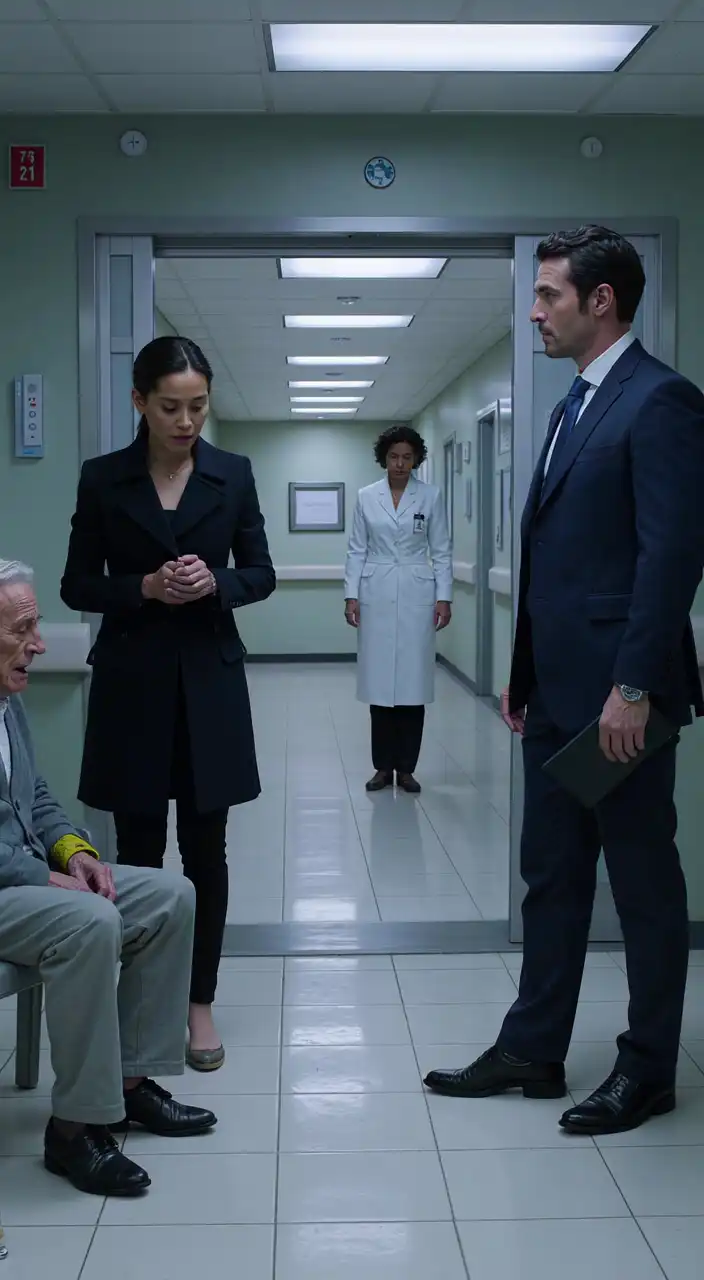
MY FATHER STARTED SHAKING OUTSIDE TRIAGE WHILE A CLINIC ADMINISTRATOR BLOCKED THE DOOR AND SAID HE NEEDED FAMILY PERMISSION FIRST.
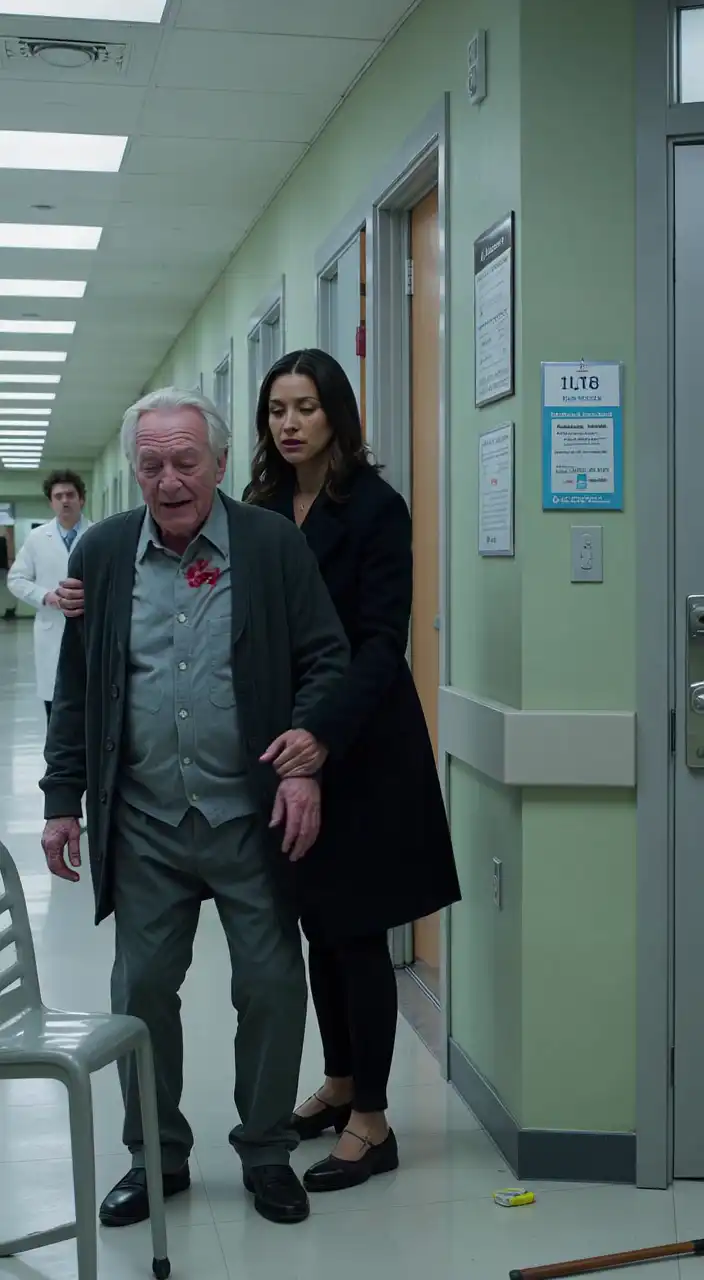
MY FATHER STARTED SHIVERING SO HARD HIS SURGICAL BANDAGE BLED THROUGH, AND THE CLINIC ADMINISTRATOR STILL BLOCKED THE TRIAGE DOOR.
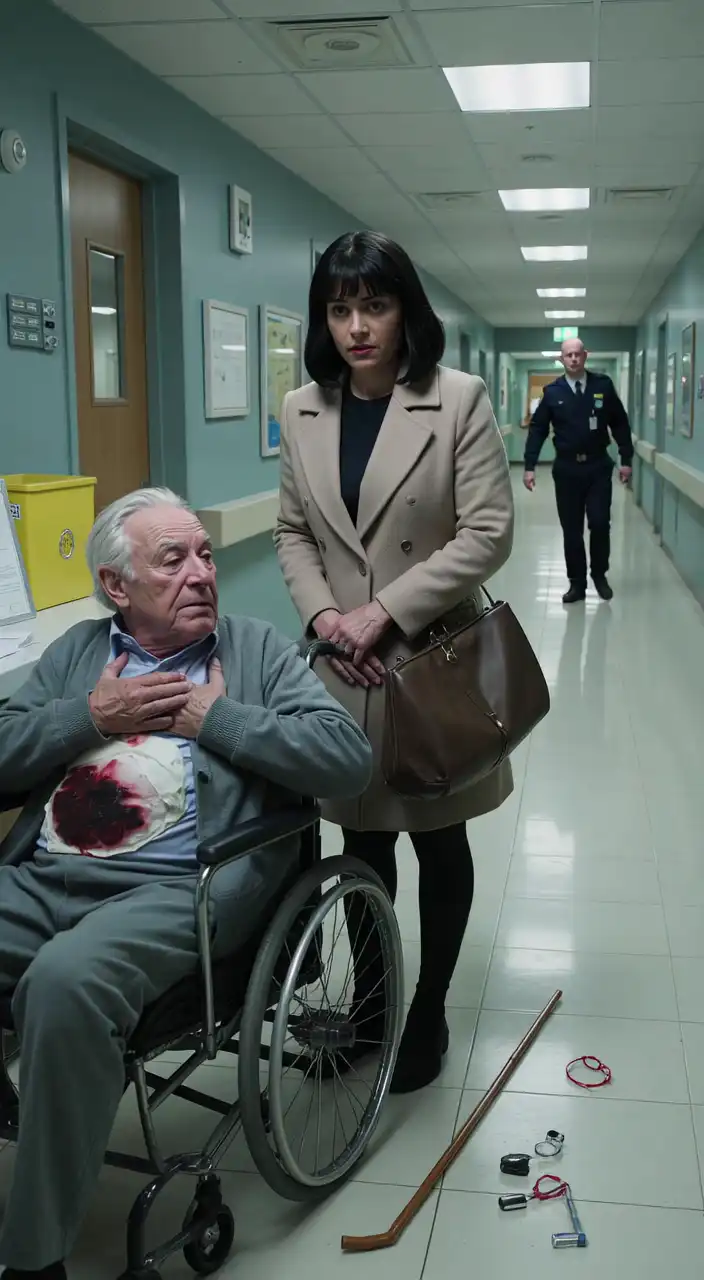
MY FATHER STARTED SHAKING IN THE HOSPITAL HALLWAY, AND THE WOMAN WHO CLAIMED TO BE HELPING HIM WOULD NOT LET TRIAGE TOUCH HIM.