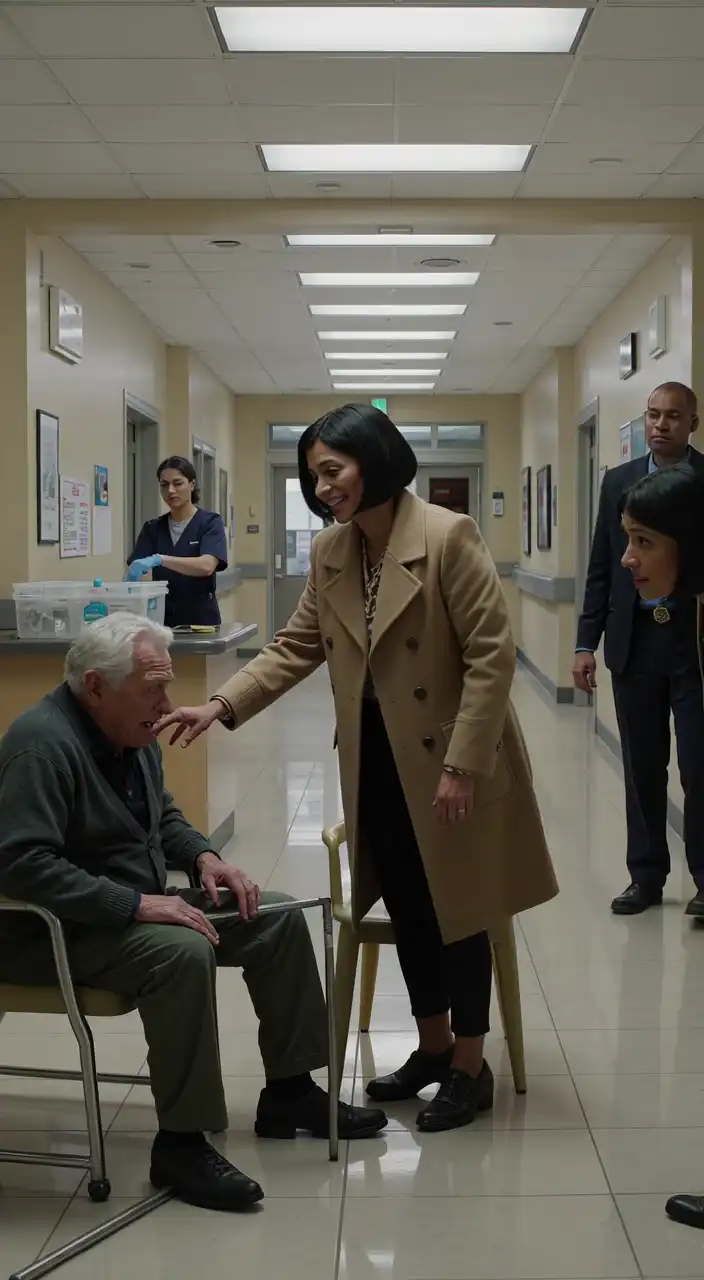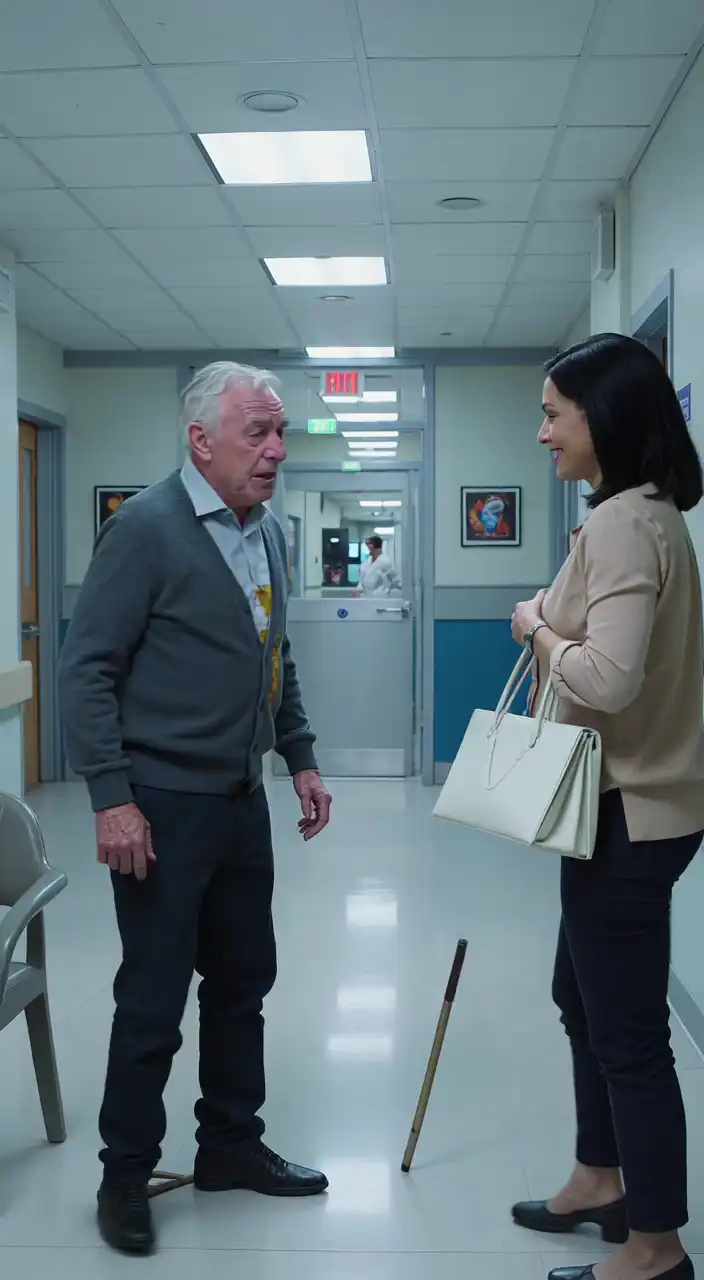
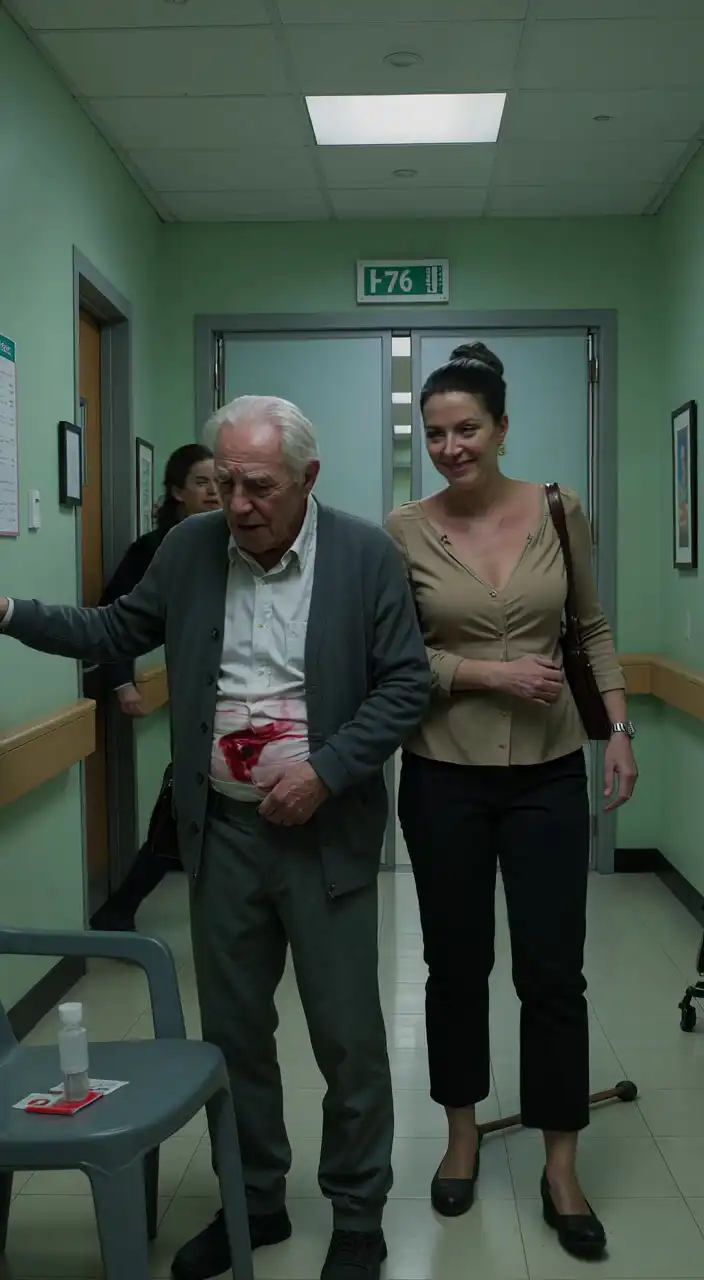
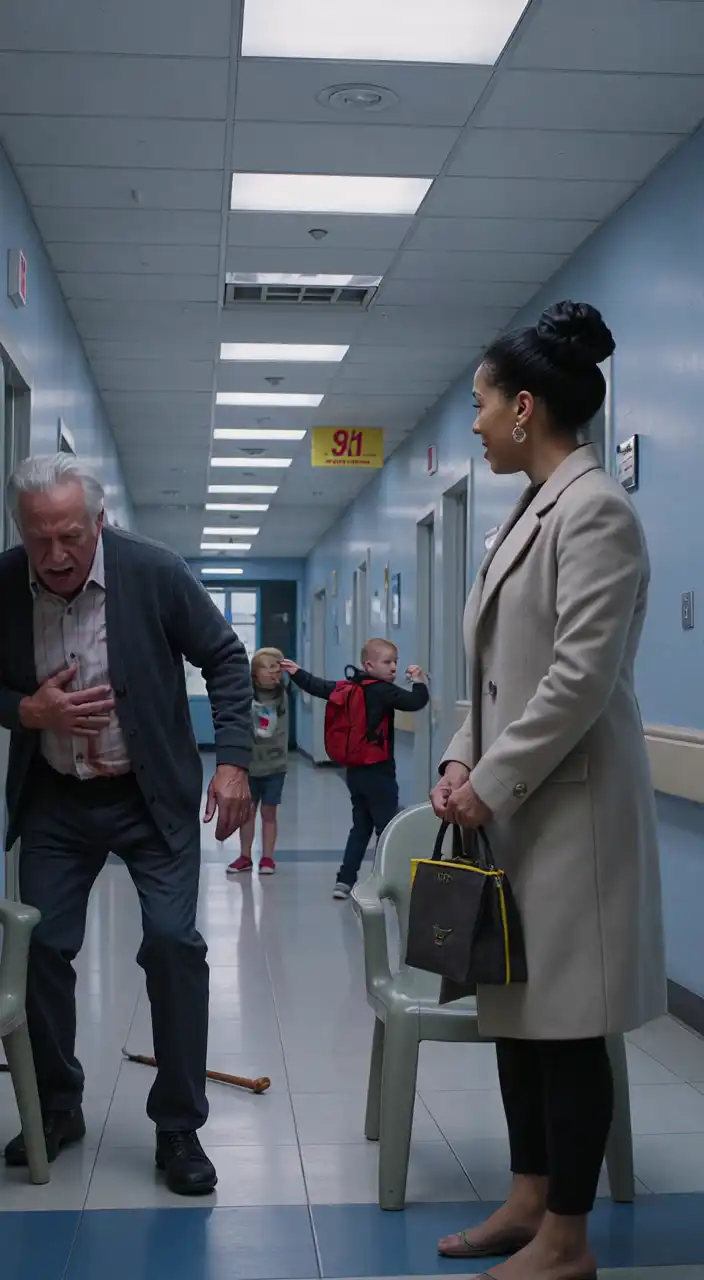

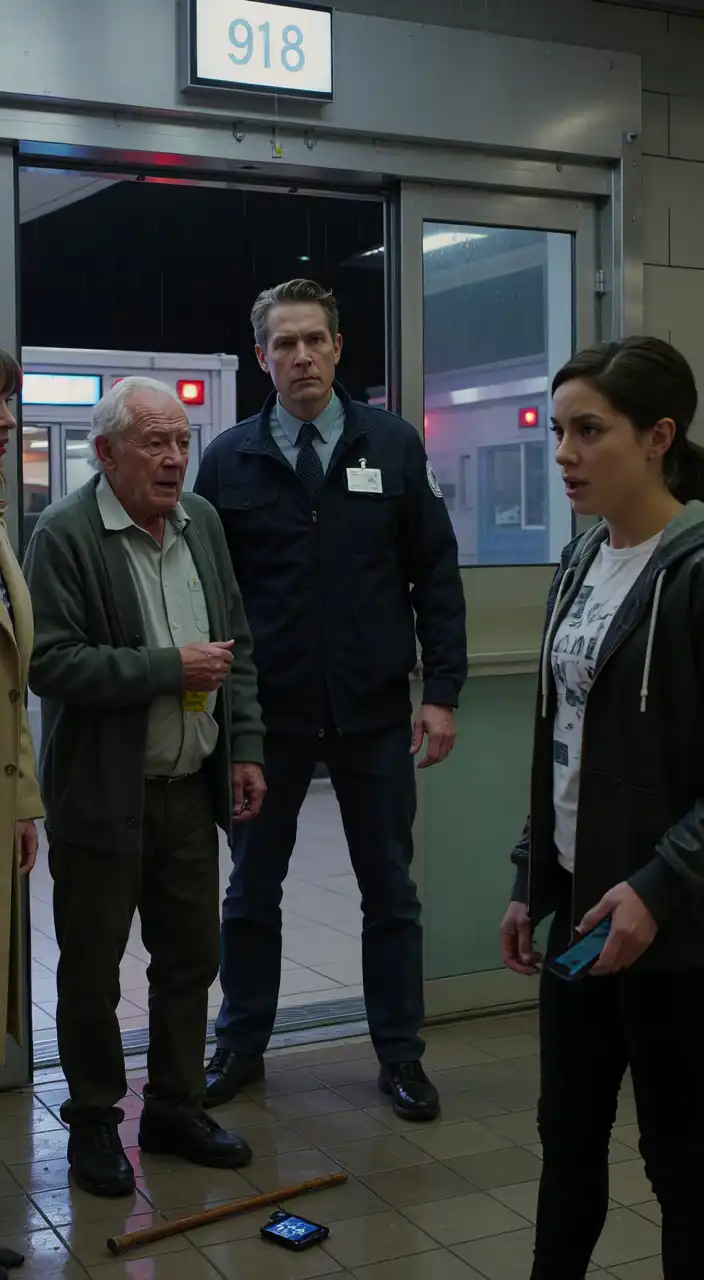
The papers slapped against her leg in the wind, and Dad saw them at the same time I did.
"Those are mine," he said, but the words came out ragged, almost lost under the hiss of rain and the whine of backing sirens. He reached for Marlene's coat pocket, missed, and grabbed the edge of the wheelchair parked by the wall instead. The chair rolled, the cane skidded, and his knees buckled.
I caught him under one arm a second before he hit the pavement.
Caleb did not move to help. He lifted his tablet against the rain and said, too evenly, "If he falls, that becomes an outside incident. You need to step away and let security handle this."
"Security?" I stared at him. "He has a fever and he can't stand."
The sliding ambulance doors opened again and a gust of cold air rushed out from the bay. Two paramedics came in fast, orange bags in hand, rain beading on their jackets. The older one, Charles, took one look at Dad half-sagging against me and dropped to a knee right there on the concrete.
"I'm Charles with county EMS. Sir, can you tell me your name?"
"Ethan," Dad whispered. His face had gone gray under the harsh lights. "Ethan Ward."
"Good. Ethan, look at me." Charles touched the side of Dad's neck, then his forehead. His expression changed immediately. "He's burning up. How long has he been like this?"
"Since they brought him out," I said. "He had surgery two days ago. He started shaking in the car lane. They won't let him back in."
Caleb cut in before I could say more. "Patient was properly discharged. Family became combative over billing. He's likely overmedicated and anxious."
Charles turned his head slowly toward him. "Who stopped the 911 call?"
The younger paramedic had already wrapped a blood pressure cuff around Dad's arm and clipped a pulse ox on his finger. Dad's hand was trembling so hard the red light bounced over his knuckles. The monitor chirped once, then settled into a too-fast rhythm.
"No one stopped anything," Marlene said. She was still clutching her coat, but the folded papers were showing now. "He wanted to go home. He gets dramatic when he's scared."
Dad's eyes opened wider at that. There was humiliation in them, but also something harder. He looked at Charles and said, with effort, "Don't let her answer for me."
That was enough to change the whole temperature of the scene.
Charles stood up just enough to put himself between Dad and everyone else. "I need space. Right now." Then to Dad: "Did you ask for an ambulance?"
Dad nodded once.
"Did anyone tell you not to call?"
Another nod. His jaw clenched against a wave of pain, and he sucked in a breath through his teeth.
The younger medic read off the vitals. "Pressure's low. Pulse one-thirty. Temp one-oh-three point four."
Charles did not look surprised, but his voice got sharper. "We are not leaving him here."
Caleb stepped forward anyway, badge out, posture stiff and polished, the same posture he'd probably used to make people feel small all day long. "This is private property and a post-discharge matter. If he is refusing family transport, I need documentation of decision-making capacity and financial responsibility before-"
"Before what?" I snapped. "Before he crashes?"
Charles rose the rest of the way and faced him. He was not taller than Caleb by much, but he had the kind of calm that made everyone else sound ridiculous. "Before nothing. He's a patient with unstable vitals requesting emergency care. Move."
The younger paramedic opened the ambulance stretcher. Metal legs hit the wet ground with a hard click that made me want to cry from relief.
Then Marlene did something I still replay at night. She stepped back, pressed a hand over the papers in her coat, and said, "He already had his antibiotics. His surgeon said this was normal."
Charles's eyes moved to her sleeve. To the bright yellow stain darkened by rainwater. To the matching smear along the edge of Dad's bandage tape.
"What antibiotics?" he asked.
"It was from home," she said too quickly. "I spilled some helping him dress."
Dad made a small sound, almost like he wanted to laugh and couldn't. "She poured it in my juice."
Silence landed hard between all of us.
The younger paramedic looked up. Caleb's face stayed smooth for one beat too long. Marlene's fingers clenched until the papers crackled.
Charles asked the next question gently, which somehow made it worse. "Sir, do you know what she gave you?"
Dad swallowed. "Said it was what they prescribed. Bitter. Yellow cap."
I looked down instantly at the little plastic cap near the baseboard. Rain had pushed it half under the metal track of the sliding doors. It was bright mustard yellow against the gray concrete. I reached for it before anyone else could.
Caleb said, "Don't touch hospital waste."
"It's not hospital waste," I said, already holding it up. There was still a thread of sticky residue inside. "It was here before the ambulance pulled in."
Charles took a specimen bag from his kit and held it open. "Drop it in."
Marlene's mouth opened, then closed.
Dad started shivering again, harder this time. Not just shaking from cold, but full-body tremors that made the monitor lead slip from his chest as the younger medic exposed part of the dressing. The tape was wet, and under the outer layer was a bloom of angry redness around the incision site.
The younger paramedic muttered, "This looks bad."
Charles looked at the wound for half a second and made his call. "Possible post-op infection, possible medication issue, possible altered discharge. Load him now."
Caleb put out one hand toward the doorway. "The emergency department is at capacity. If you're transporting, he needs to be diverted."
Dad heard that and grabbed Charles's wrist with surprising force. "No road," he said.
Charles bent close. "What road?"
"Storm. Ridge cut. Floods first."
His words were broken, but I knew what he meant. The county road to the next hospital closed early when the creek rose. We had all heard the weather alerts that afternoon. If they diverted him across county, and the ridge road shut down, we'd lose another hour.
The younger medic was already helping lift Dad onto the stretcher. "Dispatch said west route may close in twenty."
I swung toward the doors. Inside, I could see nurses moving, wheelchairs stacked near the wall, the glow of triage monitors. Care was literally fifteen steps away.
"He needs to be here," I said. "You can see he's septic or something. He was just discharged from this building."
Charles nodded once, but he was thinking through two problems at once: the patient's instability and the hospital administrator trying to wall off access. His radio crackled with weather updates and bed status, too fast for me to catch. Then he looked at Dad again and asked, "Ethan, do you want to go back into this hospital?"
Dad did not hesitate. "Yes."
That should have ended it.
Instead Caleb said, "Without a valid readmission order, this creates an uninsured uncompensated event on a restricted account. His spouse has already declined additional admission."
Dad turned his head on the stretcher and stared at Marlene like he had never fully seen her before. "You declined?"
She started crying on cue, neat tears, controlled enough that they never changed her voice. "Ethan, please. We talked about this. We cannot keep doing these dramatics every time a bill shows up."
My whole body went cold. Dad had spent thirty years as an electrician, every overtime shift he could grab, and after surgery he had been talking in his sleep apologizing for "being expensive." Hearing her say it out loud, here, while he shook with fever in the rain, made something lock into place.
Charles heard it too.
He looked at me. "Are you daughter or son?"
"Daughter," I said.
"Can you tell me who discharged him and what paperwork was given?"
"I never saw the papers. She has them." I pointed straight at Marlene. "And she hid them."
Marlene backed away. "I was protecting him from getting upset."
From inside the doorway, a voice finally cut through. "Protecting him from what?"
A nurse in navy scrubs had come out from triage, maybe the same one who looked away before. This time she was not looking away. Her eyes went from Dad's shaking body to the folded paperwork in Marlene's coat and then to the yellow stain.
Caleb's tone sharpened. "Tamara, go back inside. This is an administrative discharge dispute."
Tamara ignored him completely. She stepped to the stretcher and glanced at the dressing. "Who signed this discharge?"
"No one needs to discuss internal process in front of family," Caleb said.
Dad found enough strength to answer for himself. "Not me."
Tamara's eyes snapped to his face. "What do you mean, not you?"
He licked dry lips. "She signed. Said I was sleeping."
Marlene said, "He asked me to."
The younger medic looked at Charles. Charles looked at Tamara. It was like watching separate pieces of a door start to align.
Then Charles held up the bagged yellow cap and said, "We also have a possible medication concern. Patient reports he was given something not understood after discharge, now tachycardic, hypotensive, febrile, altered by pain and stress. Open line recorded someone discouraging EMS response."
Caleb actually took a step backward.
Tamara's face changed from concern to something closer to alarm. "What medication?"
Marlene's answer came too fast again. "Liquid antibiotic."
Tamara asked, "Name it."
No answer.
The rain hammered the bay roof. The radio on Charles's shoulder cracked with a flood advisory and a warning that Ridge Cut Road was under observation for closure. He did not wait any longer. "We are moving. Either he goes through those doors now or we transport blind in a storm while this whole argument gets documented on my chart and the 911 recording."
That was the first moment Caleb looked less like a gatekeeper and more like a man calculating what could ruin him.
He turned toward the nurse and said, "Bring a gurney inside triage."
Tamara did not move.
She held Dad's gaze for one more second, then looked at the papers sticking out of Marlene's coat. "No," she said quietly. "Bring me that discharge packet first."
Marlene clutched the papers tighter.
Charles's radio crackled again, louder this time, and somewhere beyond the bay, thunder rolled so close it shook the glass.
Tamara reached for the papers, and Marlene jerked away so hard that one page tore free and slid across the wet concrete to Charles's boot.
He bent, picked it up, and read one highlighted line. Then he looked at me and said, "Who wrote 'No oral medication due to aspiration risk' on this chart?"
No one answered, because every person standing there suddenly understood the yellow stain meant something much worse than a spilled antibiotic.
Charles held the page away from the rain, reading fast while the younger medic tightened straps across Dad's legs and chest. I could see enough upside down to catch blocks of discharge instructions, a medication list, and that highlighted warning in bright yellow marker: NO ORAL MEDICATION DUE TO ASPIRATION RISK UNTIL REEVALUATED.
Marlene lunged for the page.
Charles shifted it out of reach without drama, almost absentmindedly, like he'd done this with combative people a hundred times. "Ma'am, stop."
"It says reevaluated," she said. "He was reevaluated."
Tamara held out her hand. "By who?"
No answer.
Caleb jumped in before silence could convict her. "These instructions are preliminary printouts. Not final orders. Families misunderstand the wording all the time."
"Then the final set should be easy to produce," Tamara said.
For the first time, Caleb's polished voice roughened. "Records is down because of the storm."
Tamara looked past him through the glass doors at the central desk. "The charting system is not down. I was in it ten minutes ago."
He turned red, but only at the ears. Tiny sign. Dad used to say people who lied for a living learned to control their mouths first.
Charles handed the page to Tamara, and she scanned it fast. Her jaw tightened. "This wasn't a standard discharge packet. This is surgeon-specific post-op instruction."
Marlene said, "You people are making this sound sinister because he got scared."
Dad opened his eyes and whispered, "Read the signature."
We all looked.
At the bottom of the torn page, just above the witness line, was a crooked signature that looked like Ethan if Ethan had signed while unconscious in the back seat of a moving car. I had seen my father sign a thousand checks, permission slips, birthday cards. He made his H with a heavy upstroke and looped the n at the end. This version barely had letters. It was a dragged line with a stiff E at the front.
"That isn't his signature," I said.
Marlene folded her arms. "He was weak."
Tamara looked at Dad. "Mr. Ward, did you sign these forms?"
"No." The word came stronger this time. "She held my hand on one paper. Said insurance."
The younger paramedic swore under his breath.
Caleb tried a new angle. "This is exactly why these matters should be handled privately. The patient is febrile and unreliable, and the family clearly has conflicts."
The phrase hit me wrong because it was too rehearsed, as if he'd said versions of it before. Charles caught it too.
He asked, "How often do you handle discharges personally?"
Caleb squared his shoulders. "When there are account issues."
"Meaning when payment is uncertain?"
"Meaning when family responsibility is disputed."
Tamara cut in. "He's not bedside staff. He should not have been executing discharge at all."
Caleb turned to her with a warning in his eyes. "Tamara."
But she had already crossed some line inside herself. Maybe she had looked away once and hated herself for it. Maybe she recognized the yellow stain from another patient. Maybe she was just done.
She faced Charles and said, "If this packet is genuine, then somebody bypassed the nurse handoff and medication review. That should not happen."
Dad's tremors worsened. His teeth clicked once against each other. The medic beside him checked the pulse ox again and said, "Sat's dropping. We need oxygen on."
Charles nodded. In seconds a nasal cannula was in place. Dad flinched when the cold tubing touched his skin, then relaxed a fraction as the oxygen flowed. His wedding band tapped lightly against the stretcher rail, a tiny metal rhythm under all the chaos.
I noticed it because it was loose. Dad had lost weight before surgery. The ring slid almost to the knuckle and caught there. A stupid detail to remember, except later it mattered.
Charles kept his focus where it belonged. "Ethan, stay with me. Any trouble swallowing after surgery? Choking? Vomiting?"
Dad swallowed carefully before answering. "Coughed with water. Nurse wrote it down."
Tamara looked up sharply. "Which nurse?"
He frowned, searching through fever and stress. "Red glasses. Night shift."
That gave Tamara something real. "Lydia," she said. "She was on post-op."
Caleb said, "We're not doing staff gossip in an ambulance bay."
Tamara ignored him again and pulled a work phone from her scrub pocket. "I'm calling charge and pulling Lydia."
Marlene's control slipped for the first time. "This is insane. We were taking him home because he hates hospitals."
Dad gave a weak, pained laugh that turned into a cough. "I hate dying in parking lots more."
Even Charles smiled for half a second. Then he became all business again. "We need a destination now."
His radio chirped with dispatch. A second unit had reported water over part of Ridge Cut. Diversion to the county hospital was still technically available, but maybe not for long. The storm was taking away time by the minute.
Tamara made her decision. "Bring him into triage. If administration wants to fight it, they can explain it to the ED attending and risk manager."
Caleb stepped in front of the doorway once more. Not dramatic. Just one polished shoe forward, one arm across, badge swinging on his lanyard. It was almost worse because it looked practiced.
"You are not authorized to override financial hold on a family account tied to private guarantor review."
The phrase was so absurd against a man shaking with fever that even the younger paramedic stared.
Charles's voice dropped. "Move, sir."
"No."
That one word made everything cleaner.
Charles touched his radio mic. "Need hospital security to ambulance entrance. Possible obstruction of emergency medical access."
Caleb laughed once, short and disbelieving. "Security reports to administration."
"Not for assaultive obstruction," Tamara said.
No one had touched anyone aggressively, but the truth was obvious: he was using policy language as a physical barricade. Dad was still on the stretcher because EMS had pushed forward anyway. If Charles had not arrived when he did, Caleb would have kept us in the rain until either we left or Dad collapsed hard enough to become impossible to ignore.
Tamara's call connected. "I need Lydia at ambulance triage now. And page Dr. Patel. Tell him possible unsafe discharge and medication contradiction."
At Dr. Patel's name, Marlene went pale.
I saw it before anyone else. Her eyes flicked to the papers, then to Caleb, then to Dad's face. It was not the look of a wife worried for her husband. It was the look of someone whose story had just lost its safest audience.
Charles saw it too. "Why does the surgeon's name bother you, ma'am?"
She shook her head too quickly. "It doesn't."
Dad whispered, "Because he told her no more home dosing."
All heads turned back to him.
"What home dosing?" I asked.
He closed his eyes briefly, fighting through fatigue. "Before surgery... she kept my pain meds. Said I forgot if I took them. Mixed them for me."
Marlene's voice sharpened. "Because you did forget."
He opened his eyes. "Not till after you started."
The words landed heavy, unfinished, dangerous.
Tamara lowered her phone. "Mr. Ward, has anyone else been managing your medications at home?"
Dad looked at me, and guilt flashed over his face, the kind parents get when they know they protected the wrong person too long. "Didn't want to bother you," he said.
I thought of all the times he sounded foggy on the phone these past months. All the times Marlene answered for him and said he was resting.
Before I could speak, the sliding doors behind Caleb opened and two hospital security officers appeared. One older, one younger, both in gray uniforms already damp from going outside. Caleb straightened like he expected relief.
"Good," he said. "Remove these people from the entrance so-"
Charles cut him off. "Patient requesting emergency care is being obstructed. We need passage to triage."
The older security officer took in the stretcher, the oxygen, the rain, the administrator blocking the threshold, and he did not even pretend this was complicated. "Sir, step aside."
Caleb stared at him. "I'm the evening administrator."
"And I'm telling you to step aside."
For one heartbeat I thought Caleb might still resist, and if he had, the scene would have exploded. Instead he moved exactly six inches, enough to save face, not enough to look obedient. But it broke the wall.
The stretcher rolled forward.
As we crossed the threshold, Dad's hand groped weakly toward Marlene's coat. "My papers."
Tamara was already there. She took the rest of the packet from Marlene before she could clutch it back. Several pages slipped free onto the floor. One of them showed a medication reconciliation sheet with boxes checked and initials beside entries.
Tamara glanced down and went still.
"What?" I asked.
She didn't answer me. She bent, snatched up the page, and looked straight at Caleb. "Why is there a documented refusal of swallowing evaluation entered after transport to discharge?"
Charles turned around with the stretcher half inside triage. "Meaning?"
Tamara's face had gone rigid. "Meaning somebody charted that he refused a safety eval after he was already being wheeled out."
Dad whispered, "I never refused."
Marlene took one step backward. Caleb said, "You are interpreting timestamps without context."
"Then give us context," Tamara said.
He opened his mouth, but at that exact moment a woman in red glasses came running down the hall from post-op. Lydia.
She saw Dad, saw the stain, saw the papers in Tamara's hand, and stopped so abruptly her badge flipped over.
"I told them not to send him out," she said.
Everything changed again.
Lydia came to the stretcher first, not to any of us. She touched Dad's forearm lightly. "Mr. Ward? It's Lydia. Can you hear me?"
He nodded, eyes half-open.
Her relief lasted only a second before anger replaced it. "You weren't supposed to leave until speech cleared swallowing and Dr. Patel reviewed the fever. I documented all of it."
Marlene said, "No, you told us to follow up if it got worse."
Lydia turned to her. "I never said that."
Caleb stepped in with the confident voice he had been trying to keep all evening. "Let's slow this down. Families often hear fragments of instruction and panic."
Lydia faced him as if she had been waiting weeks to do it. "I put a hold in his chart because he coughed on water, spiked a fever, and had drainage on the dressing. Then I came back from another room and transport had already taken him downstairs."
Tamara held up the packet. "There's a refusal note entered after the discharge timestamp."
Lydia's mouth fell open. "I didn't enter that."
No one spoke for a beat.
Then Charles said, "Who has access to add that note?"
"A provider, charge, case management, or admin with override routing," Tamara said.
She did not look at Caleb when she said admin. She didn't have to.
We were inside triage now, but not safe. Dad's monitor alarm chirped again, more urgently. A nurse pulled open a curtain to receive him in a bay. Another brought a portable suction setup, and that one detail made the aspiration warning feel suddenly terrifyingly real.
Charles gave report while the younger paramedic helped transfer Dad. "Post-op male, unstable vitals, febrile, hypotensive, tachycardic, possible aspiration risk, possible unsafe discharge, questionable medication exposure, open-line 911 with interference."
Hearing it laid out like that, in clean medical language, made me realize how many chances there had been for him to be protected before this moment.
Dad grabbed my wrist before they could wheel him behind the curtain. His fingers were weak but urgent.
"Inside pocket," he whispered.
"Marlene's coat?"
He nodded once. "Green card."
Then they moved him beyond the curtain, and all I could see was the rise of his knees under the blanket and the yellowed edge of the dressing as staff descended around him.
The "green card" sat in my mind like a stone, but I had no chance to ask more because Dr. Patel arrived at a near-run from the inner hall, surgical cap still on, mask hanging at his neck. He was older than I expected, with the tired eyes of someone used to being called back into trouble.
"What's going on?" he demanded.
Tamara handed him the torn discharge page and then the medication sheet. He scanned both, then looked up sharply. "Who authorized discharge?"
Caleb answered instantly. "Case review was pending, but the family elected home recovery against recommendation."
Dr. Patel turned to Lydia. "Did Mr. Ward sign AMA?"
"No," Lydia said. "He was not competent for full review when transport came. He was drifting, febrile, and coughing. I flagged for reevaluation."
Dr. Patel looked at Tamara. "Who cleared transport?"
She swallowed. "I don't know yet."
Charles was still there, finishing documentation, and he added, "Patient states spouse administered oral liquid despite written no-oral instruction."
Dr. Patel's head snapped toward Marlene. "What liquid?"
She crossed her arms tighter, brittle now instead of controlled. "Antibiotic. You doctors hand people papers and expect families to become nurses."
"I did not prescribe oral antibiotic at discharge," Dr. Patel said. "Because there was no discharge."
The sentence hit like glass breaking.
Marlene looked at Caleb.
That was the first true reversal. Until then, I thought the whole thing was a greedy wife forcing a sick man home while an administrator protected billing. Ugly enough. But the way she looked at him was not for support. It was for confirmation. Like they had already agreed on what story they were telling.
Dr. Patel saw it too. "Why are you looking at him?"
Caleb lifted his chin. "Because you're accusing staff in front of family based on confusion and weather chaos."
"Weather didn't forge a refusal note," Lydia said.
Security had stayed by the doorway. The older officer shifted his weight, more alert now. The younger one quietly closed the triage entrance to outside traffic. Rain and ambulance lights flashed through the glass, but the space had tightened around us.
I remembered Dad's whisper. Inside pocket. Green card.
Marlene still had her coat hugged closed with one arm. In the confusion, no one was watching her hands. I stepped around the nurse station as if to get a better view of Dad's bay. Instead I stopped beside Marlene.
"What's the green card?" I asked softly.
Her whole body jerked.
"I don't know what you're talking about."
That was answer enough. I reached for the inside fold of her coat.
She slapped my hand away. "Do not touch me."
Security looked over instantly. The older officer came closer. "Ma'am."
"She has something of his," I said. "He asked me to get it."
Marlene's face sharpened into real fear. "It's private."
Dr. Patel didn't even turn from the chart in his hand. "If it concerns the patient's care, it's not private from the medical team."
Caleb said, "This is spiraling. The spouse has rights."
Dad's voice cut through the curtain from the bay, weak but clear enough. "Not anymore."
Every person in triage froze.
I could not see him, but I heard the rustle of linen as he tried to push himself up. "Wallet. Green card. In her coat."
The older security officer held out his hand to Marlene. "Ma'am, if the patient is requesting his property, give it over."
For one second I thought she might bolt. The storm had closed off the outer world, but panic can still make people stupid. Instead she fumbled into the inner pocket and pulled out a green plastic card attached to a worn envelope.
I knew the card the second I saw it.
It was Dad's medical power of attorney file card from the rehab consult packet after his first surgery scare three years ago. He had told me then, half embarrassed, that he was updating emergency contacts "just in case." We never talked about whether he actually submitted the final change.
Marlene tried to hand the envelope to Caleb.
Not to me. Not to Dr. Patel. To Caleb.
Security noticed. So did everyone else.
The older officer said, "No, ma'am. Hand it here."
She obeyed because she had run out of moves.
He gave it to Dr. Patel, who opened the envelope and removed a folded legal form, damp at the edges. His eyes moved over the signature line, the witness boxes, and then up to me.
"Miss Ward," he said carefully, "this names you as primary medical decision-maker if your father is unable to consent."
Marlene made a choking sound. "That was never finalized."
Dr. Patel checked the bottom page. "It was witnessed and scanned last year."
Tamara turned toward Caleb. "Then why was spouse entered as sole contact with authority to decline admission?"
Caleb had no quick answer. He looked, for the first time, like a man who had expected paperwork to stay buried in a coat pocket until after the storm.
Charles closed his chart tablet. "I need to know if law enforcement is being requested, because this has crossed from refusal to possible neglect and falsified documentation."
Nobody answered immediately because from behind the curtain, a nurse called out, "Pressure's falling again."
Everything snapped back to the reason we were there.
Dr. Patel moved into the bay at once. "Large-bore IV, cultures, lactate, broad-spectrum IV antibiotics now. NPO. Portable chest film and CT if he stabilizes. Call ICU."
NPO. Nothing by mouth. The yellow stain on her sleeve felt suddenly radioactive in my mind.
Tamara pressed a hand over her own mouth. Lydia looked sick.
Marlene started crying again, but this time the tears came messy. "I was trying to help him. He hates needles. He won't take things unless I put them in juice."
Dr. Patel turned back from the curtain. "What exactly did you give him?"
"I said antibiotic."
"Name it."
She shook her head.
He took one step closer. "If you gave him anything sedating, anything opioid, anything not prescribed, you may have worsened aspiration and delayed recognition of sepsis. This is not the moment to protect yourself."
Caleb cut in, desperate now. "Counsel should be present before anyone-"
The older security officer raised a hand. "Stop talking."
It was a small humiliation, but a visible one. Caleb fell silent.
Marlene looked at the floor and whispered, "Liquid hydrocodone."
Lydia swore. Tamara shut her eyes. I felt the room tilt.
Dad had coughed on water. He had a fever and a fresh abdominal incision. And she had given him narcotic syrup in juice while taking him out the door.
Dr. Patel's face went flat with controlled fury. "That was not on his active post-op plan."
"He was hurting," she said. "And he gets loud. I just needed him calm for the ride home."
There it was. Not mercy. Management.
Charles said quietly, for the record as much as for us, "Patient reports being medicated to facilitate transport against medical recommendation."
Caleb snapped, "You cannot document motive based on family conflict."
Charles met his eyes. "Watch me document what I heard."
That was the second mini-reversal. The man who had used procedure as a weapon was now trapped by procedure.
A clerk from registration approached the desk with nervous hands. "Road closure just updated. Ridge Cut is shut down."
If Charles had diverted Dad, he might have been stuck in an ambulance on a flooded route. The timing made me shake.
Inside the bay, machines beeped in quick succession. Dr. Patel disappeared back behind the curtain. Staff moved around him with the brutal efficiency of people who know there is no more room for delay.
I stood at the opening until a nurse blocked me gently. "Give us one minute."
One minute feels like a year when your parent is behind a curtain and every sound seems coded.
Beside me, the older security officer asked Tamara for names. She started listing them: discharge timestamp, who transported, who charted the refusal, who handled account restrictions. Caleb stayed very still, but I could see the pulse hammering in his neck.
Then the curtain shifted and Dr. Patel stepped back out. "He is septic until proven otherwise. Possibly aspiration on top of post-op infection. We have him for now, but I need history and I need it honest."
He looked first at me because the green card had changed the map of authority.
So I told him everything I could in under a minute: the shaking, the yellow stain, the cap by the door, the open 911 line, Dad saying she gave him something, the hidden papers, the blocked re-entry. While I spoke, Tamara bagged the rest of the discharge packet. Charles added the cap bag to the pile.
Dr. Patel listened without interrupting. When I finished, he nodded once. "Good. Stay available. Adult Protective Services and risk management are going to need you."
Marlene whispered, "APS? For a fifty-seven-year-old?"
"For a vulnerable post-surgical adult possibly removed from care unsafely," Tamara said. "Yes."
Caleb finally tried one last distance-making move. "This is becoming a misunderstanding inflated by family estrangement."
I turned to him. "Then why was my father's POA ignored and his refusal note entered after he left?"
He looked at me and did not answer. He could not answer without naming either fraud or incompetence.
From inside the bay, Dad called my name.
I went in.
He looked smaller on the bed than he had outside, maybe because the effort of staying dignified was finally gone. IV fluid ran into his arm. A nurse was hanging antibiotics. His face was slick with sweat, but the oxygen had eased some of the panic in his eyes.
He touched the wedding band that had nearly slipped off outside. "You got the card?"
"Yes."
He exhaled. "Good."
"Why didn't you tell me about any of this sooner?"
His eyes filled, and I hated that I had asked, but I needed to know. "Because she kept saying I was forgetting things. Then I started forgetting small things. Thought maybe she was right." He swallowed painfully. "Then bills. Calls. She and him... always talking low."
"Him?"
"Caleb."
I stared at him.
He closed his eyes for a second. "He came to the house once. Said he was helping with account options."
The ground shifted again. This was bigger than one discharge. Bigger than a bad spouse. There had been contact before tonight.
A nurse adjusted the monitor and murmured, "Try not to talk."
Dad tightened his hand on mine. "Phone."
"What phone?"
He opened his eyes. "My old phone. Top drawer in garage workbench. She thought I threw it away."
Before I could ask why that mattered, his monitor tone changed and two nurses moved in quickly. Dr. Patel was back at his side instantly. "Out, please."
I stumbled back behind the curtain line while they worked, not because he was coding, not anything that dramatic, but because the pressure was falling and they needed full access. The nurse guided me out with practiced kindness.
In triage, the storm battered the doors. Security had separated Marlene and Caleb to opposite sides of the desk. Tamara was on a call with someone from risk. Charles was still there because his report now mattered to more than medicine.
And in the middle of all that, I stood holding a green card that proved my father had tried to protect himself long before he found the strength to say no out loud.
Then Marlene lifted her head and said the strangest thing yet.
"If he wakes up clear," she said to no one and everyone, "ask him who started the money transfers."
Even Caleb turned toward her at that.
For a second, in the chaos of sepsis and forged notes and blocked care, a new possibility opened: maybe the money was the motive, but not in the simple way I had assumed. Maybe Dad had discovered something before tonight. Maybe the hidden old phone in the garage held more than family calls.
And if that was true, then getting him stable was only the first rescue.
The next two hours moved in waves that never fully broke.
Dad was transferred from triage to an ICU step-down room because the actual ICU had one bed left and another patient crashing in the emergency department. Dr. Patel said they had him on broad-spectrum IV antibiotics, fluids, blood cultures, imaging when possible, and strict aspiration precautions. It was enough information to calm me for thirty seconds at a time before the next fear arrived.
Charles finished his report but did not leave immediately. He found me by the wall outside Dad's room while Tamara spoke with a supervisor down the hall.
"I wanted to tell you what the 911 audio captured," he said. "Not all of it, but enough."
I braced myself.
"The dispatcher heard you requesting help, an unidentified male saying not to send an ambulance, and another female voice saying the patient was discharged and was embarrassing everyone. Then your father saying, 'I can't swallow right.'"
I covered my mouth.
Charles softened his voice. "That line matters. It supports what the nurse documented and what the papers say."
"Will they actually do something with it?"
"Hospital might try to contain the internal side. But if APS, law enforcement, and risk all get the same facts at the same time, it gets harder to bury."
He glanced down the hall toward where Caleb sat under the eye of one security officer, no longer in charge of anything. "People like him count on the room never lining up. Tonight it lined up."
The sentence held me up more than he knew.
Before he left, he handed me a card with his name and unit number. "If anyone pressures you to say he was just confused, call me."
When he walked away, orange bag swinging at his side, I had the absurd urge to hug him. Instead I clutched the card so hard the edges dented my palm.
Tamara came back a minute later carrying a printed face sheet and three photocopied pages. "I shouldn't be giving these casually," she said, "but you're listed now, and Dr. Patel approved. Read this."
The first page was Dad's emergency contact section. My name was there, primary decision-maker under the scanned POA. Marlene was listed as spouse and secondary contact only. A red audit line at the bottom showed a profile change made six weeks earlier. User override: C. Narayan.
Caleb's full last name.
My stomach turned.
Tamara tapped the line. "This is why I stopped trusting my own gut about him a while ago. He had too much 'helpful access' to too many charts."
"You suspected him?"
"I suspected pressure. Wealthy guarantors, private rooms, selective exceptions. The kind of things administrators call service recovery." Her mouth hardened. "I did not suspect they were changing who got to say yes or no at the bedside."
The second page was an event log. It showed a refusal of swallow evaluation entered at 6:42 p.m. The transport from floor to discharge elevator had been logged at 6:31.
"He charted after Dad was already downstairs."
"Looks that way. Could be his login was used by someone else." She held my gaze. "But that's not a comfort."
The third page was a medication reconciliation. Two prescribed meds had been checked as reviewed. A liquid narcotic was not listed anywhere. Yet in the margin, a note in small handwriting said family has home supply, spouse aware of use history. No initials beside it.
"Can you trace who wrote that?"
"Maybe. Maybe not. But it should never be there unofficially." She folded the pages back together. "There is another thing."
I waited.
"The yellow stain." She lowered her voice. "I know that color."
"From what?"
"Some liquid hydrocodone formulations use a yellow dye. Not all. But enough."
A planted detail clicking into place should have felt satisfying. It felt sickening.
"So Dad was right."
"About being given something orally? Almost certainly. About whether it was just to quiet him, or to help get him out before he triggered a readmit? That's where motive gets messy."
Messy. Such a thin word for what was taking shape.
An hour later Dr. Patel called me into a small consult room. Not a conference room. Not his office. One of those in-between spaces built for bad news and private decisions.
"He has sepsis from a likely surgical site infection," he said. "There are also signs consistent with aspiration risk, and we're treating conservatively until imaging clarifies whether material went into the lungs. The oral narcotic could have worsened his swallowing and masked deterioration."
"Is he going to make it?"
"I believe he has a very real chance because he got back in tonight. If this had stretched overnight at home, my answer would be darker."
I sat down hard.
He let me breathe for a second before continuing. "Now the non-medical part. His chart contains modifications and documentation that do not align with bedside observations or timing. Risk management is here. APS has been notified. I have also requested local law enforcement because if someone knowingly facilitated discharge against active hold, that is not an internal misunderstanding."
"Was Caleb doing this for Marlene? Or because of billing?"
He gave a surgeon's answer: honest about limits. "I don't know yet. But hospitals do not create financial holds that override emergency assessment. If he said that, he was using institutional language in a false way."
I thought of Dad saying Caleb had been at the house. "What if they know each other outside tonight?"
"Then tonight is not the beginning."
He slid a tissue box closer though I hadn't cried yet. "One more thing. If your father becomes more clear overnight, ask him about his baseline over the last few months. Memory changes, sedation, money decisions. We need to distinguish illness from manipulation."
That word stayed with me: manipulation.
When I left the consult room, two new people were waiting in the hall. A woman from Adult Protective Services in a plain blazer with wet hair from the storm, and a sheriff's deputy carrying a notebook already warped at the edges by rain.
The deputy introduced himself as Jensen. The APS worker was Monica Ruiz. Neither wasted time.
"We understand there may have been blocked emergency access and possible medication misuse," Monica said. "Your father is under sixty, but vulnerable adults include people with temporary incapacity from medical conditions. We need your account tonight while details are fresh."
So I gave it again. Every line. Every stain. Every word I could remember.
Jensen wrote quietly until I mentioned the old phone in the garage.
He looked up. "Why would there be a second phone?"
"Dad told me she thought he threw it away."
Monica and Jensen exchanged a quick glance.
"Could be nothing," Monica said. "Could be a safe device he used when he didn't want calls screened."
Jensen asked, "Can anyone access the house tonight?"
"Marlene can."
"Then if there is a phone with relevant messages or account records, we may need to move fast."
The storm made everything harder. The ridge road was closed. Half the deputies were tied up on weather calls. Search warrants in the middle of the night were unlikely without clearer evidence. Yet waiting until morning could mean deleted data.
"Can I just go get it?" I asked.
Jensen shook his head. "Not alone, not if there is now a potential criminal angle and conflict in the home."
Monica asked, "Any other family keys?"
I thought of Dad's ring tapping the stretcher rail. The garage keypad. Then remembered something else planted earlier in the evening but not understood: the way Marlene had kept both hands on her coat at the bay, not one. Not just protecting papers. Protecting weight.
"Her key ring," I said. "It was in the coat too."
"Do you know the house code?" Jensen asked.
I did. Dad used the same four digits for everything until we bullied him to vary them. If he had hidden a phone in the workbench, he probably had not changed the garage code.
Jensen made a quick call. Because the road to Dad's neighborhood was not yet closed, only monitored, he could escort me for a limited retrieval if APS documented consent based on my authority as decision-maker and if hospital security held Marlene on site for interview.
"Will they hold her?" I asked.
Monica glanced down the hall. "They will if she knows what's good for her. And if she tries to leave, that becomes another report."
I found Tamara at the desk and told her. She nodded immediately. "Caleb isn't going anywhere either. Risk finally woke up."
She almost smiled when she said it.
Then a new pressure point hit.
A nurse rushed from Dad's room and called for respiratory. Not a code, but urgent enough to erase every other thought. I followed halfway before being stopped again. Through the partly open door I saw Dad sitting more upright, coughing hard while a therapist adjusted suction and oxygen. Dr. Patel was there, hand on the bed rail, voice low and firm.
Aspiration was not a theory anymore. It was in the room.
Five endless minutes later, the therapist came out. "He had secretions he couldn't clear. We got him settled. You can look in from the door, but don't excite him."
Excite him. As if I were a weather pattern.
I looked in. Dad had his eyes closed, breathing through oxygen, face exhausted but calmer. The sight forced a decision in me. If there was evidence in that garage phone that explained why Marlene and Caleb pushed so hard tonight, I had to get it before anyone at the house touched it.
I leaned over Dad just enough to speak softly. "I'm going to get the old phone."
His eyelids fluttered. He did not fully wake, but his fingers moved once against the blanket. Permission.
By the time Deputy Jensen and Monica walked me to the parking deck, the rain had thinned to cold needles. The hospital behind us glowed like an island. I turned once and saw the ambulance entrance from a distance, the place where Dad had nearly been left outside of his own care because someone with a badge found a sentence ugly enough to use against him.
Jensen drove. Monica rode in back with me and reviewed the plan: enter, retrieve only what Dad identified, document location, leave. No searching drawers for curiosity. No confronting neighbors. No improvising.
The roads shone black and dangerous under weak streetlights. Twice we passed water pooled near curbs. A county alert buzzed on Jensen's dash radio every few minutes.
Halfway there, Monica asked, "Has your father ever mentioned money transfers before tonight?"
"No. But he said ask him if he wakes up clear. And Marlene said that weird thing about him starting them."
Monica nodded. "That can mean two opposite things. Either she is preparing a blame story, or there really were transfers and the issue is where the money went."
Jensen added, eyes on the road, "Either way, hidden phones usually mean records."
When we pulled into Dad's driveway, the porch light was on and the house looked painfully normal. Wind stirred the maple by the garage. Dad's truck sat where it always did. If you had not seen the ambulance bay, you would think nothing was wrong.
The garage code still worked.
Inside, the workbench smelled like sawdust, motor oil, and the peppermint hand cleaner Dad always used after wiring jobs. The top drawer stuck halfway, same as when I was sixteen. I tugged harder.
There, under old manuals and a flashlight with dead batteries, was a silver flip phone wrapped in a shop rag.
A flip phone. Of course. Dad trusted things that lasted.
When I lifted it, something else came with it: a small spiral notebook and a bank envelope.
Monica stopped me. "One at a time. Phone first. Note exact location."
I did. Jensen photographed the drawer, the rag, the phone.
Then I opened the flip phone.
It was dead.
My heart dropped.
But Dad had always kept chargers in ridiculous places. I checked the back of the drawer. There was one, rubber-banded to a bundle of spare fuses.
Monica actually let out a breath. "Plug it in. Quick."
While it booted with agonizing slowness, Jensen photographed the notebook and envelope where they lay. The screen finally blinked on.
No lock code.
The inbox was full.
Not family chatter. Not old jokes. Bank alerts. Voicemails saved. And one text thread labeled C.
Caleb.
We stared at the screen together while rain tapped the garage door and the county alert blared from Jensen's radio that the last alternate route back toward the hospital might close within the hour.
If that road shut before we got back, Dad would be there without me while the one device that might prove everything sat in my shaking hands.
I opened the thread, and the first message visible on the screen read: Keep Marlene calm. If he asks about the readmit flag, tell him I fixed the account.
Disclaimer: Mention of any brand or trademark is for identification only and does not imply partnership or endorsement
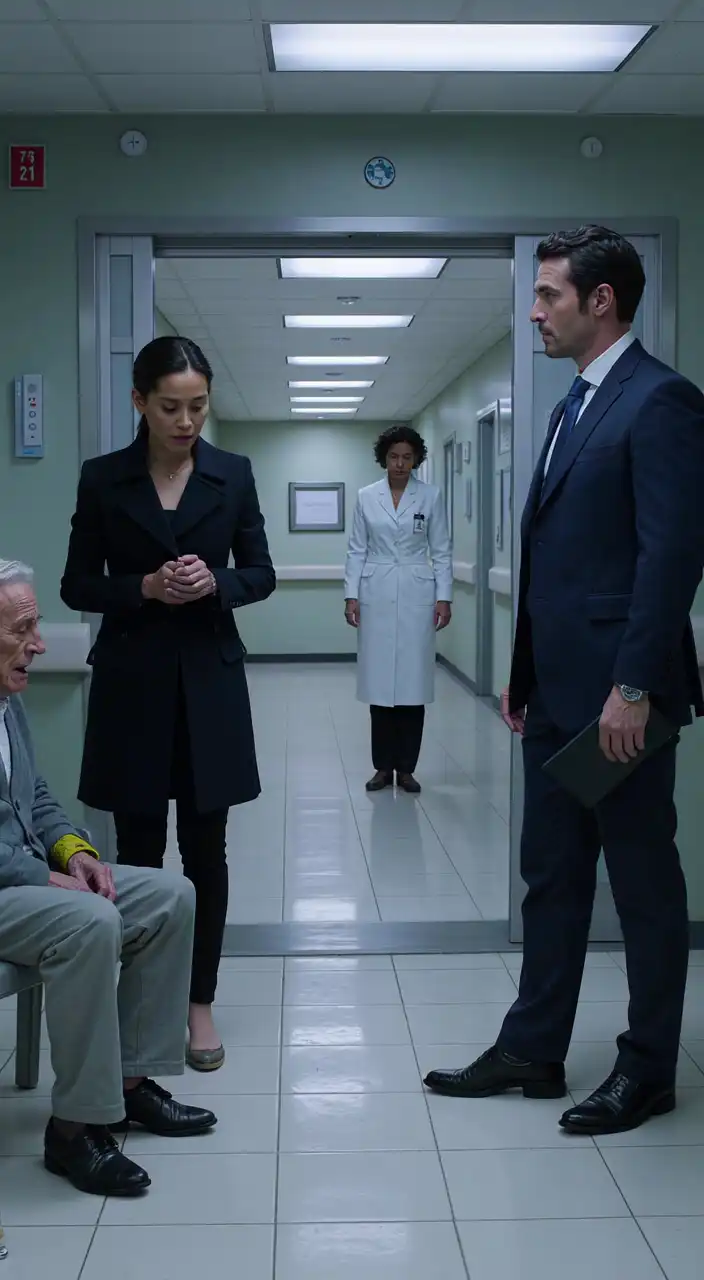
MY FATHER STARTED SHAKING OUTSIDE TRIAGE WHILE A CLINIC ADMINISTRATOR BLOCKED THE DOOR AND SAID HE NEEDED FAMILY PERMISSION FIRST.
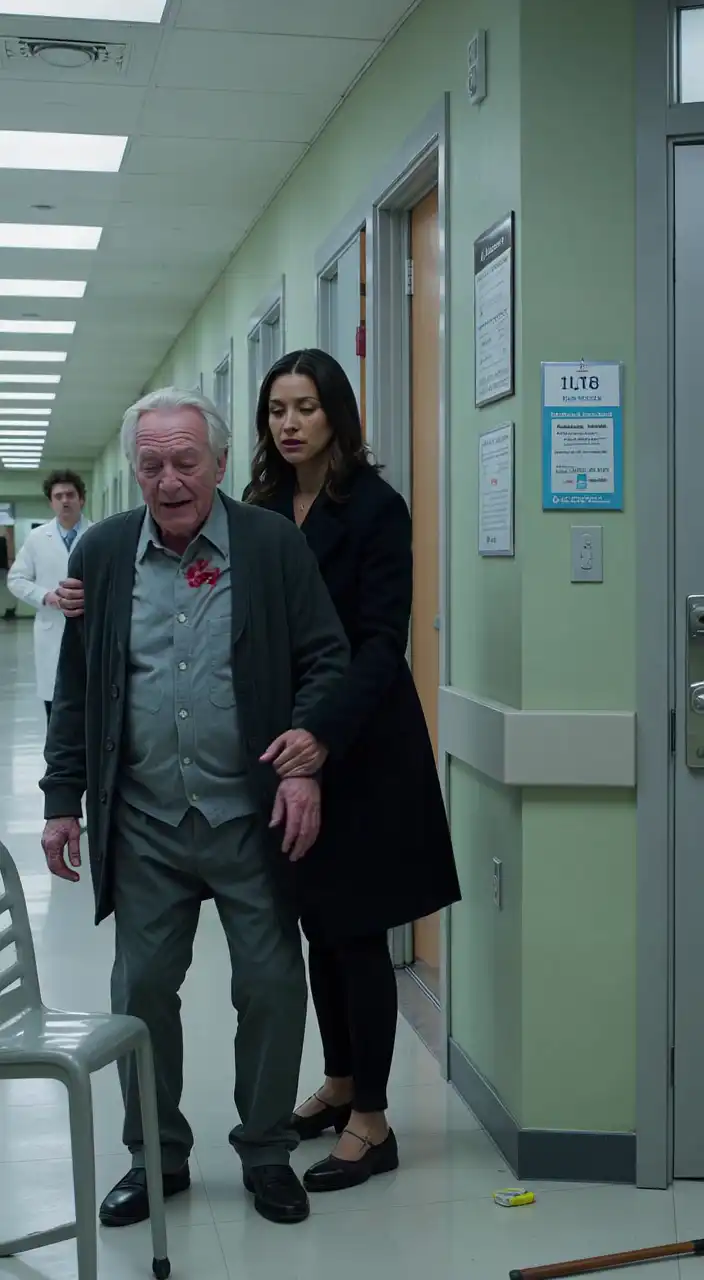
MY FATHER STARTED SHIVERING SO HARD HIS SURGICAL BANDAGE BLED THROUGH, AND THE CLINIC ADMINISTRATOR STILL BLOCKED THE TRIAGE DOOR.
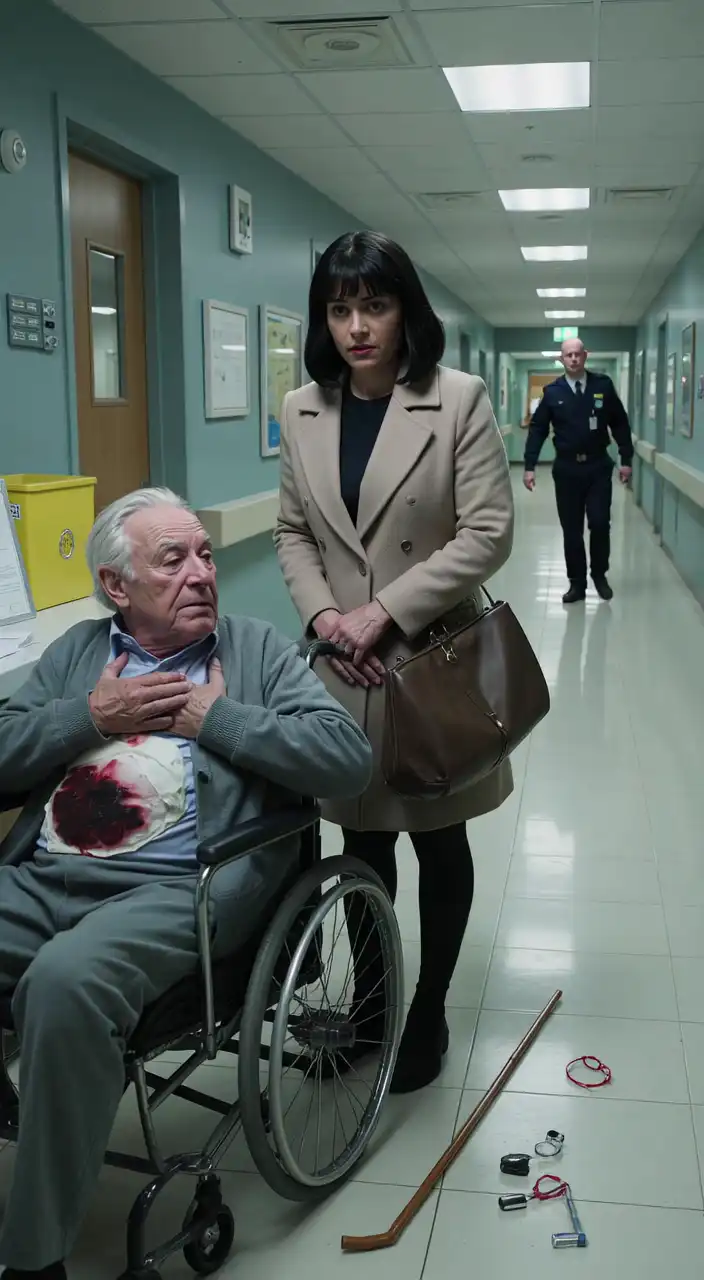
MY FATHER STARTED SHAKING IN THE HOSPITAL HALLWAY, AND THE WOMAN WHO CLAIMED TO BE HELPING HIM WOULD NOT LET TRIAGE TOUCH HIM.