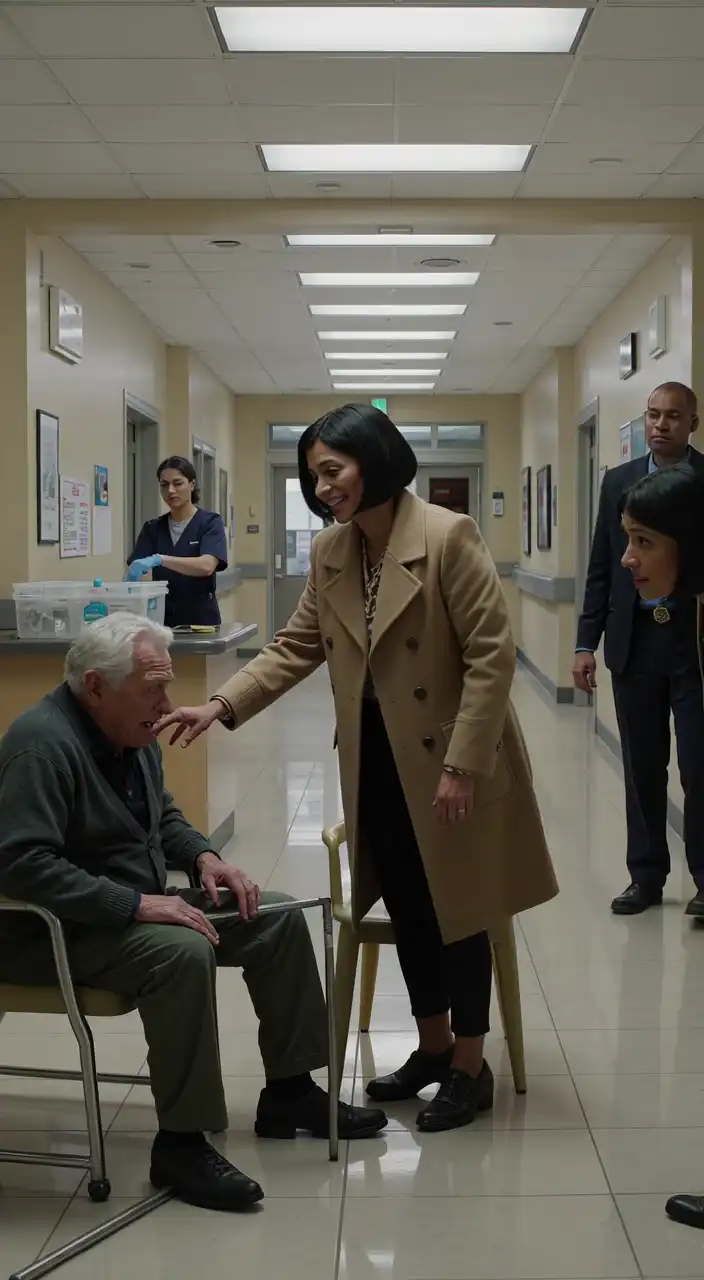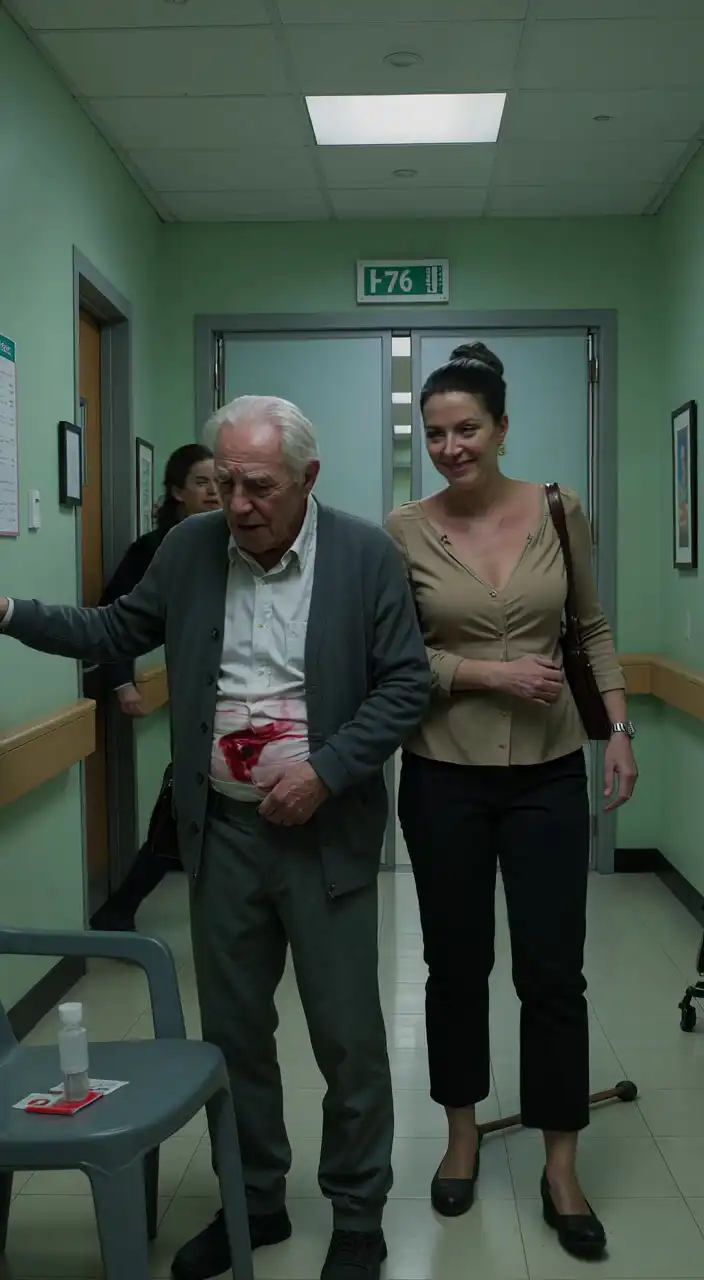
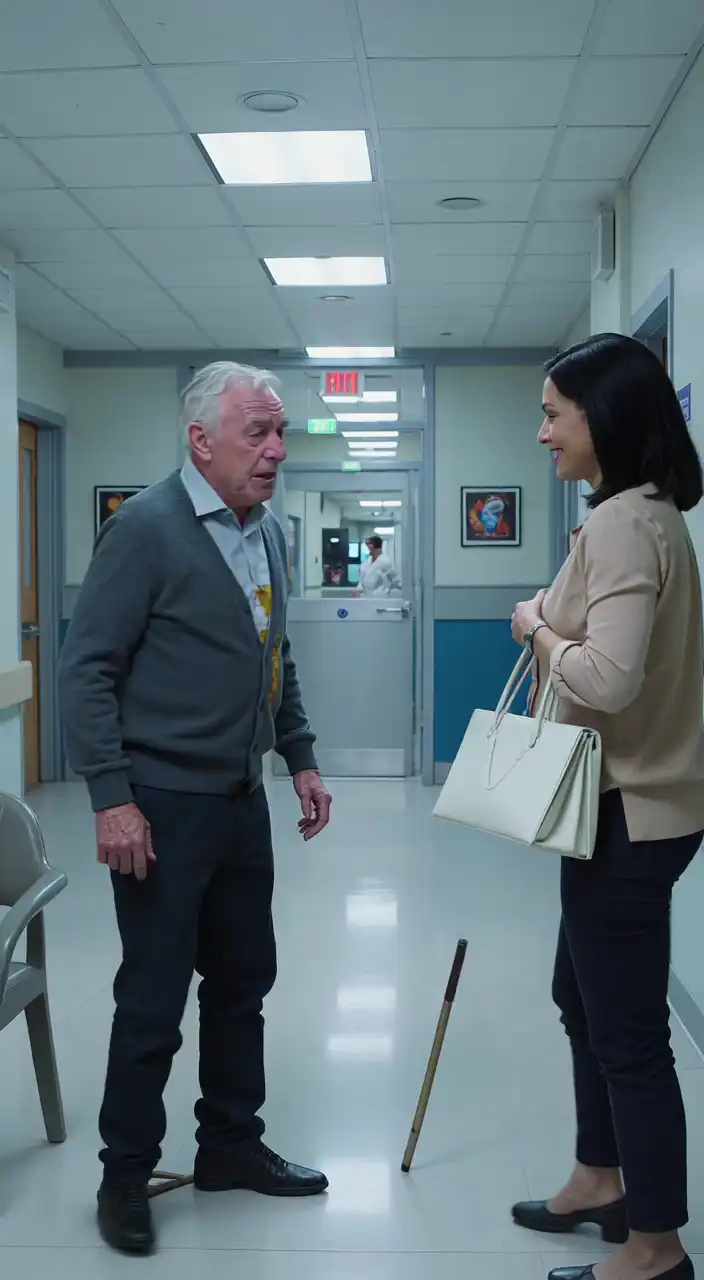
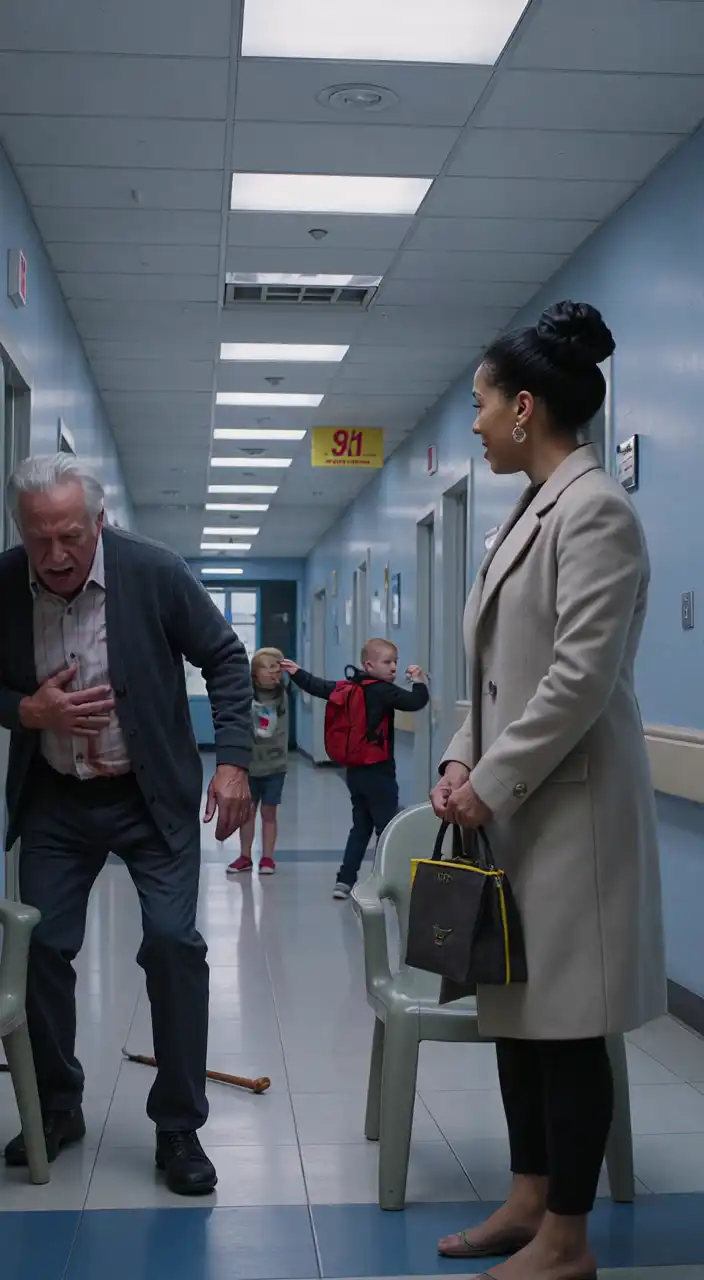

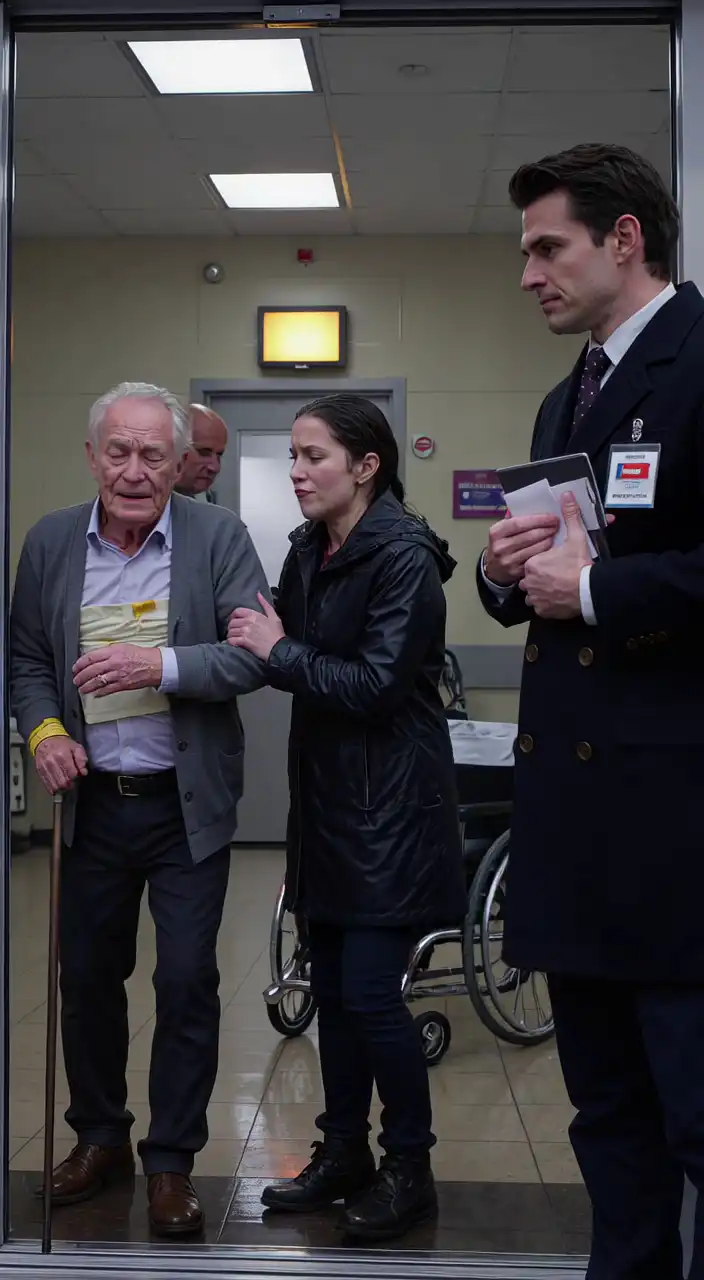
Nathan laughed first.
It was a tiny sound, the kind people make when they believe procedure will save them from shame. He lifted both hands, tablet in one, and gave the security supervisor a thin smile.
"Sir, this is a family dispute," he said. "The patient has been discharged. We are waiting for the appropriate party to handle readmission through normal channels."
The supervisor did not look at Nathan when he answered. He kept his eyes on my grandfather, on the trembling in his jaw, on the amber light still blinking against the transport monitor clip.
"What is your pain level, sir?" he asked.
Grandpa Felix tried to answer and got halfway to a number before his breath snagged. I felt the weight of him lean harder into my arm. His skin had that sick heat you can feel before you touch it properly. He whispered, "Cold. I feel cold."
The supervisor touched his earpiece. "Need a triage nurse and a chair at the ambulance entrance now. Possible post-op complication, active obstruction."
Nathan's smile finally slipped. "You don't have authority to override discharge without registration."
The supervisor turned then. He was younger than I first thought, maybe late thirties, and calm in a way that made anger look expensive. His badge said Felix Ramirez. I remember that because my grandfather's name was Felix too, and for one insane second I thought that coincidence might matter, like the universe had sent the right man by accident.
"I have authority to stop anyone from interfering with emergency evaluation on hospital property," Ramirez said. "And I definitely have authority to document an employee preventing a symptomatic patient from accessing care."
Nathan shifted his weight but didn't move. "He's not an employee of this hospital. He's from the affiliated clinic." He tried to make that distinction sound powerful. "There are financial protocols. The guarantor told us this grandson is not authorized to make treatment decisions."
"My grandfather can still speak," I said. "And he is asking for help."
As if to prove it, Grandpa lifted his head again. His voice was rough and low. "Inside," he said. "Please."
That should have been enough. Maybe in a decent world it always would be. But the ambulance bay had its own ugly logic: wet concrete, automatic doors, people moving fast, everyone pretending that one more delay was still orderly. Nathan stepped closer to my grandfather and bent a little, lowering his voice.
"Mr. Alder, your daughter said if you get worked up, you'll spike again. Let's not do this. You know where you're supposed to go."
I felt Grandpa recoil. Not physically at first. It happened in his face, in a tiny collapse around the mouth. That quiet humiliation hit me harder than the alarm.
Ramirez saw it too.
"Back away," he said.
Nathan ignored him. "Sir, I need you to confirm you understand your discharge instructions."
"I never saw them," I said.
Nathan looked at me like I was annoying paperwork that had learned to speak. "Because they were given to the family representative."
"Then why are they in your pocket?"
That landed. His hand moved without thinking, brushing the inside of his coat where I had seen the folded papers. Small detail, automatic guilt. Ramirez noticed.
By then the nurse from the far hall was already coming at a quick push with a wheelchair. Another orderly followed with a rolling vital monitor. Grandpa tried to take one step toward them. His cane skidded away on the wet pavement with a hard clatter that echoed off the concrete. He would have gone down if I hadn't caught him under the arm.
The nurse reached us and immediately took one look at his face. "Sit him."
She didn't ask Nathan anything. She didn't ask me to fill a form. She got my grandfather into the chair, clipped the monitor on properly, and the numbers began to paint a bad picture in green and yellow. Fast pulse. Low pressure. Temp climbing. She peeled back the top edge of his cardigan and frowned at the dressing.
"How long has it been leaking?" she asked.
"I don't know," I said. "They sent him home this morning after bowel surgery. My aunt said he was just tired. Then he started shaking."
Grandpa made a sound like he wanted to object, not to the facts, but to being discussed in front of strangers. He had always been a proud man. Even now, in pain, his first instinct was dignity.
The nurse touched the yellow stain on his cuff with a gloved finger. "What's this?"
Nathan answered too quickly again. "Liquid antibiotic. He spilled it."
My grandfather looked at the stain and then at me, confused. "No."
That one word changed the air.
The nurse looked up. "No what, sir?"
He swallowed. His eyes watered, partly from pain, partly from the effort of staying focused. "Didn't take... yellow."
Ramirez stepped closer, writing on his clipboard now. "Document patient denies medication reported by clinic rep."
Nathan's jaw tightened. "He is febrile and disoriented. You cannot rely on that."
Grandpa's hand searched for mine. I squeezed it. "Grandpa, did someone give you something before discharge?"
He shut his eyes, thinking through fog. "Cup. Bitter. Said for nausea."
The nurse straightened. "What cup?"
Nathan spread his hands. "Post-op meds are normal. Again, if you people would stop escalating-"
"Open the coat pocket," Ramirez said.
Nathan blinked. "Excuse me?"
"The papers."
"I don't answer to security fishing expeditions."
Ramirez's tone never rose. "Then stand where you are while I call administration and risk management for a medical abuse alert."
I had never heard that phrase before. Medical abuse alert. It sounded too formal for what was happening and exactly right at the same time. Something about hearing it named made me realize this was bigger than one rude man at a doorway.
Nathan glanced toward the inner hall, like he expected someone more powerful to appear and restore the usual order. Nobody did. People were starting to notice. A transporter slowed. A respiratory tech stopped near the wall. Public attention finally pierced his composure.
He pulled the papers halfway out as if that made it voluntary. "These are duplicate discharge instructions."
Ramirez took them without touching his hand. The nurse was already rolling my grandfather toward the doors.
"Come with us," she told me.
Nathan moved to follow, and Ramirez put out an arm. "No. You stay here."
"He is my clinic patient."
"He is not your possession."
That line must have hit everybody within earshot, because the whole entrance seemed to go quieter for a second.
I started to push the wheelchair beside the nurse, but Grandpa gripped my wrist again. "Mara."
"I'm here."
His eyes opened fully for one hard second. "Don't call Celia yet."
My aunt. The guarantor. The family representative.
"Why not?"
His mouth trembled. "She'll take me home."
The doors opened, warm air hitting us. The smell changed from wet pavement and exhaust to antiseptic and overheated hallways. Behind us, Ramirez said into his radio, "Lock clinic representative outside treatment zone. Hold for supervisor response."
That should have felt like the rescue. It didn't. It felt like the first step into a problem with roots.
Inside triage, the nurse cut away part of the bandage while another nurse drew blood. The dressing beneath was stained darker than I expected, but not just with blood. There was a thin yellowish smear near the tape edge, the same color as the mark on Grandpa's cuff.
"Was any topical medication prescribed?" the nurse asked.
I shook my head. "I don't know. They didn't give me anything."
Grandpa stared at the ceiling lights. "Wanted to go back this morning," he whispered. "Celia said no ambulance. Said I'd lose the house."
The nurse and I both looked at him.
"What house?" I asked.
He shut down then, either from fear or exhaustion. His face tightened. A doctor came in, saw the vitals, saw the dressing, and immediately ordered sepsis workup, imaging, cultures, IV fluids, broad-spectrum antibiotics, surgical consult. Everything became speed.
As they moved him onto a gurney, a folded plastic bracelet dropped from inside his cardigan sleeve and hit the floor by the wheel. It was his original inpatient ID band, cut at one end but not removed all the way.
The nurse picked it up. "Why is he still wearing this if he was discharged properly?"
No one answered.
They rushed him toward imaging, and I followed until a set of double doors stopped me. I stood there with my hands shaking, staring at a yellow stain on my fingers where I had touched his cuff.
Then Ramirez came in carrying the discharge papers, and his face told me the doorway battle had only been the beginning.
"He wasn't cleared for standard discharge," he said. "These instructions were amended after the surgeon's note. Somebody changed the route."
He handed me the top page. In the middle, under follow-up, a line had been crossed out and replaced by a handwritten note: family observation at home. But at the bottom, almost hidden under a second staple, the surgeon's original instruction still showed through: immediate return for fever above 100.4, drainage change, or rigors.
Grandpa had all three.
Ramirez pointed to the signature line. "This isn't the patient's signature."
I stared at the looping initials. "It's my aunt's."
"And according to this timestamp, it was signed before the final lab result posted."
"What lab result?"
He looked at me for a moment, measuring how much I could handle. "The one that suggested a developing infection before he ever left the building."
My knees actually weakened. I reached for the wall.
Ramirez lowered his voice. "Your grandfather told the nurse not to call Celia. If there's a reason, I need it now. Because she's already on her way, and Nathan just told administration he was following family instructions."
I looked through the glass panel at the blur of staff around my grandfather's bed.
And for the first time, I understood that getting him back inside had only moved the fight to a different room.
I told Ramirez everything I knew in under three minutes, which wasn't enough and somehow felt like too much.
My aunt Celia had handled all of Grandpa's paperwork since his surgery six days earlier. She had power in the family because she had money and because she had always acted like money was the same thing as competence. Grandpa lived in the old brick house my grandmother left behind, the one with the deep porch and the workshop out back. After his surgery, Celia had taken over the mail, the pill organizer, the visiting nurse calls, the insurance portal, and every conversation with the clinic. She said she was "keeping things efficient." What she really meant was that she was making herself impossible to bypass.
I lived twenty minutes away and worked split shifts at a dental office. I had been allowed to visit, not decide. Every time I asked to see the discharge plan, Celia said, "You worry too much. The doctors already know him." If Grandpa complained of pain, she called him restless. If he asked what medication he was taking, she said the labels were too confusing and she would handle it. This morning, when I arrived and found him feverish and trembling in his chair, she told me he had spilled soup on his sleeve, refused breakfast, and needed rest. Then she stepped outside to take a call, and Grandpa whispered, "Take me back now."
I had obeyed that voice because it did not sound confused. It sounded afraid.
Ramirez listened without interrupting, then asked the question I had been trying not to ask myself all day. "Why would she want him out of the hospital if he was getting worse?"
I looked down at the false signature on the discharge sheet. "He said something about losing the house."
Ramirez's expression changed, not softer but sharper. "Did he sign anything recently? Deed transfer, refinance, trust update?"
"I don't know."
"Did Celia mention bills? Long-term care? Payment deadlines?"
"Only constantly."
He nodded once and wrote something on his clipboard. "That may matter later, but right now the medical issue comes first." He hesitated. "There's another problem. Nathan says the yellow stain is from a liquid anti-nausea med the clinic dispensed during transport handoff. Pharmacy has no record of that order."
The yellow on my fingers suddenly felt filthy. "So what is it?"
"We don't know yet."
He handed me a small evidence envelope. Inside was the bottle cap he had recovered near the baseboard. No bottle, just the cap, bright childproof plastic with a cracked inner ring. "Pharmacy will identify it if we can find the matching container."
The cap made something click in my memory. Not the object itself, but a sound. Last night, while helping Grandpa from the recliner, I had heard a plastic snap from the kitchen and seen Celia slide something into the trash under coffee grounds. She caught me looking and said it was spoiled creamer.
I told Ramirez that. He didn't look surprised.
"Household trash still there?"
"If pickup didn't come."
"Address?"
I gave it. He relayed it quietly into his radio, asking local security liaison to request a welfare-preservation check with law enforcement because of potential evidence tied to a patient-safety alert. It all sounded too official and too slow. My grandfather was behind those doors now with people saying words like sepsis and source control.
A surgical resident came out and asked if I was family. I braced for another fight over authorization, but Ramirez stepped beside me and said, "She is the reporting relative and present caregiver. The patient requested she remain involved."
That one sentence got me into the room.
Grandpa looked smaller in the hospital bed than he had in the wheelchair, swallowed by white sheets and machinery. The amber warning had become steady green lines and periodic beeps, but none of it looked safe. There was an IV in each arm. His face was gray under the fluorescent lights. When he saw me, though, some of the panic went out of him.
The resident, Dr. Leong, explained that his blood pressure had improved a little with fluids but he was showing signs of significant infection. They needed scans to see whether there was a leak or abscess near the surgical site. They also needed a clear medication history because some of his symptoms did not line up cleanly.
"What symptoms?" I asked.
"He is febrile and post-op, yes. But he's also unusually sedated for the medication list we currently have. If he was given something not charted, that matters."
Grandpa heard enough of that to stir. "I wasn't sleepy before the cup," he said.
Dr. Leong leaned closer. "What cup, Mr. Alder?"
He took a breath like he was diving for memory. "Paper cup. Yellow stripe. Celia said Nathan brought it. Said it would settle my stomach before the ride."
The resident's eyes went to Ramirez. "Chart that."
My chest tightened. "Can she do that? Just give him something?"
"If it wasn't prescribed, no," Dr. Leong said. "If it impaired him when he should have been evaluated, that's a serious issue."
Grandpa shut his eyes again. "I told her I wanted the surgeon." His voice cracked on the last word.
I touched his hand. "You're here now."
He squeezed my fingers with surprising force. "Don't let her sign."
That was the second time he had said some version of it, and this time there was no confusion in him. Dr. Leong heard it too.
"Mr. Alder," she said gently, "do you want your granddaughter involved in your care decisions right now?"
"Yes."
"Do you want Celia making medical decisions for you?"
His lips thinned. "No."
She documented that immediately. It was just words into a chart, but it felt like a door locking on our side for once.
Then the reversal hit.
A woman from patient access arrived with a tablet and a cautious expression. "There is an active medical power of attorney on file naming Celia Alder as decision-maker during incapacity," she said. "Administration wants clarification before surgery consent if his condition worsens."
I looked at Ramirez. "He just said no."
"He did," Ramirez said. "And that's being documented."
The woman lowered her voice. "The document was uploaded this morning."
This morning. While he was feverish. While they were rushing him out.
Dr. Leong's face hardened. "If there are questions about coercion, we proceed under emergency doctrine if needed. He is not being discharged."
The patient access woman nodded and stepped back, but the damage was done. Celia had not just wanted him home. She had moved paperwork into place on the same day he deteriorated.
Grandpa opened his eyes again, fighting to stay awake. "Desk drawer," he whispered.
"What drawer?"
"Workshop. Red folder. Your grandma knew."
I bent close. "What's in it?"
But the sedation or infection dragged him under before he could answer.
A nurse came in to wheel him to CT. As they moved the bed, a folded tissue slipped from under Grandpa's blanket. I picked it up automatically. Inside it was a tiny white tablet half dissolved, chalky and damp.
The nurse noticed. "Do not throw that away."
Ramirez took it with gloved fingers. "Another lab item."
Dr. Leong looked at me. "Did he pocket meds often?"
"No. Never."
Grandpa had hidden that pill instead of swallowing it. Which meant somewhere in the haze, he had known someone was giving him something he didn't trust.
That discovery should have made me feel lucky. Instead it made me cold, because it meant he had been trying to protect himself alone.
While he was in imaging, I sat with Ramirez outside the room and watched hospital traffic move around us. A social worker joined us after hearing the abuse alert. Her name was Donna, gray braid, soft voice, eyes that missed nothing. She asked careful questions, not just about Grandpa's capacity, but about who controlled his home, his transportation, his phone, his medications, and his money. When I admitted Celia had been screening his calls and keeping his wallet "for safety," Donna wrote faster.
"Nathan's connection to the family is also odd," she said. "A clinic administrator should not be delivering meds directly to a private patient in a discharge lane."
Ramirez nodded. "He says he was doing a courtesy escort because the family is a donor account."
Donor account. There it was. The motive Nathan understood best: status anxiety in a nice suit.
Donna looked at me. "Do you know if your aunt gives to the clinic?"
"She sits on some fundraising board. She never shuts up about it."
"So he may have been protecting a relationship, not a patient."
That made ugly sense. Nathan was not family, but he had acted like a gatekeeper with skin in the outcome. If Celia wanted Grandpa gone before a lab result or surgeon consult complicated things, a clinic administrator trying to impress the right donor could become very useful.
An hour later, CT showed a fluid collection near the surgical site, suspicious for infection and possible leak. Not immediate collapse, but dangerous enough that surgery needed to evaluate him urgently. Broad antibiotics started. Blood cultures were sent. The yellow residue from his sleeve and dressing went to tox. The hidden tablet went to pharmacy. Everything was moving, but not cleanly.
Because Celia arrived.
She came fast, expensive coat open, phone in one hand, the look of offended authority already assembled on her face. She spotted me outside the room, then Donna, then Ramirez. Her gaze cooled.
"What exactly is going on?" she asked, as if we were staff who had inconvenienced her.
"Your father is being treated," I said.
"He was stable to go home."
Ramirez answered before I could. "He was not."
Celia gave him a quick dismissive smile. "Security has no role in medical decision-making."
"Good thing I'm not making one. I'm documenting obstruction and possible tampering."
That smile disappeared. "Tampering is an absurd word."
Donna stepped forward. "I'm hospital social work. We need to talk about your father's expressed wishes and who has been controlling access to his care."
Celia's eyes sharpened. "My father is confused when medicated."
"Then it's fortunate he made those wishes before further sedation," Donna said.
I had never loved a stranger faster.
Celia turned to me. "You overreacted and dragged him back here in the rain. If his pressure crashed, that's on you."
I almost believed the accusation for one sick instant. Then I remembered the folded discharge papers in Nathan's pocket and the half-hidden tablet in Grandpa's blanket. "He asked me to bring him."
She crossed her arms. "Because you agitate him. You always do this rescue fantasy thing."
Ramirez's clipboard lifted slightly. "Did you instruct Nathan to block entry until family permission appeared?"
"No."
"Did you sign discharge amendments for your father?"
"As his advocate, yes."
"Were you aware of a pending infection-related lab result at the time?"
Her pause was short, but fatal. "I was told he was borderline and should rest at home."
By whom? That hung there unanswered, because Dr. Leong came out at that exact moment and said they needed immediate consent contingencies while the attending reviewed whether they could take Grandpa back to surgery without delay.
Celia stepped toward her. "I'm his medical proxy."
Dr. Leong did not move. "Your father stated clearly that he does not want you making decisions. We are evaluating the legal status of documents uploaded today."
Celia's face went white, then hard red. "He is delirious."
From the room behind the doctor, weak but audible, Grandpa's voice carried through the half-open door.
"No, I'm not."
Every head turned.
He had pulled off his oxygen cannula trying to sit up. It wasn't dramatic, just stubborn and heartbreaking. He was using the last clean edge of his will to fight the lie in real time.
"She lies," he said.
And for the first time, Celia looked less like a daughter defending herself and more like a person realizing the patient she had counted on controlling was still dangerous to her.
The next hours became a contest over who could define my grandfather first: a sick man with rights, or a confused old man to be managed.
A patient rights advocate came down from administration. Risk management called twice. Someone from legal wanted the timeline. Nathan, who had apparently lost his nerve once the phrase medical abuse alert hit the radio, now claimed he had only repeated instructions provided by family. Celia shifted stories every ten minutes. First she said Grandpa had begged to go home. Then she said the surgeon encouraged home observation. Then she said she signed only because Dad always panics in hospitals. Every version tried to wrap control in concern.
But concern does not hide discharge papers in someone else's coat. Concern does not hand a patient an uncharted cup and hurry him toward the exit before a lab result posts.
Dr. Leong and the attending surgeon, Dr. Baines, focused on the part that mattered most: Grandpa's scan suggested a post-op leak or infected collection that likely needed intervention. They wanted to take him to interventional radiology first if possible, maybe surgery if his pressure worsened. Emergency doctrine covered them, but the fresh proxy document complicated who could linger in the room and speak as if she owned the next decision.
That was where Donna helped most. She sat beside Grandpa while he was more alert and asked clean, simple questions in front of a witness nurse and Dr. Leong. His answers were slow but consistent. Yes, he knew where he was. Yes, he knew what treatment he was agreeing to. Yes, he wanted me informed. No, he did not want Celia making decisions. No, he had not knowingly signed anything today besides "maybe one check-in pad" he couldn't read without his glasses.
His glasses were missing.
That detail hit like another dropped stitch in a wound. Grandpa never went anywhere without them. He kept them on a cord around his neck at home. Celia had told me he left them in the car. There was no car now. She had driven off after dropping him at the clinic discharge lane earlier, then returned only after I brought him back.
Donna wrote that down too. Missing glasses plus new legal documents plus rushed discharge made a pattern no one could call ordinary.
The pharmacy preliminary report came first. The hidden half tablet from Grandpa's blanket was a sedating anti-nausea medication, stronger than what was charted, the kind that could make an older patient foggy and unsteady. Not a poison, not dramatic, but enough to blunt him. Enough to make him easier to redirect. Enough to let someone later say he was confused.
The yellow residue came later and brought the bigger turn. It was not from a liquid anti-nausea medicine at all. It was staining dye from the contents of an opened antibiotic suspension capsule, mixed into moisture. Dr. Leong explained that someone may have opened a capsule or mixed medication outside normal administration, but the amount on the sleeve was not proof of a dose by itself. What it did prove was that Nathan's immediate explanation had been false.
"Why would anyone open an antibiotic?" I asked.
"Could be spilled while trying to give it in food or drink," she said. "Could be contamination from handling. But if it wasn't charted, we treat it as possible unrecorded administration."
Celia's version collapsed a little more. She had told me Grandpa refused all his meds. Nathan said he already had them. Grandpa said he got a bitter drink. The evidence said something yellow had touched his sleeve and dressing, but not in a documented way.
Ramirez found me staring at the printout and said, "People who tell the truth usually don't need three versions before lunch."
He had a point.
Then law enforcement arrived, not for a dramatic arrest, but for statements tied to the preserved-home evidence request. A deputy took my account in a family consult room while Donna sat nearby. I gave them the kitchen memory, the snap of plastic, the coffee grounds over the trash, Grandpa whispering to take him back, Celia's warnings about the house. The deputy listened, then told me officers at the residence had not entered the house but had made contact with a neighbor who confirmed Celia had rushed out earlier carrying a kitchen trash bag and a small locked file box.
My stomach dropped. "Can they stop her?"
"If she hasn't committed a visible offense in front of them, options are limited right this second," he said. "But the timeline matters."
So evidence was moving while Grandpa was being prepped for a drain procedure. That was the constant pressure of the whole day: every answer opened another hallway instead of a door.
Before they wheeled Grandpa to interventional radiology, I got five minutes alone with him.
He looked more awake with fluids and antibiotics in him, but the pain sat behind his eyes like weather. I held his hand and tried not to cry in a way he would notice.
"You scared me," I said.
He gave me the ghost of a smile. "You came anyway."
"Of course I did."
He looked past me to the curtain, making sure no one else was close. "Red folder. Workshop drawer under the radio parts. Celia's been asking for months."
"What is it?"
He took a shallow breath. "Your grandma changed the trust after I got sick last year. House can't be sold while I live there unless I sign in front of our lawyer and doctor both. Celia found out." He grimaced. "She wanted me in assisted living near her condo. Said it was best. Really meant sale."
That explained the pressure about bills, the fear about the house, the need to establish him as incapable. If she could control his care and declare him confused, she could steer everything else.
"Did you sign anything?"
He shook his head once. "She tried. Took my glasses. Said papers were insurance."
A heat rose in me so fierce I had to set my jaw to keep steady. He saw it and patted my wrist weakly. "No fighting now. Keep me here."
"I will."
"Workshop key in blue mug."
Another planted detail. Another lifeline dropped in simple household language while machines beeped around us.
The procedure to drain the collection was supposed to be straightforward. It wasn't.
They got him down to radiology, started positioning him, and then his pressure dipped again. Not crashing, but enough that the radiologist called for the surgeon and paused. More fluids. More monitoring. More waiting while everybody pretended this was still within ordinary complication range. I sat outside with Donna and Ramirez while Celia argued with anyone who would stand still long enough. At one point she actually said, "I am trying to protect him from unnecessary intervention."
Donna answered with lethal politeness. "He has an infection and requested treatment. That's not unnecessary."
The larger emotional reversal came when Nathan's own motive started to crack open. A hospital administrator finally came down to separate him from the case and interview him formally. Before going in, he saw me across the hall and said in a low, urgent voice, "You don't understand how this family works."
I stared at him. "Then explain why you blocked a sick old man from care."
He looked miserable for the first time all day. "Because if donor families complain, people like me get replaced. Because one incident report from the wrong board member can end ten years of work. Because she said he always panics and the surgeon had already signed off and she just needed him home."
"Did you give him that drink?"
"No." The answer came fast and scared. "I brought what she handed me because she said pharmacy had delayed the discharge packet and it was approved. I shouldn't have touched it. I know that now."
It was not an absolution. But it was the beginning of another truth: Nathan was not the mastermind. He was a coward with status hunger, useful to someone bolder.
Ramirez heard enough to step in. "Then put that in your statement."
Nathan shut his mouth again, but the damage was done. Celia had used the clinic administrator as a shield, and he was finally realizing shields can become witnesses.
That should have helped. Instead it made Celia more dangerous.
Because once she sensed Nathan bending away from her, she stopped acting polished. She cornered me near the vending alcove while Donna was on the phone.
"You think you're saving him," she said softly. "Do you know what one more surgery costs? Do you know what happens when the house goes for liens? He can't live alone after this. Someone has to be practical."
"Practical isn't drugging him and forcing him out."
Her nostrils flared. "I gave him what they prescribed."
"You took his glasses and tried to get a proxy signed."
"He needed help."
"He said no."
That was the line she could not bear. Her whole life with the family had been built on translating force into help. Hearing it stripped down to no made her look almost feral.
"You've always been sentimental," she said. "Grandma filled your head with fairness. Life isn't fair. Someone has to decide."
Then she walked away before I could answer, which was probably good, because the answer in my chest was not fit for hospital walls.
Two things happened close together after that.
First, the deputy came back with news from the house. The neighbor had seen Celia toss a small bottle into the outside trash bin before leaving the second time. Officers could not seize household trash without a warrant unless it was at the curb, but sanitation had not run yet. They were working on it based on the medical tampering claim. That meant the matching bottle to our cap might still exist if time held.
Second, interventional radiology called up that Grandpa's drain placement was only partially successful. The pocket was more complex than expected, and the surgeon wanted him admitted to step-down with a strong possibility of operating if his labs worsened overnight.
Movement, but not rescue. Improvement, but not safety. That was how the day kept advancing.
When they brought him back up, pale and exhausted, I walked beside the bed. He caught sight of Celia standing near the nurses' station and physically turned his face toward me instead. A tiny gesture, but it broke something open in everyone who saw it. Even one of the nurses muttered under her breath.
Dr. Baines met us at the room and said, "We bought some time. Maybe enough. But if he spikes again or the drainage doesn't improve, we go tonight."
Celia stepped forward. "As proxy, I-"
"No," Donna said, firmly enough to stop her. "Not at bedside."
Celia stared at her, then at the closed room door behind which her father had just been taken, and for the first time I saw real fear under her anger.
Not fear for him.
Fear that he might live long enough to speak.
By midnight, the hospital had split into two worlds.
In one, medicine was doing its best. Grandpa's antibiotics were running. Labs were being trended. Nurses were checking his pressure every hour. Dr. Baines had already marked his chart for immediate operative review if his lactate climbed or his abdomen worsened. Donna had flagged the case for protective discharge planning. Ramirez had filed enough incident documentation that nobody could quietly turn this into a misunderstanding.
In the other world, the one built from forms and money and family leverage, everything still felt fragile. Celia had not been removed entirely because she was still next of kin in several systems. The uploaded proxy had not yet been voided. The workshop folder at Grandpa's house might contain the missing piece explaining why she needed him declared incapable, but the house was locked and she still had access. The possible medication bottle might disappear before a warrant reached the curbside bin. Nathan had started to crack, but not enough to fully implicate himself or her.
And Grandpa's condition was sliding the wrong way again.
At 12:17 a.m., his monitor alarm changed pitch. Not the first amber ping from the doorway, but a harder, more urgent pattern that sent the night nurse in at a run. I was dozing upright in the chair and stood so fast I hit my knee on the tray table.
The nurse checked his abdomen, his temp, then looked at the screen and swore under her breath. "Page surgery. Now."
Grandpa was awake but glassy, breathing shallow, his skin slick. He tried to focus on me. "Mara?"
"I'm here."
"It hurts worse."
The nurse squeezed his shoulder. "We're moving."
Within minutes the room filled. Dr. Baines arrived in scrubs, looked at the numbers, palpated the abdomen, and decided. "No more waiting. We have to go to the OR."
That should have been simple under emergency doctrine, but emergencies do not erase people who want control. The charge nurse was printing transport papers when Celia reappeared with a hospital attorney on speakerphone and the patient access woman behind her.
"My father's delirious and overmedicated," she said. "You cannot freeze me out because my niece is emotional."
Dr. Baines didn't even glance up from the chart. "I can operate because your father is septic."
The attorney's voice crackled from the phone, asking for the latest capacity documentation and whether immediate threat justified proceeding without proxy resolution. Donna answered from the doorway: yes, repeated patient refusal of Celia's control had been documented while he was lucid; yes, there was an open abuse and tampering review; yes, delay would increase risk.
Celia tried a different tactic. She moved to the bedside and caught Grandpa's forearm.
"Dad, tell them you want to wait until morning. Tell them you want me to take you to St. Vincent's where your own doctor can see you."
Grandpa flinched like her hand burned.
I stepped between them. "Do not touch him."
She looked over my shoulder at him with a softness so practiced it was frightening. "Dad, they're frightening you. You know how you get when people rush you."
His lips parted. For a second no sound came. I saw everyone in the room hold still around that silence, as if the whole case balanced there.
Then he whispered, "Get her out."
Four words. Weak as breath. Strong as law.
Ramirez, who had apparently been waiting outside because night security had no intention of repeating the doorway disaster, entered immediately. "Ms. Alder, come with me."
She jerked back. "This is insane."
"No," he said. "This is over."
She could have walked out and saved a shred of dignity. Instead she did the desperate thing. She grabbed for the transport folder at the foot of the bed.
It was not a dramatic tackle. It was uglier than that, human and frantic. Papers spilled. A nurse shouted. Ramirez caught her wrist before she got two steps. In the scramble, a pair of reading glasses fell from Celia's oversized handbag and skidded under the IV pole on their neck cord.
Grandpa's glasses.
Every person in the room saw them.
Celia froze. Her face did not just change. It emptied. Whatever plausible explanations she still had evaporated in that tiny clatter against tile.
Donna bent, picked up the glasses, and looked from them to Grandpa. "These are yours, sir?"
He stared at them like he was seeing a witness. "Yes."
That was the final obstacle breaking open. Not just suspected coercion. Not just conflicting forms. Physical proof that she had taken the one thing he needed to read what he was being asked to sign.
Ramirez handed Celia to a deputy who had come upstairs for an updated statement. She began talking all at once then, saying she was protecting him, saying the glasses were in her bag because she meant to bring them, saying everyone was twisting good intentions. The deputy walked her out while she was still speaking.
The room exhaled exactly once, then snapped back into motion. Papers reprinted. Consent documented under emergency treatment and direct patient assent. Dr. Baines looked at me and said, "We are going now."
They rushed him toward the OR. I jogged beside the bed until the red line on the floor where family had to stop. Grandpa held the recovered glasses in one hand like a relic.
"Mara."
"Yes?"
"Folder."
"I know. I'll get it."
His eyes found mine with effort. "If I don't-"
"Don't." My throat closed. "You're coming back."
A pause. Then a tiny nod, because he was too tired to argue.
The doors closed.
That wait was the longest part of the whole story even though the clock says it was just under three hours. Donna stayed. Ramirez stayed longer than he had to. The deputy came back with updates in fragments: the trash warrant had gone through; a bottle matching the cap had been recovered from the outside bin; residue testing was pending, but the label had been partially soaked off; Nathan had revised his statement after learning security footage captured Celia handing him a paper cup near the discharge corridor; hospital administration had suspended his badge access.
At 2:40 a.m., another call came in from patrol. The old house workshop had been lawfully entered with Grandpa's consent relayed through the hospital and deputy, because he was now documented as the homeowner resisting possible exploitation. In the red folder under the radio-parts drawer they found the trust amendment, exactly as Grandpa described. The house could not be sold during his lifetime without his witnessed signature and physician certification of capacity at the time. There was also a letter from my grandmother, legal but personal, naming me as backup contact if Grandpa ever felt pressured.
Grandma knew. She had seen Celia's ambition years before the rest of us admitted it.
When Dr. Baines finally came out, I read the answer in his shoulders before he spoke. Not easy. Not perfect. But not too late.
They had found a leak at the surgical site and a deep infected pocket. He needed washout, repair, and several more days of close monitoring. There had also been significant dehydration and medication confusion that did not help his mental status. "Another delay could have gone very badly," Dr. Baines said, in the flat honest tone doctors use when they want the family to understand the edge they were on.
I sat down because my legs stopped functioning correctly. Donna squeezed my shoulder once. Ramirez looked away politely, giving me room to cry without becoming spectacle.
Grandpa went to ICU for the first day and step-down after that. The infection slowly turned. His pressure stabilized. The tremors eased. Once the uncharted sedating medication cleared, his speech sharpened with almost painful speed, as if pieces of him were walking back into the room. The first time he put on the recovered glasses and read his own name on the whiteboard, he laughed and then cried, embarrassed by both.
Celia was barred from bedside contact while adult protective services and hospital legal reviewed the case. The deputy took a formal report regarding possible exploitation, tampering, and coercive document handling. Nathan, through an attorney, admitted he bypassed protocol to "facilitate donor-family concerns" and carried a cup to Grandpa at Celia's request without verifying an order. The yellow residue tied back to a broken antibiotic capsule likely mixed into that same drink after Grandpa had refused pills. Not a murder plot, not some cinematic poison, just a chain of arrogant, undocumented meddling around a vulnerable patient by people who thought status made them safer than rules. In real life, that is often how harm looks.
The most brutal scene came on day three, when Grandpa asked me to tell him everything that had happened with the house. I expected outrage. What came first was grief.
"I raised her to think she never had to be afraid of money," he said quietly. "Somewhere that became believing money should never be afraid of her."
He stared out the hospital window for a long time after that. Then he asked for Donna and a notary.
The ending was not a miracle; it was work. Protective orders for records. Updated health care directive completed while he was fully lucid. The false proxy challenged. New passwords on the insurance and patient portal. Visiting-nurse services arranged through a team Celia could not reroute. A temporary stay with me after discharge even though my apartment was small. A locksmith at the old house. The red folder copied and secured. APS follow-up. Statements. Phone calls. A family fracture nobody could tape back together neatly.
But rescue is not neat. Rescue is a nurse cutting through a bandage instead of another excuse. A security supervisor hearing an alarm and deciding procedure will not outrank danger. A weak old man using his last clear strength to say no in the room where everyone wants him easy. A pair of hidden glasses sliding out of the wrong bag at the exact second truth needs weight.
When Grandpa was finally discharged for real, nine days later, Ramirez met us at the elevator by coincidence or maybe not. He had traded the blazer for a plain shirt but still carried that same clipboard. Grandpa, steadier now, neat cardigan buttoned, new clean dressing under it, stood with his cane planted squarely and looked him in the eye.
"You stopped her taking me out," Grandpa said.
Ramirez smiled a little. "You stopped that, sir. I just listened."
Grandpa nodded as if accepting a fact, then reached into his pocket and pulled out the old inpatient bracelet they had cut off after surgery. He had asked to keep it. The plastic was creased and ordinary. He handed it to me.
"So you remember," he said.
I do.
I remember the wet ambulance bay, the cane on the pavement, the folded papers in the wrong coat, the yellow stain no one could explain honestly, the amber alarm sounding before a single signature should have mattered. I remember how close dignity can come to disappearing when a sick person is spoken over, and how fast it returns when one trained stranger says, Step away from the patient. Right now.
Grandpa lives at home again now, with visiting nurses, a lock on the medication drawer he controls, and a mug in the workshop that still holds the spare key because some habits don't need replacing. His strength came back slowly. So did his humor. Some mornings he still shakes a little when appointments run late, and I understand why. We leave earlier than necessary. We carry every document ourselves. He wears his glasses on the cord again.
And whenever hospital doors open in front of us, he grips my hand for one second before letting go, not because he thinks I might fail him, but because once, at the threshold where help was only a few steps away, someone tried to turn his need into permission.
Now he walks through anyway.
Disclaimer: Mention of any brand or trademark is for identification only and does not imply partnership or endorsement
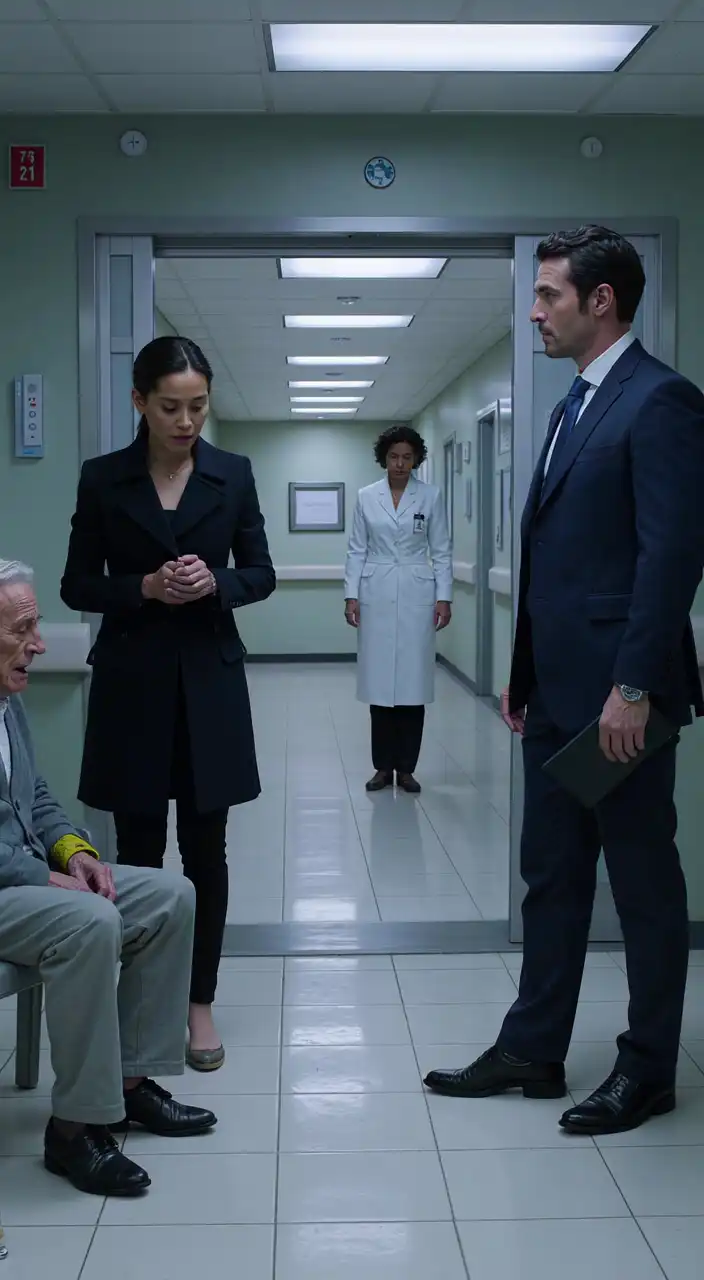
MY FATHER STARTED SHAKING OUTSIDE TRIAGE WHILE A CLINIC ADMINISTRATOR BLOCKED THE DOOR AND SAID HE NEEDED FAMILY PERMISSION FIRST.
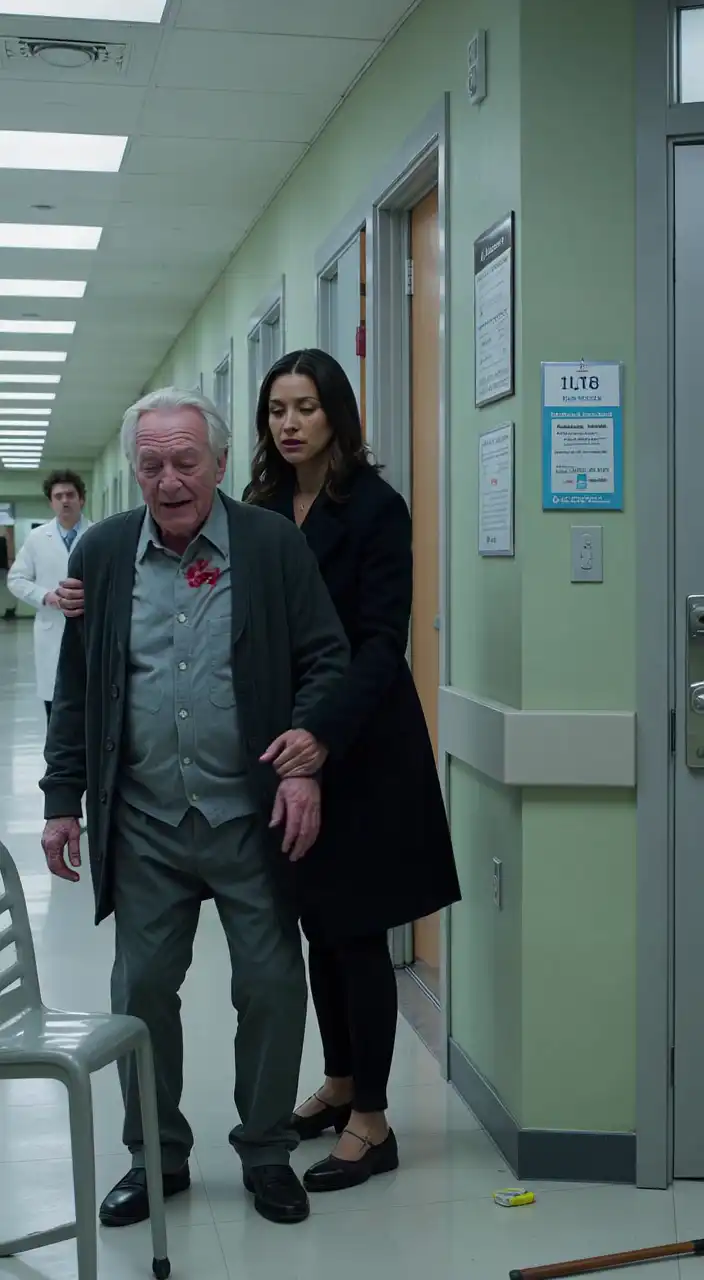
MY FATHER STARTED SHIVERING SO HARD HIS SURGICAL BANDAGE BLED THROUGH, AND THE CLINIC ADMINISTRATOR STILL BLOCKED THE TRIAGE DOOR.
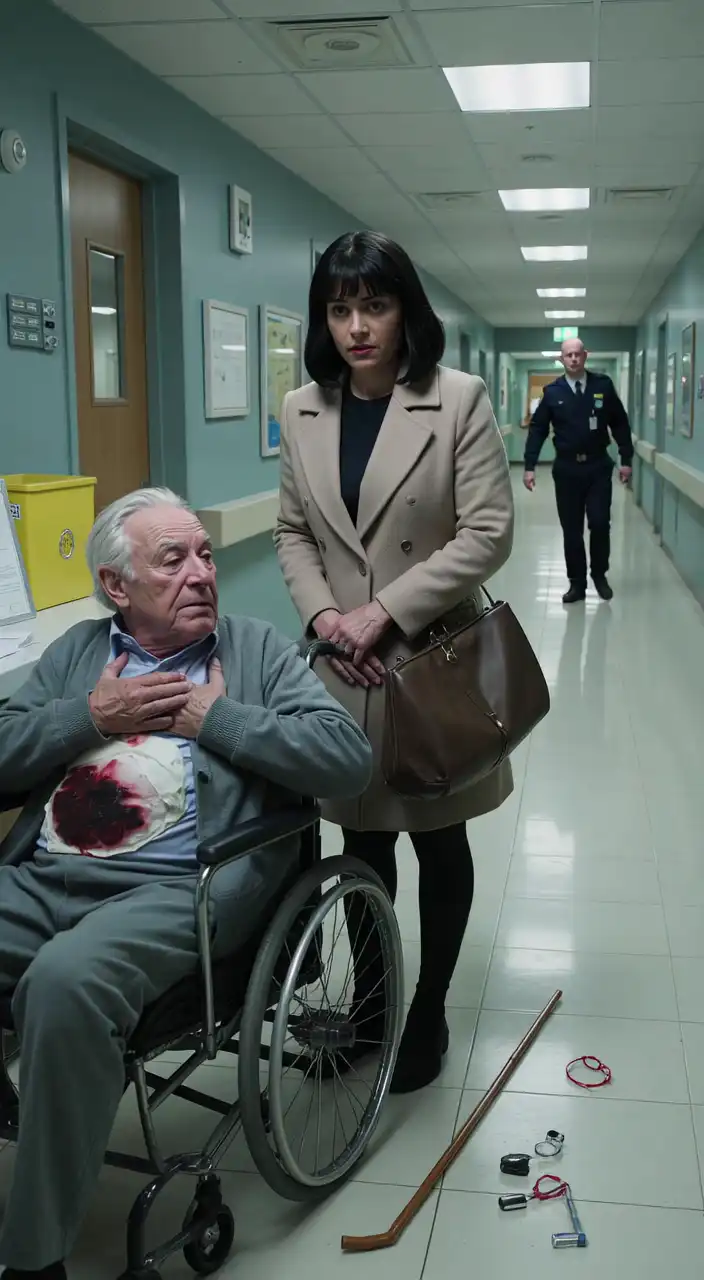
MY FATHER STARTED SHAKING IN THE HOSPITAL HALLWAY, AND THE WOMAN WHO CLAIMED TO BE HELPING HIM WOULD NOT LET TRIAGE TOUCH HIM.