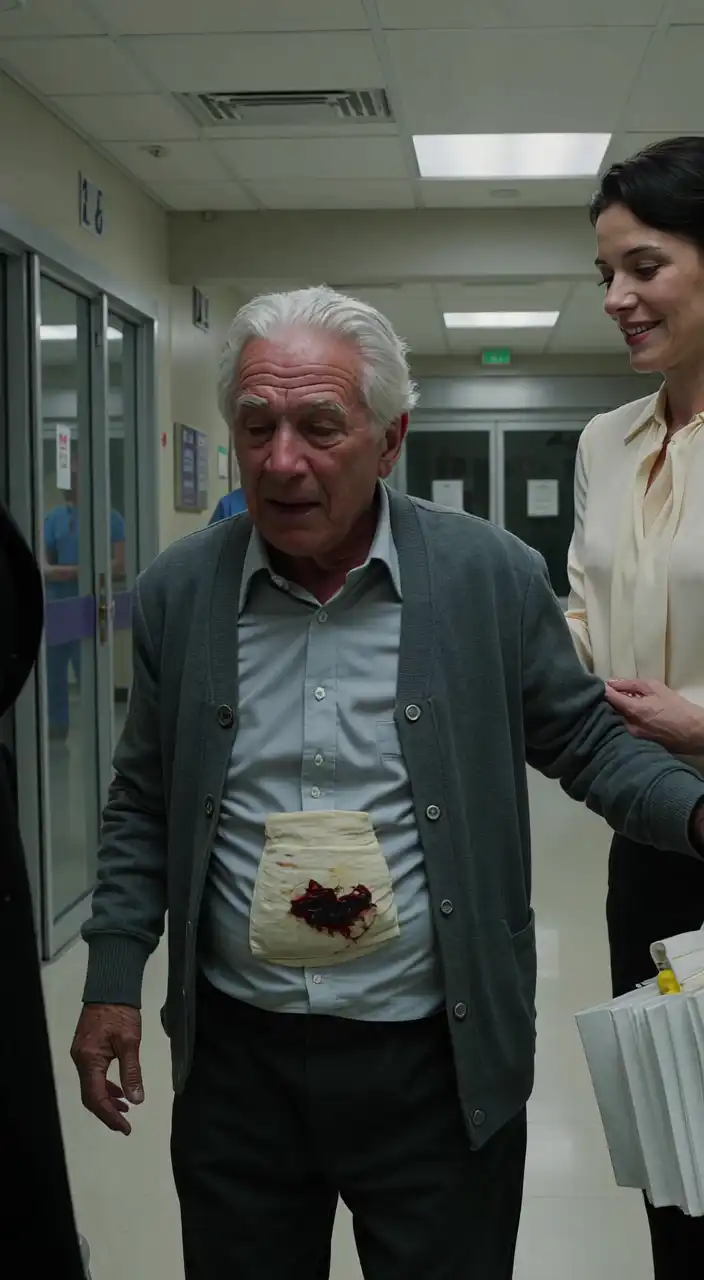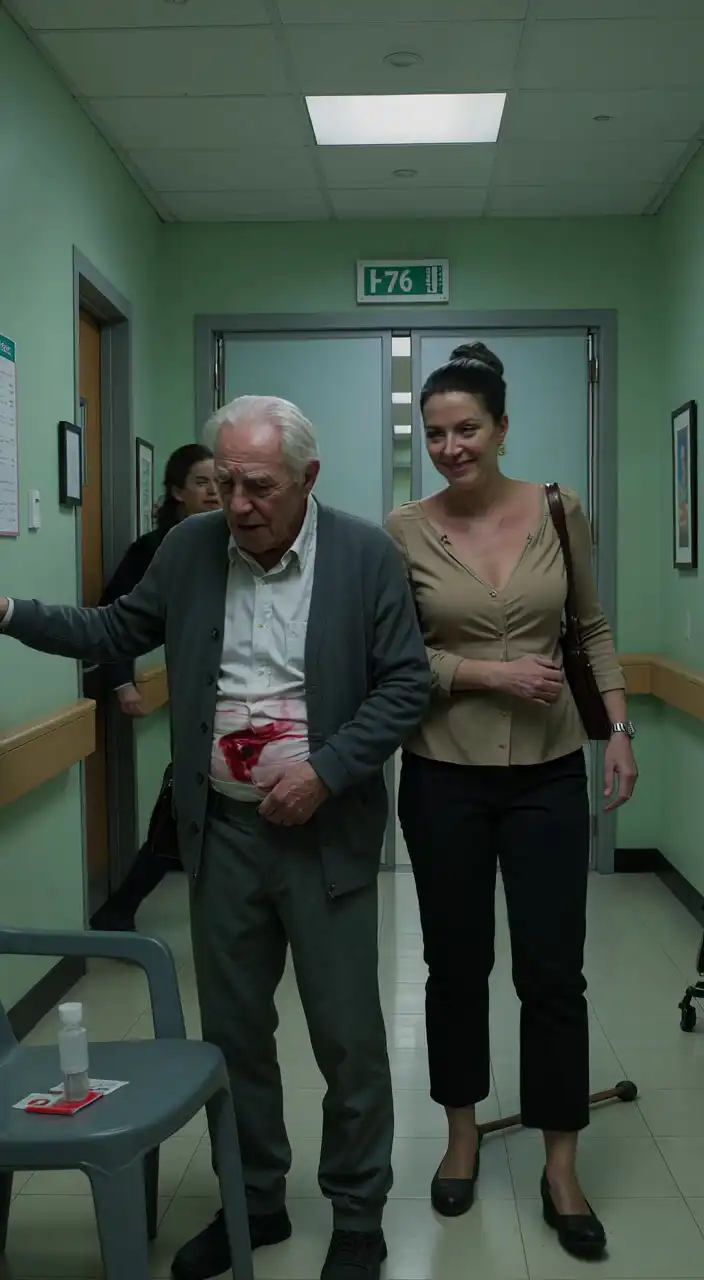

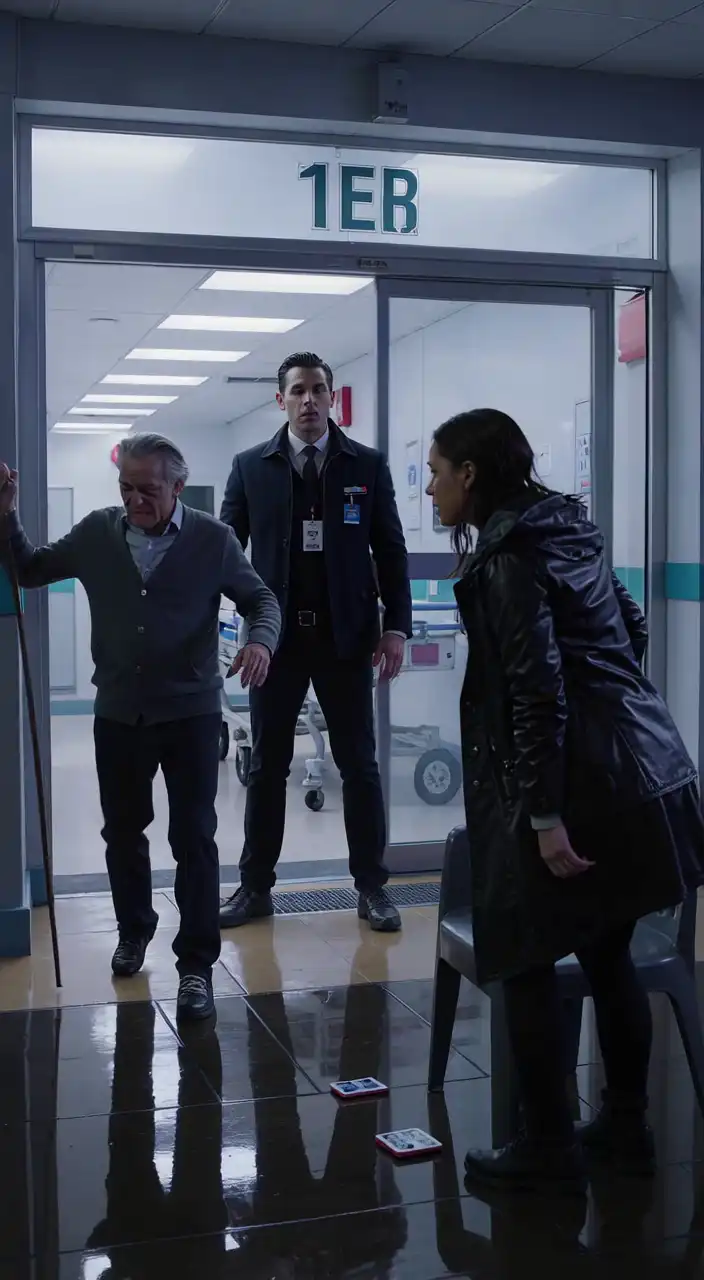
"Do not touch him," Dr. Sophia Reed said, and the whole entry lane changed around the force of her voice.
Oscar turned toward her with the polished smile of a man who thought credentials could still save him. "Doctor, this is an administrative matter. The patient has already been discharged."
Sophia did not even look at the tablet in his hand. She stepped past him and took my father's wrist. Her gloved fingers found his pulse, then moved to the edge of the dressing where the stain had seeped through the gauze and into the sleeve of his cardigan. It was not bright red. It was darker, thinner, and spread in a way that made her expression sharpen.
"Liam, can you tell me your pain level?"
Dad tried, but his teeth were chattering now. "It... it got worse in the car. Cold. And hot."
Sophia lifted his sleeve just enough to see the spreading shadow under the bandage. "How long has he been shaking?"
"Since we left the fourth floor," I said. "Maybe twenty minutes. He almost fell in the parking lot."
She looked at me then, fast and direct. "Did he get antibiotics before discharge?"
"I don't know. They rushed us out. He said he didn't feel right. This man-" I pointed at Oscar. "He took the papers, took my phone, and said Dad couldn't come back in without family permission."
"My father is the family," I snapped, and the anger in my own voice surprised me.
Sophia nodded once, already half turned toward the doors. "Security to ambulance bay entrance. Now. Bring a wheelchair and sepsis kit to triage."
Oscar lifted his tablet higher like it was a shield. "You cannot override a discharge without intake authorization. There is a billing hold and a consent note attached to this account."
Sophia finally faced him fully. "I can override anything when an eighty-four-year-old postoperative patient is febrile, trembling, and unstable at my door. Step aside."
For a second, he did not.
That second told me more than anything else had. Not confusion. Not a mistake. A choice.
Then Dad's knees dipped. I caught one arm, Sophia caught the other, and two security officers came through the doors at a run with a wheelchair rattling between them. Oscar moved back only when he had to avoid being hit by the footrests.
"Sir," one guard said to him, "we need space."
Oscar recovered fast. "You are interfering with a private family transport. The daughter is agitated. The patient was released in stable condition."
"I'm his daughter," I said. "And I called 911 because he was getting worse and this man stopped me."
The older security officer glanced down and saw my phone on the floor, screen still lit, the emergency timer frozen there like an accusation. He bent, picked it up, and read the screen before handing it back. "Ma'am, did dispatch answer?"
"Yes," I said. "He grabbed it before I could say much."
Sophia looked at the phone for a fraction of a second, then at Oscar. "Interesting."
Dad was trying to stand straight even while collapsing into the chair. That was his way. He had spent his whole life making pain look smaller so nobody would have to rearrange themselves around it. Even then, pale and trembling, he tugged weakly at his cardigan like he was embarrassed by the stain.
"Sorry," he whispered to no one in particular.
The apology hit me harder than the fear.
"Don't you dare apologize," I said, kneeling in front of him as they wheeled him toward triage. "Not for this. Not for any of this."
The doors parted. Heat and disinfectant rolled over us. The ambulance bay behind us was all wet concrete and flashing reflection, but inside was noise, clipped voices, monitor beeps, and the hard-moving current of emergency medicine. A nurse met us with blood pressure cuffs already open.
"What have we got?"
"Eighty-four, recent abdominal surgery, rigors, probable postoperative complication, possible infection, possible bleed, delayed re-entry after discharge," Sophia said. Then, sharper: "And flag this as a restricted administrative interference event."
The nurse's eyebrows went up, but she did not ask questions. She cut the cardigan sleeve at the seam before I could protest, peeled back the dressing, and inhaled softly.
I saw it then. The gauze underneath was mottled brown-red, and along one edge there was a faint yellowish spread that did not look right. The skin around the incision looked angry, too hot, too tight. Dad flinched when air touched it.
Sophia touched his forehead, then his neck. "Get blood cultures, CBC, lactate, CMP. Broad-spectrum antibiotics after cultures. Portable monitor. Call the surgeon on call and tell him I want him here before he starts making excuses over the phone."
The younger security officer came in and stood near the curtain. "Doctor, administration says this should be transferred upstairs."
Sophia snapped on a second pair of gloves. "Administration can wait. Put Mr. Liam Mercer in room three and keep that administrator out of my treatment area."
Mercer. Hearing Dad's last name spoken like a patient chart instead of "the account" made something unclench in me.
As they rolled him deeper into triage, Dad grabbed my hand with surprising strength. "My wallet," he said.
"It's in your coat."
"No. The other pocket."
I checked. Inside his cardigan pocket was a hospital wristband they had cut off after discharge and folded in on itself. He must have kept it. I almost stuffed it back, but then I noticed he was watching me.
"Keep it," he said.
I slipped it into my own pocket without understanding why it mattered.
The first twenty minutes blurred into procedures. A blood pressure that was too low. A temperature that was too high. Oxygen clipped to his finger. A nurse asking him his birthday three times. Another nurse hanging fluids while a lab tech drew vial after vial of blood from a vein that kept trying to disappear. Every time someone asked him a question, Dad tried to answer politely, as if manners could steady his body.
Oscar did not leave. I knew because even through the curtain I could hear his voice in the hall, calm and controlled, arguing in phrases like "family confusion," "private payer complications," and "release protocol." At one point he said my name wrong three times in a row, each time with the same silky regret, as if misnaming me made me less real.
Sophia came back after reviewing the first vitals and leaned toward me, keeping her voice low but not soft. "Your father is sick enough that he should never have been blocked outside. I don't know yet whether we're dealing with infection, a leak, or both. But his body is telling us this is urgent."
"Could he die?" I asked.
She met my eyes. She was not a comforting liar. "If people keep delaying his care, yes."
I had not realized I was holding my breath until then.
She nodded toward the hall. "Tell me exactly what happened, from the minute you left his room."
So I did. The discharge coming too fast. Dad saying he felt chilled but sweaty. The nurse who would not meet my eyes when I asked if the surgeon had actually seen him. Oscar appearing before we reached the elevator, somehow already knowing our names. His offer to "help expedite departure." The way he took the discharge packet and said he would walk us out because "billing addenda" were attached. Dad having to stop twice on the way to the garage because he was weak. Me calling 911 after he almost collapsed. Oscar taking the phone and saying if outside responders arrived, the hospital would classify it as a refusal event and Dad could lose readmission privileges. It sounded ridiculous now, said out loud, but it had worked in the moment because fear makes authority sound plausible.
Sophia listened without interrupting. When I finished, she asked only one thing.
"Did he ever say why he needed family authorization?"
"He said there was a note on the account. That because Dad was postoperative and over eighty, a designated contact had to approve readmission decisions." I swallowed. "My brother was listed during the surgery. Ethan. He lives in Connecticut. He has money. He hates conflict. Oscar kept saying he was trying to reach him."
A small change crossed her face. Not surprise. Recognition.
"Do you have a good relationship with your brother?" she asked.
"No," I said. "But he wouldn't tell them to leave Dad outside."
Sophia straightened. "Maybe not. But somebody wanted the delay. And somebody wrote or used a note they had no business using in a medical emergency."
Before I could ask what she meant, one of the nurses called her over. Dad's blood pressure had dropped again. They pushed more fluids. He retched once into an emesis bag and then apologized to that nurse too. She squeezed his shoulder and said, "You don't apologize in this room, sweetheart. You just stay with me."
The words broke something open in me. I turned away and pretended to look for tissues in my purse.
That was when I felt the wristband in my pocket.
I pulled it out. The plastic was bent and warm from my hand. Under the name and date of birth was a timestamp from that afternoon, and beneath it a code line with letters I did not recognize. On the reverse side, in blue marker, someone had written "Do not release to daughter. Confirm with E.O."
I stared at it until the letters blurred.
E.O. Ethan Oliver Mercer. My brother always used both initials on formal forms.
Sophia came back just as I looked up. I handed her the wristband without a word.
She read it once, and every bit of protective focus in her face went colder.
"Keep that safe," she said. "And do not let your brother know we found it yet."
"Did he do this?"
"I don't know," she said. "But now I know exactly why administration was trying to move faster than medicine."
In the hall, Oscar's voice rose for the first time. "You cannot hold me here without cause."
The older security guard answered, "Sir, you can wait for patient relations and hospital compliance."
Then a paramedic stepped through the curtain with a tablet in hand and said, "Dispatch logged the interrupted call. We also have open-line audio from the first forty-eight seconds. Doctor Reed, you might want to hear this before anyone changes their story."
The room went still except for the monitor. Dad's heart rate flickered against the screen in fast green numbers.
Sophia took the tablet.
And from its speaker came my father's voice, thin and shaking, saying one sentence before the line broke: "Please don't let him send me home again."
Sophia listened to the whole recording without moving. The paramedic stood by the curtain, broad-shouldered and rain-damp, his radio hissing softly at his collar. I could hear enough of the open-line audio to make out my own panicked breathing, the scrape of shoes on concrete, Oscar saying something about "transport liability," and then the muffled scuffle when the phone left my hand. But it was Dad's sentence that stayed in the room after the sound stopped.
Please don't let him send me home again.
Not back in. Home.
Sophia lowered the tablet. "Make a secure copy and send one to compliance, one to security, and one to me," she told the paramedic. "Chain of custody. Right now."
Oscar must have realized what that meant, because his voice shifted outside from indignant to urgent. "There has been a misunderstanding. The family has a complex care arrangement."
Sophia looked at me. "Who was he living with after surgery?"
"My brother arranged for a private recovery apartment for two weeks," I said. "He said it would be easier than Dad staying with me because I work nights and my place has stairs."
"Did your father want that?"
I hesitated. "He said Ethan insisted. Dad didn't want to be a burden."
The nurse hanging antibiotics glanced over, then back to the IV pump. In emergency rooms, people learn fast when a family story is no longer just a family story.
Sophia pulled the stool closer so we could speak without Dad hearing every word. He had drifted into a shaky half-sleep from exhaustion and fever, though every few minutes he winced as if something inside him pulled wrong.
"I need you to answer carefully," she said. "When he says 'home again,' does he mean his actual home, or that apartment?"
"The apartment," I said slowly. "He only stayed there one night before surgery, then the hospital. Today would have been the first time going back after discharge."
"Who was there with him?"
"A paid aide, supposedly. A woman Ethan hired through someone at his club. I only met her once."
Sophia's jaw tightened. "And Oscar knows your brother personally?"
"I don't know. Maybe through donors? Ethan gives money to half this hospital every year if it gets his name on a plaque."
That made more sense of Oscar's confidence than anything else. Not just a clinic administrator. A man protecting a wealthy family account, exactly the way people protect expensive art or a troublesome foundation board member. Dad was being handled like a reputational inconvenience.
The first lab results started populating. I could tell because the nurse nearest the computer went still, then called for Sophia in a voice she was trying to keep neutral.
White count elevated. Lactate elevated. Blood pressure not recovering the way they wanted. The surgeon on call had not arrived yet, but another ER physician was now peering at the chart, and the easy assumption of "readmit and sort it upstairs" had disappeared. Things had become immediate.
Sophia checked the values and said, "We are treating presumptive sepsis until proven otherwise." She looked to me to make sure I understood. "His body may be reacting to a postoperative infection. We are moving quickly."
Dad opened his eyes. "Anna?"
"I'm here."
He looked past me, disoriented. "Not there."
I leaned close. "You're not going there. You're in the ER."
His face relaxed for half a second, then tightened again. "Keys," he whispered.
"What keys?"
He swallowed. "He... kept saying no one could go in. Said Ethan said no visitors. But I heard him lock something. Little silver key. On blue ring."
The details came out in scraps. Not enough for a full explanation, but enough to build dread. Ethan had arranged the apartment. There had been restrictions. Oscar had been involved before today somehow, or at least expected. A blue key ring mattered. And Dad had been afraid of being sent back.
A woman in a navy blazer entered the room then, introducing herself as hospital compliance. She was efficient in the way of people who have learned to remain calm while hearing ugliness. She asked if I was able to provide a statement. Sophia answered for me first.
"Not until the patient is stabilized, and not without noting that an emergency return was obstructed at the ambulance bay by an administrator asserting financial and consent barriers inconsistent with emergency care obligations."
The compliance officer wrote quickly. "We have secured Mr. Oscar Tan in a conference room pending review."
So his last name was Tan. I had not known it until then. It made him feel less like a wall and more like a man who could eventually be made to answer.
The paramedic handed me a card. "Dispatch also logged your ambulance request before the line cut. Unit was eight minutes out when cancellation was attempted from a non-caller source." He paused. "That part's unusual enough that our supervisor flagged it."
"Can they do that?" I asked.
"No," he said. "Not if the caller didn't cancel and the patient is audible in distress."
Another seed planted. Not just the interrupted call screen, but an attempted cancellation. Somebody had believed they had the right to stop help already on its way.
The surgeon finally arrived, annoyed before he even crossed the threshold. That changed when he saw Dad. He asked rapid questions, pressed gently around the incision, and then straightened with a face that had lost all its impatience.
"When was he discharged?"
"Less than an hour ago," Sophia said.
His expression darkened. "He was not supposed to leave if he spiked again."
I felt every nerve in my body pull tight. "What do you mean, 'if' he spiked again?"
The surgeon glanced at me, then at the chart, and I watched him realize that whatever he thought had happened upstairs was not what had happened at all.
"He had a fever overnight," he said carefully. "Mild, but enough that I wrote a conditional hold for observation pending repeat labs this afternoon."
The room went silent.
Sophia held out her hand. "Show me the order."
He pulled it up on the computer. There it was in black and white. Continue observation. Reassess before discharge. No release if fever persists.
But Dad had been discharged anyway.
Not by accident. By override.
Sophia's voice dropped into a tone I would later remember better than the words themselves. "Doctor, your patient left this facility with a conditional hold active, and an administrator then obstructed his emergency return while attempting to cancel responding EMS."
The surgeon looked like he had been slapped. "Who authorized that?"
No one answered because we all knew the name most likely attached.
Dad moaned softly, and the nurse increased his fluids. On the monitor, the green line kept writing its anxious little mountains.
Sophia looked at me again. "You said your brother always handles paperwork?"
"Yes."
"Then Movement Two starts now," life seemed to say, though of course no one spoke in those terms. In real rooms, revelation comes as paperwork and pulse and the wrong person having too much power over a frail man's route back to care.
The compliance officer took a breath. "We may need to contact your brother."
"No," Sophia said at once. "Not until I know whether he is merely informed or actively involved."
That was the first moment I truly understood that the most frightening answer might not be Oscar. It might be family.
Dad reached weakly toward me again. "Anna. Inside coat."
"Oscar's coat?"
He nodded once, then winced.
"What is in it?" I asked.
His eyes closed. "Papers... and card. Blue card."
"What card?"
But he had slid back into feverish drift, lips moving around words too soft to catch.
I turned toward the curtain at exactly the same moment a nurse from upstairs hurried in, pale and carrying a chart envelope pressed to her chest. She looked from me to Sophia and said, "I'm sorry to interrupt, but someone asked me to shred these after discharge. I didn't. I think you need to see them."
She held out the envelope.
On the front, in my brother's neat block letters, was written: If readmission requested, notify E.O. before ED intake.
Sophia took the envelope. "Who gave you this instruction?"
The nurse swallowed hard. "Mr. Tan. He said the family was trying to avoid another unnecessary admission."
Sophia opened the flap.
Inside was the copy of the discharge order, and clipped behind it, a note no daughter should ever have to read while her father fought to stay warm under hospital blankets.
Do not discuss prognosis concerns with Anna Mercer. Patient placement to remain temporary until legal review.
I looked at the words, then at my father, and knew the illness in front of us was only half the emergency.
Sophia folded the note closed. "Security is not enough anymore," she said. "I want hospital legal, social work, and an adult protective services consult."
And before anyone could move, the monitor alarm changed pitch. Dad's blood pressure had dropped again, lower than before, and the room filled all at once with hands.
The next hour moved in sharp fragments: a second IV line, another liter of fluid, a chest x-ray wheeled in beside the bed, the surgeon muttering about returning to the OR if imaging showed what he feared, a nurse reading back antibiotic orders, another nurse clipping a fresh band onto Dad's wrist. The old one was still in my pocket like a splinter.
I stood where they told me to stand until they no longer remembered to tell me anything. That is the strange cruelty of emergencies. The body in danger becomes the center, and everyone orbiting it becomes furniture unless someone deliberately sees them. Sophia did. Every few minutes she checked my face as if measuring whether I was still useful or about to fold.
At one point she said, "He may need urgent surgery again."
The room tilted. "Then do it."
"We may. But I need imaging first, and anesthesia will hesitate if his pressure keeps sliding. We have to stabilize enough to move him."
There was the threshold again. Rescue blocked, then unblocked, then blocked by the body itself and the delay already done.
The surgeon returned from reviewing the chart with a harder look on his face. "The conditional hold was deleted from the active discharge workflow at 4:12 p.m. It still exists in audit trail."
"Who deleted it?" Sophia asked.
He glanced at the compliance officer, who was now on her phone with someone higher up. "Administrator override. User credentials linked to Oscar Tan's terminal."
Not a misunderstanding. Not a misplaced form. A deliberate deletion.
I should have felt vindicated. Instead I felt sick, because proof did not lower Dad's fever. Proof did not lift his blood pressure. Proof was only useful if it outran whatever plan had been built around him.
The upstairs nurse who had brought the envelope stayed by the wall, hands locked together. She looked about thirty, exhausted, and furious with herself.
"My name's Kelly," she said when there was a pause. "I need you to know your father asked twice if he could call his daughter. Mr. Tan said the listed contact preferred no agitation before transport."
Transport. Such a clean word for a dirty act.
"Did Ethan tell them that?" I asked.
"I never heard him directly," she said. "But there were notes in the chart and Mr. Tan kept saying he was protecting the family's wishes."
The family. Always singular. As if one wealthy son could become the whole unit and erase the rest.
Dad stirred again as they shifted him for imaging. "Anna."
"I'm here."
He blinked up at me with that same quiet humiliation still sitting under the fear. "Don't let Ethan be mad."
I could not answer for a second.
Then I said, "He can be anything he wants. He doesn't get to decide where you go."
Something wet gathered at the corner of Dad's eye. He shut it away fast, embarrassed by his own body.
Sophia reappeared with a portable ultrasound machine and a resident in tow. While they checked fluid around the incision area, her phone buzzed. She read the screen, and for the first time a flicker of surprise broke through her composure.
"What?" I asked.
She hesitated. "Your brother is already here."
I stared at her. "Here where?"
"Hospital legal says he arrived through the executive entrance ten minutes ago asking for immediate release paperwork."
Of course he had. He had not rushed to his father's bedside. He had rushed to paperwork.
The resident found something on the scan and looked up sharply. The surgeon leaned in, then swore under his breath.
"What is it?" I asked.
"Possible fluid collection," Sophia said. "Could be infected. Could be worse. We need CT if we can safely move him. If not, surgery will decide based on what we have."
At the curtain, the older security officer stepped in. "Doctor Reed, Mr. Mercer is demanding access and says he is medical power of attorney."
I had not known whether to expect anger, panic, or shame when Ethan finally entered this story in the flesh. What I felt instead was a cold, widening clarity. If he had power of attorney, and if someone had written "Do not release to daughter" onto a wristband and hidden instructions in a discharge packet, then this had been under construction long before the ambulance bay.
Sophia did not look rattled. "Did he present the document?"
"He says it's in his briefcase."
"Then he can wait until legal verifies it. He is not interfering with care."
The guard nodded. "One more thing. He says his father has early cognitive decline and his daughter is unstable."
It was so ugly, so efficient, I nearly laughed.
Sophia's face went flat. "Good. Now I know exactly what game we're playing."
She turned to me. "If there is any history of your brother trying to control access to your father, tell social work everything. Leave nothing out, even if it sounds petty. Petty details often become pattern."
There were plenty. Ethan "managing" Dad's accounts after Mom died. Ethan changing passwords in the name of convenience. Ethan moving Dad's prescriptions to a delivery service only he controlled. Ethan insisting I was too emotional whenever I questioned anything. None of it had seemed big enough alone. Put together beside a feverish man being pushed out a hospital door, it became shape.
The social worker arrived, a middle-aged woman named Denise with kind eyes that did not invite nonsense. She sat beside me with a legal pad and said, "Start with the apartment."
So I did. Ethan's insistence. The private aide I had met only once. The way Dad had gone quiet on calls after Ethan "streamlined" his recovery. Denise asked if I had visited the apartment unannounced.
"No. Ethan said not to tire him out."
"Did your father ever sound afraid?"
I thought of the previous night, when Dad had said only, "It's organized here," in a voice that sounded like someone complimenting a hotel they didn't choose. I thought of him today saying home again like a plea. "Yes," I said. "I think he did."
Denise wrote for a long time.
Then the guard returned. "Doctor, Mr. Mercer is on the phone with someone in administration. He says if his father isn't released to his arranged care, he'll pull a seven-figure donation."
Nobody in the room seemed impressed.
Sophia looked toward the hall. "Tell him his father's blood pressure is not a fundraising instrument."
The guard's mouth twitched despite himself. "Yes, ma'am."
That was the first tiny moment of relief, and it barely lasted a second.
CT transport came, but as they lifted Dad onto the scanner gurney, he cried out - not loudly, but with a deep involuntary sound that made every nurse in reach move faster. His pressure dipped again, and the transporter backed up.
"Too unstable," the nurse said.
The surgeon made the call almost immediately. "No CT. We go on clinical picture."
Sophia nodded once. "Page OR. Tell anesthesia it's a septic postoperative return with hemodynamic instability."
The words ran together in my head, but one truth came through: they were taking him back in, and they were doing it fast. Rescue had reached the next gate.
Then Ethan finally appeared at the curtain despite the guard, expensive coat still buttoned, silver briefcase in hand, and said, "Stop this. You're operating on him without my consent."
Dad's eyes fluttered open at his voice.
And instead of fear, what crossed his face was recognition mixed with defeat, as if this was the exact moment he had been trying to avoid all day.
Ethan reached toward the bed.
Dad flinched.
No one in the room missed it.
"Get him out," Sophia said.
Ethan turned to me with the expression he had worn since childhood whenever he meant to make me doubt my own sanity. "Anna, you are making this worse. Dad had a post-discharge panic episode. Oscar was trying to avoid a false emergency."
"His blood pressure is crashing," I said.
Ethan snapped back, "Because he doesn't tolerate stress."
Denise the social worker stood. "Sir, step away from the patient."
Ethan ignored her and opened the briefcase. "I have durable power of attorney and placement directives."
He pulled out a folder, blue cardstock visible inside.
Blue card.
Dad's whispered clue hit me like a current.
Sophia stepped between Ethan and the bed. "Hand those to legal. Now."
He held the folder tighter. "No."
That one syllable changed everything. Not because it was dramatic, but because truly innocent people do not refuse verification while their father is shaking under warmed blankets waiting for emergency surgery.
The older guard moved in. Ethan took one step back. The blue card slipped halfway out of the folder.
I saw the logo before the rest of it: Mercer Family Trust Recovery Housing Agreement.
Not an apartment lease.
A facility contract.
Dad had not been going to recover at home at all.
He had been going somewhere arranged, controlled, and documented under trust authority I had never even heard about.
Ethan saw me see it and shoved the card back inside.
Too late.
Denise's face changed. "Sir, if there is a placement agreement affecting this patient, withholding it during an emergency is a serious matter."
Ethan's composure cracked just enough to show the fury beneath. "You have no idea what my father is like when he's manipulated. Anna wants chaos. I want continuity."
From the bed, with all the strength his fever could barely spare, Dad whispered, "No."
Everyone froze.
Ethan leaned in. "Dad, don't exhaust yourself."
Dad's hand searched blindly until I grabbed it. His fingers closed around mine and the crumpled old wristband still in my pocket. He looked straight at Sophia, then at Denise, and said more clearly than he had spoken in an hour:
"He locked my phone in the drawer. Not home. Don't send me there."
The room fell into a silence heavier than any alarm.
Ethan's face drained.
And Denise said, in the even tone of a woman setting down legal rails under a moving train, "Sir, at this point, your father's own stated fear and the documented obstruction are enough to freeze any transfer and trigger protective review."
Ethan took another step back, clutching the blue folder.
Then he made the mistake people like him always make when control slips.
He ran.
He did not get far. The guards were faster, and polished shoes are poor equipment for sprinting across ER tile while carrying a briefcase. One of them caught the handle just as Ethan reached the hallway turn. Papers burst out, fanning across the floor in white arcs. A nurse swore. Another patient behind a curtain asked, "What's going on?" in a frightened voice.
I saw the blue card slide all the way free.
The guard pinned Ethan against the wall while the other gathered the papers. Denise bent first for the blue card, read the top line, and shut her eyes for one hard second.
"What is it?" I asked.
She looked at me. "It's not recovery housing."
The surgeon cut in, urgent. "We don't have time for this now. I need the daughter out of the way if we're moving him."
Dad was being wheeled toward the OR doors before I could process anything more.
As they moved him, his hand slipped from mine. The old wristband remained in my pocket, the letters against my palm like a warning not yet finished speaking.
I followed until the red line on the floor marked where family had to stop.
Sophia stayed one moment longer than she had to and said, "He is fighting. You fight too. And do not let anyone remove those documents from this building."
Then the doors closed behind my father, and in the hall outside surgery, Denise finally handed me the blue card.
The second line read: Mercer Family Trust Transitional Memory Placement Authorization.
Memory placement.
They had been trying to move my father from the ER to a locked memory care facility he had never agreed to, using a surgery complication and a fake narrative of confusion to do it.
And Ethan's signature was already on the line.
I sat in the surgery waiting room with a paper cup of coffee I never drank, Denise beside me, and the blue card folded inside a plastic evidence sleeve. There was no graceful way to hold a document that might prove your brother had tried to warehouse your father while he was septic. Every position felt theatrical, but the facts themselves were worse than any melodrama. A locked memory placement. Trust authorization. Instructions not to discuss prognosis with me. A deleted observation hold. A blocked 911 call. Piece by piece, the story sharpened into motive.
Control.
Not money by itself, though money lived under everything Ethan touched. Control over where Dad slept, who saw him, what he signed, and what version of his mind other people would believe.
Denise asked the questions in a careful order. Had anyone ever diagnosed my father with dementia? No. Had he had some normal age-related forgetfulness? Yes. Names now and then, a repeated story, occasional confusion when tired after Mom died. Had Ethan ever exaggerated it? Constantly. Had Dad ever said he was afraid of losing his independence? Every week.
"I need your exact words," Denise said.
So I gave them. Dad saying, "Your brother likes to decide first and ask later." Dad laughing it off when Ethan took over online banking "for efficiency." Dad saying after surgery scheduling, "Ethan says a temporary care place is just paperwork." The laugh he used to make his own unease sound small. The same laugh was gone today. In its place had been that whisper: Don't send me there.
The old wristband lay on the table between us in a clear specimen bag one of the nurses had provided. Denise studied the blue marker note on the back.
"Do not release to daughter. Confirm with E.O. before ED intake."
She circled the wording in her notes. "This helps more than people realize. It's not clinical language. It's control language."
Hospital legal arrived next, a thin man with a navy tie and the exhausted eyes of someone whose job became much worse an hour ago. He confirmed that Ethan had indeed produced a power of attorney document. It would not help him immediately.
"Power of attorney does not authorize refusal of emergency evaluation for a competent patient objecting to transfer," he said. "And capacity is task-specific, not a blanket label someone can wave around."
"Was he competent when they discharged him?" I asked.
Legal glanced at Denise, then at me. "That is now under review. Especially given the surgeon's observation hold."
He also confirmed something else: the memory placement authorization had been faxed to hospital administration three days earlier with a request to route discharge directly to a contracted transport service if "postoperative confusion recurred."
I laughed once, a hard, ugly sound. "So they were waiting for him to be weak enough to call frightened confusion."
No one contradicted me.
Outside the waiting room glass, I could see Ethan through the corridor window, speaking to a lawyer on his phone while a security officer stood several feet away. Even from there I recognized his stance - annoyed more than afraid. Ethan had always believed institutions were doors that opened if you knew the right names and used the right tone. I had spent years assuming that made him competent. Only now did I understand how much of his competence was simply other people making space.
Denise followed my gaze. "Do not talk to him alone."
"I don't plan to."
But of course family stories hate clean plans.
A half hour later I stepped into the hall only to use the restroom and found Ethan waiting by the vending machines, his phone finally lowered, his temper now hidden under practiced sorrow.
"Anna."
I kept walking.
He matched my pace. "I know how this looks."
"Like attempted kidnapping with donor privileges?"
He winced as if I were being vulgar. "Dad isn't safe with you."
I stopped so fast he took two more steps before turning back. "Say that again."
He sighed. "You work nights. You live in a second-floor walk-up. You don't understand postoperative care. He needs structure."
"He needed the ER."
"He needed calm. Oscar mishandled the optics."
The optics. Not the obstruction. Not the fact that Dad was in surgery because they had bled away the window between complication and treatment. Optics.
I looked at him for a long moment and saw what I had somehow missed for years: Ethan did not think he was cruel. He thought he was entitled to decide who counted as realistic. In his world, my father's fear was inconvenient sentiment and my objection was instability.
"Did you tell them not to let me see him?" I asked.
His silence answered before his mouth did. "I told them you're emotional."
"You wrote me out with a marker on his wristband."
"I did not write on anything."
"But you approved it."
He did not deny that either.
A nurse passed us pushing a linen cart. Ethan shifted instantly, expression softening into family concern until she was gone. Then he lowered his voice. "The memory placement is temporary."
"Locked?" I asked.
"For assessment."
"He never agreed."
"He doesn't have to agree if he's declining."
"He's septic from surgery."
"And forgetful, manipulated, and impossible when he's embarrassed. You don't see what I see."
I felt a sudden flash of childhood so strong it almost unbalanced me: Ethan at sixteen telling teachers Mom was overreacting, Ethan at twenty-six telling bank staff Dad wanted "less complexity," Ethan at forty-nine telling me I was too dramatic when Mom's pain turned out to be cancer. Every time, his confidence had borrowed authority from other people's reluctance to challenge him. Every time, someone smaller paid for the delay.
"He was asking for me," I said.
"He asks for whoever is in front of him."
That was the sentence that made me sure he believed his own version. Not because it was true, but because it protected him from having to see the terror in Dad's flinch.
Denise appeared at the far end of the hall like an answer to prayer and paperwork combined. "Anna, I need you."
Ethan straightened. "I want to be included in any care conference."
Denise did not break stride. "At present, you are under restricted contact pending protective review."
His face finally showed something uncurated. "You cannot do that."
She stopped in front of him. "Watch us."
Back in the waiting room, Denise told me Adult Protective Services had accepted the case for immediate hospital response. Not tomorrow. Not after discharge. Tonight. The combination of emergency care obstruction, contested authority, and apparent hidden placement had crossed every threshold they use to decide whether to move fast.
"Will they stop him?" I asked.
"They can help stop inappropriate discharge or transfer," she said. "But we still need facts. Especially around the apartment."
That landed. The apartment. The place Dad feared enough to call it not home. The blue ring key. The locked drawer. The aide I had barely met.
Kelly, the upstairs nurse, came back then, still not officially off shift because she had volunteered to help reconstruct the chart timeline. "I remembered something," she said. "Your father had a small overnight bag in his room. Mr. Tan told transport to send it with discharge materials, but it never reached the bay."
"Where is it?" I asked.
"In the holding closet on four. Security can release it to the daughter if legal approves."
Denise got legal approval in under five minutes, which told me how badly hospital leadership now wanted a clean record of cooperation. The bag arrived ten minutes later: navy canvas, old initials on the tag from some long-ago golf outing. I knew the bag. Mom had packed sandwiches in it for road trips when I was ten. Seeing it under fluorescent hospital light made me nearly cry from something as simple as continuity.
Inside were slippers, a shaving kit, clean underwear, reading glasses, a folded paper napkin, and a small leather address book Dad still carried because he never trusted phones. At the bottom was a pill organizer and, tucked beside it, a cheap motel notepad with one line written in Dad's shaky print.
Blue key drawer. Call Anna from landline if phone gone.
Denise looked up sharply. "He anticipated this."
That changed him in my mind again. He was not only frightened. He had been trying, quietly and strategically, to leave himself breadcrumbs.
The address book had one page dog-eared. Not Ethan. Not me. A number under the name "Marta - church."
I called it from Denise's phone on speaker with her permission. A woman answered on the second ring, voice wary until I gave my name.
"Anna? Honey, are you with your father?"
"He's in surgery," I said. "Marta, did he talk to you recently about where he was staying?"
A long pause. Then: "He asked if I'd ever heard of Rosebridge Memory Residence."
Denise and I exchanged a look. That was almost certainly the facility on the blue card.
"What did he say?"
"He said your brother told him it was only a backup if rehab was delayed, but then a man from the hospital asked if his room could be prepared. Your father sounded embarrassed, like he thought maybe he misunderstood. He asked me not to tell you because he didn't want 'the children fighting.'"
The children. At eighty-four, he still used that word when trying to protect us from ourselves.
"Marta, did he say anything else?"
"Only that there was a drawer in the apartment office desk where they kept the phone charger and some papers he wasn't supposed to bother."
Blue key drawer.
After I hung up, Denise wrote the facility name and circled it three times. "Now we have an independent witness, a location, and a hidden document drawer likely tied to restricted communications."
Security confirmed something else a few minutes later: Ethan's blue key ring had been inventoried from his briefcase after his hallway outburst. One small silver key, one electronic fob, and a tag printed with a street address I didn't recognize.
The apartment.
We had enough to ask for a welfare check on the location, but not enough yet to enter privately managed property without a stronger basis. Denise spoke to APS. APS spoke to a county investigator. The legal gears began turning, but never as fast as fear.
Then Sophia came into the waiting room wearing the same white coat, though the shoulders were now creased and one cuff bore a faint brown stain. That sight alone made me stand before she spoke.
"He's out of immediate danger," she said.
It was not a fairy tale sentence. It was better. It was precise.
I sat back down because my knees failed all at once.
She continued. "There was an infected fluid collection near the surgical site. Not a major catastrophic leak, but enough to tip him into sepsis if left untreated. Surgery drained it, cleaned the area, revised part of the closure, and placed drains. He'll go to step-down, maybe ICU overnight depending on pressure trends."
"Will he wake up okay?"
"He already did briefly and asked whether his coat was ruined."
I laughed and cried at the same time.
Sophia let me have ten seconds, then her face sobered. "He also said, very clearly, 'Don't let Ethan sign me away.' I had anesthesia witness it in the record before he drifted back down."
There it was: a moral reversal made official. The man everyone had tried to treat as confused had just given the clearest statement in the whole building.
Denise closed her notebook. "That matters tremendously."
"It matters to me too," Sophia said. "Because whatever this was, it wasn't concern gone messy. It was organized."
Kelly the nurse spoke from the doorway. "I checked upstairs supply logs. The same contracted transport service listed on the memory placement fax called twice this afternoon asking when room release would happen."
"Before he was medically cleared?" Denise asked.
"Yes."
No one said kidnapping. No one needed to.
The next pressure point came in the form of a call from APS. Their county investigator could meet us in person, but the fastest way to secure the apartment for evidence related to elder neglect and coercive transfer was if police accompanied a hospital representative or authorized family member on a welfare and property-preservation check. The problem was timing. Overnight cleaning staff, private management, and anyone connected to Ethan could remove what remained by morning.
"I'll go," I said immediately.
Sophia frowned. "Your father will wake asking for you."
Denise answered before I could. "If we lose the apartment, we may lose whatever he was trying to protect with that note."
Sophia considered, then nodded once. "Go quickly. He'll be sedated for a bit. I'll document current condition and concerns for law enforcement."
The county investigator was delayed across town. A deputy from hospital police coordination could meet us first. The phrase sounded bureaucratic until I realized it meant a real car, a real badge, and someone else seeing with their own eyes whatever Ethan wanted hidden.
Before we left, I was allowed two minutes at Dad's bedside in step-down. Machines now did part of the work his body had been failing to do. He looked smaller, but not lost. His hand was warm instead of burning.
I leaned close. "They're helping you. I'm going to check the apartment."
His eyelids fluttered. "Blue drawer," he murmured.
"I know."
"And... red book."
"What red book?"
But he had drifted again.
Another planted detail. Another breadcrumb.
Denise drove because my hands were shaking too hard. The deputy met us outside the building listed on the key tag: a high-end furnished rental tower marketed as executive recovery suites, all brushed metal and fake warmth. Too nice. Too temporary. Exactly the sort of place a rich son chooses when he wants care to look elegant while feeling unowned.
The concierge went rigid when he saw the deputy. "I can't provide access without resident authorization."
Denise laid out the situation in clear institutional terms: emergency return, contested transfer, protective investigation, possible evidence preservation. The deputy added just enough legal gravity. The concierge made a call, listened, blanched, and handed over a master key card.
"Suite 1408."
The elevator ride up was silent except for the deputy's radio and my pulse in my ears.
When the door opened, the apartment looked staged for a brochure. Soft lamps, tasteful throws, expensive quiet. But there was no food in the kitchen beyond protein shakes and carefully labeled low-sodium meals. No family photos. No newspaper folded by a chair. Nothing that said my father had chosen this place. It smelled faintly of lemon cleaner over something medicinal.
In the bedroom, Dad's clothes hung in a closet arranged by someone who had never met him. Cardigans on matching wood hangers. Shoes lined military-neat. His own scuffed brown loafers shoved behind the dresser.
"Look for the office area," Denise said.
There was a small desk in the corner. Top drawer empty except for hotel stationery. Second drawer held chargers and a Bible. Bottom drawer was locked.
Blue key.
My fingers shook as I slid it in. The lock clicked open too easily.
Inside were three things that made the whole room go cold: my father's cell phone powered off, a red ledger book, and a folder stamped Rosebridge.
I touched the phone first. Battery dead. The screen, when eventually charged, might show messages or missed calls, but even dead it proved the point. Dad had not misplaced it.
The red ledger book was old-fashioned, the kind used for household accounts. Inside, in Dad's handwriting, were dates and notes from the last six months. Not every day. Just when something bothered him enough to put it somewhere Ethan couldn't edit.
Ethan moved statement box. Password changed again. Oscar from hospital called after pre-op, asked about "post-discharge placement." Aide said don't trouble Anna, Ethan handling stress. Found memory place brochure in briefcase. Ethan said precaution. Phone missing for two hours after I said I wanted to go home from apartment.
The entries got shakier after surgery scheduling, but clearer in meaning.
If unwell, call Anna direct. Not Ethan first.
I had to sit down.
Denise took photos of every page while the deputy documented the drawer contents. Then she opened the Rosebridge folder. Inside were intake forms already half completed, including a section marking Dad as "periodically disoriented, resistant to redirection, vulnerable to daughter-induced agitation." My name there, reduced to a trigger.
There was also a financial note attached from the Mercer Family Trust office authorizing a ninety-day transitional placement pending neurocognitive evaluation and property-management review.
Property-management review.
Not care. Property.
I had always assumed Ethan's obsession was efficiency and image. But there it was in black ink. If Dad entered memory placement under a decline narrative, Ethan could justify taking over the remaining house decisions, account controls, maybe everything.
The deputy, who had remained professional and quiet throughout, finally said, "This is beyond a family misunderstanding."
Then Denise found one more thing tucked into the folder: a discharge transport schedule for tonight, timed thirty minutes after the original release window, with "direct to Rosebridge" handwritten beside it.
Direct. Not discuss. Not offer. Direct.
The rescue had come closer than I realized to vanishing behind respectable paperwork forever.
My phone buzzed then. Sophia.
I answered immediately.
"Where are you?"
"At the apartment. We found his hidden phone, a ledger, and the facility folder."
"Good," she said. "Because your brother just tried one more thing."
My stomach dropped. "What now?"
"He called step-down pretending to confirm a transfer hold release under legal review. Luckily the charge nurse knew better and alerted me."
I sat perfectly still, looking at the dead phone in my hand and the elegant prison around me.
"He was still trying?" I whispered.
"Yes," Sophia said. "So whatever you are finding, make sure it gets preserved tonight. By morning he will claim concern. By afternoon he will claim confusion. By next week he will claim he was protecting your father from you."
I looked at the ledger page where Dad had written, in shaky block letters, If unwell, call Anna direct.
"Not this time," I said.
Denise sealed the red book in an evidence bag and nodded to the deputy.
We had the proof.
Now we still had to survive what proof does to people who think they own the story.
By the time we returned to the hospital, it was after midnight, and the building had that strange half-muted energy hospitals take on in the early hours, when fluorescent lights are the only weather and everyone inside is living by need rather than time. Dad had been moved from step-down to a monitored room because his pressure was finally responding. He was still weak, but no longer slipping in the same terrifying way.
Before I could see him, Denise stopped me outside the room. "One more development."
The county investigator from APS had arrived, reviewed the apartment evidence, and placed an immediate protective hold on any non-medical transfer pending assessment. Rosebridge had been notified not to accept the patient. Hospital administration had also frozen Ethan's claimed authority until document validity and coercion concerns were reviewed.
"He's furious," Denise said.
"I hope he stays that way."
"He may. But understand this: fury often becomes performance. He might cry next."
I almost smiled. "You know him already."
She didn't smile back. "I know patterns."
Sophia met us at the nurses' station. "Your father woke more clearly twenty minutes ago. He asked for you and then refused pain medication until someone promised Ethan couldn't remove him tonight."
That told me exactly how deeply the fear had settled.
I entered the room quietly. Dad lay propped up, skin gray but no longer flushed, oxygen tubing in place, drains hidden under blankets I did not need to understand to hate. His eyes found me immediately.
"You came back."
"Of course I did."
I took his hand. He gripped hard enough to hurt, which was the best sign I could have asked for.
"They said surgery," he murmured.
"They fixed the infection."
He shut his eyes for a second. "Thought I was making a fuss."
"No."
A tear slid sideways into his hairline. I wiped it before he could seem embarrassed.
"Dad," I said softly, "we found your phone. In the apartment drawer. And your red book."
His eyes opened again, filled now with something beyond pain. Relief, maybe, but mixed with shame at having needed secret evidence in his own life.
"I didn't know what to do," he whispered.
"You did exactly what you needed to do."
He looked toward the door before saying the next part. "He said if I made trouble, you'd lose everything."
I felt my chest go hollow. "What does that mean?"
Dad's throat worked. "House. Accounts. He said trust review. Said if I looked confused after surgery, they could say I needed protection. Said you were too unstable to manage anything. Said memory care would be temporary until papers were easier."
There it was. The hidden secret now fully dangerous and fully exposed. Not just care blocked. A future arranged through illness.
"Why didn't you tell me?" I asked, the question coming out more broken than accusing.
"Didn't want you fighting him while your work was bad and... after your divorce..." He faltered. "He always sounds so sure. Makes me feel... old."
I bent forward until my forehead rested against our joined hands. "Being tired doesn't make me unstable. Being old doesn't make you theirs."
He let out a shaky breath that might have been the beginning of real rest.
The charge nurse stepped in to adjust an IV and said, in the bluntly kind way some veteran nurses have, "He needs calm, but he also needs the truth around him. So let's keep the right people in the room and the wrong ones in the hallway."
I could have hugged her.
Around two in the morning, the county investigator interviewed Dad briefly with Sophia present to confirm he was alert enough for simple preference statements. Even exhausted, he was clear on the essentials: no transfer to memory care, no withholding information from me, no return to the apartment without me present, and no private meetings with Ethan. Hearing him say those things out loud felt like watching someone reclaim his own name.
Then came the final obstacle.
Hospital legal informed us that Ethan's attorney had filed an emergency motion attempt to enforce the existing power of attorney and block "interfering family members" from access until a formal capacity exam could be performed. It would not be heard that night, but the threat itself could still muddy the morning if the hospital leadership wavered.
"He wants delay," Denise said. "Delay is how control rebuilds."
Sophia folded her arms. "Then we give leadership a reason not to blink."
That reason became a rapidly assembled conference at 3:10 a.m. in a small consultation room: hospital legal, compliance, APS investigator, Denise, Sophia, the surgeon, the charge nurse, and me. I expected cold procedure. Instead, it became something closer to a reckoning built from scene-level facts.
Sophia led with medicine. "This patient returned unstable after inappropriate discharge with a deleted observation hold. Delay in care materially increased risk."
The surgeon followed. "My order was overridden without consultation. Had he gone to the arranged placement, he could have deteriorated outside acute care."
Compliance added the administrative trail: Oscar's login deletion, the hidden packet, the blocked re-entry argument, the attempted ambulance cancellation logged through dispatch.
APS laid out the apartment evidence: hidden phone, red ledger, prearranged memory placement, transfer schedule.
I gave Dad's statements, the flinch, the fear, the years of Ethan consolidating control.
No single piece alone carried the whole thing. Together, they formed a wall stronger than donor pressure.
Legal finally said the sentence I had needed all night: "The hospital will not recognize any transfer directive initiated by Ethan Mercer pending court review, and patient access will follow treating-team safety restrictions."
Sophia was not finished. "And Oscar Tan?"
Compliance answered. "Placed on immediate administrative leave pending investigation."
Not justice yet. But consequence. Real enough to touch.
There was only one remaining danger: Ethan himself trying to reach Dad before sunrise, using charm or guilt where paperwork had failed. Security tightened the floor list. Only approved staff and me. The nurses printed it and taped it discreetly inside the station cabinet. Mundane acts can feel sacred when they guard a life.
At dawn, Ethan made his final play.
He arrived in a different suit, no briefcase this time, carrying only a bouquet of white lilies as if he were auditioning for concern. Security stopped him at the desk. I watched from the room doorway while he argued in hushed, furious tones.
Then he saw me.
For a second, brother and sister simply looked at each other across the polished floor and the night we had both survived differently. He lifted the flowers slightly, absurdly.
"This is still our father," he said.
"No," I answered. "He is his own father first."
It sounded strange and perfect. Ethan had no answer to it.
He tried a new voice. Soft, wounded. "Anna, you are destroying this family over a misunderstanding."
Behind me, Dad spoke from the bed, not loud but clear enough to travel.
"Ethan."
We both turned.
Dad had pushed himself higher against the pillows. The oxygen was gone now. His face looked carved by exhaustion, but his eyes were steady.
Ethan took one hopeful step. "Dad, thank God. They have everyone confused-"
"Stop."
He did. Even now, even after all these years, that single word from our father still had bones in it when he chose to use them.
Dad swallowed. "You don't speak for me anymore."
The silence that followed was the cleanest sound I had ever heard.
Ethan's face changed in stages: disbelief, outrage, then something harder and more private. He looked not at Dad, but at the nurses' station, at the security officer, at the institutional audience he had lost. He knew then that performance was useless.
"You don't understand the position you're in," he said, but it came out weaker than he intended.
Dad rested his hand over mine. "I understand enough."
The charge nurse stepped forward. "Sir, visiting is not permitted."
Security took that as the cue it was. Ethan stood there one second more, lilies hanging stupidly in his hand, then turned and walked away without another word.
I watched until the elevator doors closed on him.
Only then did my body finally believe the immediate threat had passed.
The rest unfolded over days, but not as summary. As scenes of release earned one small piece at a time.
Oscar was interviewed, and the audit trail held. He claimed donor pressure, administrative misunderstanding, concern about duplicate EMS billing. None of it survived contact with the deleted hold, the hidden note, or the open-line audio. The hospital could not make that disappear quietly, not with APS, legal, and emergency care documentation aligned.
Rosebridge denied knowing the family intended placement without full informed participation, which may even have been partly true. Institutions often receive people through polished narratives. But the intake file and transport sheet made clear somebody had been preparing to deposit Dad there before he had recovered enough to object effectively.
The contracted aide from the apartment, when interviewed, admitted Ethan had instructed her to redirect calls and "avoid overstimulation." She had not hidden the phone herself, she said, but she knew the office drawer was kept locked after Dad tried to call me twice. Sometimes rescue comes not from heroes but from ordinary workers deciding they no longer want to be the smallest gear in a bad machine.
Most importantly, Dad improved.
Not instantly. Not magically. Recovery after sepsis and repeat surgery is not cinematic. It is incremental and humbling. Fever broke. Pressure stabilized. Drains came out. He walked ten feet, then thirty, then to the hallway window. He complained about broth. He asked whether his cardigan could be mended. Each small irritation felt like a hymn.
Sophia visited even when she technically didn't need to. One afternoon she lifted the old wristband from the bedside table where Dad now kept it and said, "This belongs in a museum of things people underestimate."
Dad gave a tired smile. "Thought it was ugly enough no one would steal it."
"It helped save you," I said.
The interrupted 911 call screen mattered too. Dispatch preserved the audio. Hearing it later in a formal review made my stomach turn all over again, but it ended arguments before they could grow. There is something about an actual frightened voice that strips power from crafted explanations. The cracked phone that Oscar stepped over in the bay became the simplest truth in the whole story: help was asked for, and someone tried to stop it.
The red ledger book mattered. So did the blue card. So did the little silver key. Three details Dad had either hidden, carried, or named under pressure became the rails that kept his future from sliding somewhere quiet and locked.
A week later, when he was strong enough, Dad asked me to bring his address book. He turned to Marta's page and called her himself.
"They listened," he told her.
I left the room so he could have that dignity without my tears in it.
As for Ethan, the legal and family fallout stretched beyond any single sunrise. Temporary financial controls were reviewed. Dad revoked what authority he could while alert and supported, with independent counsel present so no one could later say I guided his hand. That scene mattered more than drama: a pen, a witness, a tired old man choosing his own line. Real freedom often looks like paperwork done in a chair by a window.
There was no grand courtroom speech. No handcuffs in front of cameras. Only consequences that fit the world we lived in: restricted contact, formal review, administrative exposure, and a father no longer isolated enough to be routed by other people's signatures.
The day Dad was truly discharged, it happened through the same ambulance bay where this nightmare had almost closed over him.
This time the doors opened and stayed open.
The pavement was dry. His cane was in his hand, not on the ground. I had the papers in my own bag. Sophia came down at the last minute in her white coat, pretending she just happened to be passing through.
"You heading somewhere safe, Liam?" she asked.
Dad straightened as much as the recent stitches allowed. "My daughter's apartment first. Stairs and all."
"Good," Sophia said. "I like stairs better than secrets."
He laughed, a rusty but real sound.
Before we left, he took the old wristband from his pocket - because he had insisted on carrying it again - and handed it to me.
"Keep it," he said. "In case I forget why I fought."
I closed my fingers around the plastic and looked at the doors, the lane, the place where a man had nearly been turned back into silence under the language of procedure.
"You won't forget," I said.
Maybe he will forget pieces with age, someday. Maybe we all do. But blocked care became exposed care here. That much is fixed. A doctor saw a stain and chose not to look away. A dispatcher kept a broken call alive long enough to matter. A nurse saved papers from a shredder. A social worker believed pattern over polish. And an eighty-four-year-old man who had been made to feel old and difficult left himself clues anyway, trusting that someone who loved him would follow them.
I did.
And when the elevator doors opened onto my building later that afternoon, Dad looked up at the cracked paint and narrow stairs and said, with more peace than I had heard in his voice for months, "Now this feels like going home."
Disclaimer: Mention of any brand or trademark is for identification only and does not imply partnership or endorsement
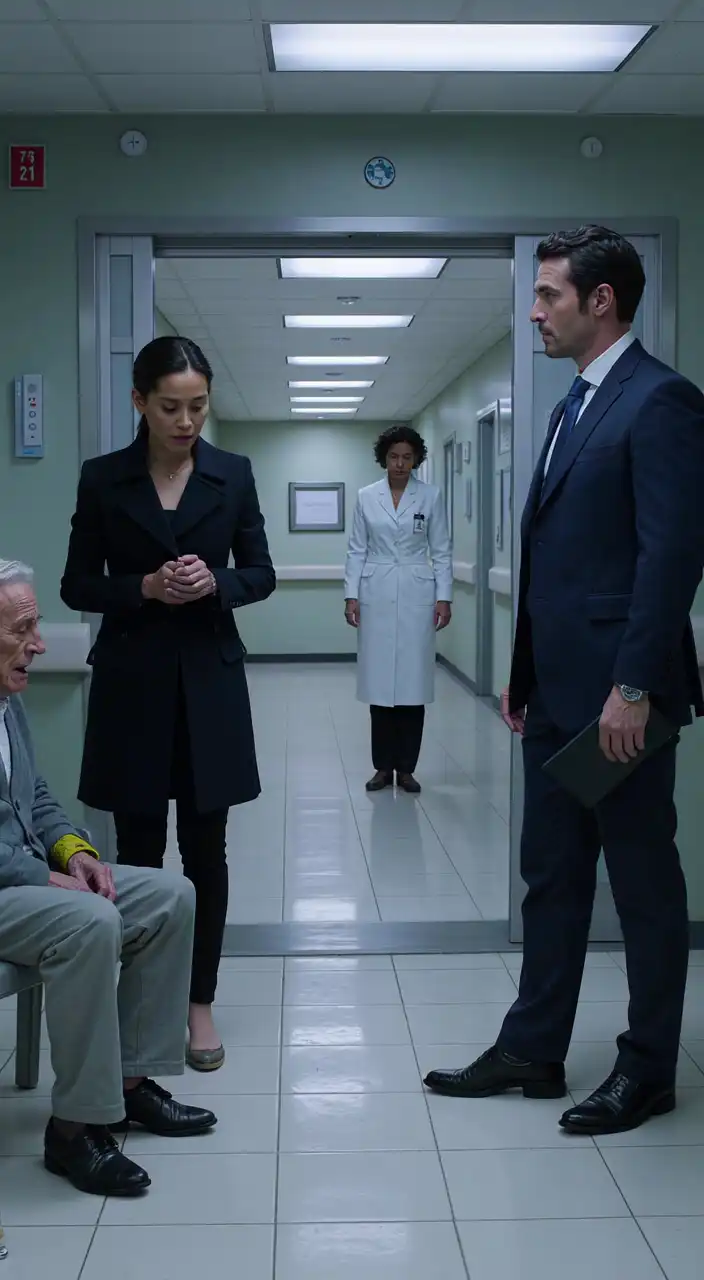
MY FATHER STARTED SHAKING OUTSIDE TRIAGE WHILE A CLINIC ADMINISTRATOR BLOCKED THE DOOR AND SAID HE NEEDED FAMILY PERMISSION FIRST.
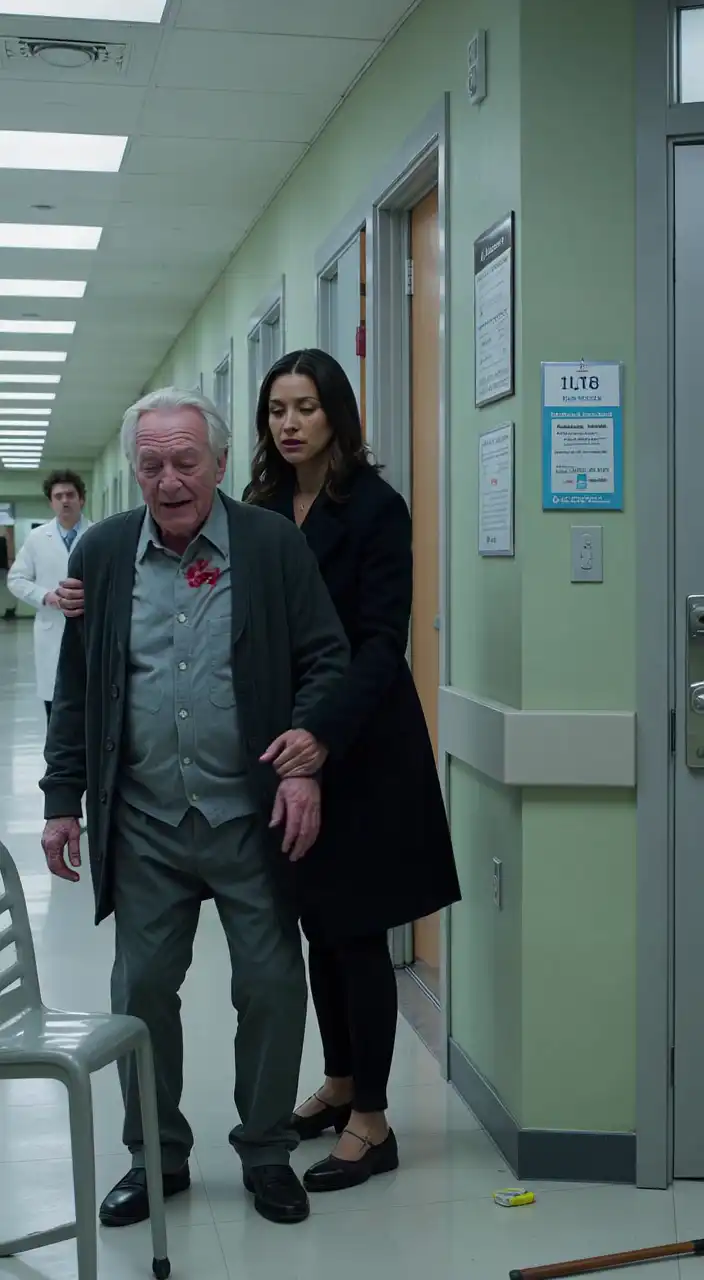
MY FATHER STARTED SHIVERING SO HARD HIS SURGICAL BANDAGE BLED THROUGH, AND THE CLINIC ADMINISTRATOR STILL BLOCKED THE TRIAGE DOOR.
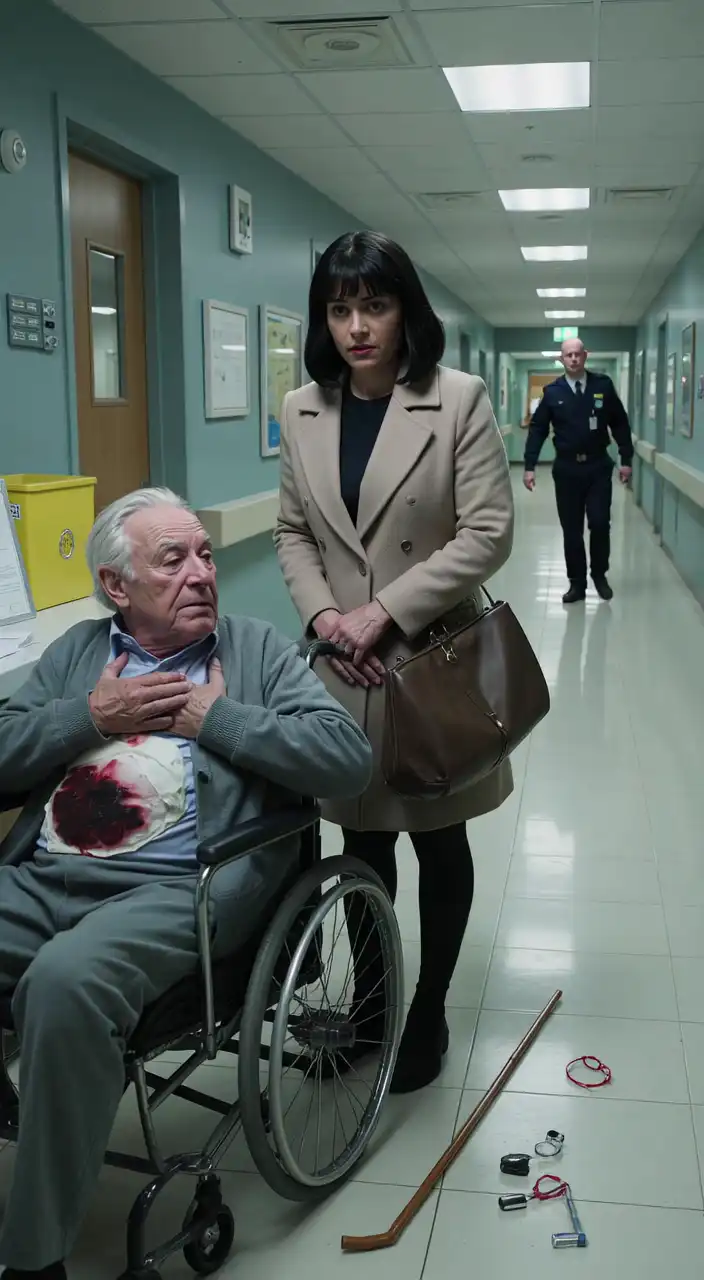
MY FATHER STARTED SHAKING IN THE HOSPITAL HALLWAY, AND THE WOMAN WHO CLAIMED TO BE HELPING HIM WOULD NOT LET TRIAGE TOUCH HIM.