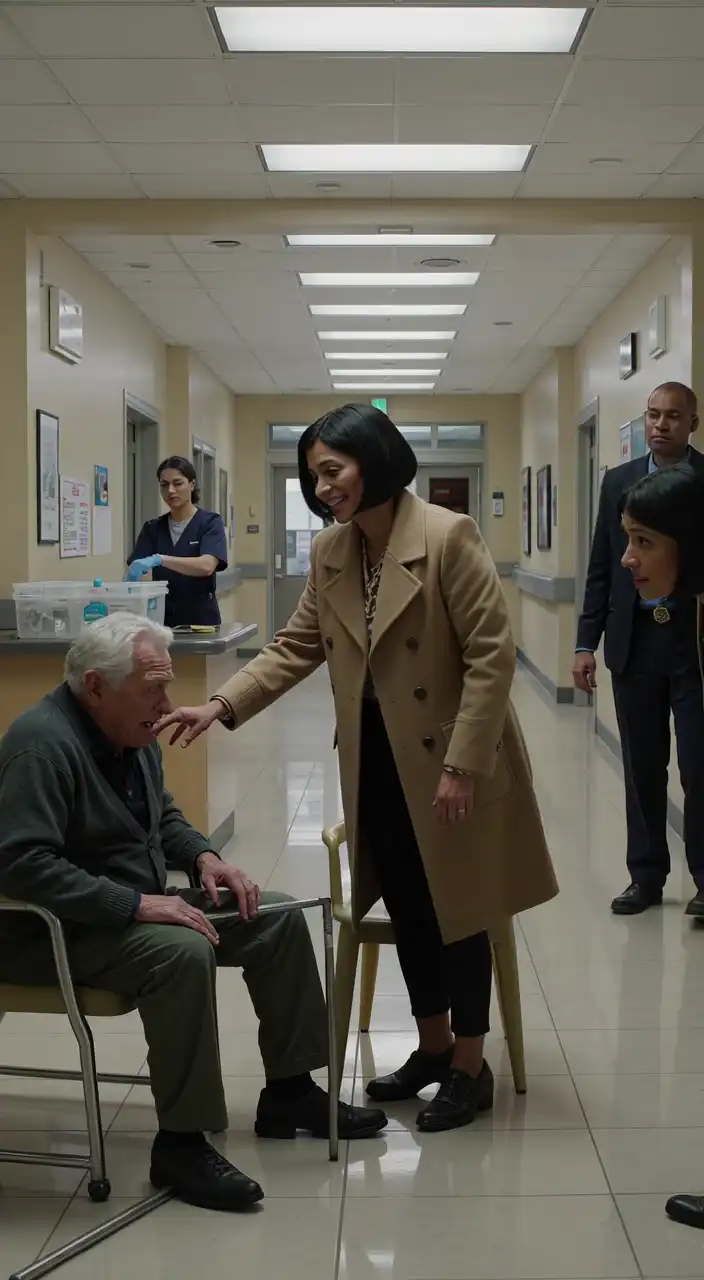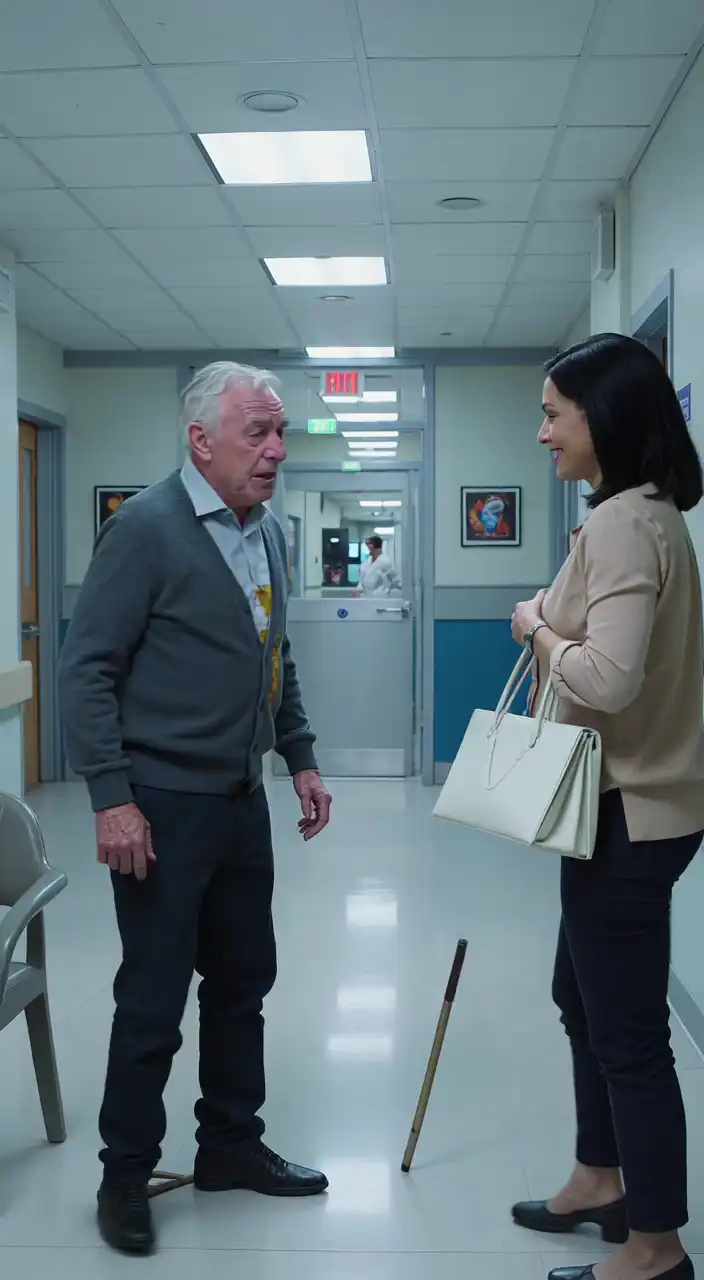
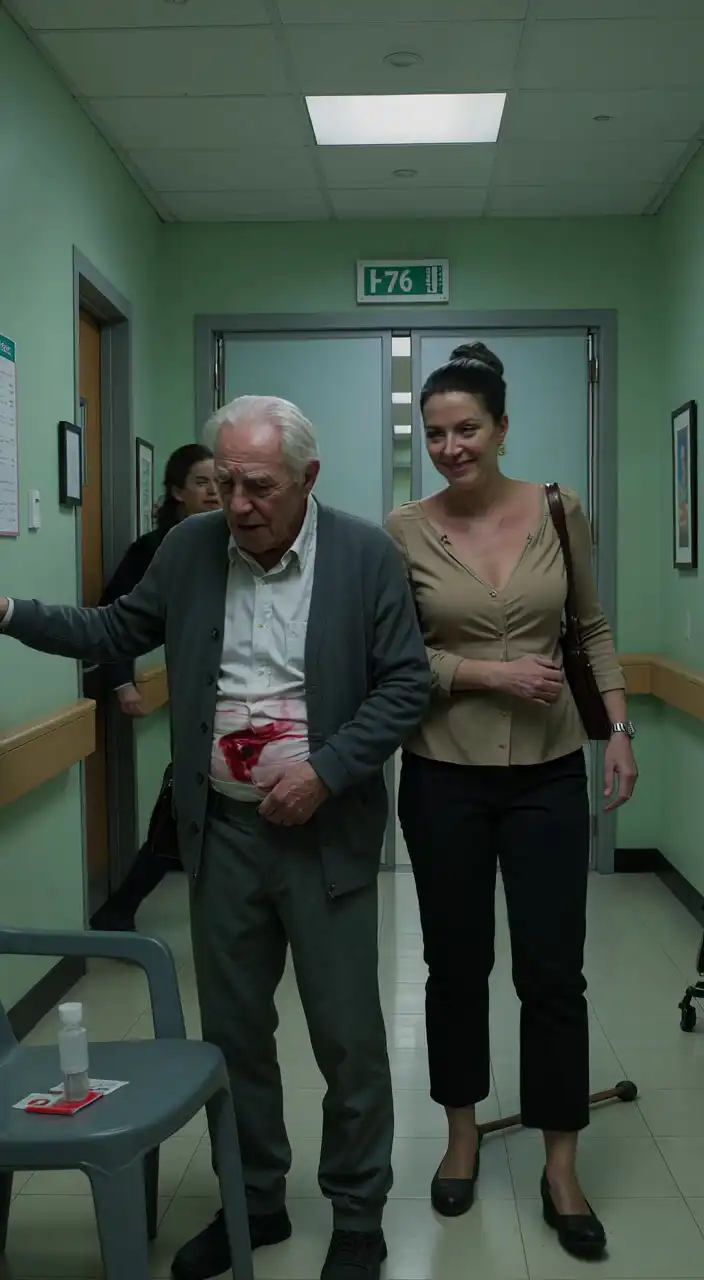
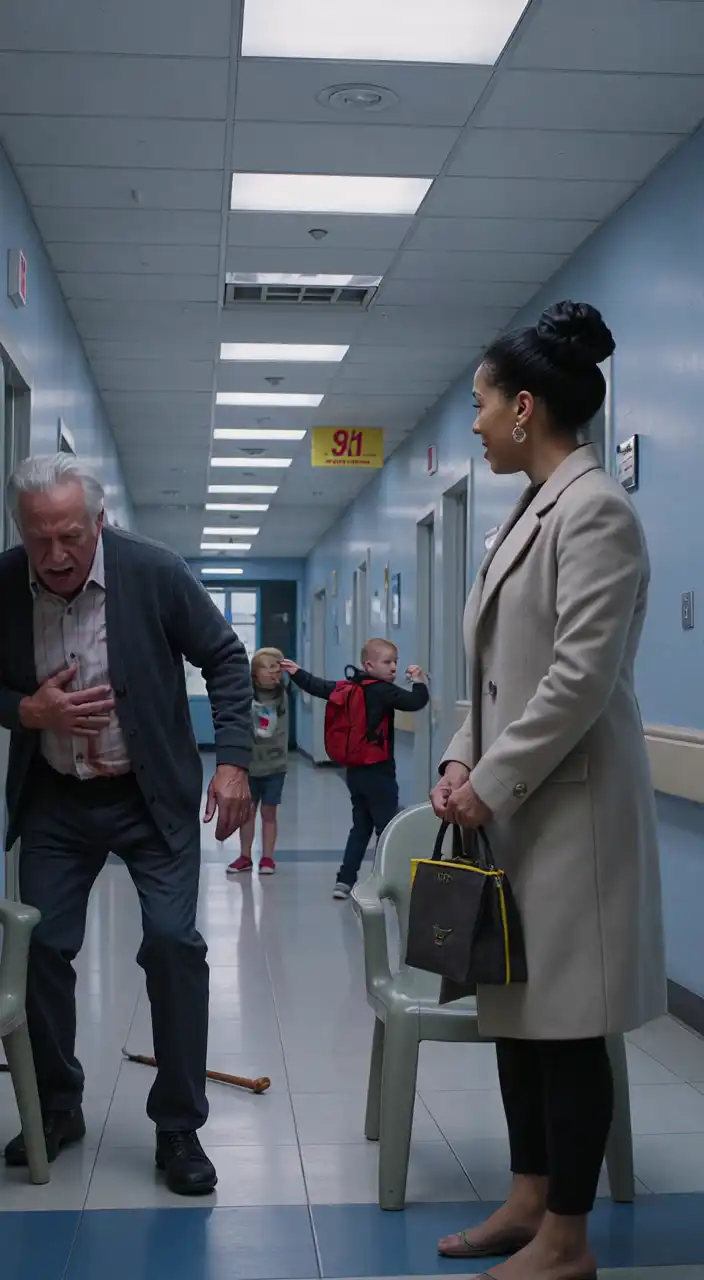

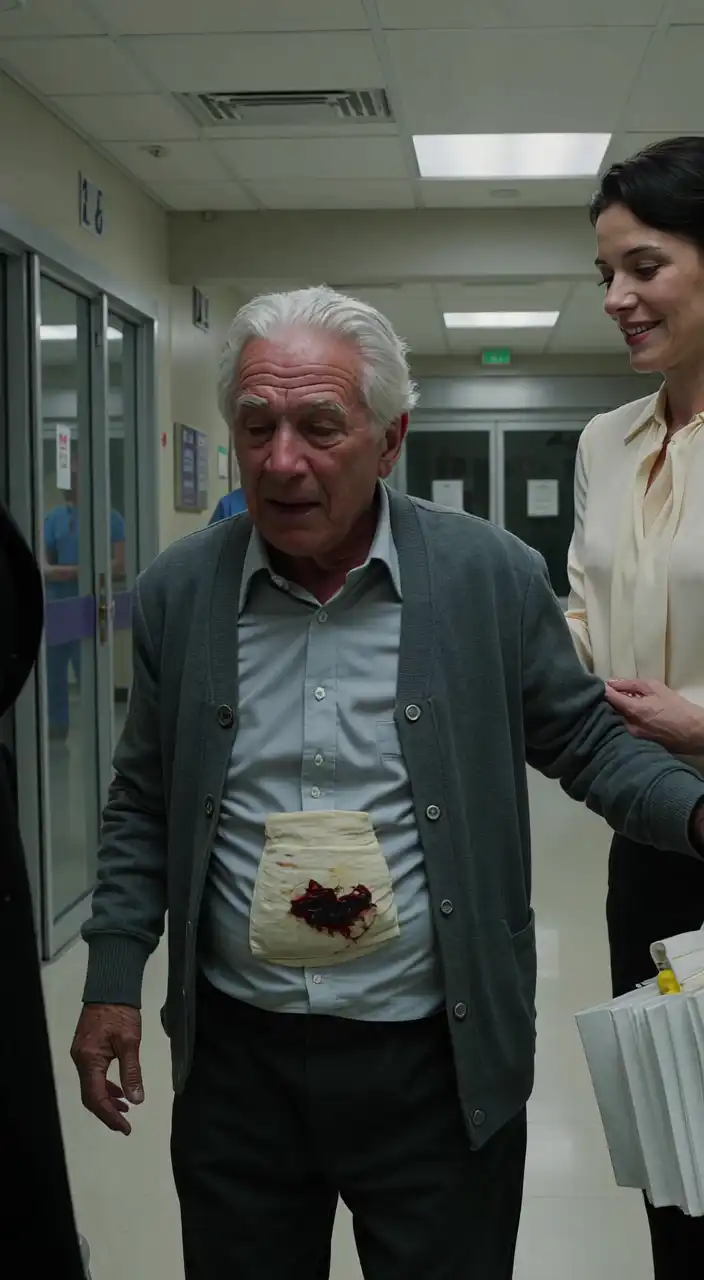
Leon did not raise his voice. That was what made the moment turn.
"Ma'am, set the bag on the chair," he said, one hand open, body angled so Olivia could not pull my father toward the doors or the parking lot. "Sir, stay seated. Nurse, I need clinical staff here now."
Olivia laughed once, sharp and offended, like he had insulted her in public. "This is ridiculous. He's my patient at home. He's post-op, he's disoriented, and his daughter is escalating him."
"I'm his son," I said, still holding Dad's cane hard enough that my palm hurt.
Dad's head lifted at that, just enough for me to see that he was trying to stay with us. Sweat had pasted gray hair to his forehead. His breathing came shallow and fast. "Nico," he whispered.
That one word did more for me than all the panic hammering in my chest. He knew exactly who I was. He knew exactly where he was. Whatever Olivia was saying, he was not too confused to be heard.
The triage nurse came around the desk then, pushing through the hesitation that had held everyone in place a few seconds too long. She crouched in front of Dad. "Sir, can you tell me your name?"
"Oscar Delaney." The answer came rough but immediate.
"Do you know where you are?"
"Mercy South." He swallowed. "Something's wrong. Fever. Burning."
Olivia cut in. "He says that every time he has gas pain."
Leon shifted his attention to her without moving from the path to the exit. "Bag on the chair, now."
For one second I thought she would refuse outright. Her smile dropped, and underneath it there was the panic the profile of her face had been hiding all day. But hospital hallways have their own kind of gravity. A nurse was now standing beside my father. Another had appeared at the triage door with a wheelchair. Two visitors down the hall were openly watching. Olivia seemed to understand that any sudden move would make her look exactly as bad as she was trying not to look.
She set the handbag down with theatrical patience. "There. Happy?"
The nurse touched Dad's forehead, then his wrist. "He's hot." She looked up at the second nurse. "Get him in."
Olivia stepped toward the chair before the other nurse could reach it. "No, he was discharged. We just need instructions clarified."
Dad grabbed my sleeve with surprising force. "Papers," he whispered. "She kept them."
That was the first time the hallway truly went still.
Leon bent, picked up the handbag himself, and kept it in his hand rather than returning it to her. "You can explain that in a minute."
Olivia's voice sharpened. "You cannot take my personal property."
"I can hold it pending a patient safety review when there is active concern about interference with care."
She stared at him. "Interference? He needs rest. If you readmit every anxious old man-"
Dad doubled over before she could finish, one hand clamped hard across the dressing on his abdomen. The wheelchair nurse moved in, but he retched first, dry and painful, onto the tile beside his dropped shoe. Mixed in with the spit was the same thin yellow color I'd seen on his sleeve.
The crouching nurse's expression changed. "What did he take?"
"Nothing unusual," Olivia said immediately.
Dad opened his eyes and looked at me, not her. "Bitter," he whispered. "She said it was antibiotic."
The nurse stood. "Wheel him in now."
Olivia reached for the handles. Leon caught her wrist, not roughly, just decisively enough that her face flushed with sudden rage. "Not you."
She yanked back. "You think I'm hurting him?"
"I think he asked not to leave with you, I think you answered for him repeatedly, and I think he's actively symptomatic." Leon handed the bag to another staff member who had just arrived with an incident form. "This stays with us."
The second nurse rolled Dad through the triage doors. I moved with them until the first nurse lifted a hand. "Family only, one at first."
"I'm family," I said.
Olivia said, "I'm his caregiver."
Dad found enough strength to speak before either of us could keep going. "Nico."
That settled it.
I followed the wheelchair into triage while Leon remained in the doorway, a human lock between Olivia and the rest of the hospital. Over my shoulder I heard her demand a supervisor, then complain about discrimination, then switch instantly to a tearful voice about trying to help. It was such a fast shift that even before we knew the full truth, I understood that almost everything about the day had been staged.
Inside triage, the fluorescent light made Dad look thin and transparent. The nurse clipped a monitor to his finger and started cutting away tape around the dressing stain while another took his temperature. The number flashed high enough that both of them exchanged a glance. Blood pressure low. Pulse racing. They asked him what surgery he had, what time he was discharged, what medication he'd taken. Each answer came in fragments. Gallbladder. Morning. "Two capsules. Yellow. She gave them in pudding."
"Who is she?" one nurse asked.
Dad's eyes shifted toward the doors. "Olivia. Neighbor." Then, after a pause that carried more shame than confusion: "Handles my rides. Bills. Since my fall."
I felt the ground move under old memories. Not literally. But all the small things from the last six months rearranged themselves at once. Olivia carrying his grocery bags and charming every receptionist. Olivia intercepting his mail because his hands shook. Olivia insisting she was "like family" after my mother's death. Olivia telling me Dad was embarrassed to have me too involved. Dad defending her because needing help had humiliated him.
The nurse opened the front of his cardigan farther and frowned at the stain. "This isn't just drainage." She pressed gauze lightly to the edge of the dressing and looked at the yellow on the fabric, then at the residue around his mouth. "Has he vomited before this?"
"In the car, maybe," I said. "I wasn't with them. She picked him up."
"What kind of capsules?" she asked Dad.
He shut his eyes. "I don't know. She said antibiotic. Said hospital forgot."
That was enough to escalate everything.
A physician assistant came in first, then the ER attending after hearing "recent abdominal surgery, fever, hypotension, possible wrong medication, possible caregiver interference." Dad was moved from triage to a treatment bay so fast the curtain barely settled before blood cultures, IV fluids, labs, and broad questions started flying. Every answer revealed another missing piece. He had been sent home with standard discharge instructions, but he did not have them. He had not been given any new antibiotic prescription. He did have a pain regimen, but it was supposed to be in a pharmacy-sealed bottle. He didn't know where that bottle was either.
"Can anyone verify what he took?" the attending asked me.
"The cap in the hallway," I said immediately. "Yellow stain on his sleeve. There was a cap under the wall."
The nurse who had first seen it nodded from the doorway. "Security already bagged it."
Good. One planted piece mattered already.
Dad reached weakly for my wrist as staff moved around him. "Don't leave," he said.
"I'm not leaving."
He nodded once, but his eyes drifted toward the curtain and the hall beyond it, where Olivia still was. That fear wasn't the fear of a patient worried about illness alone. It was the fear of a man who had finally spoken one disloyal sentence out loud and knew the person he depended on might retaliate.
The attending leaned close to him. "Mr. Delaney, I need to ask directly. Do you feel safe with the person who brought you in?"
Dad's mouth worked before sound came. He hated this kind of question. He hated admitting need. He hated becoming a man everyone had to protect.
Finally he whispered, "No."
The doctor did not dramatize it. She simply nodded and said to the nurse, "Social work and charge nurse. Note patient states he does not feel safe with caregiver." Then to me: "We are treating the medical emergency first. But if someone withheld papers or gave him unknown medication, that changes the way we handle access."
From beyond the curtain came raised voices again. Leon's voice stayed low. Olivia's did not.
The physician assistant returned with a clear plastic bag. Inside was the bottle cap from the hallway and a folded sheet someone had found tucked into the side pocket of Olivia's handbag when they secured it: the top page of Dad's discharge paperwork.
Only the top page.
The rest was missing.
The attending looked at me. "If the medication list isn't with this packet, we need pharmacy to verify everything. Also..." She held up the paper. "He was told to return immediately for fever over 101, worsening pain, or any drainage discoloration."
Dad gave a tiny, exhausted laugh that sounded more like grief. "Told her," he murmured. "She said I'd get billed twice."
That was the contradiction that opened the second door in my mind. Olivia had not merely minimized his symptoms. She had known exactly how serious they were because the hospital had written it down. And she had still kept him outside the line.
Then the charge nurse came to the curtain and said, "Security needs a statement. Also, the woman outside is insisting she's his medical proxy."
Dad opened his eyes.
"No," he said, stronger than before. "No proxy."
The charge nurse hesitated. "She has a photocopy of a notarized form."
For a second, all the machines seemed to get louder.
Dad stared at me with the same stunned anger I felt rising in my own chest. "I never signed..." He stopped, swallowing hard against nausea and pain. "Unless..."
He looked past me, not at the curtain, but at some memory.
Three months earlier, after his hip fall, he had let Olivia take him to a bank and a rehab follow-up on the same day because I was out of state for work. He had mentioned signing "transport forms" on a clipboard in the car because he didn't want to stand in the wind.
The attending saw the realization hit both of us. "Let's keep treatment moving," she said. "And no one lets that woman near this bay."
Outside, Olivia had started pounding on the nurse station glass and shouting that they were kidnapping an elderly man.
Inside, the first lab alarmed red, and the doctor looked down at the numbers with a face that turned this from disturbing into dangerous.
"We may be dealing with infection and something else," she said. "I want tox involved now."
The medical emergency had finally made it past the door.
But whatever Olivia had done started long before this hallway, and she had come prepared for more than one kind of control.
A toxicology fellow named Dr. Singh arrived with the kind of focused calm that made everyone around him sharpen. He listened to the attending's summary without interrupting, then bent over Dad's bed. "Mr. Delaney, I know you're exhausted. I need details that may seem small. Bitter taste, yes? Anything else about the capsules?"
Dad's eyelids fluttered. "Soft. Stuck in my teeth."
"Color?"
"Yellow. Maybe gold."
Dr. Singh nodded once and turned to the bagged cap. "Could be from a supplement bottle. Could be from compounded medication. Could be nothing. But the stain on the sleeve matters if some of the contents dissolved."
He asked if Dad had been on digoxin, blood thinners, diabetes medication, sleep aids, or old pain meds from before surgery. Dad answered in fragments. Blood pressure pills, yes. Occasional sleep tablet, yes. No diabetes. Blood thinner only in hospital. Dr. Singh asked me if there were supplements at home. I said there had been vitamins and turmeric because Olivia was always pushing "natural support" and talking like she knew more than physicians did.
At that, one of the nurses glanced up. "Turmeric can stain like crazy."
Yellow stain. A plausible explanation. Too plausible.
Dr. Singh didn't dismiss it. "It can. But bitter capsules hidden as antibiotics would still be concerning." He pointed to the corner of the discharge sheet. "What concerns me just as much is this patient apparently had clear red-flag instructions and was kept from care."
A social worker came in next, badge swinging, notepad ready. Her name was Maribel, and her face changed in a subtle but important way when Dad again said, haltingly but clearly, that he did not feel safe with Olivia handling his medication or paperwork. Maribel had the practiced patience of someone who had heard denial, fear, loyalty, and shame all braided together before.
"Mr. Delaney," she said gently, "I'm going to ask a few questions to understand who helps you at home. You are not in trouble. No one can remove you from treatment because you answer honestly."
Dad stared at the blanket. "I know that."
But he said it like a man who had not fully believed it until this minute.
We learned more in pieces. Olivia lived two houses down. She had begun helping after Dad's hip injury and after my mother's death left him lonely enough to accept favors. At first it was rides and groceries. Then she offered to organize medications because "men your age mix things up." She started attending appointments when I couldn't. She charmed staff by keeping lists and asking the right words. She took over his online bill payments after he forgot one utility bill and was embarrassed. Then, without any single dramatic handover, she became the person every office called first because her number was listed on forms she had filled out "to save him the trouble."
Maribel asked, "Did you ever sign power of attorney or healthcare proxy papers?"
"No." Dad's answer came quickly, then slowed. "Not knowingly."
"Did she ever ask you to sign blank pages? Ride forms? Insurance forms she said she would fill out later?"
Dad looked at the ceiling. "In the car. At the bank parking lot. Maybe one at home after my cataracts. She'd put tabs where my name went."
That was the second planted detail before payoff: papers signed in compromised situations.
Leon came in during that conversation, closing the curtain behind him. "Update," he said to the attending. "The woman identifying herself as Olivia Brooks continues to claim proxy authority. We have her separated from patient access. Also, when our officer inventoried the handbag in her presence, there were multiple prescription bottles inside with labels partially peeled off."
Every person in the room stilled.
"Whose names?" Dr. Singh asked.
Leon checked his clipboard. "One appears to be Mr. Delaney's old sleep medication from before surgery. Another label is damaged. Another is a vitamin bottle with no contents. Also cash envelopes and what looks like a checkbook register."
Maribel exhaled quietly through her nose. "Financial control."
Olivia's motive was beginning to show itself, but not completely. Control, yes. Maybe theft. Maybe dependence. Maybe fear of losing access if he got readmitted and spoke. But the medicine still mattered most because Dad's pressure remained low despite fluids, and his fever kept climbing.
The attending ordered imaging to check for a postoperative complication: leak, abscess, infection. Dad needed to go to CT. Before transport took him, he caught Leon's sleeve. "Please," he said. "Don't let her drive my car."
Leon leaned down so Dad did not have to strain. "She's not taking you anywhere tonight, Mr. Delaney."
That should have reassured him, but instead Dad looked stricken. "House keys," he whispered. "In her bag."
I felt the next problem immediately. Home. Mail. documents. medications. If Olivia had keys and access, then the hospital wasn't the only threshold she controlled.
Maribel saw it too. "We'll handle immediate safety here. Nico, do you have access to the house?"
"Yes. My own key."
"Good. Don't go alone if she leaves before law enforcement speaks with her."
"Law enforcement?" I repeated, half stunned that we were there already.
"Unknown medication, possible forgery, possible exploitation of a vulnerable adult, and active interference with emergency care," she said. "We don't wait until after discharge to take that seriously."
The CT transport team arrived. As they moved Dad, his cardigan sleeve brushed my hand. The stain had dried in ridged streaks, and the smell under the hospital antiseptic hit me faintly at last: earthy, medicinal, not juice. Not exactly turmeric either. Something compounded, concentrated, wrong. I filed it away because by then every little thing might matter later.
While Dad was in imaging, Leon asked me for a formal hallway statement. We stepped to a consultation alcove off the ER where I could still see Dad's bay if I leaned. Leon's notebook was plain, his questions exact. What time had Olivia picked him up? Had I seen him before discharge? Who found the cap? Had Olivia made statements about billing, confusion, or prior medication? Had Dad ever previously said he felt unsafe?
That last question took me longest.
"Not directly," I said. "But he changed around her. Smaller. Careful. If I offered to come to appointments, he'd say she already had it handled. If I asked what meds he was on, he'd tell me she had the list. Last month he said I should stop 'making trouble' for someone trying to help him. He sounded like he was repeating her."
Leon wrote that down. "People under coercive control often do."
The phrase made my skin crawl because it fit too well.
Then came the first reversal.
The attending found us after reviewing the initial CT read. "Good news and bad news," she said. "The surgery site likely is infected. That's serious but treatable. The worse surprise is that his labs suggest oversedation or ingestion of something beyond his prescribed post-op meds. Not enough to explain everything, but enough to impair judgment and maybe mask symptoms."
"So she drugged him?" I said.
Dr. Singh, who had followed her out, lifted a cautioning hand. "Maybe. Or he took an old medication unintentionally. We have to prove what. But if someone wanted him too groggy to advocate for himself, old sleep medication would do that."
Leon looked up. "One of the bottles in the bag was an old sleep prescription."
My relief at the treatable infection vanished under a colder understanding. Dad might have survived the surgery, recognized a dangerous complication, and still been kept from help by someone using just enough medication and just enough authority to blur his alarm until he looked "confused."
Then the plausible but incomplete explanation arrived.
A deputy from the hospital substation interviewed Olivia in a separate office, and through Leon we heard her first formal story: she claimed Dad had begged not to be readmitted because he was terrified of costs, that she only gave him turmeric and his prescribed pain medication, and that she held his paperwork because he always lost documents. She said the proxy copy was legitimate and that I was an absent son trying to dump guilt on her because she had "done the ugly work" of caregiving for months.
On paper, parts of it fit too well. There really had been costs. I really had not been there enough. Dad really did lose papers when stressed.
Maribel warned me, "Manipulative caregivers often hide inside truths."
The deputy also relayed one more thing: Olivia claimed the yellow stain was from a supplement she mixed into applesauce because Dad refused pills.
Turmeric again. Enough truth to muddy poison.
When Dad returned from CT, weaker and shivering, he heard that and looked furious in a way I had not seen since before Mom died. "Not applesauce," he rasped. "Chocolate pudding. She knew I'd take it."
That detail would matter.
The nurse adjusted his IV and asked softly, "Did she tell you what it was?"
"Antibiotic hospital forgot." He shut his eyes, then reopened them with effort. "She said if I came back in, they'd cut me open again. Said fever was normal. Said Nico overreacts."
The doctor touched his shoulder. "You came back anyway."
Dad looked at me. "Tried."
There it was, the guilt I had not let myself feel because panic had come first: he had tried to get to triage before she shut him down. I had been late by minutes, maybe less.
The deputy came to take Dad's statement, but halfway through, Dad's blood pressure dipped again, and they had to pause. The doctor ordered antibiotics and closer monitoring. "He may need admission to step-down," she said. "The infection is real. We are not out of the woods medically."
So the rescue wasn't complete just because he was inside. He was finally in care, but still unstable. And outside, Olivia was not done.
Twenty minutes later, Leon got another call and his jaw tightened.
"She says there is one more family member en route who can verify the proxy," he told us. "And she wants access to his phone because she claims there are medication notes on it."
Dad's hand moved weakly toward the bedside drawer. "Phone."
The nurse checked the belongings bag. No phone.
I looked at Leon. "She has it."
Dad's face changed in a way worse than fear. "Photos," he whispered. "Documents. Notes."
A man who had already lost control of his medications and papers suddenly realized his phone was gone too, the one place many older patients keep pictures of pill bottles, appointments, and messages. If Olivia had it, she had more than contacts. She had evidence.
Leon turned immediately. "I'm locking down her property search further."
But Dad caught his sleeve again. "Kitchen drawer," he said. "At home. Spare checkbook. Red folder."
More evidence at the house. More reason for Olivia to keep moving before anyone could reach it.
Maribel looked at me. "Do you understand what that means? If she gets out before police decide probable cause, she could clear everything."
I understood too well.
And just then, from the hall, we heard a fresh burst of shouting and the unmistakable crash of a chair going over.
Olivia was making her desperate move before the hospital could turn suspicion into proof.
By the time Leon and the deputy reached the ER consult office, Olivia had already changed tactics.
The overturned chair was still spinning slowly against the wall. A unit clerk stood frozen, one hand over her badge reel. Another security officer had stepped in from the main corridor. Olivia was near the side exit that led toward imaging, not the public entrance, and she had tears running down her face with unnerving precision. Not messy panic. Useful panic.
"She tried to access the restricted hallway," Leon said under his breath as we caught up. "Said she needed a restroom, then doubled back."
The deputy held out a hand. "Ms. Brooks, stay where you are."
She turned toward him, shoulders shaking. "I was trying to call his insurance. You people are humiliating me. He'll be furious when he knows what you're doing."
Leon didn't answer. His eyes had fixed on something in her hand.
Dad's phone.
Not hidden. Clutched.
"Ma'am," Leon said, "place the phone on the floor."
She looked down at it as if she had forgotten it was there. "This is mine."
"It has his lock screen photo," I said. "That's my parents at my graduation."
For a split second, the tears vanished. Real calculation replaced them. Then she bent like she might comply, and instead she swiped the screen with frantic speed.
Leon moved first, deputy second. They didn't tackle her; they boxed her in. The phone slipped from her hand, hit the vinyl floor, and skidded under the clerk station. The deputy got her wrists before she could dive after it.
"What did you delete?" I heard myself shout.
"Nothing!" Olivia snapped, and there was the real voice, hard and furious. "You think one grown man with an infection makes me a criminal?"
The deputy did not answer that either. He recited instructions, told her she was being detained pending investigation, and passed her to the second officer. She started screaming then, not from fear but strategy, drawing every eye in the corridor.
"Ask him who pays his mortgage! Ask him who keeps him from falling in filth! Ask his precious son where he was while I cleaned him up!"
It hit where she meant it to. Shame is leverage because it often has some truth in it. I had not been there enough. I had let helpfulness stand in for safety because it made my own life easier to manage. But none of that changed the thing at the center of the night: she had blocked emergency care.
Leon crouched, slid Dad's phone out from under the clerk station, and looked at me. "Passcode?"
I knew it. My mother's birthday. Dad had never changed it.
The screen lit.
Battery 9 percent. Dozens of unread messages. A note app tile open in the recent window. And, for one sickening second, a banking app screen still half visible before the phone locked itself.
Leon handed it to the deputy, not me. "Chain of custody."
That was fair. It also nearly killed me.
Back in Dad's bay, they were hanging another bag of fluid and discussing whether he might need a higher level of care if his pressure did not stabilize. He looked worse and more alert at the same time, which the doctor said could happen when the wrong sedating medication started wearing off. Pain sharpened as the fog lifted.
"They got my phone?" he asked.
"Yes."
He sagged with relief. "Notes app."
Dr. Singh, still there because toxicology had become central rather than optional, looked over. "What notes app?"
Dad took a shallow breath. "I started writing down... things she said. Things missing. Didn't trust myself to remember."
A third planted detail, hidden in plain sight by his own shame. He had been documenting.
The deputy requested emergency consent to search the notes app and recent messages because of the active patient safety concern. Dad gave it instantly. Within minutes, while nurses worked around us, the deputy and Leon stood near the curtain reading in silence.
Then Leon looked up at me, and for the first time his controlled anger fully showed.
There were dated notes: "Olivia says utility payment doubled." "Pain bottle missing 4 pills." "Asked me to sign grocery receipt blank." "Told doctor office she is niece. Not true." "Said not to bother Nico, he has enough." "Yellow capsule after lunch made me sleep 4 hrs." "Need ask surgeon if normal drainage."
There were photos too. Not many. Dad had apparently snapped them when he felt uncertain but did not know what to do with uncertainty. A prescription bottle on the kitchen counter with a peeled label. A stack of envelopes with red final notice stamps. A photocopied form naming Olivia as emergency medical decision-maker, only the signature line partly visible. And one image that mattered more than all the others: discharge paperwork from that very morning spread on his table before Olivia must have gathered it up. The page listing warning signs and medications was visible enough to compare later.
Maribel came back in and saw Leon's face. "What is it?"
"He documented concern before tonight," Leon said. "And she appears to have represented herself falsely to multiple providers."
The deputy added, "There's also a text thread with an unknown contact discussing 'keeping him settled' until direct deposit clears tomorrow."
The room changed temperature.
That was motive with a clock attached.
Tomorrow.
Dad's social security deposit, maybe pension. If he got readmitted and someone else saw his finances, Olivia's access could vanish. She had not just minimized his fever because she disliked hospitals. She had needed him compliant and outside scrutiny until money moved.
I sat down hard because my knees suddenly didn't trust me. Dad saw my face and misread it. "Nico," he said, hoarse, "not your fault."
I wanted to believe him. I didn't yet.
The deputy asked Dad whether Olivia had access to bank cards or account passwords. Dad closed his eyes in humiliation. "She helped set autopay. I wrote things down for her." Then, after a pause: "Red folder in kitchen drawer. Statements."
Maribel put a hand lightly on the rail. "We'll secure what matters. First we keep you alive and safe."
The movement of the story should have shifted then entirely to evidence, but the medical pressure surged again before anyone could settle into that. The nurse looked at the monitor and called for the attending. Dad's blood pressure had fallen further. His skin went ashy. He pressed a hand to his abdomen and whispered, "Cold."
The attending came fast, assessed him, and ordered rapid labs, another bolus, and a surgery consult. "If the infection has progressed or there is a leak developing, he may need intervention tonight."
The words sliced through all the legal and emotional noise. He could still die from the thing Olivia had delayed, regardless of what proof we held in our hands.
As staff moved around us, Dr. Singh spoke quietly to the deputy. "From tox perspective, we may have enough to send the pills for analysis, but the acute danger right now is sepsis plus possible ingestion of old sedatives. The obstruction itself is part of the harm."
The deputy nodded. "Understood."
Leon stepped back into the hall to coordinate the property inventory, and a few minutes later returned with another small clear evidence bag. Inside was not just the cap but three soft gelatin capsules recovered from a side zipper in Olivia's handbag.
"Found with no labeled bottle," he said.
Dr. Singh held the bag to the light. Amber-yellow. Viscous contents.
"Toxicology send-out," he said, "but this shape and color are consistent with concentrated supplement gels. Could be turmeric, yes. Could also be mixed with something else if she altered them."
Olivia, cornered, had built her lie around enough ordinary detail to survive first contact. But now every ordinary detail pointed the other way. Turmeric wasn't the defense she thought it was if she had been swapping contents, disguising sedatives, or using "natural" pills to make him sleepy on demand.
Then came another reversal, one more human and painful than evidentiary.
The "family member" she had called finally arrived.
Not a lawyer. Not an ally from some fraud scheme. It was her seventeen-year-old son, Marcus, still in a fast-food uniform, face blotchy with confusion. He had been told his mother was being harassed while helping an old man. Leon kept him outside Dad's treatment area, but because the consult alcove was near enough and voices travel, I heard enough to understand.
Marcus looked from the deputy to his mother and back again. "You said he fell again," he said. "You said you needed me to bring the folder from home."
"What folder?" the deputy asked.
Olivia snapped, "Marcus, be quiet."
But something about the hospital, or the uniforms, or the sight of his mother in actual trouble pushed him past obedience. "The red folder. The one from the kitchen drawer. You texted me to grab it before the son got there."
My stomach dropped.
Dad had a red folder in his kitchen drawer. Marcus had likely just removed it from the house.
The deputy's tone changed. "Where is that folder now?"
Marcus held up a plastic grocery bag with shaking fingers. "In my car. I didn't know-"
Olivia lunged before anyone could stop her and screamed, "Don't give them anything!"
That was the desperate action that cracked the rest of her performance beyond repair.
Marcus started crying as the deputy took the bag and another officer moved Olivia farther back. "She said it was insurance stuff," he kept saying. "She said if I didn't help we'd lose the house."
Lose the house. Her house, not Dad's. More motive. More pressure. More collateral damage.
The deputy looked into the bag, then sealed it without spreading the contents in the public hall. "This gets inventoried."
Dad heard enough through the curtain to understand there was a child - nearly a man, but still a child - tangled in this. His face twisted not with anger but pity. "Marcus?" he whispered.
I nodded.
He shut his eyes. "She used everyone."
That was the larger moral reversal of the night. Olivia wasn't some comic-book villain twirling lies for fun. She was a woman under money pressure, probably drowning, who had built a whole identity around useful competence until control became exploitation and then emergency obstruction. Understanding that did not excuse anything. It just made the damage wider.
The inventory of the red folder could wait ten more minutes because Dad suddenly could not.
The surgeon arrived, looked at the labs, the CT, the dressing, and Dad's worsening vitals. "He may have a postoperative abscess and systemic infection. Interventional radiology may be enough if we're lucky. If not, he may need the OR."
Luck.
After everything else, we were back at that primitive word.
They prepped to move him for urgent drainage evaluation. The attending asked me if he had any advance directives. I almost laughed at the cruelty of the question after the false proxy scare, but Dad answered himself.
"My son," he said. "Only him. Until papers done right."
The nurse documented it. Maribel squeezed my shoulder once and stepped aside so transport could swing the bed.
As they rolled him out, the edge of his cardigan shifted and his hospital wristband flashed under the fluorescent lights. Not the triage bracelet from some cliché story, but the actual proof that he was finally in the system where Olivia could not speak him back into the hallway.
I walked beside the bed until the double doors to the procedure area. Dad's hand found mine briefly.
"Kitchen drawer," he whispered again. "Check under the towels too."
Even at the edge of sepsis and possible surgery, he was still trying to hand me the map out of the trap.
When the doors shut, I turned and saw Marcus in the corridor, pale and wrecked, while Olivia glared from between two officers as if all of this were somehow betrayal done to her.
Leon came to stand beside me. "Deputy's getting a search warrant for the house now," he said. "And financial crimes will be looped if the folder matches what we think."
"What do you think?"
He looked toward procedure, then back at the sealed bag in the deputy's hand. "I think she delayed care to keep him quiet until money hit. I think she rehearsed every sentence. And I think your father knew enough to leave breadcrumbs because part of him knew this night might come."
I thought of the notes app. The yellow stain. The cap under the baseboard. The red folder. His one clear plea in the hallway: don't let her take me back.
Marcus suddenly spoke from his chair, voice cracking. "He told me once my mom shouldn't handle his pills."
Both officers looked at him.
He wiped his face with his sleeve. "I thought he was just old and stubborn. But sometimes she'd put the soft pills in pudding because she said he argued less after. I thought they were vitamins."
No one said anything for a second.
Then the deputy crouched in front of him. "Marcus, I need you to tell that exactly as many times as necessary."
The final obstacle had shifted. It was no longer just whether the hospital believed us or whether Olivia could wave papers around. We had enough to expose her.
Now it was whether Dad could survive long enough to step into the safety all that evidence might create.
The procedure took two hours.
That was not long in the language of hospitals, but it was long enough to age me.
I sat with a paper cup of burned coffee gone cold in my hand while every mechanical door sound snapped my head up. Maribel helped coordinate practical things between updates: she had an adult protective services intake started, a temporary no-visitor restriction in Dad's chart for Olivia, and a plan for police escort if I needed to go to the house later. Leon stayed past what I realized must have been the end of his scheduled shift. The deputy moved between interviewing Marcus, processing the property bags, and waiting on the warrant.
No one treated this like gossip. That mattered. Every step was dramatized by time, paperwork, signatures, and whether Dad's blood pressure would hold. Safety was not a speech. It was a chain that could still break.
Marcus eventually sat across from me and asked, without looking up, "Is he gonna die?"
I should have hated him for bringing the folder, for obeying her text, for helping in all the small ways kids help adults when they think they are just being useful. Instead I heard my father's voice saying, She used everyone.
"I don't know," I said.
He nodded, crying silently. "She said if he got admitted they'd find out she used his card for groceries. She said she'd pay it back after next week. Then she said if I didn't help we'd be homeless."
There it was in full. Not some mysterious inheritance twist. Groceries, bills, direct deposit, small theft widened into sustained control. Everyday desperation curdled into criminal abuse because one vulnerable man's trust was easier to reach than honest help.
The deputy came over with a measured look. "The red folder contains bank statements, utility notices, a photocopied healthcare form, and discharge paperwork. The healthcare form appears altered. Signature likely copied from another document. We'll verify. Also found were sticky notes with passcodes and one envelope showing a recent withdrawal from his checking account."
Dad had been right to hide details under kitchen towels. He had known he might need a second hiding place.
"Anything from the house yet?" I asked.
"Officer is on scene with warrant team now."
When the surgeon finally returned, all of us stood.
He still had on a cap and mask hanging loose at his neck, and I could read the whole first sentence on his face before he said it.
"We drained an abscess," he told me. "That's likely the main source of the sepsis. He was getting sicker quickly, but we got source control, and he's responding better now than I expected."
I let out a breath that felt torn from somewhere deep.
"He will need IV antibiotics, close monitoring, and at least a few days inpatient, maybe more depending on cultures. But right now, he is stable enough to say the immediate danger has eased."
Immediate danger. Not full safety, but enough for my knees to stop shaking.
"Can I see him?"
"In recovery briefly, yes. He asked for you before sedation fully wore off."
When I stepped into recovery, Dad looked pale and wrung out, tubes and monitors doing the work his body could not yet trust itself to do. But he looked like himself. Not like a man being narrated over.
His first word was not my name.
"Marcus?"
I blinked. "He's here. He's okay."
Dad nodded weakly. "Not his fault."
"Yeah," I said. "I know."
His eyes drifted to the side, then back. "Proud you came."
That nearly undid me more than anything else.
"I should've come sooner."
"You came when... I finally said it."
The truth of that hurt because it was mercy. He was not absolving the months. He was naming the moment. Rescue started when he crossed his own threshold and asked not to go back.
I told him, as simply as I could, that Olivia was being held, that the false proxy was being investigated, that his phone and notes were safe, that the doctors had found the infection in time. I did not mention every financial detail yet. He looked exhausted enough without adding the full inventory of betrayal.
But he surprised me. "Money?" he asked.
"Some problems," I admitted. "We'll sort them."
He closed his eyes. "I knew. Not all. Enough."
That was another difficult mercy. He had not been fully duped. He had been lonely, post-surgical, ashamed, and dependent. He had sensed danger and documented around it because direct confrontation felt impossible while she still controlled rides, pills, and paperwork.
Leon visited recovery only long enough to tell Dad one thing directly. "Mr. Delaney, you did the right thing in the hallway."
Dad's eyes filled. He gave the smallest nod.
By dawn, the house search results came back. Under the kitchen towels, officers found an envelope of Dad's spare checks, his actual pain medication bottle with several pills missing, and original bank mail he had never seen. In Olivia's car, they found additional mail addressed to him and a folder of copied IDs and signed forms. One bottle from her bag tested preliminarily consistent with his old sedative prescription, and one of the gelatin capsules had residue that would require full lab analysis but was not standard hospital-issued medication of any kind.
The probable cause picture was complete enough that the deputy stopped sounding careful and started sounding firm. Charges would be pursued for exploitation of a vulnerable adult, forgery, theft-related counts depending on the bank records, and obstruction related to medical interference if prosecutors agreed. Hospital risk management was involved because she had represented herself falsely in clinical settings before. Adult protective services would coordinate discharge planning so Dad did not go back into the same dependency web.
And still, the most moving scene of the morning happened in a plastic-chair consult room with no courtroom drama at all.
Marcus asked if he could apologize.
Maribel checked with Dad first. Dad said yes.
The boy came in wringing his paper hat from work between both hands. "I didn't know," he said before even sitting down. "I thought she was helping you. Sometimes I knew stuff felt weird, but if I asked questions she said I was ungrateful. I'm sorry I brought the folder. I'm sorry I ever gave you those puddings if she asked me to."
Dad looked at him for a long time. Then he held out his hand.
Marcus started crying harder when he took it.
"You don't owe me a lifetime because your mother made bad choices," Dad said softly. "But you do owe yourself the truth now."
It was exactly the kind of thing my father would say when he was healthiest, and hearing it told me more about his recovery than any monitor.
There were practical aftermaths. Banks had to be called while accounts were frozen and resecured. The surgeon had to explain infection risks, drains, cultures, and why delaying a return after fever can become catastrophic fast. Maribel had to help us build an actual discharge plan with home health, medication lockboxes, direct provider contact to me, and no unsupervised access for anyone not verified. Leon filed his incident report with the yellow stain and cap noted in clinical language that would matter later. Dr. Singh updated us that the likely sedative exposure was limited but real enough to support impaired alertness. The yellow residue may have come from altered supplement gels used as a disguise. Not dramatic movie poison. Something uglier and more ordinary: enough to keep an elderly patient quieter, sleepier, more manageable.
That truth fit the whole story. Olivia had not needed a theatrical toxin. She needed delay.
When the sun came fully up through the high hospital windows, the hall outside Dad's room looked almost innocent. Fresh shift, fresh coffee, machines humming. The same triage doors opened and shut for new emergencies, as if nothing world-changing had happened on that cold tile overnight. But to me the place had split into before and after.
Before, urgent care had been close enough to see and still blocked by one person with a bag, a smile, and rehearsed language.
After, every little thing my father had managed to save became a bridge back to himself: the yellow stain no one could explain away forever, the bottle cap by the baseboard, the notes app on his phone, the hidden red folder, the memory of pudding instead of applesauce, the line on the discharge sheet she tried to conceal.
On the second evening, once his blood pressure had steadied and he could sit up without grimacing, Dad asked for his phone back after the deputy released a copy of the relevant evidence and hospital IT helped preserve what mattered. He didn't open the bank app. He opened the notes app.
The last entry was from that morning before discharge: "If fever later, come back no matter what she says."
He stared at it, then handed me the phone.
"Will you help me change everything?" he asked. Not just passwords. The whole arrangement of dependence and pride.
"Yeah," I said. "All of it."
He nodded. "No more quiet help."
That line stayed with me.
Weeks later, when he was home again with legitimate home nursing and a lockbox mounted inside a cabinet only he and I could open, Leon stopped by once off duty with a department victim advocate packet Dad had left unsigned. He wasn't there as family, not quite friend, but something close to witness in the best sense.
Dad thanked him for the hallway.
Leon shook his head. "You made the hallway matter."
The case moved forward after that. Marcus gave a statement and stayed with an aunt. The forged proxy fell apart under document review. Bank records showed small repeated siphoning, then larger withdrawals around surgery week. The residue results supported medication tampering sufficient to deepen concern even if every capsule could not be perfectly reconstructed. The hospital flagged Olivia from representing herself for any patient without direct verification. None of that was tidy, and some of it would take months.
But the moral center of the story never changed. A man in postoperative crisis was almost spoken back out of care by someone who had learned how to sound helpful. He lived because a nurse paused, a security supervisor noticed a yellow stain and a hidden cap, and my father found one sentence stronger than humiliation.
Don't let her take me back.
That sentence gave everyone else permission to act.
And once they did, the blocked care became exposed care, then real care, then the beginning of a life no longer run through somebody else's handbag.
Disclaimer: Mention of any brand or trademark is for identification only and does not imply partnership or endorsement
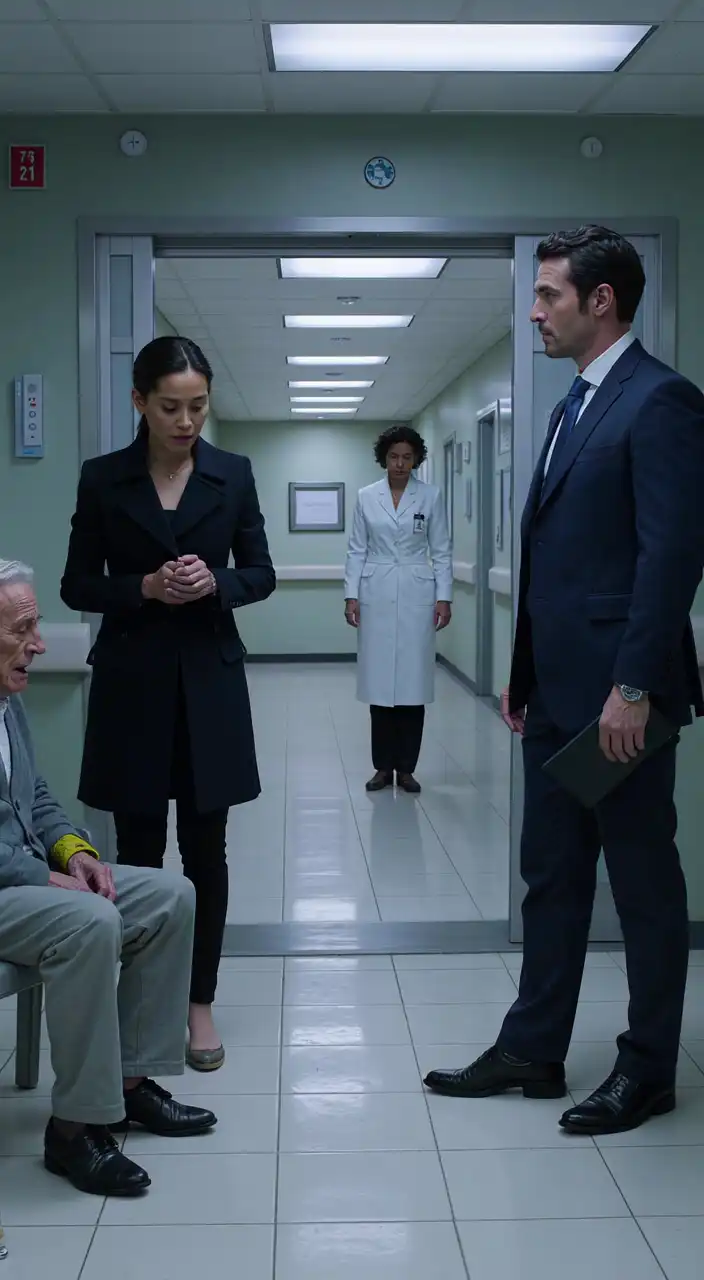
MY FATHER STARTED SHAKING OUTSIDE TRIAGE WHILE A CLINIC ADMINISTRATOR BLOCKED THE DOOR AND SAID HE NEEDED FAMILY PERMISSION FIRST.
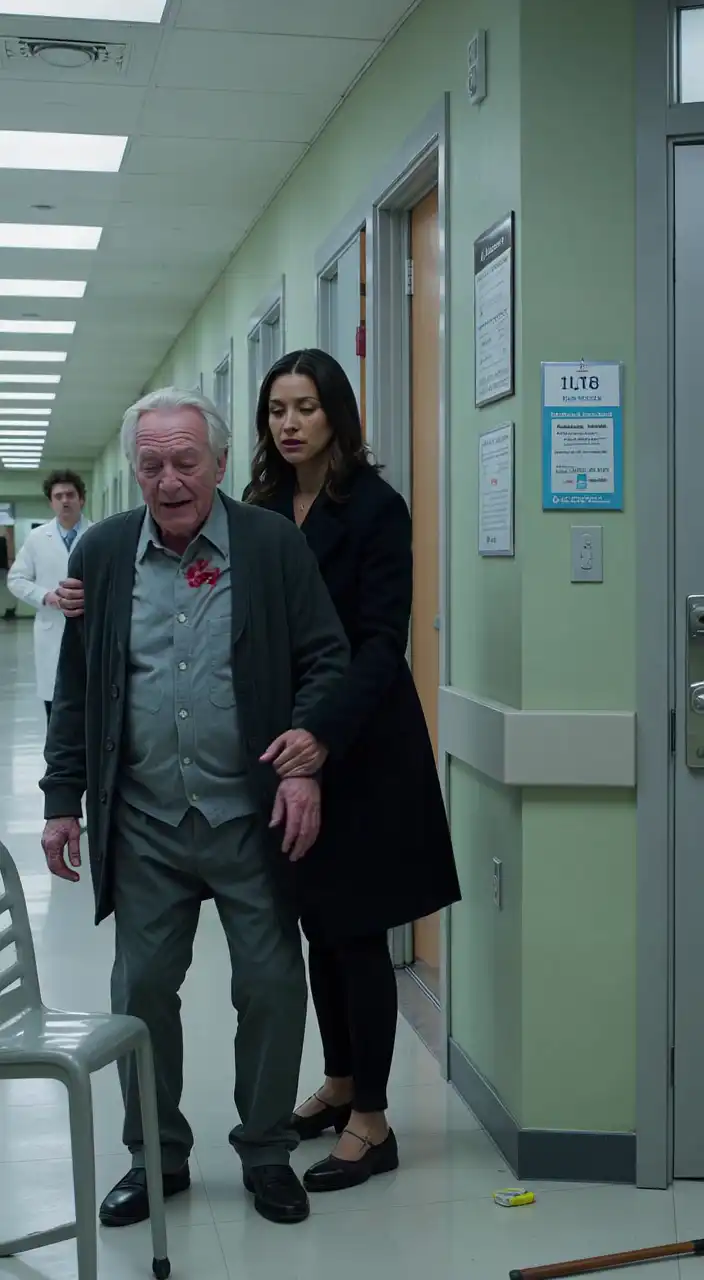
MY FATHER STARTED SHIVERING SO HARD HIS SURGICAL BANDAGE BLED THROUGH, AND THE CLINIC ADMINISTRATOR STILL BLOCKED THE TRIAGE DOOR.
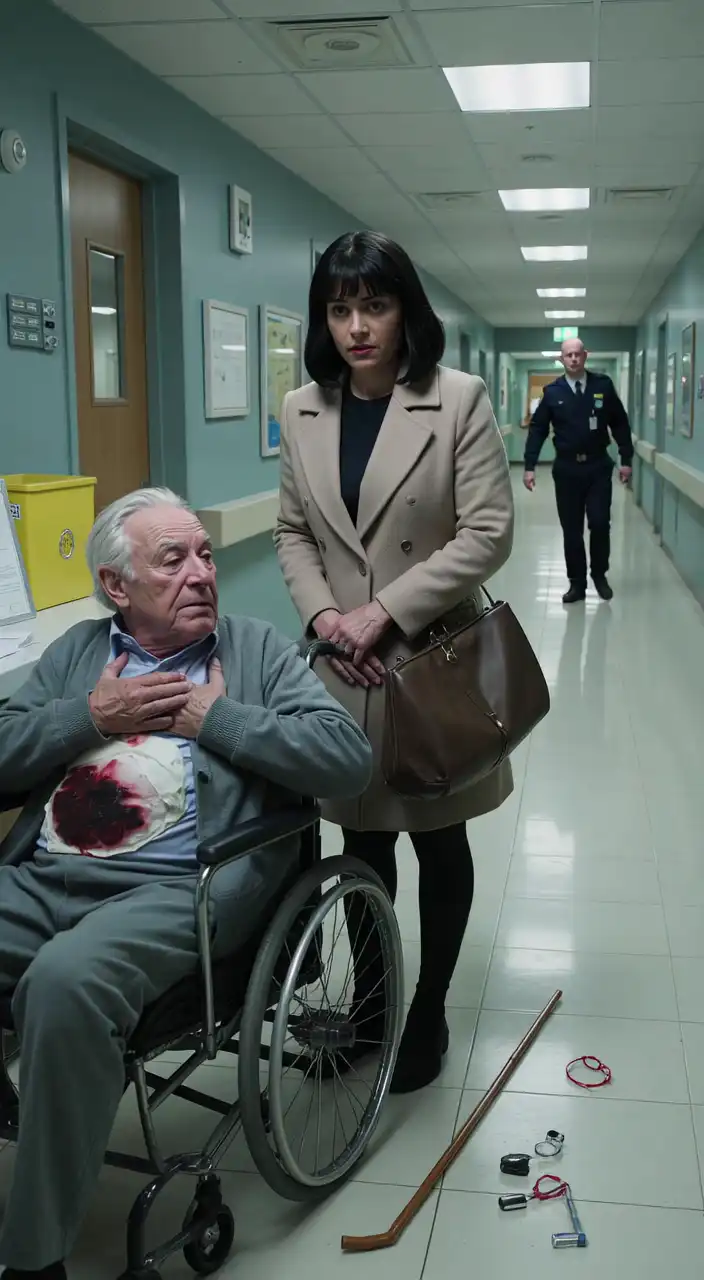
MY FATHER STARTED SHAKING IN THE HOSPITAL HALLWAY, AND THE WOMAN WHO CLAIMED TO BE HELPING HIM WOULD NOT LET TRIAGE TOUCH HIM.