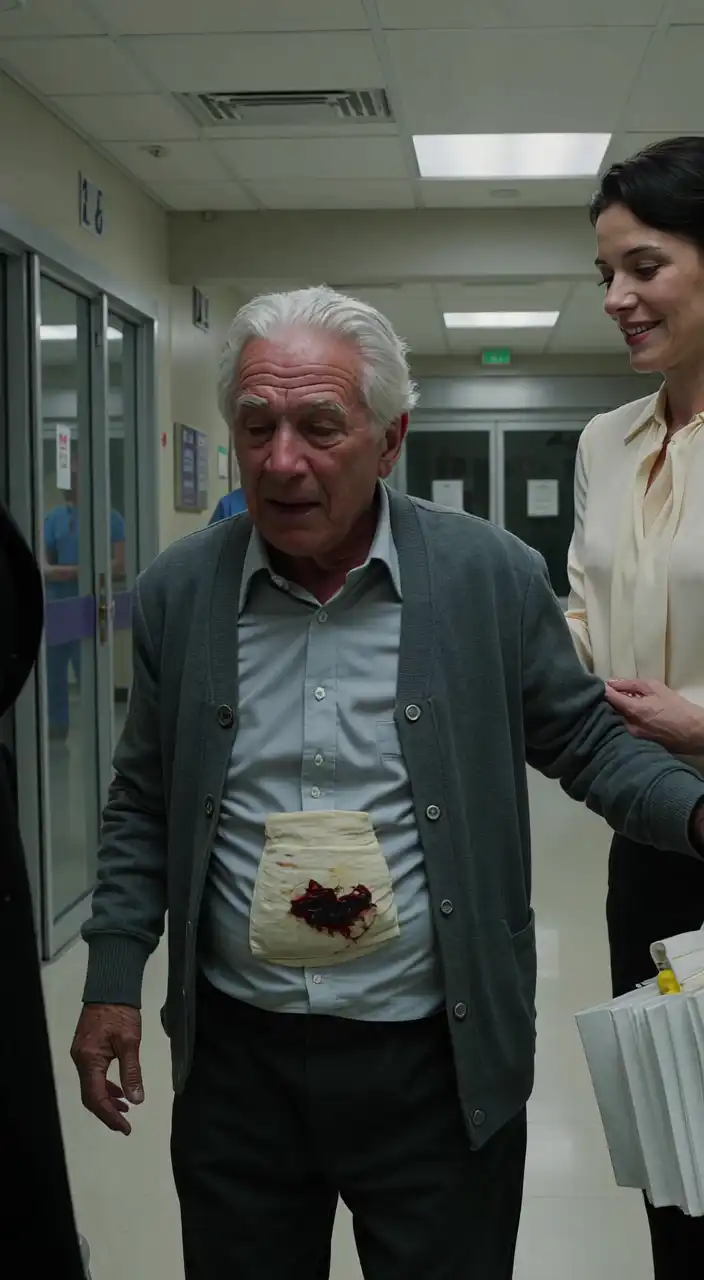
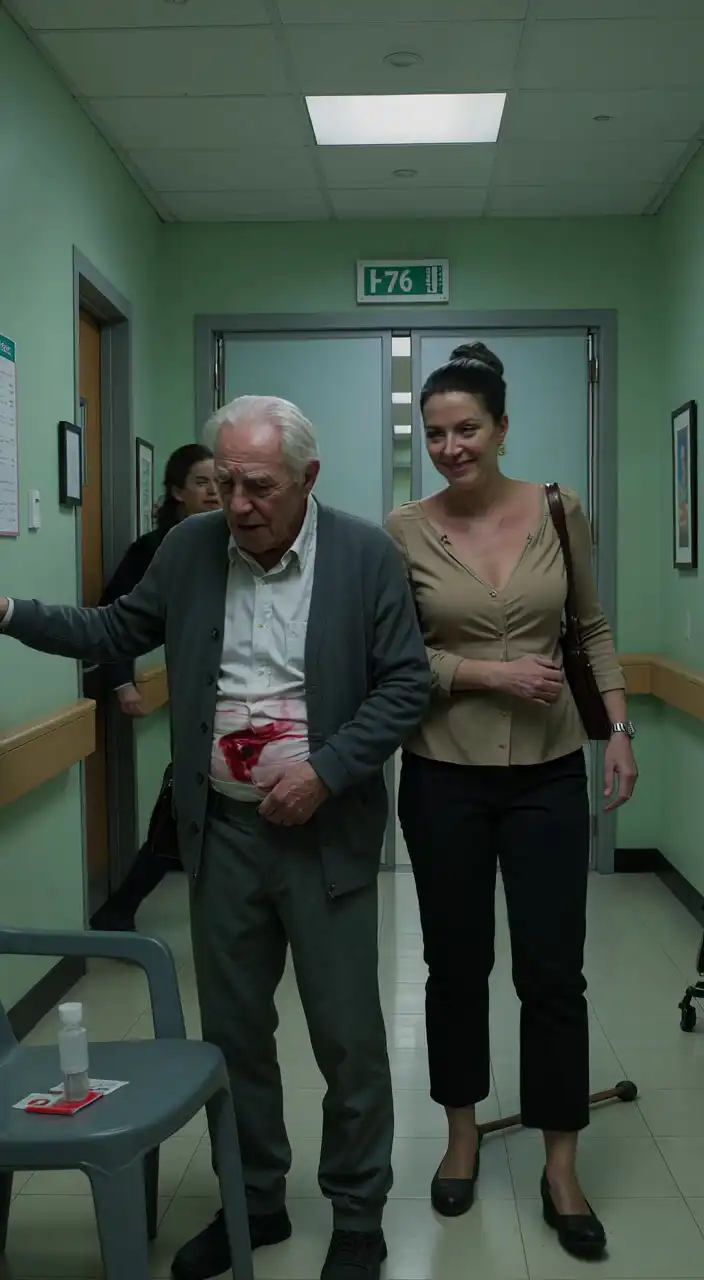
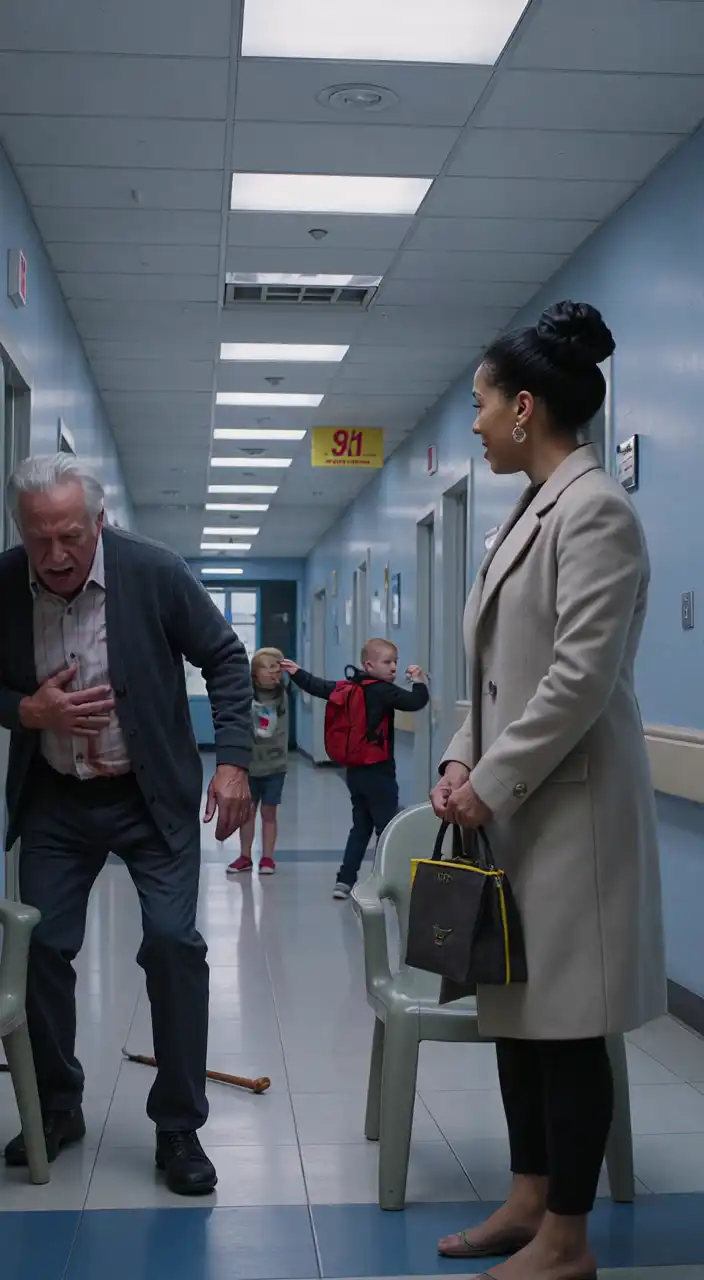

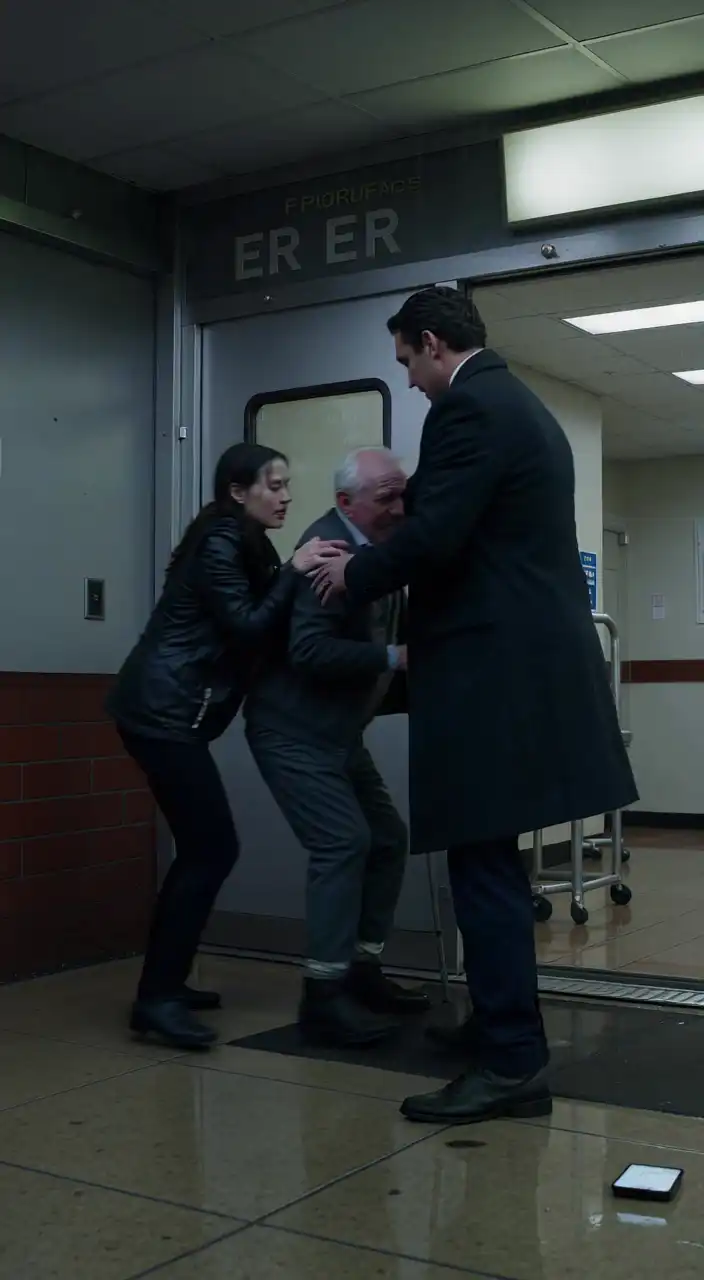
Dr. Sophia Green did not answer him right away. She crouched instead, one knee on the wet pavement, and put two gloved fingers against my father's wrist. Her eyes flicked from his face to the stain climbing under the edge of his bandage, then down to the phone by my shoe. The frozen 911 timer still glowed through the crack in the screen.
"What surgery?" she asked me.
"Partial bowel resection five days ago," I said. "He got sent home this morning. He started shaking in the car. He said his belly felt like it was ripping. I called 911 and he-" I pointed at Oscar because for a second I could not force his name out through my anger. "He grabbed my arm and said I couldn't make that call on hospital property if Dad had already been discharged."
Oscar straightened his lanyard as if that mattered. "Doctor, this is a misunderstanding. The patient has a completed discharge. His daughter became disruptive. We were attempting to direct them through proper readmission procedure."
"I am his son," I snapped.
Dad made a low sound in his throat and bent forward. Sophia's hand went to his shoulder before he pitched sideways. "Sir, look at me. Mr. William Hart, can you tell me where your pain is worst?"
He pressed a shaking palm to the lower right side of his abdomen. "Burning," he whispered. "Cold too. I can't get warm."
Sophia looked up and raised her voice toward the door. "Need a wheelchair, now. Bay intake. And call security." Then back to Dad, softer: "You are not waiting on paperwork."
Oscar took one step closer. "Doctor, if the family has not signed financial responsibility-"
Sophia stood so fast he stopped talking. She wasn't tall, but the force in her face made him look suddenly small. "If you block my patient again, your next conversation is with hospital security and risk management. Move."
The sliding doors opened behind her with that mechanical hiss that had sounded impossible a moment earlier. A nurse pushed a wheelchair out while a monitor somewhere inside kept giving its amber chirp. Relief hit me so hard I almost sagged, but it lasted only a second because Dad tried to take a step, stumbled, and a fresh bloom of fluid seeped through the dressing.
The nurse saw it. Sophia saw it. Even Oscar saw it, and for the first time his expression slipped. Not guilt exactly. Calculation.
Dad was half-lowered into the chair when he grabbed Sophia's sleeve. "Don't... call Melissa," he said.
Melissa was my sister.
Sophia's eyes moved to me. "Who makes medical decisions if he can't?"
"He does," I said immediately. "He's alert. And if he can't, it's me. He changed his paperwork last year after a stroke scare." I looked at Dad. "Right?"
He nodded once, then closed his eyes against a stab of pain.
Oscar spoke over us. "Our file lists the daughter as primary family contact."
Sophia did not even turn toward him. "Then your file may be wrong." She started wheeling Dad inside with the nurse, and I followed so close I nearly clipped the chair. Security came through the side hall at the same time, two officers in dark uniforms. Sophia pointed without stopping. "That man stays outside treatment areas until administration verifies his authority."
Oscar raised both hands. "I'm an administrator."
"Then you know better," one of the officers said.
I thought that would be the end of him for the moment, but as they intercepted him he twisted toward me and said, "If you force this admission without resolving guarantor status, the family will be responsible for every denied charge."
That would have scared me once. Maybe even that morning. But with Dad shaking in the chair and the bandage warming through under my fingers, it sounded obscene.
Inside the intake bay, the air changed from damp outside chill to that hard hospital cool that always smelled faintly of bleach and plastic. Nurses moved with quick, practiced urgency. Dad was transferred to a stretcher. A blood pressure cuff squeezed his arm. A pulse ox glowed red at his fingertip. Sophia peeled back the cardigan sleeve and then carefully lifted the edge of his dressing.
The smell came first. Not rot, not anything dramatic, just that sharp infected heat smell I knew from taking care of my wife after a C-section years ago. Sophia's jaw tightened.
"When did this drainage start?" she asked.
Dad frowned like he was trying to search through fog. "Last night. Maybe before." Then, embarrassed: "Melissa said the surgeon's glue leaks sometimes."
"Did you have a fever at home?"
He hesitated.
I answered for him. "He was drenched in sweat this morning. She gave him Tylenol before the ride."
Sophia looked up. "She?"
"My sister. She picked him up from discharge before I got there. She told me he was tired and wanted to go home. But when I met them at the bay, he could barely stand."
Dad opened his eyes. They were glassy. "She kept the papers."
That landed between us all at once. Sophia glanced toward the nurse. "Temp."
The nurse slid a thermometer into Dad's ear. "One-oh-three point one."
Sophia turned all business. "CBC, CMP, lactate, blood cultures, IV fluids, broad-spectrum antibiotics after cultures. Page surgery. And get me a stat CT abdomen and pelvis with contrast if his pressure holds."
The nurse repeated orders and moved.
Dad's hand groped along the blanket until it found my wrist. He squeezed once, weak but urgent. "She said I'd lose the house."
I leaned close. "Who said that, Dad? Melissa?"
His eyes shifted toward the ceiling. "If I came back in... insurance would deny. Bills would eat the equity. She said she was handling it."
Sophia heard that. I could tell because her expression changed in a way that was colder than anger. "Mr. Hart, did anyone tell you not to ask for help?"
He swallowed. "Said I was overreacting. That readmission would ruin everything."
Before he could say more, the blood pressure machine finished its cycle. The nurse read it aloud, and the room seemed to sharpen around the number. Low enough that even I knew it was bad.
Sophia stepped closer to Dad's face. "William, I need you to stay with me. We're treating you now. Nobody is taking you home."
That was when the first real reversal hit: we were through the door, but Dad was far sicker than I had let myself believe.
They hung fluids and started another line because the first vein blew. Dad apologized to everyone each time he flinched. A young nurse with a sunflower badge said, "You stop that right now. You are allowed to be sick." He looked at her as if no one had ever put it that plainly.
A tech came to take him to CT, but before they rolled him out, security reappeared at the curtain.
"Sir?" the older officer said to me. "We need a quick statement about the interrupted 911 call."
Sophia answered before I could. "You can get it while they're moving. He stays with the patient."
So I walked beside the stretcher toward imaging, talking in bursts while Dad's teeth clicked from chills despite the warm blankets. I explained the sequence: Melissa insisting Dad was fine, Oscar intercepting us at the door, my call to 911, the slap to my wrist that sent the phone down, Oscar telling me to stop before I created legal problems, Dad trying to say he needed to lie down. The officer listened without interrupting.
"Did your sister work here?" he asked.
"No. But she knows people on the donor board. Or says she does."
He wrote that down.
At CT, Sophia peeled away to make calls. I heard pieces only because the imaging doors had not shut yet. "Post-op sepsis concern... unauthorized discharge pressure... yes, document the interrupted emergency call... no, do not release records to the daughter without confirmation from the patient."
The words made my pulse pound. Unauthorized. Pressure. Records. Until then I had still been trying to fit everything into a smaller explanation: a hard administrator, a controlling sister, a bad decision. Sophia's tone said she already suspected something broader.
While Dad was in the scanner, I sat in a plastic chair under cold fluorescent lights and finally looked at my phone. The screen was spiderwebbed, but the call log remained. 911, connected for twenty-three seconds. There was a tiny speaker icon showing audio had been active when the call cut off. Under it, a voicemail notification from Melissa.
I stared at it without playing it. I was not ready to hear her voice.
The officer came back from a phone call of his own. "Dispatch confirmed an open line from this device. They heard a male voice say, 'You do not call emergency services from this entrance,' then the line disconnected."
Not my voice. Not Dad's.
Oscar's.
That was proof. Small, ugly, plain proof. For a second I just held the phone and felt something inside me stop doubting itself.
They rolled Dad back out twenty minutes later looking smaller than before, the warm blankets tucked tight around his shoulders. Sophia met us halfway down the hall with the scan report printing in her hand.
"I don't have the full read yet," she said, "but I have enough. There's fluid and inflammation near the surgical site. We are treating this as a post-op infection with possible leak until surgery evaluates. He needs admission now."
Dad seemed to hear only one word. "Surgery?"
"Maybe," she said honestly. "We're moving fast so it doesn't become worse."
He closed his eyes again. Not from surrender. More like someone bracing against the next wave.
As they turned his stretcher toward a room, Melissa walked out of the elevator at the end of the hall in a camel coat with Dad's folded discharge papers still tucked under one arm.
She saw me first. Then the blood pressure cuff, the IV pole, the security officer beside me. Her face did not collapse in guilt. It rearranged itself into concern so polished it made my skin crawl.
"Oh my God," she said, already quickening her pace. "Dad, what happened? I told them he wasn't ready to leave."
Sophia stopped in the middle of the corridor and blocked her path with one hand.
"Did you?" Sophia asked.
Melissa's eyes dropped for one dangerous second to my cracked phone.
That was when I knew she understood exactly what evidence was already in the building. And instead of backing down, she tightened her grip on those papers and said, "Doctor, my father gets confused. My brother is emotional. I have his documents."
Dad opened his eyes and, from the stretcher, whispered the first clear sentence he'd said all day.
"Don't let her sign anything."
Sophia looked at security.
And Melissa took one step backward toward the elevator.
The older security officer moved first, not fast enough to look aggressive, just decisively enough to cut off the path to the elevator before Melissa could pivot away. His younger partner angled to the other side. It happened so smoothly that for a second Melissa was trapped by geometry before she seemed to understand she was trapped by people.
"Ma'am," the older officer said, "I need you to stay here."
Melissa let out a short disbelieving laugh. "Excuse me?"
Sophia did not raise her voice. "The patient has spoken. He does not want you signing anything. Step away from the stretcher."
Melissa's expression sharpened. "He is septic and medicated. He is not competent to make that determination right now."
"I'm right here," Dad whispered.
His voice was weak, but every one of us heard it.
Melissa turned toward him with immediate softness, almost convincing if I had not watched her for the last twenty-four hours stage concern like costume changes. "Daddy, you're scared. That's all this is. You told me this morning you wanted to go home and rest."
Dad tried to lift his head. The effort made his face tighten with pain. "You said... no choice."
The hallway changed again. Not louder, not chaotic. Worse. It became the kind of quiet where every word leaves a stain.
Melissa's eyes flashed to me. "What have you been telling him?"
I felt heat rise so quickly my vision narrowed. "The truth. That you hid his papers. That you dosed his fever. That you told him readmission would cost him his house."
Her face hardened. "I told him what the bills would do. Which someone in this family has to think about. You always get to play hero because you never look at numbers."
Sophia glanced at the discharge packet under Melissa's arm. "Give those to security."
Melissa clutched them tighter. "These are his legal documents."
"They are medical records belonging to the patient," Sophia said. "And they are relevant to an active treatment dispute. Hand them over now."
For one second I thought Melissa might actually crumple them and run. Instead she switched tactics with that speed she had always had, the speed that made people doubt what they had just witnessed. She looked at the officers and gave them a small, pained smile. "This is insane. I brought my father here. I sat with him through surgery. I am the one who's been helping him because my brother visits in dramatic bursts and then disappears when practical decisions have to be made."
I opened my mouth, but the younger officer cut in first. "Ma'am, the doctor gave an instruction. Please comply."
Dad made a sudden choking sound. It snapped every head back toward him. His eyes were open but unfocused, his breaths quick and shallow. The monitor clipped to his finger began to alarm in faster bursts as the stretcher nurse reached for the side rail.
"Sats falling," she said. "He needs the room now."
Sophia's entire body turned back into medicine. "Move him."
The stretcher rolled. Melissa tried to step forward with it. I moved too, and for one dangerous half-second we were face to face, inches apart, in the corridor.
"This is on you," she hissed. "If they open him up again and he dies, this is on you."
Then the doors into the treatment room swung between us.
I followed Dad in. Security kept Melissa outside.
Inside, the pace became brutal. Another nurse appeared. Oxygen was placed under Dad's nose. The monitor alarm settled from frantic to urgent, but not normal. Sophia pressed gently along the bandaged edge of Dad's abdomen and his whole body tensed.
"William, stay with me. Open your eyes."
He did, but slowly.
The nurse hung antibiotics. Another spiked a second bag of fluids. Someone from surgery called in on speaker, and Sophia gave a compact, clipped summary that somehow made the whole situation sound even more serious than it had in my head. "Post-op day five from bowel resection. Fever one-oh-three. Hypotension, tachycardia, rigors, drainage from incision, CT concerning for fluid collection and possible leak. Family reports obstruction of attempted emergency call and pressure to avoid readmission. He needs bedside surgical eval now."
The word leak kept echoing. It sounded less like a medical term than a betrayal inside the body.
Dad gripped my hand again. His skin was cold despite the fever. "Don't fight with her here," he whispered.
I bent close. "I'm not leaving you."
"House papers," he said. "Desk. Blue folder."
I stared at him. "What house papers?"
His eyes moved under half-closed lids as if he was trying to keep one thought from sliding away. "Melissa... wanted deed transfer. Said easier after surgery. Just in case."
The room tipped sideways inside me though I knew I was standing still.
Sophia heard enough to look over. "Did he sign anything?"
Dad's face pinched. "Not sure. Too many papers."
There it was. Another piece. Not just panic over hospital bills. Not just control. Property.
A surgical resident rushed in, then the attending behind him, still pulling on a disposable gown. The attending was a broad man in his fifties with silver at his temples and the kind of expression that had no patience left for institutional nonsense. He introduced himself as Dr. Levin, examined the incision, reviewed the scan on the wall monitor, and asked Dad a series of direct questions.
"When did the drainage start?"
"Last night."
"Did you call our office?"
Dad looked at me, then toward the closed door as if Melissa could hear through it. "She said no. Said they'd mark me noncompliant."
Dr. Levin glanced sharply at Sophia. "Who discharged him?"
"That's one of the questions about to become administrative," Sophia said.
He gave a grim nod and pressed on. "William, I am concerned you may have an anastomotic leak or deep post-operative infection. That means where the bowel was reconnected may not be holding, or infection has built up around the site. Best case, we drain it and continue antibiotics. Worst case, we have to take you back to the OR tonight."
Dad's face went almost childlike with fear. "Again?"
"Again if that's what keeps you alive."
No one softened it. I was grateful for that. We had had enough soft lies for one family.
The door cracked open and the older security officer slipped in, keeping his voice low. "Doctor, we have hospital admin coming down, and risk management's been notified. Also dispatch sent over the audio preservation request on the 911 call. We need the family members separated."
Sophia said, "Good."
He looked at me. "Sir, your sister is claiming your father lacks capacity and that she has financial power of attorney."
Dad's eyes opened wider. "No."
Dr. Levin stepped to the bedside. "William, I need to ask this clearly. Do you understand where you are and why you are here?"
"Hospital. Infection. Belly surgery's gone bad."
"Do you understand the risks of delaying treatment?"
"Could die."
"Do you want your daughter making decisions for you right now?"
Dad swallowed. "No."
"Who do you want involved?"
He looked at me. "My son."
Dr. Levin nodded once to the officer. "Document that immediately."
The officer left.
Outside the room, raised voices began to cut through the hall noise. Melissa's, unmistakable. Controlled at first, then sharpened by resistance. Another lower voice joined hers, male and tense. I moved toward the door instinctively, but Sophia blocked me with a look.
"No. Stay where he can see you."
Dad was slipping in and out now, not unconscious but fading around the edges. When he reopened his eyes they often searched until they found me, and only then did his breathing settle. I had not realized until then how much of my own anger had been powered by helplessness. Standing by his bed while skilled people fought to keep him alive did not erase the fear, but it gave the fear direction.
Then Melissa's voice rose enough to make out words.
"... donor relations ... you cannot detain me over family paperwork ..."
And then another male voice, calmer, colder.
"She can be detained if she interfered with emergency access."
I knew that voice. Oscar.
I looked at Sophia. She had heard it too. Her mouth became a straight line.
A woman in a dark suit appeared at the doorway a moment later with a clipped badge and an expression that announced she had arrived to contain fire. "I'm Karen Holt, hospital risk management," she said. "Dr. Green, I need a factual summary."
Sophia gave it without drama and without mercy. "Post-op patient with signs of sepsis and probable surgical complication. Family reports daughter withheld discharge documents and discouraged emergency return. Administrator Oscar Chen blocked ambulance-bay entry pending financial clearance and allegedly interfered with an active 911 call. Security has witness statements. Dispatch has an open-line confirmation. The patient has clearly stated he does not want the daughter making decisions."
Karen Holt's eyes did not widen, but something in them shut and locked. "Understood."
She turned to me. "I will need your statement in full. Not now. Your father comes first."
Dr. Levin was already discussing whether Dad needed vasopressors if his pressure failed to respond to fluids. The words were technical, but the implication was not. Dad was balancing on something narrow. Every delay now had a measurable cost.
A nurse arrived with a consent tablet. "If he's able, we need surgical consent in case he deteriorates before we can take him upstairs."
Melissa chose that exact second to push into the doorway behind Karen.
"I object," she said.
Everyone froze from surprise more than deference. She must have slipped past someone in the corridor while attention shifted.
Karen turned sharply. "How did she get in here?"
Melissa ignored her and fixed on Dad. "Daddy, listen to me. They are panicking you. A second surgery could bankrupt you and they know it. We need to transfer you to St. Mark's under your supplemental plan."
Dad stared at her as if he was trying to locate the daughter he thought he had raised inside the woman before him. "You left me outside."
"No, I kept you from making a rash decision."
"You took my papers."
"For your own good."
I thought that would be the moment he finally turned away from her. It wasn't. The reversal was smaller and worse. He started crying.
Not loudly. Not theatrically. The tears just leaked out of the corners of his eyes while he lay there with oxygen under his nose and tape on his skin and a bandage wetting through over a wound that might be poisoning him. And because he was still my father, because dignity mattered to him almost more than pain, he tried to apologize for crying.
Sophia put a hand lightly on his shoulder. "No."
Dad looked at Melissa and said in a ragged whisper, "I believed you."
The room went dead still.
Melissa's face changed. For the first time the polished certainty cracked. Not all the way to remorse. But enough to expose panic under it.
"I was trying to save what you built," she said. "Do you know what the rehab estimate was? Do you know what another admission does? They said there were out-of-network charges and if the claim denied after a complication review-" She stopped, aware too late that she had said they.
Dr. Sophia Green caught it instantly. "Who said?"
Melissa pressed her lips together.
Karen Holt stepped in. "Ms. Hart, step outside now."
Melissa shook her head, eyes bright with fury and something desperate. "You people don't understand. Oscar told me if Dad crossed back through emergency after discharge without financial authorization, the account would trigger full review. He said if we waited twelve hours and used the scheduled callback line, we could avoid immediate readmission penalties."
Sophia's voice dropped low. "Oscar told you to delay evaluation of a febrile post-op patient with wound drainage?"
Melissa looked around and realized there was no version of this room in which that sentence helped her. "He said the surgeon's office sees this all the time. He said the ER would overreact."
Dr. Levin made a sound under his breath that was almost a laugh and entirely disbelief. "Overreact to a possible leak and sepsis. Incredible."
Karen spoke into the radio clipped at her hip. "I need Mr. Oscar Chen escorted to interview now. Not later. Now."
Melissa straightened, retreating into indignation because panic had failed. "This is absurd. Oscar was helping us navigate your billing mess."
"And your father nearly coded at the door," Sophia said.
The nurse holding the consent tablet looked at Dad. "Mr. Hart, do you feel able to sign for treatment and possible surgery?"
Dad's fingers trembled so badly he could not hold the stylus steady. I reached to support his wrist, but he pulled away with a tiny flare of pride and tried again on his own. The signature came out jagged and incomplete, but it was his.
Melissa watched it happen. Something fell away from her face then, some expectation that his weakness would remain useful to her. "Dad, please. I was trying to protect you."
His response was almost inaudible. "From doctors?"
That one landed harder than anything shouted all day.
Karen opened the door fully and gestured. Security immediately appeared. "Ms. Hart, outside."
Melissa looked at me, maybe for alliance, maybe for blame. "Say something."
I did. "Give them the rest of the papers."
Her hand tightened around the packet. Then slowly, with visible effort, she held it out. Karen took it and passed it directly to the younger officer, who slid it into an evidence envelope from somewhere inside his jacket.
Evidence. The word was no longer metaphor.
As they led Melissa into the hall, she twisted once more toward Dad. "If the insurance refuses this, don't come crying to me when there's nothing left."
Dad shut his eyes.
The door closed.
For three seconds no one spoke. Then the blood pressure cuff cycled again.
The nurse looked at the reading and said, "Still dropping."
Everything accelerated. Dr. Levin made the call. "He's not waiting. Book an OR. Broad coverage already running? Good. Get anesthesia. If IR can drain faster than we can cut, I want them looped in, but we move as if this is operative."
Sophia looked at me. "You need to hear me clearly. We got him in before he lost the chance to fight this. But he is very sick."
I nodded because I could not trust my voice.
She added, quieter, "You were right to push."
That nearly undid me more than the danger had.
As they prepared to move him upstairs, Karen handed me a photocopied sheet from the discharge packet. "You need to see this before it disappears into process."
I took it. Near the bottom was a section labeled transportation and discharge understanding. Dad's signature was there, or something like it, shaky and stretched. Beneath it, in the witness line, another signature. Melissa Hart. And in a notation box, typed: Family confirms patient afebrile, ambulatory, oriented, and comfortable with home recovery instructions.
I looked up. "He had a fever. He was shaking."
Karen's face remained professional, but the muscle in her jaw moved. "Yes."
There was another page behind it. Medication instructions. Tylenol listed at a dose and time. Last administered: one hour before discharge. Not prescribed by surgery. Handwritten in after print.
Sophia read over my shoulder. "They masked the fever."
Dr. Levin, hearing only the last sentence while checking Dad's abdomen one more time, looked up sharply. "Who is 'they' exactly?"
No one answered because no one could yet.
But the clue had moved. It was no longer only the interrupted 911 call and the withheld papers. Now there was a documented fever suppression before discharge and a witness line signed by Melissa. That changed shape. That made intent harder to blur.
The transport team arrived to take Dad to pre-op. One was a compact woman with a calm voice who explained each movement before she made it, even while everyone was moving at speed. "We're lifting on three. You're going to feel the bed shift. Breathe for me, Mr. Hart."
Dad looked at me as they unlocked the stretcher. "Come up?"
"I'm coming."
On the way to the elevator, the hallway outside had become a knot of authority. Security. Risk management. A nursing supervisor. Someone from patient relations. And, held near the nurses' station by an officer and looking suddenly younger than thirteen despite the badge on his chest, Oscar.
He saw Dad first and seemed to realize all at once that the man he had called a readmission issue was being rushed toward surgery. He tried to summon his old administrative calm. "Dr. Green, this is becoming disproportionate."
Sophia didn't even break stride. "A septic patient in shock is disproportionate."
Oscar's eyes moved to me and then to the evidence envelope in the officer's hand. He understood that too. "The daughter requested assistance. I followed account protocol."
Karen stopped beside him. "Our protocol does not include blocking emergency access or interfering with 911."
"I did not interfere, I advised them-"
"The audio says otherwise," the older officer replied.
Oscar blinked. That was the first visible crack in him, the discovery that the thing he thought had disappeared onto wet pavement was in fact recorded and preserved.
He recovered fast. "Then let's listen to the full context. Families become hysterical. We de-escalate."
On the stretcher, Dad turned his head with slow effort. His voice was rough but stronger than before, maybe from anger, maybe from the fact that he had finally crossed into being believed. "You told my son to stop calling for help."
Oscar actually met his eyes. "Mr. Hart, I was trying to keep your case compliant."
Dad stared at him. "I am not a case."
No one in that hallway moved for a beat.
Then the elevator arrived, doors sliding open with a soft ding that felt absurdly polite for what it carried. We loaded in with transport, Sophia, and the anesthesia resident who had just joined us from a page. As the doors closed, I saw Oscar still standing in the hall while Karen spoke into her phone, and Melissa farther back between two officers, coat open now, hair half-fallen, no longer polished enough to pass as composed. For the first time that day, they looked less powerful than the truth.
Upstairs in pre-op, the brightness intensified. Dad was transferred again, this time under warmer lights and tighter focus. Anesthesia asked him to confirm his name, procedure, allergies, whether he had loose teeth, whether he'd had anything to eat. The questions were simple, but every answer seemed to tether him more firmly to the people trying to save him rather than the people who had nearly managed his decline into paperwork.
Dr. Levin returned after a quick consult with interventional radiology. "We're not waiting for drainage. Too much concern for a leak and worsening sepsis. We need to explore."
Dad looked at me. "How bad?"
Dr. Levin answered him directly. "Bad enough that delay is dangerous. Not hopeless."
That mattered. I saw Dad take hold of that distinction.
While anesthesia prepared, a pre-op nurse asked for next of kin and emergency contact verification. I braced for another paperwork fight, but Sophia had already set the path. "Patient designates son for updates and bedside decisions if capacity changes. Remove daughter from active decision contact pending investigation."
The nurse typed it in.
Typed it in. Such a small sound, keys clicking, and yet it felt like a gate closing.
My phone buzzed in my pocket. I almost ignored it, then saw an unknown internal extension. I stepped to the wall and answered.
"This is dispatch records," a woman said. "Hospital security requested preservation of the open 911 line. We also have a partial transcript because the line remained connected briefly after the device dropped. We need to know whether law enforcement has been contacted regarding possible interference with emergency services."
My throat went dry. "They should be. Yes."
"Thank you. We are flagging it. An officer may request certified audio."
I hung up and stood still a moment. Even now, while Dad was being prepared for surgery, the evidence was still moving outward. From my phone to security. From security to dispatch. From dispatch toward police. The circle around what had happened was widening beyond family and beyond hospital walls.
When I turned back, Dad was watching me.
"What now?" he asked.
"Dispatch has the call."
He exhaled slowly. I could not tell if it was relief or grief. Maybe both. "Then don't let me back down later."
I went to him. "I won't."
His hand searched for mine and found it. "Even if it's Melissa."
That was the real reversal. All day I had been fighting to prove his pain. Now he was asking me to stand against his daughter after the crisis if he lost nerve in the aftermath. He already knew what guilt would do to him once the danger passed. He knew he might want to soften what she had done just to survive loving her. The clarity of that hurt me more than anything yet.
"I promise," I said.
Anesthesia began giving medication. The resident explained each step. Dad's eyes grew heavy. Just before they rolled him through the OR doors, he looked at Sophia, who had stayed longer than she had to.
"Doctor?"
"Yes?"
"Thank you for seeing me."
Her expression shifted, some private anger softening into something gentler. "You made it to us. That's what matters."
Then he was gone into the operating room.
The silence after the doors shut was enormous.
I expected to collapse into a chair and wait. Instead the machinery of consequence kept coming for me. Karen from risk management found me within ten minutes and asked if I could give a preliminary statement while details were fresh. A hospital social worker joined us, not because I needed counseling at that exact minute, she said, but because situations involving coercion and medical decision interference often required support once adrenaline wore off.
We sat in a consultation room with fake wood cabinets and a box of tissues placed too centrally to be accidental. Karen set a recorder on the table.
"Start from when you first arrived at the hospital this morning," she said.
So I did. Every detail. Melissa calling me late, saying discharge had been moved up. Her insistence that I meet them at the ambulance bay instead of the surgical floor. Dad in the passenger seat looking gray and sweating through his shirt. Melissa stepping out first and saying, "Do not overreact, he's exhausted." Dad trying to stand and nearly buckling. The cane hitting wet pavement. My phone out, 911 dialing. Oscar appearing from the side entrance in those spotless shoes, reaching for my wrist, saying, "That is not how this facility handles post-discharge concerns." The line connecting. My saying, "My dad's collapsing." Oscar's hand knocking the phone down. Melissa saying, "Please don't make this worse." Dad whispering he hadn't agreed to discharge. Oscar folding the papers into his coat during the hallway argument before we'd reached the bay. Everything.
Karen asked precise questions.
"Did Oscar identify himself by name before he touched you?"
"Yes."
"Did your father ever refuse readmission in your hearing?"
"No."
"Did your sister ever mention donor relations, family accounts, or protecting status before today?"
"Not donor relations. She did say this hospital 'takes care of people who know how to manage optics.'"
Karen wrote that down.
The social worker, Elise, asked more human questions. "Has your father historically deferred to your sister in financial matters?"
"Yes. Since Mom died, Melissa took over bills, taxes, appointments. She framed it as helping him."
"And to you did it ever feel controlling before now?"
I laughed once without humor. "For years. But controlling adult children don't usually leave their father outside an ER while he's septic. Or maybe they do and everybody just calls it family stress until someone almost dies."
Elise did not disagree.
Halfway through the statement, the older security officer knocked and entered carrying a clear property bag. Inside was Dad's cracked phone charger from Melissa's purse, a folded blue document, and several smaller papers. "Found during consensual property review when Ms. Hart claimed she had additional discharge material," he said to Karen.
My chest tightened. "What's the blue document?"
He handed it to Karen, who unfolded it carefully. It was a photocopy of a quitclaim deed packet. Dad's address at the top. Transfer of survivorship interest pending signature. Melissa Hart named as grantee.
No one spoke.
Then Karen asked, "Was your father planning to transfer the house to her?"
"Not that I know of."
The officer added, "There are sticky notes attached marking signature lines."
That clue hit with sickening force. Dad had muttered about a blue folder in his desk. Melissa had a blue property document in her purse at the hospital on discharge day while arguing against readmission. Maybe it was not completed. Maybe it was only preparation. But the convergence was too ugly to ignore.
Karen closed the folder. "This broadens the concern significantly."
Elise looked at me carefully. "You may need adult protective services involved, not just hospital administration."
I nodded numbly. The scope kept changing. Every time I thought we had reached the bottom, another trapdoor opened.
Then came the suspense hook I had been dreading: Karen's phone buzzed. She checked it and looked up.
"Melissa is demanding release and threatening counsel. Oscar is refusing further interview without representation. Also, the original discharge nurse is claiming she charted concerns this morning that are no longer visible in the current summary."
I stared at her. "What does that mean?"
"It means either there is a charting discrepancy or someone amended documentation after the fact."
The room seemed to get colder.
Karen stood. "I have to secure the record."
She left at once.
For the next hour I waited in a state too activated to be still and too exhausted to stand. Elise brought water I forgot to drink. The officer returned once to say law enforcement had been contacted because of the interrupted 911 call and possible elder exploitation concerns. I signed a written statement. Another administrator asked whether Dad had a copy of his advance directive at home. I texted my wife to go to Dad's desk and look for a blue folder. She replied ten minutes later: Found it. Will bring. There are missing pages.
Missing pages.
When Karen returned, her composure had become a kind of armor.
"The discharge nurse's original note was recovered from the audit log," she said. "It documented elevated temperature, complaint of worsening abdominal pain, and recommendation for surgeon callback before discharge. That note was edited forty-two minutes later. The final visible version removed the temperature reference and changed 'worsening pain' to 'expected soreness.'"
I felt actual dizziness. "Who changed it?"
She hesitated. "The audit trail shows access under Oscar's administrative credentials and one nursing cosign still under review."
"Can he do that?"
"Administrators should not independently alter clinical symptoms. There are very narrow addendum pathways. This was not one."
So the evidence had moved again, this time inside the system itself. The call. The papers. The audio. The deed packet. And now an audit log.
I sat down harder than I meant to.
Elise leaned forward. "Breathe."
I did, because she said it like a command.
"What about the nurse?" I asked.
"She is being interviewed," Karen said. "She may have been pressured. I do not know yet."
The emotional reversal there was subtle and awful. It would have been simpler to hate a chain of villains. Harder to face that some people in the chain might have folded under pressure from status, policy, or fear of losing jobs. Harm can be bureaucratic long before it becomes personal. But when it becomes personal, someone still bleeds.
Three hours after Dad went in, Dr. Levin finally found me.
His cap was off. His hair was damp at the temples. He looked tired in a way surgeons look only after something technically hard and ethically enraging.
"We found a leak at the surgical connection," he said. "There was infection building in the abdomen. He was heading toward full septic shock."
My knees nearly gave. I grabbed the back of a chair.
"We washed out the infection, repaired what we could, and created a temporary diverting ostomy to protect the area while it heals. He is going to ICU. He's not out of danger, but he made it through the operation."
It took me a second to process the words in order. Leak. Infection. Temporary ostomy. ICU. Made it through.
"Would twelve more hours have..." I could not finish.
Dr. Levin did. "Twelve more hours could have killed him."
There it was. No maybe. No softening.
I put a hand over my mouth and turned away because I could not let the first sound out in front of him. It came anyway, half laugh, half sob, the noise a body makes when terror briefly loses its grip and leaves rawness behind.
Dr. Levin waited.
When I could speak, I said, "He kept apologizing outside."
The surgeon's face tightened. "He should not have been outside."
No. He should not have.
ICU allowed me in only briefly once they had him settled. He looked transformed by tubes and lines and the heavy stillness of sedation. But he was pinker. Warmer. Attached to machines because he had been rescued in time, not because anyone had finally admitted defeat.
Sophia was there again, standing at the foot of the bed reviewing a note. She looked up when I entered.
"He came through stronger than his blood pressure suggested," she said.
I stood beside Dad and looked at the dressing over the new surgical work, the central line, the rhythmic ventilator support that they hoped to lighten by morning. "You were right. He lost the chance to keep pretending he was okay."
Sophia gave a small sad nod. "A lot of people almost helped him. That's the part I hate. Medic saw him. Staff saw him. Your sister saw him. Oscar saw him. The difference is somebody finally acted."
I thought of the phone glowing on wet pavement. The whole story of the day sat inside that image. Help attempted. Help interrupted. Help witnessed. Help finally forced through.
Before I left ICU, the nurse asked if there was anyone who should not be given updates by phone. I said Melissa's name. She entered it. Restricted.
Outside, near midnight, authority pressure turned public. A uniformed police officer arrived to take a formal report. He had already spoken with dispatch and security. He asked if I was willing to allege that Oscar physically interfered with my emergency call and that Melissa knowingly obstructed care. The question felt huge and irreversible.
I thought of Dad asking me not to back down later, even if it was Melissa.
"Yes," I said.
The officer took notes for a long time. He requested the damaged phone, which IT first imaged for records. Karen provided the audit log preservation notice. The evidence envelope with the discharge papers was logged. The deed copy was photographed. The police officer said adult protective services would likely open a case because financial coercion and medical neglect intertwined here. Hearing those words applied to our family made me feel both exposed and vindicated. The worst thing had happened in plain view. The second worst thing would have been calling it a misunderstanding.
At one in the morning, my wife arrived with the blue folder from Dad's house. We sat in the family consultation room and spread papers across the table. Insurance statements. A handwritten list of medications. A copy of his updated healthcare proxy naming me alternate and explicitly limiting financial agents from making medical decisions. A note in Dad's blocky handwriting clipped to the front: Review before signing anything after surgery. Ask Daniel.
Daniel. Me.
I sat back and closed my eyes. He had known enough to leave himself a rope. He just had not expected the people closest to him to cut it.
Two pages were indeed missing from the folder, and based on the page numbers they matched the deed packet copy found with Melissa. Karen photographed the note and proxy. "This is important," she said simply.
At two-thirty in the morning we got another twist. The original discharge nurse requested to speak with me in the presence of risk management. Her name was Jenna. She looked wrecked, mascara smudged under eyes that had probably been holding back panic for hours.
"I need you to know," she said before even sitting, "I tried to keep your father upstairs. His temp was one hundred point four before Tylenol. He said his pain was different, deeper. I called the resident. While I was waiting, Mr. Chen came by with your sister and asked whether discharge could proceed if the family accepted instructions. I said not until surgery called back. He told me the family had private follow-up arranged and that delay was causing a donor complaint."
"A donor complaint?" I repeated.
She nodded miserably. "He said there had already been concern about service optics because your father had used a semi-private room despite family expectations. I know how awful that sounds. I pushed back. Later my note was changed. I did not change it. I should have escalated higher immediately, and I didn't."
"What did Melissa say?" I asked.
Jenna looked down. "She said your father gets dramatic when he's uncomfortable and that if we kept him for every fever bump he'd never leave. She also asked if there was any way to chart him afebrile after Tylenol because the insurance review thresholds were stricter above one hundred point three."
The room went silent again.
That was intent in a new shape. Not confusion. Not love gone wrong. Strategy.
Jenna began to cry. "I'm sorry. I should've called the attending myself. I let him steamroll the floor because everyone knows Oscar has backing from families who give money. I kept telling myself if surgery called back in time it would be corrected. Then transport came and he was gone."
I wanted someone uncomplicated to blame. Oscar. Melissa. A system. But Jenna's shame made clear how these things happen. Pressure moves downhill until it finds someone tired enough, junior enough, or scared enough to let one wrong thing pass. Then another. Then a man stands outside an ER door burning with infection while policy language is used like a barricade.
Karen thanked Jenna and told her to go home after Employee Health cleared her. When she left, I asked the question that had been growing all evening.
"Will anything actually happen?"
Karen met my eyes. "Yes."
She said it with enough certainty that I believed she meant it, though not enough certainty to make me naive.
Morning came gray and ugly through the waiting room windows. ICU called at six to say Dad was off the ventilator and had opened his eyes. By seven I was at his bedside.
He looked wrecked. There was no kind way to frame it. But he was conscious. He tracked me when I entered, and when I took his hand he squeezed back.
"You stayed," he rasped.
"Of course."
He blinked slowly. "Did they... save it?"
At first I thought he meant the house. Then I realized he meant himself.
"Yes," I said. "They found the leak. They fixed what they could. You're in ICU."
He swallowed. "Melissa?"
I pulled a chair close. This was the moment he had warned me about, the moment guilt would begin pressing in through the cracks left by relief.
"She's not making decisions," I said. "Security took the papers. Risk management found altered chart notes. The police took a report."
His eyes shut. He looked pained in a different way than surgery pain. "Police."
"You asked me not to back down."
A tear slipped sideways into his hairline. "I know."
I waited.
After a while he whispered, "She always hated feeling poor. Even when we weren't. Your mother used to say Melissa heard shame in every bill envelope."
This was not excuse. It was history. Families make these terrible offerings after a crisis, little fragments that explain how a person traveled from ordinary flaw to unforgivable act. I let him speak.
"When your mother died, Melissa handled everything. It was a relief. Then it became easier to let her keep handling. Taxes, insurance, repairs. She'd say, 'Don't worry, Dad, I know how to talk to these people.' Maybe I liked being managed. Maybe I was tired."
"You were grieving," I said.
He gave a weak half-shrug. "And stupid."
"No. Trusting."
He looked at the monitor instead of me. "Did she really leave me outside?"
There it was. The mind resisting its own evidence.
"Yes," I said softly. "And she told them not to bring you back in right away."
He nodded once, eyes still on the monitor. "Then don't lie for her later."
That was the second promise.
By noon, the consequences had begun to escape the building. Hospital administration informed me Oscar was suspended pending investigation. Melissa had been asked to leave the property and not return without clearance. Adult protective services had opened an emergency file. A detective from the city police department's vulnerable persons unit wanted to speak with Dad when he was stronger because of the overlapping medical obstruction and property coercion concerns. Local law enforcement also requested the hospital preserve surveillance footage from the ambulance bay, elevator lobby, discharge floor, and the hall outside intake.
Surveillance. Another movement of evidence. I had forgotten cameras existed until then. The day had mostly lived in my body and in the words of witnesses. Now there might be silent footage of the cane skidding, the phone dropping, Oscar blocking the door, Melissa clutching the papers. Truth from above, indifferent and hard.
When I told Dad about the cameras, he stared at the ceiling for a long time. Then he said, "Good. Maybe I won't soften it in my head."
That sentence gutted me because it was so honest. Harm done by strangers can stay sharp. Harm done by family blurs itself because love keeps trying to survive around it.
Melissa called my phone three times that afternoon from different numbers. I sent them all to voicemail. The fourth time, I answered only to stop the flood.
Her voice came in hot and breathless. "You need to shut this down."
I stepped into the ICU family alcove and closed the door behind me. "Dad almost died."
"He didn't die."
The sentence was so nakedly wrong that for a moment I had no reply.
She rushed on. "You are letting the hospital bury its own mistakes under my name and Oscar's. Do you understand they discharged him? Do you understand the surgeon cut him and sent him home? But somehow I'm the villain because I tried to stop another catastrophic bill?"
"You told them to chart him afebrile."
Silence.
Then, carefully, "Who told you that?"
"It doesn't matter."
"It matters because they're lying to save themselves. Oscar said if we handled re-entry correctly we'd avoid a readmission denial. He said these things become administrative disasters and patients get trapped in observation loopholes. I was trying to keep Dad from being financially destroyed by complications they caused."
That was the emotional reversal I had not expected: for one sick half-minute I could hear the shape of her logic. Twisted, status-soaked, manipulative, yes, but not cartoon evil in her own mind. She had turned medicine into account management and fear into strategy. She thought she was controlling fallout. She had chosen money and optics over vital signs, and she had done it so long it felt to her like competence.
"You don't get to triage sepsis with billing advice," I said.
She began to cry, real or not I could not tell. "You always judge from the outside. You weren't there when Mom's chemo bills came. You didn't sit with Dad when he panicked over taxes. You don't know what it's like holding a whole life together with tape while everyone else says, 'It'll work out.'"
"I know what it's like to call 911 while our father shivers in his own blood and have your friend knock the phone from my hand."
"He is not my friend."
"Then why was your witness signature on discharge and his credential on the altered note?"
She inhaled sharply. Got you, the sound said, though she did not speak it.
When she finally did, her voice had turned cold. "If you go through with police and APS, there is no coming back from this."
I looked through the glass into Dad's room. He was asleep, one hand still curled where he'd last held mine.
"There wasn't a way back from leaving him outside," I said, and ended the call.
I saved the recording notification and told Karen immediately. She asked me to email a written summary while details were fresh. Another breadcrumb. Another consequence.
Two days later, Dad was out of ICU. He was weaker than I had ever seen him, learning the language of drains, antibiotics, and the temporary ostomy he had not expected to wake up with. The practical humiliation of that nearly crushed him more than the surgical pain. But the nurses were extraordinary. One older wound-care nurse named Marisol treated every new indignity like weather, not failure. "Bodies are messy when they heal," she told him while changing the appliance. "That is not a character flaw, Mr. Hart."
He looked at her with the same startled gratitude he'd shown the sunflower-badge nurse when she told him he was allowed to be sick.
Sophia visited once on rounds even though he was no longer technically hers. Dad reached for her hand. "I remember your face at the door."
She smiled a little. "Good. Means you were still with us."
He cleared his throat. "I said thank you?"
"You did."
"Good."
By then the hospital investigation had become formal enough that I was asked not to discuss certain staff names with outside media because, yes, media had entered the edge of it. I learned this when a local reporter left a message saying she had heard from a source about a patient denied emergency re-entry over financial clearance concerns. I did not call back. Not yet. Dad needed stability first. Exposure is a kind of rescue sometimes, but it is also a storm.
Still, the story was already leaking. A paramedic who had seen the ambulance bay scene apparently filed a quality concern after hearing from a nurse that the patient had gone straight to emergency surgery. A dispatcher logged the interrupted call as unusual. Security had camera pulls. Too many systems now held pieces of the same day.
On the third day after surgery, the detective came.
She was plainspoken, mid-forties, and introduced herself as Detective Ramos from vulnerable persons. She asked Dad first whether he was well enough to talk. He said yes. Then she asked the question everyone else had circled.
"Mr. Hart, did anyone pressure you to avoid returning for urgent care because of money, property, or family authority?"
Dad looked at me, then back at her. "Yes."
"Who?"
"My daughter. And a hospital administrator named Oscar Chen."
"Did your daughter ever ask you to sign property documents around the time of surgery?"
"Yes."
"Did you understand those documents?"
"No."
"Did anyone tell you they were routine?"
"Yes."
He answered slowly, each truth seeming to cost him something. Detective Ramos never pushed beyond what his strength allowed, but she did not let him retreat into vagueness either. When she left, she told us two things plainly. First, interference with emergency calls and vulnerable adult coercion were being reviewed. Second, if financial exploitation was substantiated, she would recommend protective orders if Dad wanted them.
After she was gone, Dad looked stricken. "Protective order against my own daughter."
"You don't have to decide today," I said.
He rubbed at his eyes. "No. But I do have to decide before I lose my nerve."
That evening he asked me to bring the blue folder from home. We sat together while he reviewed his healthcare proxy, house deed, bank authorization list, and old power-of-attorney documents Melissa had been helping him with. Every page became a small excavation of trust. He found two insurance forms he had signed blank because Melissa said she would fill in the claim codes later. He found a note in her handwriting reminding him to "finalize title simplification after post-op recovery." He found nothing proving the house had transferred, but enough to make us both feel sick.
"How did I get this passive?" he asked.
I answered carefully. "You got older. You got tired. Someone offered to carry things. That's not a crime."
He looked at his abdomen under the blanket, where all the carrying had led. "Maybe not. But it is dangerous."
By the end of the week, rescue and exposure had fused. Oscar's suspension became termination. The hospital sent a formal notice stating his access had been revoked pending external review. The discharge nurse was placed on leave but later, I learned, shifted into protected witness territory rather than target once the audit logs clarified who had altered what. Karen told me quietly that donor board pressure had indeed been invoked in internal messages, though not by anyone formally empowered to override care. A thread of emails showed Oscar boasting about keeping "high-sensitivity families" calm by routing readmission "through financial optics first." That phrase made me nauseous.
Financial optics first. While a bowel leak brewed.
The hospital's chief medical officer met with us in person. He apologized without hedging. Not the polished "we regret your experience" language I had braced for. He said, "Your father should never have been discharged in that condition, and once he returned, no nonclinical barrier should have delayed his access to emergency evaluation." He promised a review of discharge override processes and emergency access rules. Maybe it was institutional self-protection. Probably some of it was. But his face when he looked at Dad seemed genuinely ashamed.
Dad listened, then asked one thing only. "Will there be a rule that says nobody can stop a 911 call here again?"
The chief medical officer said, "Yes."
That mattered to Dad more than money. More than blame, maybe. The idea that what happened to him might be harder to repeat.
Melissa sent one final message through an attorney asking for a private family meeting before any restraining or protective action moved forward. Dad read the request from his hospital bed. He folded it once and set it on the tray table.
"No," he said.
It was not dramatic. Just final.
I felt something in me unclench that had been braced for him to rescind everything out of pity. Instead he looked almost peaceful. Grieving, yes. Brokenhearted, absolutely. But no longer unsure.
"People will say I turned on my daughter," he said.
"People say lots of stupid things."
A faint smile. "Your mother would've liked that answer."
He closed his eyes for a moment, then reopened them. "I didn't turn on her. I turned back toward myself."
That was the truest thing anyone had said since the ambulance bay.
Weeks later, when he finally left the hospital for rehab with a scar remade, an ostomy to learn, and a future less certain than before, the sliding doors opened for him without obstruction. A transport aide walked beside him. I carried the actual discharge papers this time. Dad held his cane with steadier hands.
At the threshold he paused and looked at the wet black line in the pavement seam where rainwater had gathered the day he nearly collapsed. It was dry now. Ordinary. No sign of what had happened there except in us.
"You picked up the phone," he said.
"You got yourself through the door."
He shook his head slightly. "No. She did." He meant Sophia. Then after a beat: "And you kept pushing when I was too embarrassed to be inconvenient."
I wanted to tell him none of it should have depended on being loud enough, stubborn enough, lucky enough to catch the right doctor's eye at the right second. But he already knew. We both did.
So I just said, "We're not doing quiet about pain anymore."
He nodded, and for the first time since the crisis began, the nod looked like the start of a different life rather than the end of one.
Disclaimer: Mention of any brand or trademark is for identification only and does not imply partnership or endorsement
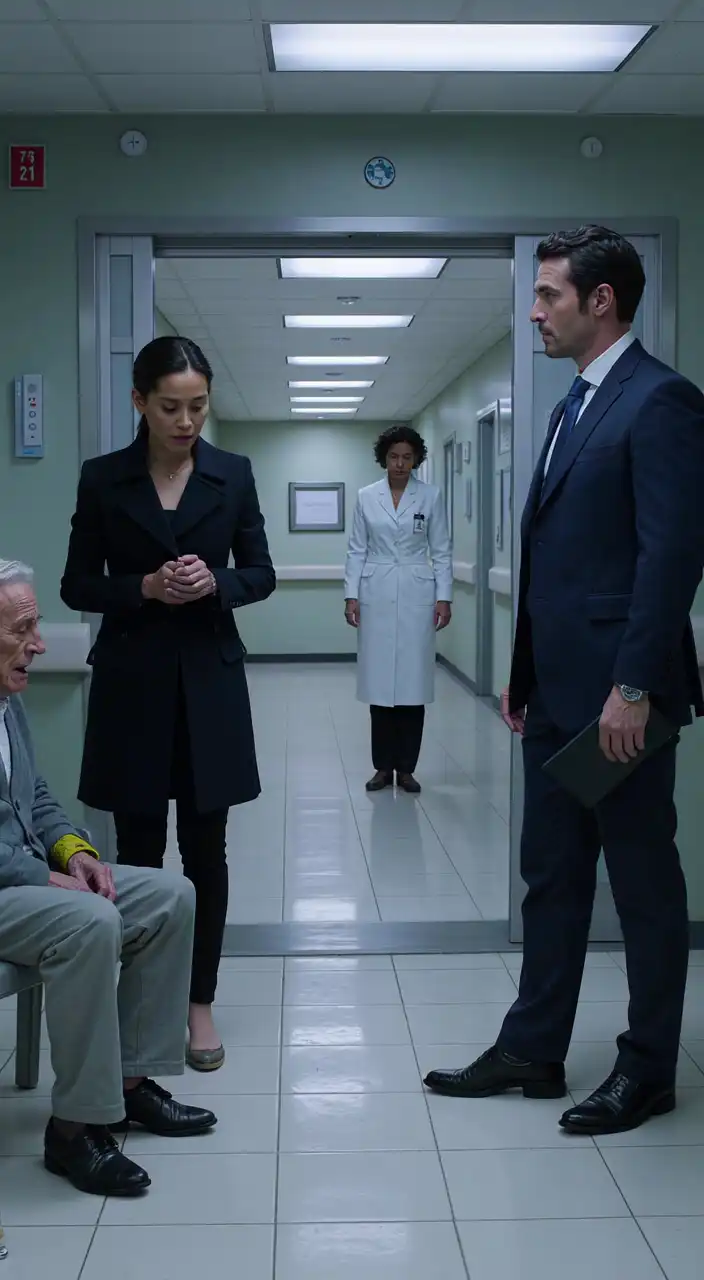
MY FATHER STARTED SHAKING OUTSIDE TRIAGE WHILE A CLINIC ADMINISTRATOR BLOCKED THE DOOR AND SAID HE NEEDED FAMILY PERMISSION FIRST.
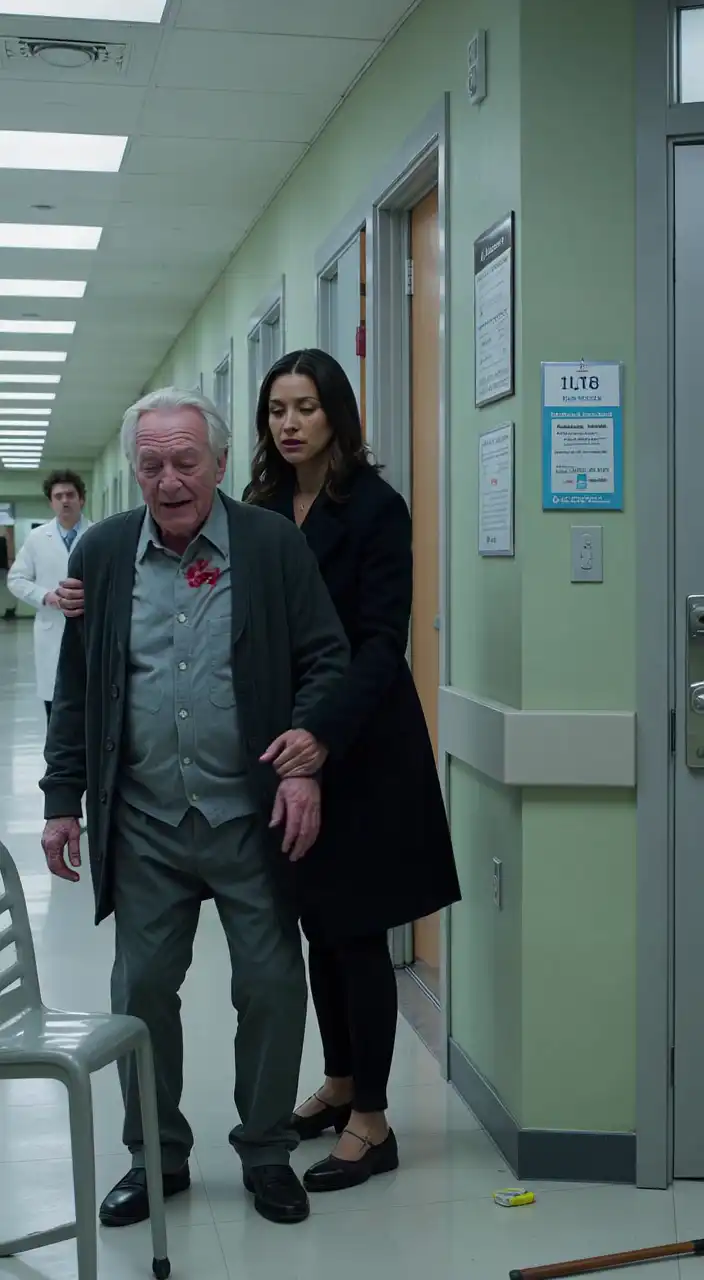
MY FATHER STARTED SHIVERING SO HARD HIS SURGICAL BANDAGE BLED THROUGH, AND THE CLINIC ADMINISTRATOR STILL BLOCKED THE TRIAGE DOOR.
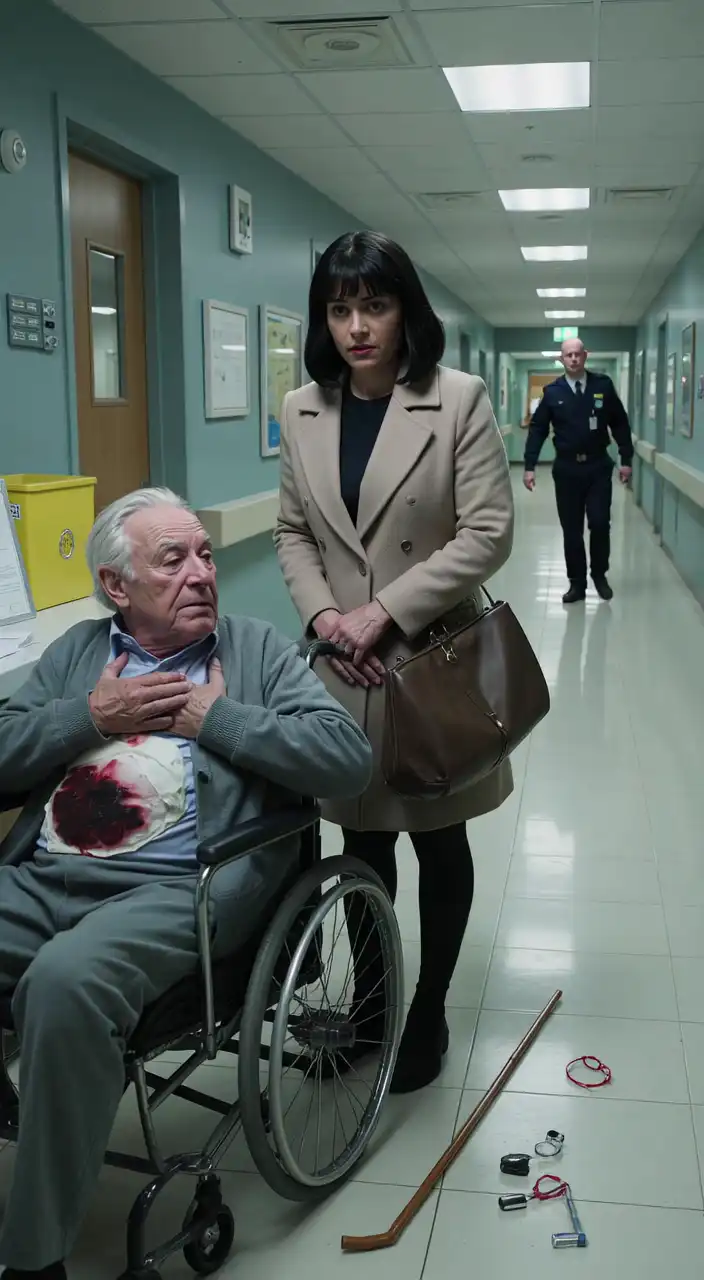
MY FATHER STARTED SHAKING IN THE HOSPITAL HALLWAY, AND THE WOMAN WHO CLAIMED TO BE HELPING HIM WOULD NOT LET TRIAGE TOUCH HIM.