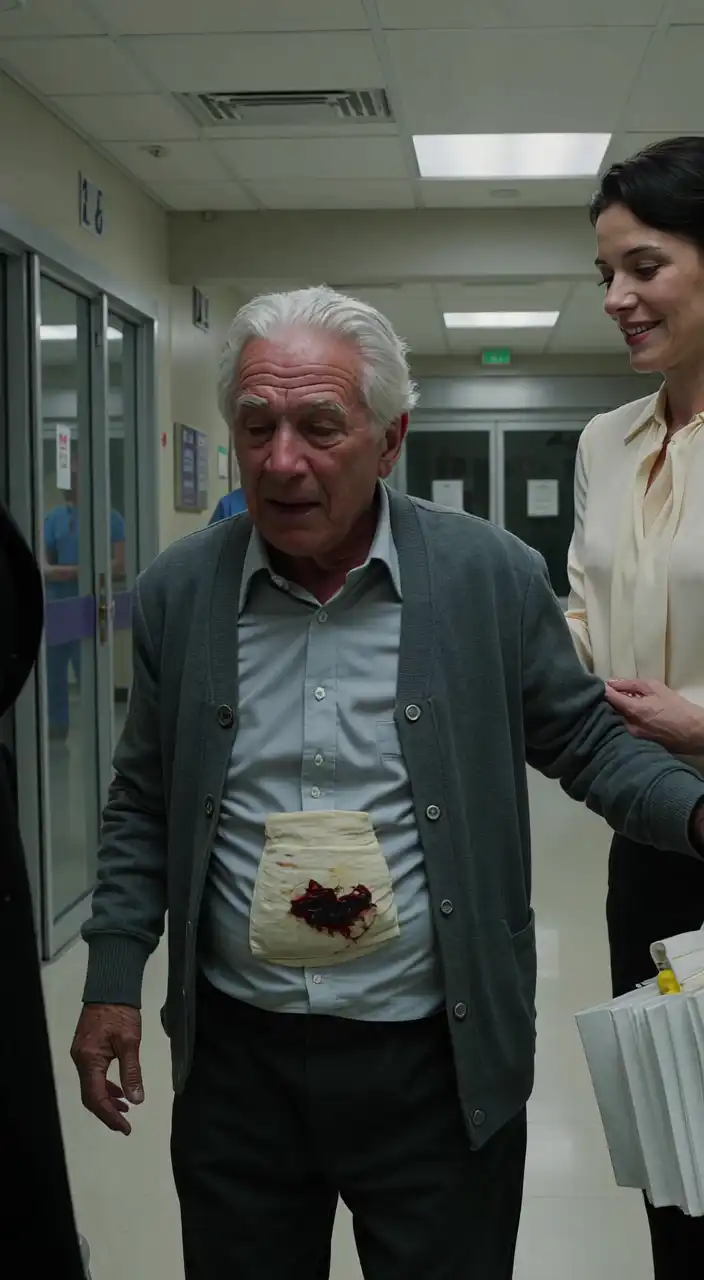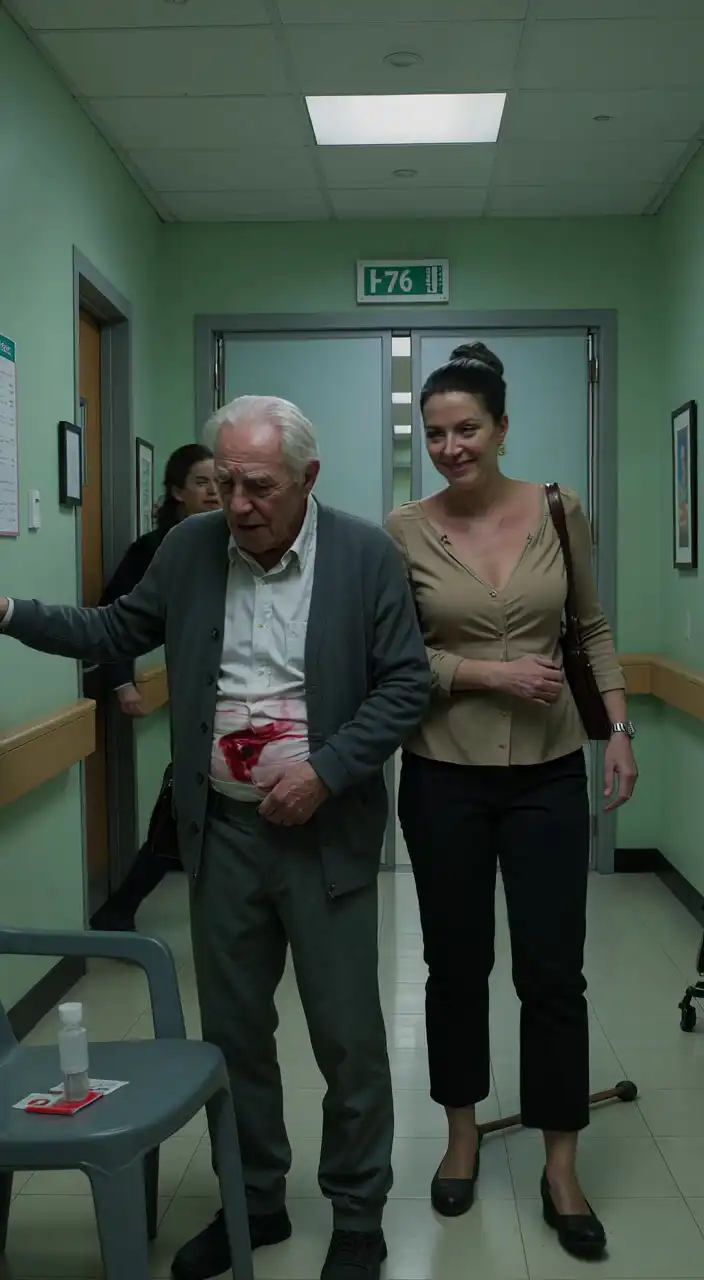
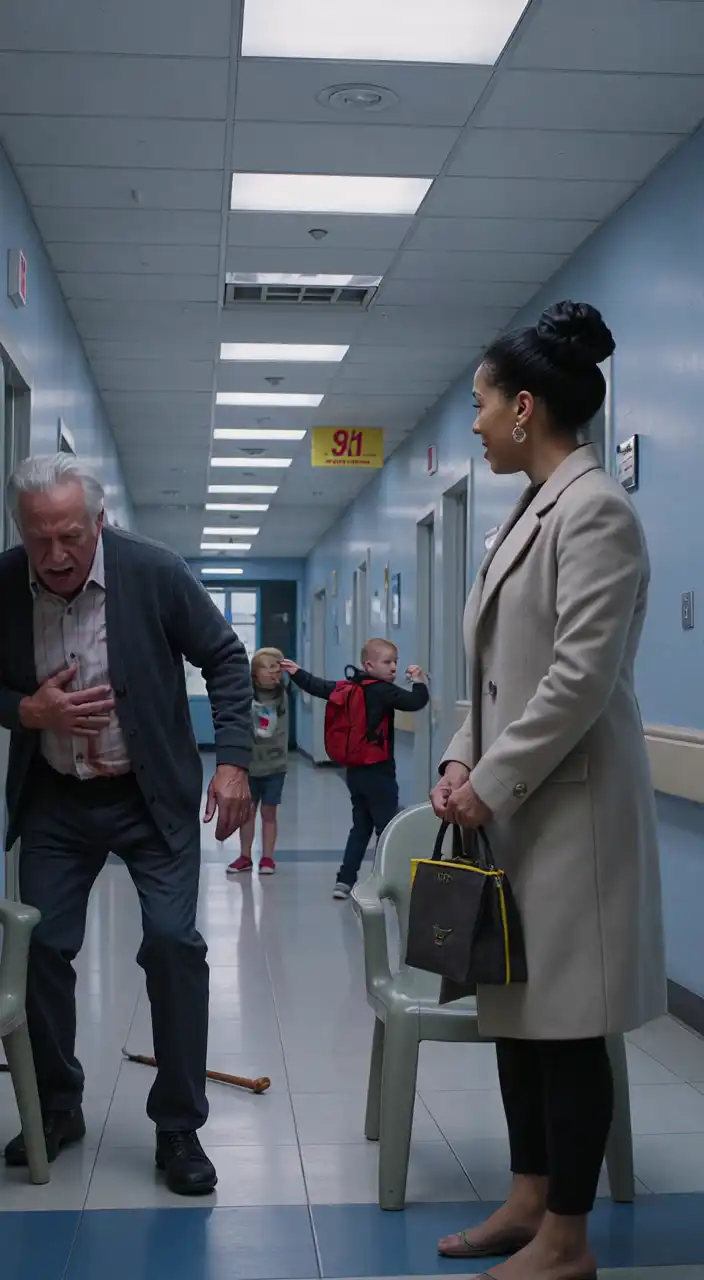

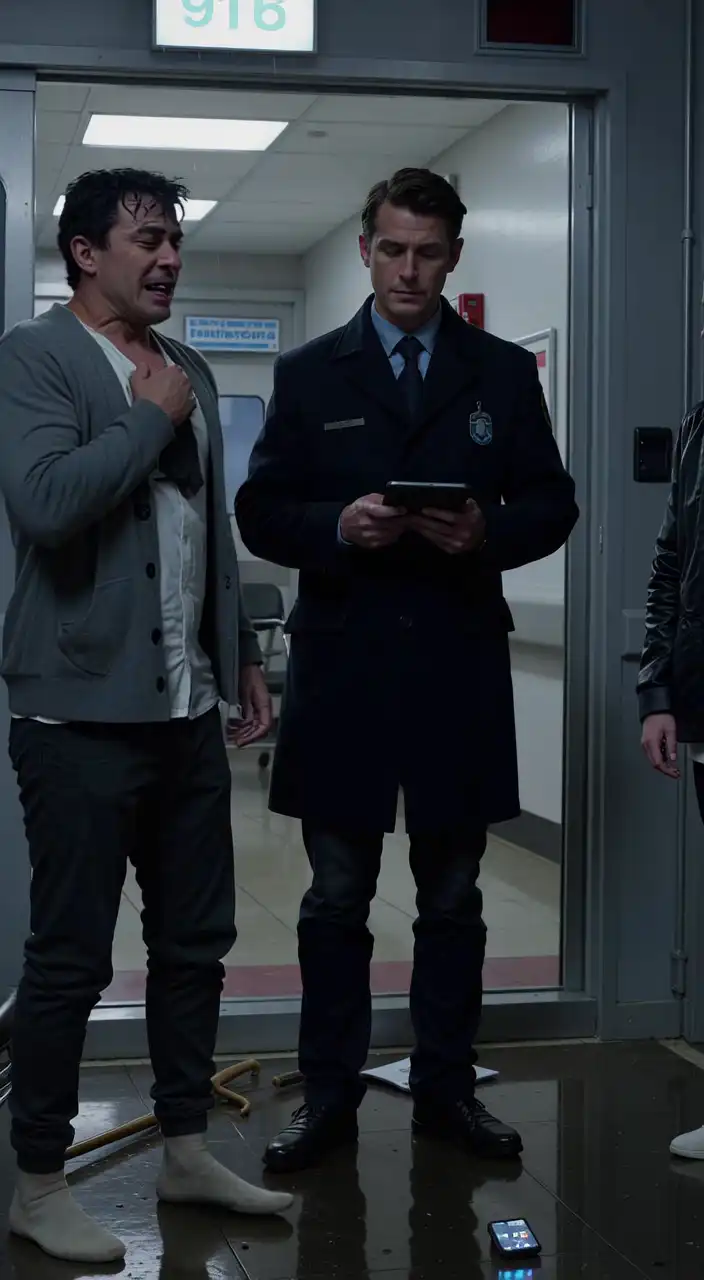
"Who stopped this call?"
The paramedic's voice wasn't loud. That was what cut through everything. He didn't need to shout over the rain, the storm alert, or Caleb's polished administrator tone. He just looked from the cracked phone glowing under the chair to Marcus slumped against the wall, then to Caleb's hand still tight around my arm.
Caleb let go of me first.
"Sir is a discharged patient," Caleb said quickly. "They're agitated. I was trying to maintain order."
The paramedic crouched by Marcus before he answered. He was younger than I'd first thought, maybe early thirties, with rain on his shoulders and that calm, focused expression people get when panic around them has become background noise. MICHAEL was stitched over his chest. He slid two fingers against Marcus's neck, then looked at the bandage stain spreading under the cardigan.
"Marcus, can you hear me?" he asked.
Marcus opened his eyes, but only halfway. "Cold," he whispered. "I didn't... I wasn't done."
Michael turned his head just enough to call over his shoulder. "I need a stretcher at the ambulance bay entrance now. Possible post-op complication, fever, altered status."
Caleb stepped in again, not physically touching him this time but angling his tablet between Michael and the door as if a screen could stop a medical emergency.
"You cannot admit through this access point without registration review," Caleb said. "This account has been flagged for family authorization."
Michael looked at him for one beat, then back at Marcus. "He's not asking for a billing review. He's asking for air and care."
The sliding doors opened behind him and another EMT came in pushing a stretcher, wheels hissing on wet concrete. A security guard from the front desk slowed when he saw us, then stopped completely when Michael said, "Not now. Medical."
I knelt beside Marcus while they lifted him. His cane clattered away again, and I caught sight of the phone under the chair, still lit, the red call timer frozen at 02:14. The dispatcher was gone now, but the line had done its job. Michael noticed me staring at it.
"Is that your phone?" he asked.
I nodded.
"Did you call because he collapsed?"
"I called because he was getting worse and Caleb knocked it away."
Caleb laughed once, a short disbelieving sound. "That's not what happened."
Michael didn't argue. He just said, "We'll sort that out after I get vitals."
That was when Marcus grabbed my sleeve with surprising force. "Don't let him send me away again," he said, eyes opening wider in a flash of raw fear that didn't match a man his age. It sounded like something a child says after a nightmare, and it made my stomach turn because Marcus was not dramatic, not fragile, not prone to making scenes. He was the kind of man who apologized when he bled on his own shirt.
"I won't," I told him.
But Caleb heard it too, and I saw a change in his face. Not guilt. Calculation.
He tapped his tablet hard, as if pulling up some record that would rescue him. "This patient signed discharge at 4:12 p.m. He was stable. He declined transfer. Family was contacted."
Marcus blinked at him. "No."
Michael looked up sharply. "You signed discharge, Marcus?"
Marcus swallowed. His lips were dry and pale. "No. They said my son was coming. I said call him again. Then..." His face tightened. "I woke up in the chair."
That did two things at once. It made Caleb sound less certain, and it made me realize we weren't just dealing with a rude administrator hiding behind policy. Someone had moved Marcus through discharge when he was too weak, maybe too medicated, to understand.
A nurse appeared in the doorway then, drawn by the stretcher and raised voices. She was middle-aged, tired-eyed, with a coffee stain near one pocket and the kind of expression that said she had seen bad systems defended by good grammar too many times.
"What's going on?" she asked.
"Post-op male, febrile, tremors, possible bleeding, altered orientation," Michael said. "Administrator says discharged. Patient says he didn't consent. I need him inside now."
The nurse's gaze dropped to the stain on Marcus's dressing. Her whole posture changed. "That wasn't there when he left."
Caleb turned to her fast. "Rina, do not speculate in front of-"
She ignored him and leaned closer to Marcus. "Sir, when did the shaking start?"
Marcus tried to answer and failed. His teeth knocked together. Michael wrapped a warmed blanket over him, clipped on a pulse ox, and watched the numbers with a frown.
"Pulse 132," he said to his partner. "Temp likely high. We need sepsis protocol consideration."
The word landed like a dropped tray.
Even Caleb flinched.
Storm wind shoved another spray of rain across the floor, and over the loudspeaker a recorded announcement repeated that southbound access might be restricted if flooding worsened. Michael's partner muttered that if they had to transport out to another facility after road closure, the delay could get ugly. The urgency tightened around us from two directions at once: Marcus's body was failing, and the weather was narrowing every safe option.
Caleb seemed to understand that too. He switched tactics.
"This family account is under administrative review because of prior payment disputes," he said, now speaking toward the nurse as if building an official audience would help him. "The patient's son instructed us not to authorize additional nonessential admission without direct contact."
I stared at him. "His son? Evan?"
Marcus's fingers twitched on the blanket. "No," he said again, more desperate this time. "No."
Michael glanced at me. "You know the son?"
"I know enough to know he hasn't been here all day. He's out of state on a pipeline job. Marcus has been trying to reach him since this morning."
Caleb's answer was ready too fast. "We have notes."
Rina held out her hand. "Then show me the notes."
For the first time, Caleb hesitated.
It was barely a pause, maybe one second. But in a place built on procedure, hesitation was a confession.
Michael caught it. So did I.
Then Marcus made a sound deep in his throat and turned his head sharply before vomiting dark fluid onto the edge of the blanket and concrete. Everyone moved at once. The second EMT suctioned. Rina called for a crash cart not because he was coding but because they were wasting seconds pretending this was optional. Michael put a hand against Marcus's shoulder and raised his voice for the first time.
"We're going in."
Caleb spread one arm in front of the doorway. "You do not have admitting authority through-"
Rina stepped between them.
"I do," she said.
Her badge swung as she shoved the door wider with her hip and motioned to the EMTs. It wasn't dramatic. It was practiced, tired, and absolute. The stretcher rolled over the threshold into the harsh white corridor beyond, and for half a second Caleb looked less like a gatekeeper and more like a man who had just watched a lock stop working.
I started after them, but he caught my sleeve.
"Family members wait outside treatment," he said, lower now. "If you push this, you'll make his chart much worse."
There it was. The threat under the policy voice.
I pulled free. "You already did."
As I followed the stretcher inside, something white slid partway from Caleb's coat pocket when he turned. Folded papers. A corner stamped with Marcus's name.
Michael saw that too.
He didn't stop walking, but he said into the radio clipped near his shoulder, "Unit lead, be advised. Possible interference with patient access and possible chart irregularity at ambulance entrance. I need hospital supervisor and security review."
That changed the air more than any argument had.
Caleb heard it. His face went perfectly still.
And as the elevator doors opened for Marcus's stretcher, I realized the papers in Caleb's pocket were only the first lie. The bigger one was whoever had told the hospital Marcus's own family wanted his care delayed.
They took Marcus to an observation room off emergency instead of the main hall, partly because of the vomiting, partly because his blood pressure had started dropping, and partly, I suspected, because Michael did not want him anywhere Caleb could reach easily. The room was narrow, bright, and too cold, with monitor leads, a rolling ultrasound unit parked against one wall, and that familiar hospital smell of sanitizer and overworked air.
Rina cut away the edge of the dressing while another nurse started an IV. I stayed near the foot of the bed until someone told me to move, then hovered by the curtain opening where I could still see his face. He looked gray under the fluorescent lights. Every few minutes he tried to push himself up as if he needed to prove he wasn't causing trouble.
"Marcus," Michael said gently while wrapping a cuff around his arm, "look at me. Do you know where you are?"
"Hospital."
"Do you know why you came back?"
Marcus shut his eyes. "Because something's wrong."
Rina lifted the dressing enough to inspect underneath and swore under her breath. It wasn't dramatic blood everywhere, nothing like television. It was worse in its own grounded way: angry heat, seepage, swelling where swelling should not have been. A smell of infection.
"He should never have been sitting in discharge with this," she said.
Michael asked the nurse for blood cultures and broad-spectrum antibiotics on standing emergency order if the attending agreed. A doctor I hadn't seen before came in, listened for thirty seconds, and agreed immediately. The room turned purposeful. Temperature. Lactate. CBC. Fluids. Questions.
One of those questions came back to me.
"Are you next of kin?" the intake nurse asked.
"No. Neighbor."
She nodded and kept typing. "Do you know his son?"
"Yes."
"When was the last time son spoke to him?"
I pulled out my phone, finally retrieved and wiped dry by the second EMT downstairs before he'd sent me up. The screen was still cracked. Missed numbers from the interrupted 911 call sat at the top, and beneath them a thread from Evan from three days ago, when he'd asked me to check on Marcus after surgery because he was stuck in North Dakota with weather delays.
"I have texts," I said. "Evan asked me to pick Marcus up tomorrow, not today. He said the hospital planned at least one more night."
The nurse glanced up. "Can you send those to patient relations if requested?"
"Yes."
That was the first small shift. Not enough to save Marcus by itself, but enough to put weight on the side of truth.
The second came from Marcus himself, once the fluids had started and some of the fog in his eyes loosened. Michael stayed longer than I expected, probably because he'd made the call about interference and knew this case was no longer routine. He crouched near the bed so Marcus didn't have to look up.
"Did anyone explain your discharge to you?" he asked.
Marcus looked at the ceiling. "A woman said paperwork was processing. I asked for my son again. Then Caleb came in and said if I kept refusing to cooperate, the account would be frozen."
"What account?" I said before I could stop myself.
Marcus gave a brittle little laugh that turned into a cough. "Exactly."
Rina was labeling blood tubes. "Did you sign anything?"
"I remember a clipboard. My hand wouldn't stop shaking." He looked down at his right hand as if it belonged to someone else. "I don't remember what was on it."
That might have sounded vague if not for the tremor still visible in his fingers and the fever reading now posted on the monitor. It was plausible but incomplete, and that incompleteness made room for Caleb to hide if we couldn't find proof.
Then the contradiction arrived.
A woman in a charcoal suit entered with a plastic smile and a badge that read PATIENT ACCESS SUPERVISOR. Behind her stood a hospital security officer and, a few paces back, Caleb. He had recovered his poise. His coat was buttoned now. The folded papers were gone.
"Mr. Hale," the supervisor said to Marcus in a bright voice no one in pain should ever have to hear, "we're sorry for the confusion. We understand there was some distress at discharge."
Marcus turned his face away.
Michael straightened. "This isn't a discharge confusion. This is a patient with probable post-op infection and bleeding who reports he did not consent to leave."
The supervisor kept smiling, but less. "We are reviewing documentation. At present the chart shows signed acknowledgement and a family communication note."
"From who?" I asked.
She looked at me like a stain on the floor. "And you are?"
"The person he called because his son wasn't answering and your administrator was hiding his paperwork."
The security officer's eyes flicked to Caleb.
Caleb answered in that controlled tone again. "No one hid anything. Family requested that all communication route through the designated contact, and there were concerns about financial exploitation. We followed a protective flag."
For a second, I thought I had misheard him.
Then I realized what he was doing. He wasn't just delaying care to protect some wealthy account review. He was attaching suspicion to Marcus himself. Making him a problem patient around money. Maybe vulnerable, maybe manipulated, maybe unsafe to make his own decisions. In a hospital system, that kind of label spread like spilled dye.
Marcus heard enough to understand. He forced his eyes open and whispered, "Exploitation? By who?"
No one answered him immediately. That silence was its own cruelty.
I stepped closer. "Say the name. If you're going to accuse someone of exploiting him, say the name."
The supervisor cut in. "No one is accusing anyone. There was a flag based on communications from family."
"Which family?" Michael asked.
"That information is in the chart."
Rina stopped what she was doing and looked straight at the supervisor. "Then pull it up and read it out loud."
Another pause.
Again, tiny. Again, enough.
The supervisor shifted to smoother ground. "Out of respect for privacy, we can discuss chart notes with the patient once he's stabilized."
Marcus let out a weak, bitter breath. "I am the patient."
That landed harder than any of us expected. Even the security officer looked away.
The attending doctor entered at exactly the right moment, read the room in one sweep, and asked for everyone not directly involved in care to step back. He examined Marcus, reviewed the first labs as they populated, and his face tightened.
"We're treating presumed infection and possible internal complication from recent surgery," he said. "He should not have been sent home in this condition."
The supervisor started, "Doctor, there are administrative-"
He cut her off without raising his voice. "Administrative issues can wait. Sepsis cannot."
The word came again, firmer this time. It pushed everyone one inch further from pretending.
Still, Caleb had not lost. Not yet.
Because when the supervisor left with the security officer and Caleb, she took confidence with her. She believed the chart would protect them. And ten minutes later she sent back a printout.
I didn't see all of it at first. Just enough over Rina's shoulder to read the line that made my skin go cold.
Designated family contact: son, Evan Hale. Contacted 3:48 p.m. Approved discharge. Requested no readmission without direct consent due to concerns re: medication seeking and coercion by neighbor.
By neighbor.
Me.
Rina looked from the page to me. "Did Marcus ever tell staff not to trust you?"
Marcus was too weak to sit up, but rage cut through the fever like a clean blade. "No."
I took the paper with shaking hands. The language was neat, official, and poisonous. One sentence and I became a reason to delay care. One sentence and Caleb's obstruction looked like caution.
"Call Evan," I said.
Marcus closed his eyes. "He won't answer. He's on a job site."
Michael, who should have left already but hadn't, pulled out his own phone. "Then we keep trying. And we preserve everything."
He asked me for screenshots of Evan's messages, the interrupted 911 log, and the timestamps from the day. Then he asked a smarter question than any of us had yet.
"Marcus, who handles your insurance and paperwork usually?"
Marcus swallowed. "My ex-wife used to. After the divorce, Evan helped. Lately..." He frowned as if searching through heavy fog. "Lately hospital kept saying account representative."
"Did you authorize one?" Michael asked.
"No."
There it was. Plausible but incomplete had become contradiction with teeth.
A nurse from records arrived to scan the printout back into the chart. Rina stopped her. "I want the actual source note and call recording request."
The records nurse blinked. "Those need supervisor approval."
"Then get it."
She hurried out.
The rain hammered harder against the small high window. Somewhere in the hall an alarm sounded and was silenced. Marcus's blood pressure crept up with fluids, but not enough to relax anyone. The doctor ordered imaging. Porters came for him. Before they wheeled him away, he caught my wrist.
"If Evan calls," he whispered, "don't let them talk first."
I nodded.
As they rolled him toward CT, Michael finally got a response from one of his own calls. Not Evan. Dispatch.
He listened for a few seconds, then looked at me. "The 911 center archived the open-line audio because of the cut-off and weather event. There may be enough background on it to establish what happened at the bay."
Caleb had built his version inside the chart.
But the chart wasn't the only record anymore.
By the time Marcus came back from CT, Caleb had escalated from obstruction to something riskier: he was trying to disappear the trail that connected his lie to the moment of delay.
I knew because Rina came in angry.
"They can't locate the original discharge packet," she said quietly, setting fresh antibiotics on the pump. "And the note claiming son approval was entered under an admin access layer, not a nurse or physician login."
Michael's jaw tightened. "Can they tell who entered it?"
"Not without compliance opening the audit."
"Then open it."
Rina gave a short humorless laugh. "If this were any other patient, yes. But apparently this one intersects with a donor account."
That was the first time anyone said the real motive plainly. Wealth. Not Marcus's wealth. Somebody else's. A family account Caleb was protecting, and somehow Marcus had become collateral because his chart, his insurance, or his contact chain touched it.
"How?" I asked. "How does Marcus connect to some donor account?"
Rina lowered her voice. "His surgery was moved under a concierge bundle after a 'family office intervention.' I only know because I saw the notation when he was admitted. Those accounts get treated like concierge clients even when the patient isn't one."
Marcus stirred. "Family office?" he repeated. "My son doesn't have a family office."
"No," Rina said. "But someone with the same last name does."
That sounded absurd until she explained. Months ago the hospital had onboarded a wealthy local philanthropic family named Hale. Same surname, large donation, enhanced access, admin handling. If a rushed staffer or opportunistic administrator blurred records, the wrong patient could slide under the wrong umbrella. And if that wrong patient then generated complications, hiding them might protect more than just one employee's pride.
A planted detail from earlier clicked in my head: Caleb's exact phrase in the ambulance bay. This account has been flagged for family authorization. Not your insurance. Not this patient. This account.
Marcus stared at the blanket. "So they mixed me up with rich people and then treated me like I didn't belong in my own chart."
Michael said, "Or someone used the overlap to control who got to speak for you."
That was worse.
The CT results weren't catastrophic, but they were bad enough: fluid collection near the surgical site, concerning for infection, possible developing abscess. The doctor said Marcus needed admission, IV antibiotics, and surgical review. A normal hospital would have treated that as the end of the debate.
Instead, a new lie arrived.
The supervisor returned with a man from compliance in a blue tie and the same security officer as before. Caleb was not with them this time, which made me think he was working somewhere else, somewhere quieter.
The man in the tie introduced himself as Jared from Risk and Compliance and spoke in the careful neutral language of people who believe calm words can shrink moral damage.
"We're initiating a chart review," he said. "In the meantime, we ask that no one make assumptions about staff misconduct."
Michael crossed his arms. "No assumptions. We have an open-line 911 interruption, a patient reporting nonconsensual discharge, missing paperwork, and a suspect family contact note."
Jared nodded as if checking boxes. "Understood."
I said, "Then freeze the chart and lock down edits."
He looked at me, surprised. "That is standard when there is a question of integrity."
"Then do it now."
He assured us he would. Then he added the sentence that revealed the next problem. "Unfortunately, one addendum has already been entered clarifying that the patient became verbally aggressive and refused standard instruction."
Marcus actually laughed at that, a dry unbelieving sound that ended with him grabbing his side in pain. "I could barely stand."
Rina went still. "Who entered the addendum?"
Jared checked his tablet. "Administrative witness notation."
Michael said, "Caleb."
Jared did not confirm it, but he didn't need to.
The addendum mattered because it reframed the whole ambulance bay scene. If Marcus was aggressive and confused, then a phone being knocked away could become de-escalation. If I was coercive, then my insistence could become interference. The lie was adapting in real time.
Rina looked at me. "Do you still have the call log and messages?"
"Yes."
"Back them up right now."
I emailed screenshots to myself, to Evan, and to a new address Jared gave us for compliance evidence. Then I remembered one more planted detail: when the phone slid under the chair, the screen had stayed lit with the red call timer. If security cameras in the ambulance bay covered that corner, the footage would show the phone still connected after impact.
I said it out loud.
Michael snapped his fingers once. "Exactly. And if audio from dispatch catches his warning about security removing you for creating a scene, that establishes the obstruction before the collapse."
Jared's eyes sharpened. For the first time he stopped sounding merely procedural. "I need the precise location and approximate timestamp."
I gave it.
Then my phone buzzed.
Evan.
I answered so fast I nearly dropped it. "Evan, listen to me, don't hang up."
Wind roared through his side of the call. He sounded exhausted and confused. "Why did the hospital email me saying my dad had a behavioral incident and unauthorized interference from a neighbor? What is going on?"
Marcus heard his son's voice and tried to sit up.
"Evan," I said, putting the phone on speaker, "did you approve your father's discharge today?"
"No. What? No. I couldn't even get a signal most of the afternoon. I texted you because they told me he was staying overnight."
The whole room listened.
Jared spoke. "Mr. Hale, for verification, are you the person who spoke to hospital staff at approximately 3:48 p.m. and requested no readmission without your direct consent?"
"No," Evan said, and now there was anger under the fatigue. "Who told you that?"
Marcus closed his eyes. Relief and grief crossed his face so quickly they looked like the same thing.
Michael asked, "Do you authorize your father to receive any medically necessary emergency care immediately?"
"Yes," Evan snapped. "Why are you even asking that? Of course I do."
That should have ended the dispute. Instead, it exposed how far Caleb had gone. The false note wasn't a misunderstanding. It was fabrication.
Jared stepped into the hall to make calls. Rina muttered, "Now watch them say they couldn't verify identity earlier."
But the reversal came from Marcus, not the administrators.
While Evan stayed on speaker, Marcus said weakly, "Son... did you ever sign anything for me after the surgery center called last month?"
There was a pause. "No. Why?"
Marcus looked at the monitor, not at any of us. "Because someone had me sign a release when I was still groggy then too. They said it was pharmacy delivery."
The room chilled.
This wasn't one blocked readmission. It might be a pattern.
Michael slowly lowered his phone. "Can you describe the paperwork?"
Marcus frowned. "Blue stripe on top. I remember because my thumb left a medicine stain on it. The nurse joked I was branding the form orange."
Rina's head lifted. "Orange? Like chlorhexidine prep stain?"
"Maybe."
That detail mattered because discharge and consent packets in this hospital were white with green headers. Blue stripes belonged to outside financial authorization forms used by concierge administration.
The medicine stain, the trembling signature, the vanished papers in Caleb's coat - suddenly they aligned.
Jared came back in just as security called from downstairs: footage from the ambulance bay had been preserved, but someone had already requested deletion hold release ten minutes earlier under admin credentials.
"Who?" Michael asked.
Jared looked at the screen and went pale.
"Caleb."
The lie was no longer hiding in paperwork. It was moving.
And somewhere in the building, Caleb had realized the storm might close roads, but it could also close exits if he didn't get ahead of the evidence first.
They moved Marcus to a higher-acuity room after his blood pressure dipped again. The surgical resident came, then the attending surgeon, and the language turned more urgent: probable return to OR if the fluid collection worsened, definite admission, close monitoring through the night. Marcus understood enough to apologize for "being trouble" twice before the surgeon finally put a hand on his shoulder and said, "The trouble is what happened before you got back in here."
That made Marcus cry without sound. He covered his eyes with the back of his hand and turned his face away.
I stepped out to give him privacy and found the hallway transformed. Compliance. Security. A house supervisor. Michael still there somehow, wet boots drying under the chair, refusing to leave before handoff because he had become witness as much as responder. Rain rattled against the distant ambulance entrance. The storm had knocked out one route south. If Marcus had been sent away in a car, even ten minutes later, they might not have made it back through flooding.
That fact landed hardest on Caleb's replacement at the desk downstairs, who whispered it to another clerk with a face gone sick. Delay had nearly become disappearance.
Jared intercepted me by the nurses' station. He no longer used neutral language.
"We pulled preliminary audit logs," he said. "The discharge note was opened and modified three times from Caleb's admin workstation. The family contact field was manually overwritten. We also found a scanned authorization from a prior visit attached to today's encounter."
"Was it signed by Marcus?"
"It appears to be his signature, but not for today's care. Different form type."
"So he reused an old signature?"
"That's what it looks like."
Rina, listening while charting, said, "And the blue stripe form?"
Jared nodded grimly. "Concierge financial liaison release. Not a medical discharge."
There was the larger reversal. Caleb had likely been harvesting signatures obtained from medicated or rushed patients to move records through special-account pathways, where fewer people questioned unusual directives. Marcus had stumbled into that machinery because his last name matched a wealthy donor family and because he was vulnerable enough to be manageable.
The emotional reversal came right behind it: this wasn't random neglect. Marcus had been targeted as easy to control.
I asked the question that had been clawing at me. "Why would Caleb care so much? One bad discharge can't be worth all this."
Jared looked over the station before answering. "Because if a donor family account and an ordinary patient chart were being blended, even occasionally, it could hide billing irregularities, concierge privileges, off-book scheduling, all kinds of misconduct. A post-op readmission draws review. Review exposes patterns."
Michael said quietly, "So he tried to keep Marcus outside long enough to make this a family ride-home problem instead of a hospital problem."
No one contradicted him.
A hospital security sergeant approached then. "We have the ambulance bay footage," she said. "No sound on camera, but visual confirms the patient unstable at the threshold, the phone knocked from hand during active call, and administrator retaining folded papers in his coat before relocating them."
She stopped there, professional. But the implication hung in the hall like a bell.
"Where is Caleb now?" I asked.
The sergeant's mouth hardened. "Not in his office."
He was gone.
For ten frantic minutes the building split in two stories. In one, Marcus's fever climbed despite antibiotics and surgery debated whether to take him back sooner. In the other, security searched for an administrator with access credentials and possible evidence in his possession.
The two stories fused when Marcus started asking for his wallet.
Rina tried to calm him. "You don't need it right now."
"Yes, I do," he said, more alert than before, alarm cutting through illness. "Insurance card. Old pharmacy card. He kept asking for my wallet."
I went to the personal belongings bag hanging by the bed. Hospital socks, cardigan, keys, but no wallet.
My chest tightened. "It isn't here."
Marcus stared at the bag as if maybe looking harder would change it. "I had it at check-in."
The room went very still.
A missing wallet in any hospital was bad. A missing wallet in the middle of forged authorizations and account manipulation was explosive.
Evan was still on speaker, quieter now because he'd driven into better reception and parked. "Dad, did you give anyone your cards?"
"No."
Jared, who had followed me in, immediately called security again. The sergeant returned within minutes and took the details. Marcus described the worn brown leather, a faded union card, a pharmacy rewards tag, and a photo from Evan's high school graduation tucked behind his ID. That photo made his voice shake more than the medical questions had.
"If he has my wallet," Marcus said, "then he has everything."
Not just identity. Insurance numbers. Signatures. A clean way to keep building lies.
The larger moral reversal hit me then. Caleb had not simply blocked emergency care for a wealthy account's convenience. He had likely been using vulnerable patients' personal information as raw material inside a prestige system built to satisfy rich clients faster and more quietly than ordinary people ever could. Marcus's dignity fraying in the rain wasn't collateral damage. It was the business model exposed in one human body at the worst possible time.
Michael got a text and read it aloud. "Dispatch processed the open-line audio. There's a clear statement from a male voice saying, 'If you create a scene, security will remove you both.' Then a second voice reports post-op fever and bleeding, impact noise, and the patient collapsing."
"That's enough," I said.
"It's enough for obstruction," Jared said. "It may also be enough for law enforcement once we tie the falsified note and missing property."
Rina looked at him sharply. "Once? You still need more?"
He didn't like the accusation, but he answered honestly. "I need him found with evidence or we risk him saying this was all a chaotic misunderstanding."
At that exact moment the surgical attending walked in and said, "No more delays. We're taking Marcus back down if his next pressure stays this low."
Marcus heard him. Fear flashed across his face, not of surgery exactly, but of disappearing into systems again while the truth was still mobile in someone else's pocket.
He grabbed my hand. "Don't let them lose it."
"I won't."
Then another reversal, smaller but sharp: Evan said, "Wait. The wallet photo - dad keeps a folded yellow receipt behind it from his hardware store. He writes PIN hints on the back because he forgets card numbers."
The whole room reacted.
If Caleb had the wallet, he had direct access not just to identity but to accounts. That raised everything from chart manipulation to financial fraud. Jared started issuing orders fast. Freeze patient financial records. Alert registration. Notify hospital police liaison. Check garage cameras. Lock admin exits if possible.
The storm complicated all of it. Half the building staff were juggling flood protocols. One entrance was closed. The parking structure cameras were lagging because of intermittent power flickers. Practical pressure met institutional delay in the worst way.
And then Marcus's monitor dropped again.
All administrative conversation ended. Nurses moved. The resident called for another bolus. The surgeon made the decision.
"We're going now."
They started wheeling Marcus out. He looked smaller under the warmed blankets, but his eyes found mine with perfect clarity for one hard second.
"If he says I signed," Marcus whispered, "ask him about the orange thumbprint."
Then he was gone toward surgery.
That left us in the hall with a missing administrator, a forged family note, a vanished wallet, and one specific planted detail only the real paperwork would carry: a medicine-colored thumb stain on the wrong form.
If Caleb still had that form, it could bury him.
If he had destroyed it, we had to find out what else he'd taken before the storm locked the city down.
Surgery took just under two hours, and every minute stretched because no one could do the one thing we most wanted: ask Marcus more questions. The surgeon believed the infection had localized enough to treat aggressively without catastrophic damage if they moved now, which they had. "You got him back in time," he told me before going in. I held onto that sentence like a rail.
Outside the OR waiting area, the storm turned the windows black. Hallway TVs scrolled flood warnings. Staff moved faster than usual, all of them glancing at phones and radios because roads were closing by the mile. The weather was no longer background. It was a shrinking perimeter.
Michael finally had to clear with his unit, but before he left he handed Jared a copied incident statement and turned to me. "If anyone tries to flatten this into policy confusion, remind them the patient nearly lost transport access because of delay. That's not paperwork. That's danger."
"I will."
He nodded once and left, orange bag over one shoulder, the calm urgency that had cracked everything open disappearing around the corner.
Then hospital police liaison arrived: an off-duty deputy contracted for campus response because city units were stretched by the storm. Her name was Denise Carter. She was compact, direct, and visibly unimpressed by executive badges. Jared brought her up to speed while a tech hunted garage camera footage and security traced badge swipes.
Within fifteen minutes they found the first solid lead. Caleb's badge had accessed records, then the concierge office, then a side stairwell near the staff garage. No exit swipe afterward.
"He could still be in the building," Carter said.
Or hiding evidence.
Rina joined us with coffee she wasn't going to drink. "Housekeeping found this in a shred bin beside concierge." She held up a clear specimen bag. Inside were damp scraps of paper with a blue-striped header and a smudge of orange-brown across one torn corner.
For one second nobody spoke.
The thumbprint.
Carter took the bag carefully. "You found this where?"
"Locked utility alcove only admin and senior support have access to after hours."
Jared exhaled through his nose. "He panicked."
"No," Rina said. "He adapted. Panic would've left the whole page."
She was right. Caleb had tried to destroy just enough. Which meant he still believed some version of control remained possible.
The mini-hook tightened when tech called from security. A garage camera caught Caleb twenty minutes earlier entering an executive sedan not registered to him. The car had not exited the main gate because flood barriers were up. It was likely still in the lower structure, trapped by weather and closed access.
Carter stood. "Good. Then he trapped himself."
They moved fast. I wasn't supposed to follow, but no one stopped me because by then I was attached to the case as witness, target of the false coercion note, and the person Marcus had asked to stay. We took the service elevator to the parking structure with security and one maintenance lead carrying keys because power had flickered twice already.
The lower garage smelled of wet concrete and engine heat. Water seeped in thin lines under one far door. Rows of cars sat under dim emergency lighting, and somewhere a horn chirped once and died. It felt like walking through the underside of every polished floor above us.
They found the sedan backed into a shadowed corner near a caged storage room. Windows fogged. Engine off.
Carter approached from the driver's side with her light raised. Caleb was inside.
For a wild second I thought he was unconscious. Then he moved, too quickly, stuffing something down beside the seat.
Carter knocked hard. "Hospital police liaison. Open the door."
Caleb looked at us and seemed to make three calculations at once. Fight, flee, explain. The flood barrier beyond the ramp made fleeing impossible. He opened the door with a face arranged into injured professionalism.
"This is absurd," he said. "I came down here to make private calls because I'm being harassed."
Carter's light hit the passenger seat. Marcus's brown wallet sat in plain view.
No one needed dramatic music. The sight was enough.
Jared made a small sound of disbelief. Rina closed her eyes briefly as if disappointed even in being right.
Carter told Caleb to step out of the vehicle.
He did, but not quietly anymore. "You have no idea what this hospital asks of us," he said. "You think donor accounts manage themselves? You think people don't demand miracles and then shred careers when billing gets messy? I was cleaning up chaos."
"By stealing a patient's wallet and falsifying his chart?" Carter asked.
"By preventing exploitation," Caleb shot back, looking directly at me. "That man was being manipulated."
I almost laughed at the desperation of it, except Marcus was upstairs recovering from emergency surgery because of this lie.
Carter frisked him, handed him to security, then searched the car with maintenance witnessing. In the console they found folded discharge papers with Marcus's name. In the glove box, two more blue-striped forms with partial signatures from other patients. In Caleb's satchel, a USB drive, concierge logs, and a stack of photocopied insurance cards.
Jared went white.
"This is bigger than one chart," he said.
Caleb stopped talking then. Really stopped. Silence replaced the polished procedure voice. He knew the threshold had finally crossed from internal damage control to criminal exposure.
But one final obstacle remained, and it came from above us.
Jared's phone rang. He answered, listened, and his expression changed from vindicated to furious. When he hung up he said, "Executive administration wants this kept internal until morning because of the storm and the donor gala list tied to these records."
Carter stared at him. "You're kidding."
"I'm not."
There it was: the last barrier. Not just one blocker now, but institutional self-protection trying to postpone truth until it could be managed.
Rina said, "If they sit on this overnight, systems will be touched, people warned, narratives aligned."
Carter nodded. "Then we don't sit on it overnight."
She called city dispatch from the garage and requested responding law enforcement despite storm conditions, citing active evidence preservation concerns, vulnerable adult medical endangerment, suspected identity theft, and falsified records. Her wording was deliberate. Impossible to flatten. Impossible to mishear.
While we waited, Caleb tried one last move.
He looked at me through the open door, all polish stripped away, and said quietly, "You don't know what Marcus told us about his son."
It was bait. Maybe confession, maybe poison.
I didn't answer.
He continued anyway. "He said he was afraid of becoming expensive. Afraid his son would leave him in a facility and sell the house."
The words hit because they sounded possible. Human. The sort of fear a sick man might confess while groggy.
Jared looked shaken. Even Rina didn't dismiss it immediately.
Then I remembered Marcus's exact pattern through all this: apologizing for bleeding, worrying about trouble, asking us not to let them talk first when Evan called. Shame, not accusation. Fear of burden, yes. Fear of his son, no.
Caleb saw hesitation and pressed. "People say things in pain. They beg you not to tell family. Then later they deny it. I was trying to protect-"
"Protect who?" I cut in. "Marcus? Or the wealthy Hales? Or yourself?"
He opened his mouth.
I stepped closer. "Because if Marcus had said he was scared of his son, you would've documented capacity concerns, social work consult, something real. Instead you forged family approval, called me coercive, and hid his wallet."
That ended it. Not because it was eloquent, but because it aligned motive with action. Caleb didn't answer because there was no answer that could survive the objects in the car around him.
City officers arrived twenty-five minutes later, delayed by flood detours. Long enough to feel dangerous. Short enough to matter. Carter handed over the evidence chain. Jared, to his credit, did not soften anything. The officers took statements there in the garage while rain thudded overhead and water lapped at the far drain. When they read Caleb his rights, he stared at the concrete as if all the smooth polished floors in the building had vanished.
Upstairs, Marcus was out of surgery and stable enough for recovery.
That should have been the release, but movement five had one final edge: when we got back to his room, a social worker was there because Caleb's earlier notes had triggered an automatic vulnerable-adult concern referral. The system was still acting on his lies. We had to stop the damage from continuing in softer forms.
The social worker, Lena, looked mortified once she got the update. But she still had to ask the questions because systems leave tracks.
"Marcus," she said gently when he woke enough to focus, "do you feel safe with your son?"
Marcus looked confused first, then wounded. "With Evan? Yes."
"Has your son pressured you about money, housing, or treatment decisions?"
"No." His voice was hoarse. "He works too much and worries too much. That's different."
Lena smiled despite herself. "Do you feel safe with your neighbor here?"
Marcus turned his head toward me. "She called when I couldn't. So yes."
The simple dignity of those answers did more to clear the emotional wreckage than any audit log. Marcus wasn't a chart anomaly. He was a man who knew exactly who had shown up for him.
Lena documented everything and promised a formal correction. Then she paused. "There's another thing. The house - someone from administration requested an emergency asset contact form from records this afternoon."
Marcus stared. "My house?"
Jared, who had stayed because by then there was no leaving cleanly, said, "If your wallet and old forms were being used, they may have been testing whether they could verify identity for billing or lien notices. We don't know yet."
Marcus closed his eyes. He was as close to the emotional threshold as he had been physically in the bay. Not because of pain now, but because illness had become invasion. Body, paperwork, dignity, home.
I took his hand. "They're not getting anything else."
He squeezed once. Weak, but certain.
And then the surgeon came back with the sentence we'd all been waiting for.
"The source was caught in time. He's going to be all right."
That was when the rescue finally began to feel real.
By dawn the storm had thinned to cold drizzle, and the building felt wrung out. Shift changes carried news in hushed bursts. People who had not been in the ambulance bay knew enough to look at Marcus's room with that specific mixture of pity and respect reserved for those who have survived both illness and a machine built to deny it.
Marcus woke clearer around six. Fever down. Color returning in slow, stubborn increments. Evan was still twelve hours away by road because flights were canceled, but he stayed on video call until his battery threatened mutiny. The first thing Marcus said when he saw his son was, "You didn't leave me."
Evan's face crumpled. "Never."
They cried a little then, neither of them trying to hide it. I turned away out of courtesy and found Rina pretending to check supplies for the same reason.
The release came in pieces, each one earned.
Carter returned with an update: Caleb had been formally removed from hospital access, the city had seized the satchel and drive, and preliminary interviews suggested at least three other patient files with questionable admin modifications tied to concierge handling. Jared had escalated beyond internal administration to the hospital system's legal and ethics board, making it much harder for anyone to bury overnight what daylight had already started exposing.
Lena came back too, this time not to probe but to repair. She sat beside Marcus and explained, in plain language, that false concern flags would be removed, his chart locked against unauthorized edits, and a patient advocate would handle every communication until discharge. She apologized without script. Marcus listened, then asked the most Marcus question imaginable.
"Will the nurse who helped me get in trouble?"
Rina, standing in the doorway, snorted softly. "No, honey. Not this time."
That made him smile for the first time.
The planted details paid off one after another. The interrupted 911 call audio established the blocked rescue. The blue-striped form scraps with the orange thumb stain tied Marcus's medicated signature to the wrong paperwork. The folded discharge papers taken from Caleb's car proved concealment, not confusion. And Marcus's missing wallet, recovered with the yellow receipt still tucked behind the photo of Evan at graduation, turned possible sloppiness into theft with intent.
Evan arrived that evening looking like he'd driven straight through three states and one year of his life. He crossed the room in two strides and bent over Marcus so carefully, as if his father might still break under touch. Marcus put a weak hand on the back of his neck and held him there.
"I'm sorry," Evan said. "I should've-"
"No," Marcus interrupted, with more strength than before. "They counted on distance. That's not your fault."
It was the right sentence. It put blame where it belonged.
Evan thanked me, then Michael through a speaker call, then Rina in person with the awkward intensity of a son who knew gratitude was not big enough for the thing being offered. Michael laughed it off from the ambulance station and said, "Your dad did the hard part. He stayed alive long enough to be stubborn."
By the second day, administration changed its tone completely. What had begun as "distress at discharge" became "serious deviation from protocol," then "alleged misconduct," then, under pressure from evidence and law enforcement, a full notice of patient harm review. There would be lawyers later. Depositions maybe. News perhaps, if other families stepped forward. But those belonged to another threshold.
This one was about care finally getting through.
Jared came in once more, looking like a man who had not enjoyed what his audit had uncovered. "For what it's worth," he said to Marcus, "your case stopped something that might have kept going for years."
Marcus considered that. "I didn't stop it. They did." He nodded toward me, toward Rina, toward the absent shape of Michael in the story now lodged permanently between all of us.
Jared accepted the correction.
On discharge - the real one, days later, after doctors were satisfied and every paper was explained twice - Lena sat with Marcus line by line. Evan held the packet. I watched from the chair by the window. No one rushed him. No one took his pen. When his hand trembled, he paused. When he signed, Rina joked gently, "No orange thumbprints this time."
Marcus looked at the page and then at all of us. "Good," he said. "This one I mean."
Outside, the storm had washed the parking lot clean. The ambulance bay doors opened and shut on ordinary emergencies again. Same wet concrete. Same bright threshold. But now when Marcus stepped through in regular shoes with his cane planted firmly and Evan on one side, he didn't look humiliated. Tired, yes. Sore, absolutely. But not erased.
Near the exit desk, Michael had left something with the charge nurse for him: a printed copy of the 911 incident number and a note in block letters.
You called. The line stayed open. That mattered.
Marcus read it twice and tucked it into his cardigan pocket beside the folded photo from his wallet.
As we reached the curb, he stopped and looked back at the sliding doors where Caleb had once blocked him. "I kept thinking I was making a fuss," he said quietly. "Even when I knew I was sick."
Evan answered before I could. "They wanted you to think that."
Marcus nodded, absorbing it as if it were medicine too.
The hospital couldn't give back the minutes in the rain, the fear in the hallway, the shock of hearing himself talked over in his own chart. But it could no longer pretend those things were procedural weather. They were named now. Preserved. Witnessed.
And in the end, that was the moral center no report could soften: blocked care had become exposed care because a cracked phone stayed lit on the floor, a paramedic followed an open line, and enough people decided that one trembling man in a wet ambulance bay was worth believing before it was too late.
Disclaimer: Mention of any brand or trademark is for identification only and does not imply partnership or endorsement
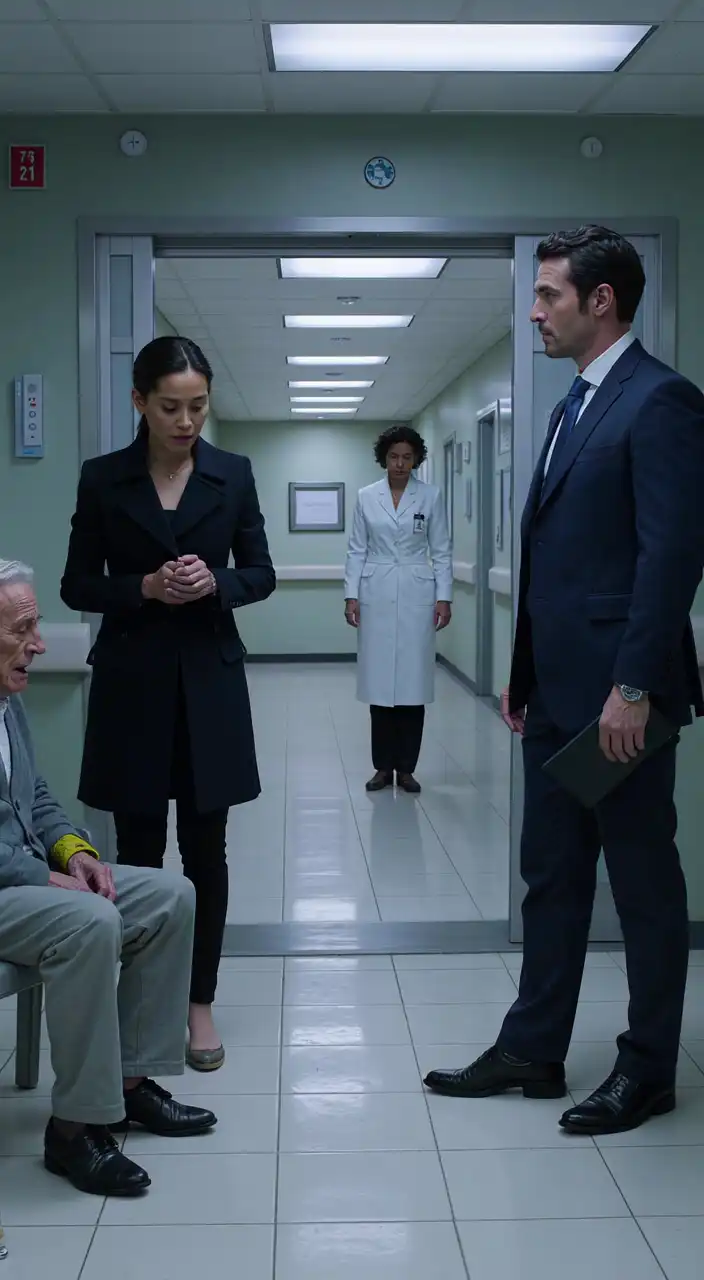
MY FATHER STARTED SHAKING OUTSIDE TRIAGE WHILE A CLINIC ADMINISTRATOR BLOCKED THE DOOR AND SAID HE NEEDED FAMILY PERMISSION FIRST.
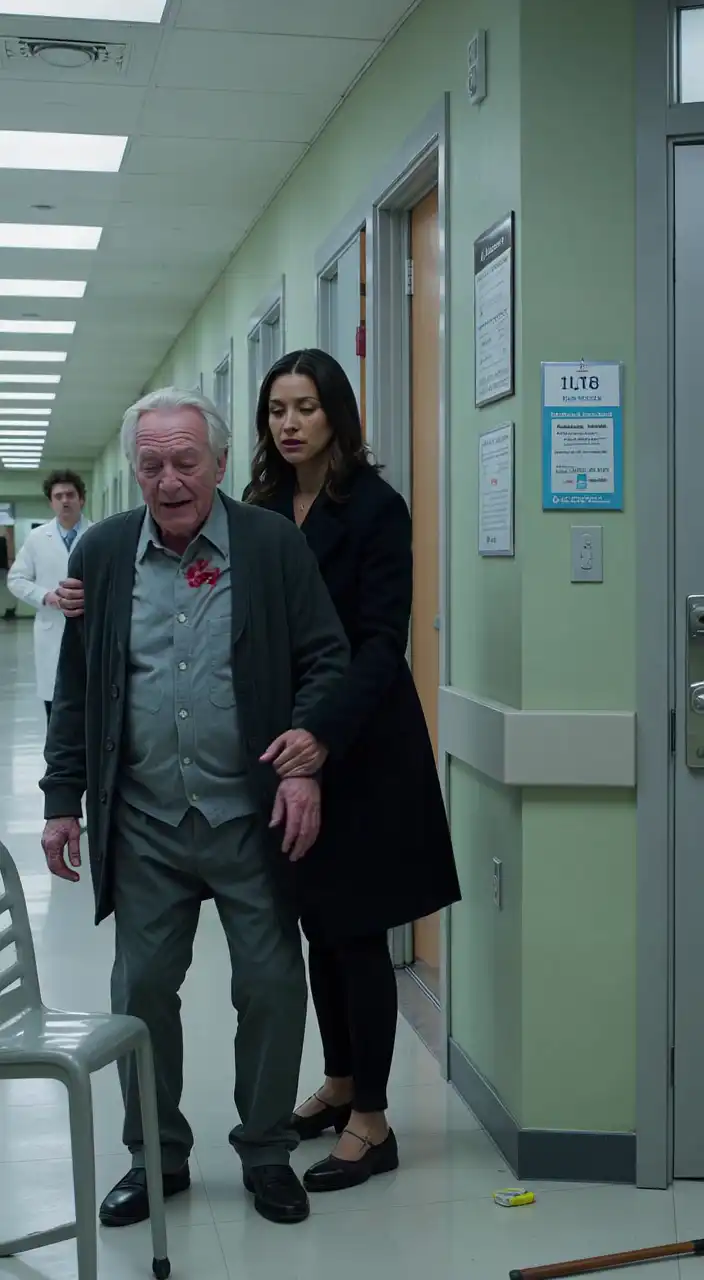
MY FATHER STARTED SHIVERING SO HARD HIS SURGICAL BANDAGE BLED THROUGH, AND THE CLINIC ADMINISTRATOR STILL BLOCKED THE TRIAGE DOOR.
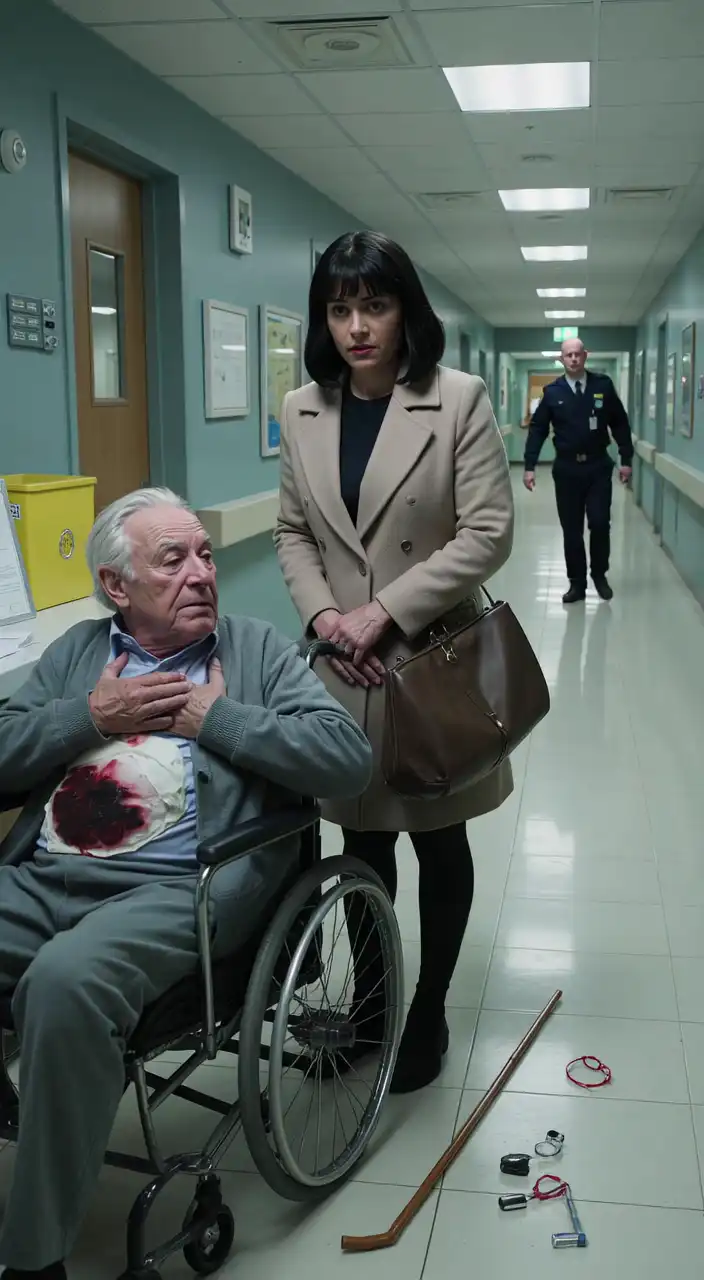
MY FATHER STARTED SHAKING IN THE HOSPITAL HALLWAY, AND THE WOMAN WHO CLAIMED TO BE HELPING HIM WOULD NOT LET TRIAGE TOUCH HIM.