
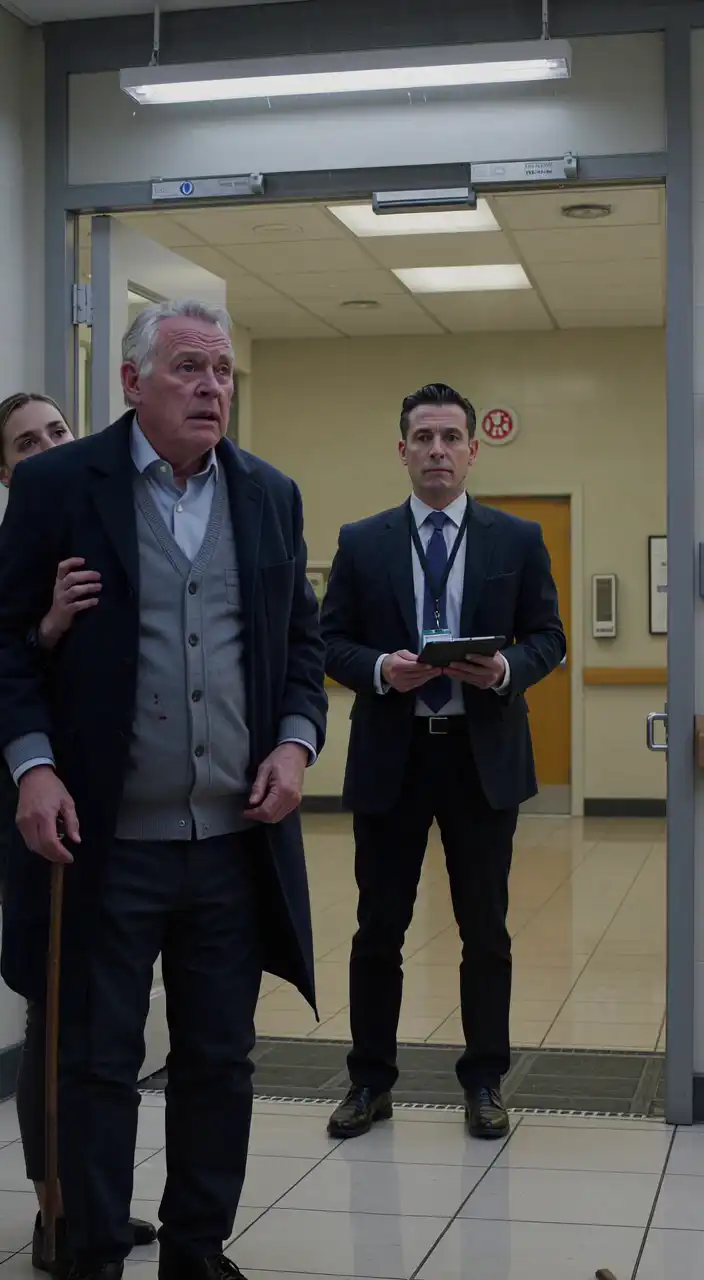
The man with the earpiece did not ask anyone to calm down.
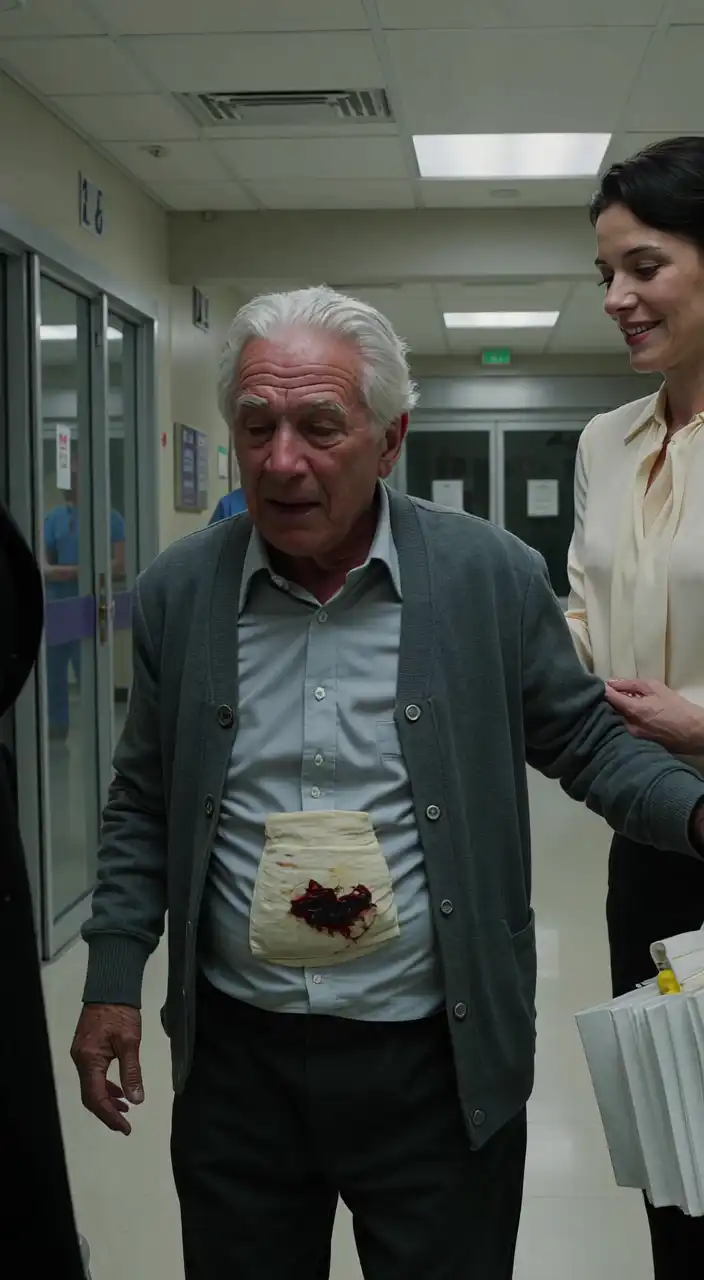
He looked at the timer on my phone, then at my father on the floor, then at Victor standing there with his tablet held against his chest like it was armor. The man crouched beside Dad first, two fingers at his neck, one hand pressing gently against the edge of the bandage where the stain had broken through.
"Sir, can you hear me?" he said.
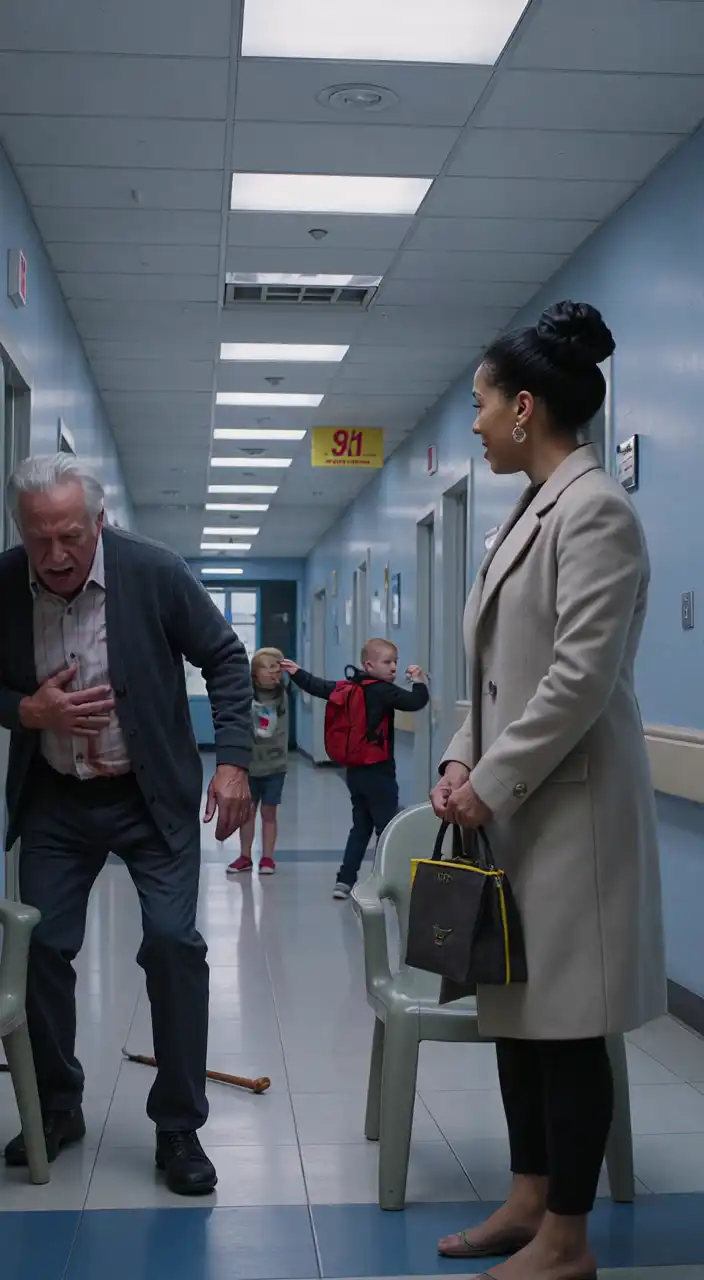
Dad opened his eyes halfway. "I'm fine," he whispered automatically, the old reflex of a man who had spent his whole life trying not to burden anyone.
"No, you're not," the man said, not unkindly. He touched his earpiece. "Medical alert at ambulance bay entrance. Post-op male, altered, active bleed, interrupted outside emergency call. I need a chair, a nurse, and to hold outbound movement on this patient now."
Victor straightened. "Security is not authorized to override discharge status without administrative review."
The man's head turned slowly. His badge clipped to the dark blazer caught the fluorescent light: Victor Alvarez, Security Supervisor. For one absurd second I noticed that both men were named Victor, and then the moment got swallowed by urgency again.
Supervisor Alvarez stood up. "I am not overriding discharge status. I am stopping a possibly impaired patient from being removed from emergency access while a medical abuse alert is assessed."
The clinic administrator's face hardened. "There is no abuse alert."
Alvarez held up my phone. "Then explain why a 911 call was interrupted from your threshold while the patient is bleeding through a surgical dressing."
For the first time, the younger Victor lost the smooth tone. "The daughter became combative."
"I'm his son," I snapped.
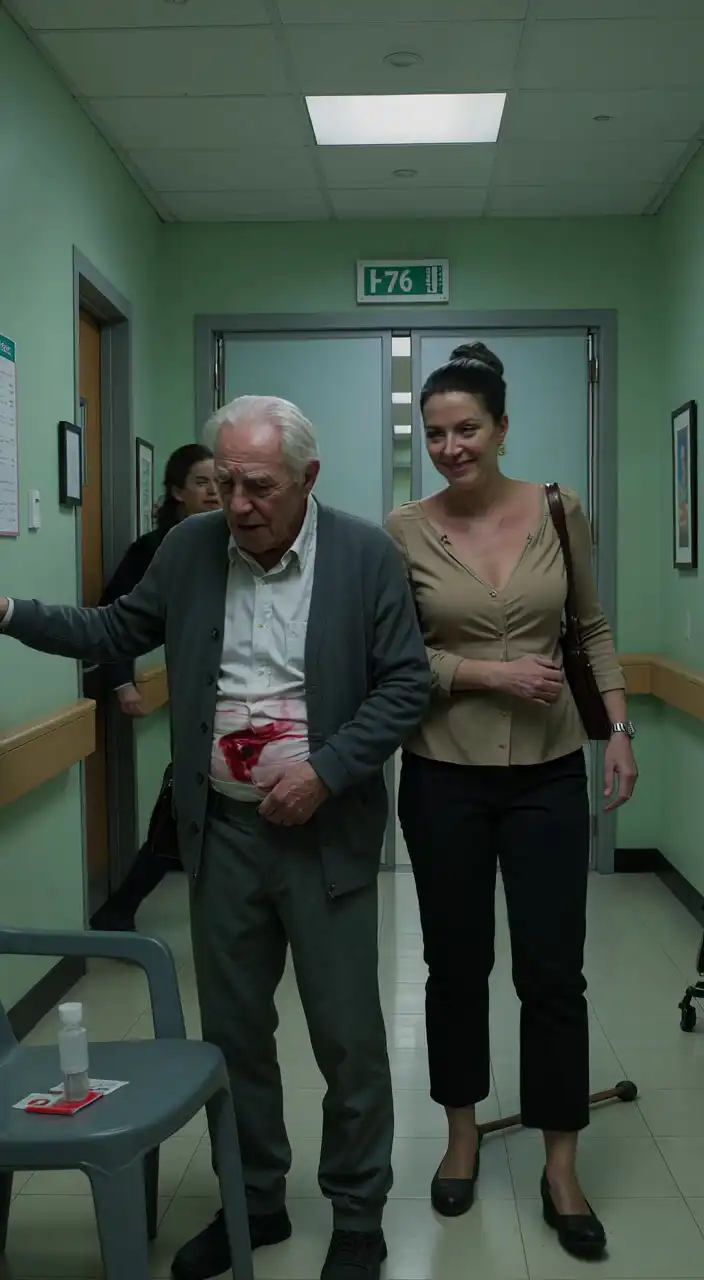
Dad made a weak sound, part cough, part groan. His hand slipped from his side, and I saw more than blood now. There was a thin yellow-brown seep at the bandage edge, darker in the center, the kind of stain that made even me - with no medical training beyond years of helping family through ordinary illness - feel cold all over. Not just bleeding. Something wrong underneath.
A nurse arrived pushing a wheelchair, another behind her with a small tray. Alvarez pointed. "Do not move him to the curb, do not discharge him, and do not release him to any nonclinical party. He needs immediate reassessment."
The administrator stepped in again, physically, one spotless shoe sliding into the path of the wheelchair. "The account holder instructed no additional services without direct consent."
Alvarez's voice dropped lower, which somehow made it more dangerous. "A person with decision-making authority can refuse care. A billing contact cannot order a bleeding, disoriented post-op patient kept outside. Move."
The nurse did not wait for the administrator to agree. She and I got our hands under Dad's arms while the second nurse lifted his legs, and Dad cried out for the first time, sharp and shocked, the sound torn out of him before he could swallow it. When we eased him into the chair, his cardigan fell open.
The folded discharge papers slid from inside someone else's coat pocket.
They landed near the administrator's shoes.
Everybody saw them.
The papers were bent, smudged, and half tucked into the inside pocket of his tailored gray coat, the one he'd draped over one arm despite the humid heat. His eyes went to them too late. He reached down, but Alvarez was faster.
He picked them up and unfolded the top sheet.
Dad's breathing had turned shallow. The nurse checked his temperature with a forehead scanner and swore under her breath. "One-oh-three point six."
That snapped the hallway into motion. The second nurse hit the code phone on the wall and gave report in clipped phrases. Post-op. Fever. Bleeding. Possible infection. Near-syncope. Interrupted EMS call. Wheel him in.
The clinic administrator said, "Those are internal discharge notes."
Alvarez looked at the page. "They're also patient records. Why were they in your pocket instead of in his hand?"
"It's not what it looks like."
Then what it looked like got worse.
Because as the wheelchair turned, Dad's right hand groped blindly toward me. I grabbed it, and his fingers closed around my wrist with surprising strength. "Don't let her sign anything," he whispered.
"Who?" I asked, already knowing the answer would matter.
His eyelids fluttered. "Marianne."
My stepmother.
She wasn't there, but somehow she was everywhere.
Three days earlier she had kissed Dad's forehead before surgery and told me, with tears in her eyes, "Your father hates hospitals. Once they're done, get him home and let him rest." She had sounded devoted. Exhausted. Practical. She had also insisted on handling all insurance and "family paperwork" because, in her words, "these places nickel-and-dime confused patients."
Now a clinic administrator was invoking her as the account holder while my father bled through his bandage.
I walked beside the wheelchair as they took him through the sliding doors. Alvarez stayed near us, not close enough to crowd, close enough to block anyone from peeling Dad away again. Behind us, the administrator was talking rapidly into his phone, all politeness gone.
Inside triage, everything sharpened.
A nurse cut away the dressing while another started oxygen. I caught one glimpse of the incision site before they pulled a curtain and turned me back. The dressing had been taped over twice. Under it, the skin around the wound looked angry and swollen, with a wetness no one should have sent home.
"When was he discharged?" a physician assistant asked me.
"Forty minutes ago."
She stared at me. "Who approved that?"
"I don't know. They told us he was fine if his family took him."
"He had a fever at discharge?"
"He was warm in the car. He got worse on the ride around because they said he couldn't come back through the front desk and had to use ambulance bay intake if he deteriorated. So I drove him here when he almost passed out."
The PA looked over the curtain at someone I couldn't see. "Get lactate, blood cultures, CBC, CMP, repeat vitals, fluids wide open, and page surgery now."
Dad tried to push the oxygen mask away. "No more bills," he mumbled. "Marianne said insurance won't cover another night."
I felt that sentence like a hand around my throat.
The PA heard it too. Her expression changed from clinical focus to something else, a thin controlled anger I would see more than once that night. "Sir," she said clearly, leaning in so he had to hear her through the haze, "right now we are treating your body, not your bill."
Alvarez stood at the curtain entrance. "I need to document the interrupted emergency call and the attempted removal. Also, the administrator was carrying the patient's discharge papers."
The PA did not even look up. "Document everything."
Then a charge nurse arrived with a yellow form clipped to a red board and asked me quietly, "Did anyone prevent him from getting help or speaking for himself?"
The question was so direct that my answer came out before my shame could get in the way.
"Yes."
She nodded once. "I'm placing a vulnerability flag until we sort authority, consent, and safety. If anyone tries to move him again without medical clearance, call us immediately."
"Can they stop his care over money?"
"No."
"Can his wife?"
"Not if he's competent and says no. Not if he's not competent and she's making unsafe decisions. Not if there are signs of coercion."
That word landed heavy and exact. Coercion. Not family disagreement. Not confusion. Not paperwork. Coercion.
A surgeon came in and peeled back more dressing. His jaw tightened. "This should never have left recovery like this."
"What is it?" I asked.
He glanced at me, decided honesty was faster. "Could be a post-op bleed. Could be early wound infection. Could be both. He's febrile, hypotensive, and confused. We need imaging and likely to take him back."
The world tunneled.
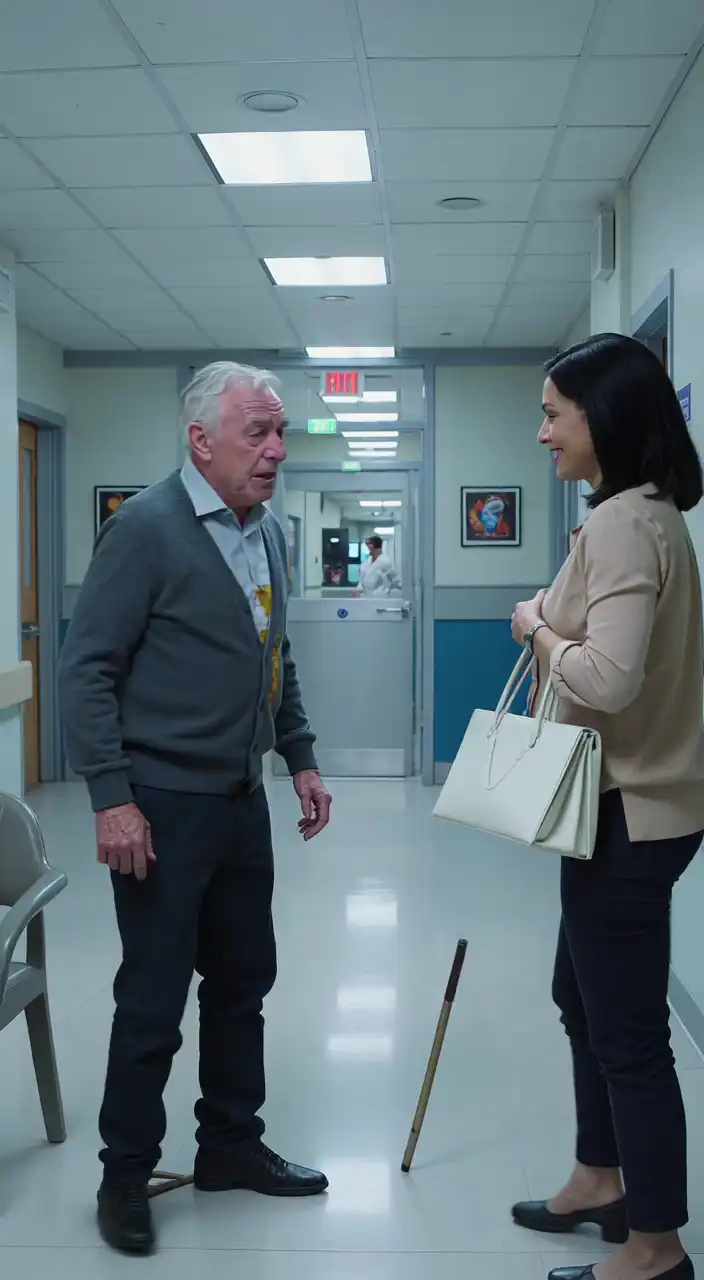
Dad had undergone bowel surgery four days before. It was supposed to be routine enough that everyone kept using that soothing phrase, routine enough, like bodies understood contracts. He had been proud of how well he was recovering. He had insisted on walking the hall with his cane. He had even joked with me this morning that the cardigan made him look like a retired professor instead of a man held together with staples.
Now a surgeon was saying likely to take him back.
The nurse handed me my cracked phone. "Dispatcher called back twice while the line was open. We captured the callback times in the system."
I looked at the screen. The call timer had frozen at 00:47. Under it, three missed unknown numbers blinked. It was such a small thing, just digits on cracked glass, but it made my knees weak. Proof that I had reached for help. Proof that help had been interrupted.
Alvarez asked if I could tell him exactly what happened outside. I did, fast and shaking. The administrator took my wrist. He said outside calls would complicate billing. He said family authorization was missing. He stood in front of the doorway. Dad almost collapsed before security got there.
"Did he touch your father?" Alvarez asked.
"He put a hand on the wheelchair when the nurse tried to bring it through."
"Did anyone from your family instruct the hospital to delay care?"
"He said the account holder did. My stepmother."
"Does your father control his own medical decisions?"
"Usually yes. Unless she gets between him and the form."
He wrote something on his clipboard. "I am filing this as a patient access obstruction and possible elder coercion incident. That triggers review."
I had never been so grateful for bureaucracy in my life.
Then my phone lit with Marianne's name.
I stared at it until it stopped.
It rang again immediately.
The charge nurse saw my face. "You don't have to answer in here."
But I did. I stepped just outside the curtain.
Her voice was calm enough to chill me. "Where is your father?"
"In triage."
"You were told to bring him home."
"He was bleeding."
A pause. Then, sharper: "He panics in hospitals. You are making this worse. Put the administrator on."
"I think he's busy being investigated."
Silence. Breathing. A tiny sound like she'd covered the mouthpiece and moved the phone away.
Then she said, very carefully, "Listen to me. Your father is confused on pain medication. He gave me authority because he can't handle stress. If you start accusing people, insurance may deny everything. Do you understand what that would do to him?"
Before I could answer, a voice behind me said, "I do."
Supervisor Alvarez had stepped into the hall. He wasn't looming. He didn't need to.
"Ma'am," he said, "this line is being noted in an active medical safety review. If you attempt to direct nonclinical discharge or interfere with reassessment, I will refer the matter to hospital risk and law enforcement."
Her inhale was audible.
"I only want what's best for my husband," she said.
"Then come discuss it with surgery and patient advocacy," Alvarez replied. "Not with the person trying to keep him alive."
The line went dead.
I looked back through the curtain gap just in time to see two transport staff wheel Dad toward CT while the surgeon signed something on a tablet. Dad's hand had fallen off the side rail, fingers twitching weakly. The paper hospital bracelet around his wrist caught the light.
I knew that bracelet. Marianne had tried to take it off in the car, saying discharged patients didn't need "that depressing thing" hanging on them.
I had tucked his hand away from her and pretended not to understand.
Now the bracelet was still there, and the nurse stopped me at the scanner doors just long enough to ask, "Did anyone remove or alter any discharge items, medications, or instructions before he left?"
My answer came too slowly.
Because I suddenly remembered something that had bothered me in the parking lot and then been buried under panic: his pill bottle had smelled wrong when I helped him into the car, sweet and chemical, not like the pain meds listed on the label.
Before I could say it, the scanner doors closed behind my father.
And the administrator who had blocked him was gone from the hallway.
The first hour after they took Dad to imaging passed in sharp pieces that refused to line up.
A social worker brought me water and a form for emergency contact updates. I crossed out Marianne's cell number with a hand that would not stay steady. Patient advocacy arrived, asked for a private statement, and wrote down every detail about the phone, the doorway, the papers, the "account holder" language, and Dad's whispered warning not to let her sign anything. Supervisor Alvarez came back once to tell me the clinic administrator had tried to leave the floor and had been instructed to remain available pending internal review. I should have felt safer hearing that. Instead I felt like someone had slid a door open behind the events I already knew and shown me there was a whole other room back there.
Then the surgeon returned from CT.
He did not sit down, which told me everything before he opened his mouth.
"There is a fluid collection near the surgical site," he said. "It looks infected, and there's concern for a leak. His blood pressure is dropping despite fluids. We need to take him back to the OR."
I grabbed the edge of the chair. "Can you fix it?"
"We can try. But I need a clear answer now. Is anyone likely to challenge consent or try to remove him from care?"
"My stepmother."
"Is she legal next of kin?"
"Yes. But he can usually speak for himself."
"Usually doesn't help me tonight."
The social worker who had been standing near the wall stepped closer. "He expressed fear regarding her signing authority. We also have a possible coercion concern."
The surgeon nodded once, already calculating. "If he can answer orientation questions, I can speak to him directly. If he cannot, and if there's an emergency threat to life, we proceed under emergency exception and document the safety concerns."
It was strange what my brain clung to: not threat to life, not emergency exception, but the fact that someone in authority was finally talking around the obstacle instead of waiting for it to move.
They let me stand by Dad's bed for less than a minute before anesthesia took him. His skin was damp and too hot. His eyes opened when I said his name.
"Dad, they need to go back in."
He blinked at me, then at the ceiling lights. "How much trouble?" he asked.
"None that matters."
A ghost of his old dry smile appeared. "That bad, huh?"
The surgeon leaned over him. "Lucas, tell me your full name."
He did.
"Do you know where you are?"
"Hospital." His breathing hitched. "Still the same ugly one?"
The surgeon almost smiled. "Do you understand that you may have an infection and bleeding from your recent surgery, and I recommend emergency treatment tonight?"
Dad shut his eyes, opened them again, and looked at me. "Not Marianne," he said. "You hear me? Not Marianne."
"I hear you."
The surgeon asked, "Do you consent to emergency surgery?"
Dad nodded. "Fix it."
That should have settled everything. It almost did.
Then Marianne arrived.
I heard her before I saw her, heels fast on tile, voice already sharpened into controlled outrage. "Where is my husband?"
She came around the corner in a cream raincoat and expensive glasses, carrying the kind of handbag that looked soft until you noticed how structured it was. Her makeup was perfect, but not because she was untouched by stress. Because she did not allow herself to arrive anywhere looking damaged. She took in Dad on the bed, me at his side, the surgeon, the social worker, and then she saw the yellow vulnerability form clipped to the chart.
Something flashed across her face before she covered it.
"You people have no right to keep me from making decisions for my husband."
The surgeon did not rise to her tone. "He just provided informed consent."
"He is septic and medicated."
"He's oriented enough to consent."
"He doesn't understand billing consequences."
I turned on her. "He understands blood."
She ignored me. "Doctor, my husband has severe anxiety around hospitalization. We had a plan to manage recovery at home. This readmission is being pushed by my stepson, who has always dramatized."
The social worker said, "Ma'am, this is not a billing conversation."
Marianne's eyes moved to her, assessed, dismissed. "No, this is a family matter being turned into a spectacle because people don't understand our arrangement."
Dad made a weak sound. His hand moved under the blanket, searching. I took it.
The surgeon said, "What arrangement would justify delaying a bleeding postoperative patient from re-entering care?"
She answered too quickly. "No one delayed care."
Supervisor Alvarez, who had appeared behind her without sound, said, "That statement conflicts with video and witness accounts."
She pivoted. "Oh, the security team. Wonderful. Then you've also seen my husband become agitated and refuse instructions when my stepson gets him wound up."
It was a neat move. Not denial, but reframing. Dad was the problem. I was the trigger. She was the manager cleaning up emotion and cost.
Then she reached toward the bed rail as if to stroke Dad's arm, and he flinched.
Small movement. Barely there.
But everyone saw it.
Her hand paused in midair.
The surgeon looked at Dad. "Lucas, do you want her making medical decisions tonight?"
Dad's throat worked. I could see how hard this cost him. He had lived with her eight years. He hated conflict. He hated disloyalty even more, even when it was deserved. But fever stripped him down to whatever was most true.
"No," he whispered.
The room changed.
Marianne withdrew her hand with slow dignity, but her eyes sharpened into something dangerous. "He is confused."
The social worker wrote something.
The surgeon nodded to anesthesia. "We're moving."
Marianne stepped forward and put one hand on the bed.
It wasn't dramatic. No shove, no scream. Just a hand placed where movement had to stop.
"I object," she said.
And for one suspended second, after all the talking and forms and warnings, she was physically doing exactly what the administrator had done outside.
Blocking care with her body.
Alvarez moved immediately. "Ma'am, step away from the patient."
"This is my husband."
"And this is emergency treatment. Step away now."
She didn't.
Then a nurse at the bedside wrinkled her nose and looked at the medication bag Marianne had brought from the car, the one hanging half-open from her shoulder. "What is that smell?"
Marianne turned too late.
The nurse reached in and pulled out Dad's prescription bottle.
The cap was loose.
And the sweet chemical smell I had noticed in the parking lot bloomed into the room.
Every eye went to the bottle in the nurse's gloved hand.
Marianne's voice thinned. "That's his pain medication."
The nurse looked at the label, then at the liquid shining around the cap threads. "Pain medication doesn't smell like this."
Dad was rushed through the OR doors before anyone could say more.
They left me outside with the smell still hanging in the air and Marianne being asked, very calmly, why she had a leaking prescription bottle that did not match what the label said.
I thought the night had shown me its worst shape already.
I was wrong.
Once the OR doors swallowed Dad, the hospital shifted from urgent motion to contested ground.
Marianne did not melt down. She reorganized.
That was what made her frightening.
A person in a panic can be contained. A person who starts calculating in real time is harder. As soon as the nurse carried the bottle toward the medication room, Marianne stopped arguing like a wife and started speaking like someone used to moving systems by sounding more reasonable than everyone else.
"This is absurd," she said. "The cap must have loosened in the car. You are humiliating me in front of my husband while he's unstable."
"He is in surgery now," the social worker corrected. "And the medication needs verification."
Marianne turned to me, eyes suddenly glossy. "Are you happy? You have always wanted to turn him against me."
It would have worked on me a year ago. Maybe even six months ago. Dad had always hated being triangulated between us, and Marianne knew it. She often spoke softly enough that Dad thought he was diffusing conflict when he asked me to let things go. But this time there was a frozen 911 timer, discharge papers in another man's coat, and a leaking bottle that smelled wrong.
"No," I said. "I want him alive."
Her face flattened. The tears were gone instantly.
That was when I understood something I should have understood sooner: she only borrowed vulnerability when it was useful.
Supervisor Alvarez stood beside the wall phone giving a report to someone higher up. I caught fragments. Security footage preserved. Restricted access. Possible law enforcement referral. Patient advocacy requesting immediate chart lock on nonclinical modifications. It all sounded surreal, as if my father's body had become a site everyone suddenly realized had been negotiated over by the wrong people.
A pharmacist arrived, summoned by the smell. She was a compact woman with clipped gray hair and a look that said she trusted molecules more than people. She took the bottle from the nurse, read the label, opened it carefully under a hood in the med room doorway, and frowned deeper.
"This is not standard oral oxycodone suspension," she said. "At minimum it's contaminated. At worst it's been transferred."
Marianne folded her arms. "Are you accusing me of poisoning my husband?"
The pharmacist did not blink. "I'm saying the contents do not appear consistent with labeled medication and need immediate analysis. Did he ingest any tonight?"
I answered first. "He took a dose at home before we left."
"How much?"
"Half a capful. She handed it to him."
Marianne snapped, "Because he was in pain."
The pharmacist asked, "Did he become more confused after that?"
"Yes," I said.
Marianne spoke over me. "He was already upset."
The pharmacist turned to the nurse. "Document possible medication tampering. Notify surgery and ED physician. I want tox screening added if feasible."
That word - tampering - should have exploded everything. Instead it settled in with sickening logic, fitting around things that had not made sense before. Dad too sleepy that afternoon. Dad mumbling that the world felt tilted. Marianne insisting I not read the paper instructions because "they're all generic." The administrator speaking about authorization like a family preference mattered more than a man's wound.
A police officer in a hospital uniform shirt but no patrol hat arrived twenty minutes later. Not a city detective. Hospital police. He introduced himself, asked whether Dad was in immediate danger from an outside person, and requested initial statements while details were fresh. Marianne asked for counsel. I expected him to stop there. Instead he said, "You may decline to answer. You may not interfere with patient care or evidence handling."
Evidence. The word made her jaw tighten.
He interviewed me in a small family consult room that smelled like old coffee and copier heat. I told him everything from the curb to the bottle. The interrupted 911 call. The administrator grabbing my wrist. Dad whispering not to let Marianne sign anything. Her insistence that insurance would not cover another night. The attempt to remove his bracelet in the car. The smell from the bottle.
"Did your father ever say he feared her?" the officer asked.
My answer took time. "Not in those words. He said things like, 'She handles the stressful stuff,' and 'Don't upset Marianne, she's carrying so much.' But lately he started asking me to come to appointments more often. He used to text me the times himself. The last two months she started sending them from his phone."
The officer wrote that down.
"Any financial dependency?"
"She manages his business accounts since surgery prep. She says it's temporary. She also convinced him to put her down as billing contact for everything."
"Do you know why the clinic administrator would listen to her over the patient?"
"No. Unless she knows someone here."
That part I couldn't prove. Not yet.
When I came out, Supervisor Alvarez was waiting outside the consult room. "The footage from ambulance bay is clear," he said quietly. "He obstructed the wheelchair."
"Will they fire him?"
"I'm more concerned with whether he delayed emergency access for money or because someone pressured him."
"Can you see if she called him?"
"That will be for investigators. But internal systems log administrative access."
He was careful not to promise what he couldn't control. I appreciated that. Everyone else in the last six hours had either minimized or dramatized. Alvarez just kept putting one fact where it belonged and then another.
At midnight the surgeon called from recovery.
Dad was alive.
The leak had been real. Infection too. They repaired what they could, cleaned the area, placed drains, started broad-spectrum antibiotics, and moved him to ICU for close monitoring. The sentence ended with "the next twenty-four hours are critical," but I barely heard it over the first part.
Alive.
Then came the reversal.
The surgeon added, "Toxicology flagged a sedative in his system that was not administered here."
I sat down in the hallway without meaning to.
"What kind of sedative?"
"Still confirming. Enough to worsen confusion and blood pressure. Not enough alone to explain everything, but enough to make a sick man look weaker, more disoriented, easier to manage."
Easier to manage.
Not easier to heal. Easier to manage.
I thanked him and hung up. The fluorescent lights above the waiting area hummed so loudly it felt personal.
When I looked up, Marianne was gone.
I found out a minute later why.
She had asked to use the restroom near the elevators and then tried to leave through the parking deck connector.
Not running. Leaving. Composed. Purse on shoulder. Phone in hand.
A volunteer had recognized her from the active safety alert and notified security.
They brought her back not in handcuffs but with a choice: remain for interview or formally depart and have the matter referred as patient abandonment and interference. She chose to remain. Even cornered, she chose the path that preserved her image longest.
At two in the morning patient advocacy found me again, this time with an older man in a navy suit and a young woman carrying a laptop. Risk management, they said. They needed to explain why the administrator had authority to place any kind of billing hold note near a postoperative account and why discharge papers were not with the patient. I could hear the institution waking up to its own danger.
The young woman pulled up access logs. "There was a notation added to his file six hours before discharge," she said. "It states, 'Family requests no readmission without spouse notification due to anxiety and noncompliance.'"
"I never said that," I said.
Marianne said from across the room, "I did."
The risk manager turned to her. "On what basis?"
"He becomes overwhelmed and says yes to anything."
The social worker, who had somehow still not gone home, answered before I could. "He refused her decision and consented directly to emergency surgery."
That should have been enough. But the young woman at the laptop was still scrolling.
"There's more," she said. "The note wasn't entered by nursing or surgery. It was entered under ambulatory administration credentials."
Everyone looked at the clinic administrator, who had been seated at the far end of the room with his coat folded in his lap and his status finally stripped down to an ordinary frightened young man.
His name tag said Victor Chen.
He looked about twenty-four now, not high-status, not spotless, just trapped.
"I was told it was a financial flag," he said. "A family safeguard for unauthorized services."
"By whom?" the risk manager asked.
Chen's throat moved. "Mrs. Delaney said there had been problems before. She said if he was readmitted without approval, the account would be disputed and my director would hear about it."
"So you inserted a care-delay note into a postoperative chart based on a family request?" the risk manager asked.
Chen looked at Marianne, then down. "I wasn't trying to hurt anyone."
"That is not an answer."
His fingers tightened on the coat. "Her family funds the donor wing renovation."
There it was.
Not a movie villain payoff. Something smaller and uglier and more believable. Status anxiety masked as procedure, exactly what he'd looked like from the beginning. A rich donor family. A young administrator trying to protect his place. A wife who knew which pressure points in institutions felt softer than a bleeding man at the door.
Marianne said, "That is a gross distortion."
The risk manager ignored her. "Did you remove the discharge papers from the patient packet?"
Chen hesitated.
"Answer," Alvarez said.
"Yes," Chen whispered. "I wanted to check whether surgery had noted restrictions that would conflict with the hold. Then things escalated outside and I... I still had them."
I stared at him. "You let us stand in the rain while he shook, and you had the papers in your pocket."
He looked wrecked now, but I could not afford to feel sorry for him yet.
The young woman at the laptop looked up again. "The discharge instructions included immediate return criteria for fever over one hundred one, wound drainage, confusion, and fainting."
The room went dead quiet.
Every single condition Dad had.
The papers had literally contained the reasons he should have been readmitted without delay.
Marianne's composure slipped by a fraction. "He often runs warm after procedures."
The social worker said, "Stop."
Just that. Stop. Not loud, but final.
Then came the second reversal, one that changed not only what had happened tonight but what had been happening longer.
The pharmacist entered with a preliminary printout. "The bottle contained trace amounts of prescription sedative mixed into the pain medication suspension. We need confirmatory testing, but it's enough to explain excess drowsiness and confusion."
The officer asked, "Accidental cross-contamination possible?"
The pharmacist gave him a look. "Not with this combination."
My stomach turned over.
Marianne shook her head. "I manage multiple medications. If there was a mistake, it was a mistake."
The problem was, it almost sounded plausible. Caregivers do make mistakes. Families get exhausted. Bottles get mixed up. Part of why abuse hides so well is because real caregiving is messy.
Then Alvarez said, "The son mentioned a bracelet."
I looked at him, startled.
"On camera in the parking area before return to the bay," he continued, "Mrs. Delaney appears to reach for the patient's wrist. The son moves his hand away. I couldn't tell what was being removed."
"The hospital bracelet," I said. "She tried to take it off."
The pharmacist's expression sharpened. "Why would anyone remove a post-op ID bracelet during a complication return?"
No one answered.
Because the answer was obvious now.
To make him look less like a current patient.
Less like a direct return.
Less like someone whose chart, discharge status, and readmission criteria could be checked quickly against the body in front of them.
At three in the morning, they moved me up to ICU.
Dad was pale under the warmer lights, lines and monitors surrounding him, the steady beep both a comfort and a threat. There was a new surgical dressing, cleaner, heavier. His cane had been left with his belongings in a corner, absurd and humble beside all the machines. His hospital bracelet was still on.
I pulled a chair to the bed and sat.
The nurse told me he might wake briefly and not stay oriented. "If he says something important, write it down," she said.
That advice sounded odd until dawn, when Dad surfaced long enough to do exactly that.
His eyes opened to slits. "Phone," he whispered.
I put mine in his hand, but he shook his head weakly. "Mine."
His belongings bag sat on the shelf. Inside were his wallet, glasses, cardigan, and his own phone, dead until the nurse found a charger.
When it powered on, messages filled the screen.
Most were from Marianne.
Where are you Do not let them admit you again Remember what we discussed about costs Tell them you feel better Do not sign anything until I get there
Then older messages.
Take the pills and sleep I already told admin not to process extra services You do not need your son upsetting everyone If they ask, say you're just tired
I felt every hair on my arms rise.
Some of the texts were hours old. One was from earlier that afternoon, before Dad had even been discharged.
Another was from someone saved as V.C.
Hold noted. Front desk informed. Bay route only if deteriorates.
I stared at the screen until the words blurred.
Not just chaos. Coordination.
Dad's fingers twitched toward the phone. "Delete?" he murmured, frightened even now.
"No," I said. "I'm keeping it."
He closed his eyes, and for the first time I understood how long fear can live inside ordinary politeness. He had not been unable to see what was happening. He had been unable to fight it while sick, dependent, and ashamed.
The ICU nurse photographed the texts per protocol and called the officer back up.
By morning the story had changed again.
Not because the facts changed, but because now there was proof that the blocked rescue had been planned before the threshold.
And Marianne, who had spent the night insisting everything was misunderstanding and family stress, was suddenly asking whether she was free to leave.
Dad slept most of the next day, trapped in that gray place between sedation and pain, where every movement looked expensive. I stayed at his bedside until the ICU nurse made me eat a stale muffin and drink coffee that tasted burned enough to qualify as punishment. His fever came down a little. His blood pressure steadied. Small mercies began arriving in numbers: oxygen improved, urine output acceptable, labs still bad but less terrifying.
The medical rescue had finally started winning inches.
Everything around it got messier.
By noon, hospital administration had formally suspended Victor Chen pending investigation. I heard that from Supervisor Alvarez, who delivered the update the way he did everything else: no drama, no extra garnish. "He is no longer permitted on the floor," he said. "His device access has been limited. Internal audit is preserving communications."
I nodded, but my eyes stayed on Dad.
Alvarez lingered a second. "Your father asked for you when he was more awake around eight."
"What did he say?"
"He asked if the bracelet was still on."
I looked at Dad's wrist, the soft plastic band sitting above the tape from his IV. Such a small ugly thing. I remembered Marianne pinching the edge of it in the car and saying, "Let's get that off, Lucas, you're home now." I remembered the way Dad had let his hand go limp rather than pull away openly. Not agreement. Survival.
"The bracelet matters," I said.
Alvarez's expression tightened. "It may matter more than we knew. There is a camera at the parking deck exit. It caught part of your return route. She reached for his wrist before he slumped in the passenger seat."
"Because she didn't want him recognized as a current patient."
"Possibly. Or because the barcode on it connects directly to his active discharge criteria and surgical unit."
I sat with that. Abuse can hide in grand cruelties, but often it survives by attacking little bridges to help. A bracelet. A phone. A piece of paper. A ride through the right entrance.
The officer from the night before came up with a detective from the city, because once medication tampering and coordinated obstruction entered the record, this was no longer just a hospital problem. They interviewed Dad's surgeon, the ICU nurse, the pharmacist, Alvarez, and me. They also asked for permission to image my phone and Dad's phone, preserving the interrupted call screen and the text messages.
"I need you to tell me if there has been a pattern of isolation," the detective said.
I thought of the last year.
Marianne volunteering to manage Dad's scheduling because "he keeps forgetting." Marianne telling me he was resting when I asked to visit. Dad canceling lunch twice and then later saying, confused, "I thought you changed it." The way he had grown apologetic every time money came up, though he had done well for himself his whole life. The way she had started describing him as "fragile" in front of strangers, even when he was right there.
"Yes," I said. "I just didn't know what I was looking at."
That confession burned.
The detective surprised me by shaking his head. "Most families don't until a threshold event happens. That's why threshold events matter."
Threshold event. A phrase cold enough for training manuals, but it fit. Some line had been crossed so publicly, so dangerously, that the private machinery around it became visible.
Later that afternoon, a patient advocate helped Dad complete a new limited access form while he was lucid enough to understand it. He removed Marianne as default billing contact and decision contact. He added me. He also asked for a notary.
I looked at him. "You don't have to do paperwork right now."
His voice was weak but steady. "If I don't do it now, she'll talk me out of doing it later."
There it was again: not ignorance, not confusion, but a man telling the plain truth once enough people had made space for him to tell it.
He signed with a shaking hand.
The notary left. Dad leaned back and shut his eyes. "I thought if I kept things peaceful, she'd settle down."
I didn't answer immediately because any answer I had would accuse him or comfort him, and neither felt fair.
Finally I said, "You were healing. You were trying to get through surgery."
He stared at the ceiling. "She kept saying the business couldn't survive another bad quarter. Then the donor thing started. The wing campaign. She said if I looked unstable, they'd freeze some partnership plans."
I turned toward him. "What donor thing?"
He exhaled slowly. "Her brother sits on a foundation board. They pledged a big gift if the clinic expansion went through. She liked being connected to all of it. Important people, dinners, photos. Victor Chen was around because she kept introducing herself as a donor family rep, not just my wife."
That connected too neatly with the lanyard, the deference, the "account holder" nonsense spoken as if it could outrank blood pressure and infection.
"Did you know she had contacted admin before discharge?" I asked.
His jaw tightened. "I suspected. She took my phone twice yesterday. Said she was making sure no one billed duplicate services." He swallowed. "When I got warm in the car, I said we should turn around. She said no. Said if I went back in, we'd lose everything she'd arranged."
"Everything?"
He gave a mirthless little smile. "That's the thing. It was never clear."
Fear often arrives with blurry nouns. Everything. Ruined. Trouble. Consequences. It fills the gaps with whatever scares you most.
"Did you know about the medication?" I asked quietly.
His eyes moved to mine and away. "I knew it made me sleep harder than the hospital doses. She said the home bottle was stronger because insurance changed the brand."
It took all my strength not to react in a way that would force him to comfort me.
The ICU nurse came in to flush a line and glanced at the new contact form clipped to the chart. "Good," she said simply.
Dad looked embarrassed. "I'm sorry for all this."
"No," she said, adjusting his blanket with a tenderness that nearly undid me. "You're having surgery complications. The rest is other people's choices."
That sentence stayed with me.
By evening a new pressure point arrived.
The detective returned with an update: Marianne's attorney had called, which meant she had moved from influence to defense. Worse, she was now claiming Dad's altered state made the phone messages meaningless and suggesting I had manipulated access to his devices after the fact. I almost laughed at the audacity until I realized that legal audacity still creates delays, and delays are dangerous in another way. They fray certainty. They make institutions retreat into caution.
"Do you have independent corroboration for the messages?" I asked.
"Metadata, timestamps, provider records if necessary," the detective said. "But yes, we'll need more than outrage."
That was when one of the planted details paid off in a way I had not expected.
My cracked phone still held the dispatcher callback logs, but the ICU nurse reminded me that 911 centers record not only completed calls but partial audio and ambient sound if a connection opens. The officer had already requested it. At seven-thirty that night, he returned with a transcript summary.
The open line had captured my voice giving the location, Dad groaning, the administrator saying, "End the outside call, sir, we can handle this internally," and my protest before the phone struck the floor.
Not an interpretation. Not family memory. Audio.
I closed my eyes.
"There's more," the officer said. "After impact, footsteps, a male voice says, 'No readmit without spouse approval. Put the phone away.'"
Victor Chen.
Supervisor Alvarez was standing in the doorway. Even he looked shaken by that. "That secures the obstruction piece," he said quietly.
Not everything. But a piece. A real one.
Then Dad spiked another fever.
The monitors changed tone. Nurses moved faster. The ICU physician ordered more cultures and adjusted antibiotics. I got pushed gently back from the bed while they worked. All day we had been building a case, building a record, building protection. The body did not care. It was still fighting for itself under all the paperwork.
That was the fifth movement of the nightmare: the awful reminder that exposure does not guarantee rescue if the person at the center is still medically losing ground.
The physician came out after midnight with that careful face doctors wear when they need family to stay steady. "He's not crashing," she said, which meant he had come close enough that the word was in play. "But his pressure is softer, his fever is back up, and if his kidneys don't respond we may need higher-level support. We are not out of danger."
I leaned against the wall. "Did the delayed return make this worse?"
She did not give me the mercy lie. "Delay matters with postoperative infection. So does the sedative if it masked symptoms. I can't quantify exactly how much, but yes, it mattered."
I stood there under the ICU lights and understood that there would never be a version of this story where what they did was merely rude or controlling or financially gross. It had weight in flesh. In labs. In fever. In a man struggling to stay attached to the world.
At two in the morning Dad woke agitated, trying to pull at his oxygen and murmuring about needing to get home before Marianne got angry. The nurse gave him medication, but before it took hold he gripped my sleeve and said, with terrible childlike urgency, "Don't leave me where she can talk for me."
That was the closest he came to saying afraid.
I bent over and promised, "I won't."
Then the final obstacle arrived.
Hospital legal, citing the spouse status and the evolving criminal allegation, wanted a short hearing the next morning with ethics, attending physicians, social work, and security to formalize restricted visitation and decision authority while Dad drifted in and out of lucidity. Necessary, yes. But if they overbalanced toward process, Marianne could still exploit the gray areas. She had already requested a private bedside visit "to reduce patient distress."
"No," I said immediately.
The social worker agreed. "Given his repeated expressed fear and the coercion concerns, private access would be unsafe."
But Marianne had one last card. Through her attorney she argued that separating a lawful spouse from a recovering patient was retaliatory and emotionally harmful, and that the son - me - had a motive to alienate her for inheritance reasons.
Inheritance. There it was. The old gravity trick. Turn rescue into greed. Turn fear into family politics.
For one awful hour, I was back in uncertainty, not because the facts had changed, but because institutions are trained to move carefully when family roles and legal ties collide.
Then Dad, half exhausted and half furious, solved it himself.
During the ethics meeting at his bedside, while the doctor explained capacity fluctuations and the attorney summarized concerns, Dad opened his eyes and said, very clearly, "Write this down."
Every person in that room stopped.
He pointed weakly to Marianne, who had been allowed to attend with two staff present and no private access. "She told them not to take me back."
Marianne spoke instantly. "Lucas, honey, you're confused."
He ignored her. "She changed my pills. She kept saying one more night in the hospital would ruin us. We are not ruined. I am sick."
Then he looked at the doctor. "If I get confused again, he speaks for me." He meant me. "Not her."
The attending physician asked three orientation questions. Dad answered all three. Not perfectly fast. Not beautifully. But enough.
The ethics chair nodded to the recorder. "Statement noted."
Marianne stood so suddenly her chair scraped. "This is coercion. He is being fed a narrative."
Dad turned his head toward her with more effort than it should have taken. "No," he said. "I am finally allowed to finish a sentence."
It was the bravest thing I had ever seen him do.
That broke it.
Not in a theatrical way. No police rushing in that second. No confession. But every remaining ambiguity in the room tilted. The legal team authorized restricted no-private-contact status. The social worker initiated an adult protective referral. Security formalized trespass conditions if Marianne attempted unsupervised entry. The detective requested a warrant for medication analysis and communications. The institution stopped treating this as an unpleasant family dispute and started treating it as endangered care.
Once the machinery finally aligned with the truth, rescue moved fast.
Marianne was escorted out after she tried one last time to lean over Dad and whisper something none of us could hear. He recoiled visibly. That was enough. She lost the privilege of return that day.
Victor Chen, confronted with the audio, the chart note, the papers, and his access log, gave a formal statement admitting he had entered the hold notation, removed the discharge packet, and attempted to redirect us away from readmission because he feared retaliation from donor-connected families and leadership embarrassment. He did not admit malicious intent. He did not need to. His choices spoke.
The bottle testing came back confirming the sedative mixture. Not enough for the kind of crime TV builds episodes around. Enough for the kind of control ordinary people can hide behind: he was just sleepy, he was just confused, he didn't know what he wanted.
The rescue ending was not one single shining moment. It was a series of hard-won corrections.
Dad's antibiotics started working for real on day three. His fever broke and stayed broken. The drains cleared gradually. His blood pressure stabilized without escalation. He moved from ICU to step-down with a face that looked carved thinner but unmistakably present again. When physical therapy came, his cane waited beside the bed, and the therapist treated him like a man recovering strength, not a burden to be managed around money.
Patient advocacy helped him file formal complaints with the hospital and licensing board. Risk management stopped using euphemisms and acknowledged in writing that inappropriate administrative interference had delayed emergency reassessment. The 911 recording was preserved. The text messages were copied. The bracelet, absurdly, was placed in an evidence envelope after he no longer needed it because the attempted removal and continuous ID chain had become relevant to the timeline. Dad laughed weakly when they told him that. "Imagine that," he said. "Saved by ugly plastic."
I laughed too, then cried in the bathroom where he couldn't see.
When he was strong enough, Dad asked to review his own phone messages with the detective present. He did not collapse under them. He grew steadier. Every text he read seemed to return one inch of his own judgment to him. By the end he said, "I kept thinking if I was kinder, she'd stop pressing. I was wrong."
The detective answered, "Pressure like that rarely rewards kindness. It rewards distance."
A temporary protective order followed. Then a longer one. Financial review uncovered that Marianne had been moving money between accounts under the cover of "charitable commitments" and "care coordination expenses." Not all of it was criminal. Some of it was simply manipulative, opportunistic, ugly. Real life is crowded with harms that don't fit neat labels but still leave marks.
Victor Chen lost his job. I learned later he cooperated fully after the initial denial, gave investigators his message history, and admitted he had been told by Marianne that if Lucas looked unstable and difficult, the hospital could justify refusing "nonessential readmission." It was monstrous in hindsight, bureaucratic in the moment, and that was part of why it worked as long as it did.
Weeks later, when Dad finally came home to his own house without her there, the rain had stopped for good. He moved slowly, one hand on the cane, the other on the doorframe, like a man crossing back into a life that had almost been negotiated away from him. The first thing he asked me to bring in was not his overnight bag or medications.
"My cardigan," he said.
The same one from that night. Washed now, but the fabric still faintly puckered where blood had soaked through. He folded it himself and put it over a chair in the living room.
"Why that?" I asked.
He looked at it for a moment. "Because I want to remember what waiting cost."
Then he looked at me, embarrassed by his own honesty.
I said, "Good."
He kept the bracelet too. Not on his wrist. In the kitchen junk drawer, of all places, beside batteries and takeout menus and a screwdriver with a cracked yellow handle. A plain reminder that rescue sometimes depends on ridiculous, fragile things staying in place long enough for one decent person to notice them.
Months later, when the hospital asked whether he wanted to participate in staff training about access obstruction and coercive family control, he said yes. He stood in a conference room with his cane and his rebuilt strength and told a room full of nurses, admins, transport staff, and security what it felt like to be spoken over while your body was failing.
"The worst part wasn't pain," he said. "It was being treated like my emergency belonged to whoever sounded most important."
No one in that room looked away.
Supervisor Alvarez was there too, in the back, arms folded, listening. Afterward he shook Dad's hand and said, "You did more than most people could in that condition."
Dad gave his tired half smile. "You picked up the phone."
Alvarez answered, "It was already trying to tell the truth."
That line stayed with me because it was the whole story in one sentence. The phone. The bracelet. The papers. The smell from the bottle. Tiny objects carrying more honesty than the people trying to manage them.
Marianne's case moved slowly, like all such cases do, through hearings and denials and experts and records. I won't pretend justice came in one clean drop. It came in paperwork, in corroboration, in one institution after another deciding not to look away once enough facts were arranged in the same light. Some charges stuck. Some did not. The civil protections mattered more immediately. Dad kept his home. He kept his business. He kept the right to have fear believed when he named it.
And he lived.
That is the center I keep returning to.
He lived long enough to regain weight, complain about physical therapy, argue about baseball, and grumble that hospital coffee should be illegal. He lived long enough to apologize to me for "making you fight like that," and long enough for me to answer, truthfully, "You fought too." He lived long enough to stop lowering his voice when he said Marianne's name, and then, eventually, to stop needing to say it much at all.
Sometimes he still wakes from a nap disoriented and asks where his phone is. Sometimes I hand it to him and watch him check that no one has answered for him. He catches me watching and rolls his eyes.
"I'm getting better," he says.
"I know."
And he is.
But every time I pass automatic hospital doors and hear that seal of air break open, I remember the wet pavement, the dropped cane, the folded discharge papers in the wrong coat, and my cracked screen glowing on the floor with the rescue call frozen mid-breath.
I remember how close help was.
I remember who tried to stand between a sick man and the doorway.
And I remember that in the end, the blocked care became exposed care because one supervisor bent down, picked up an interrupted phone, and refused to let procedure outrank a human body bleeding in plain sight.
Disclaimer: Mention of any brand or trademark is for identification only and does not imply partnership or endorsement
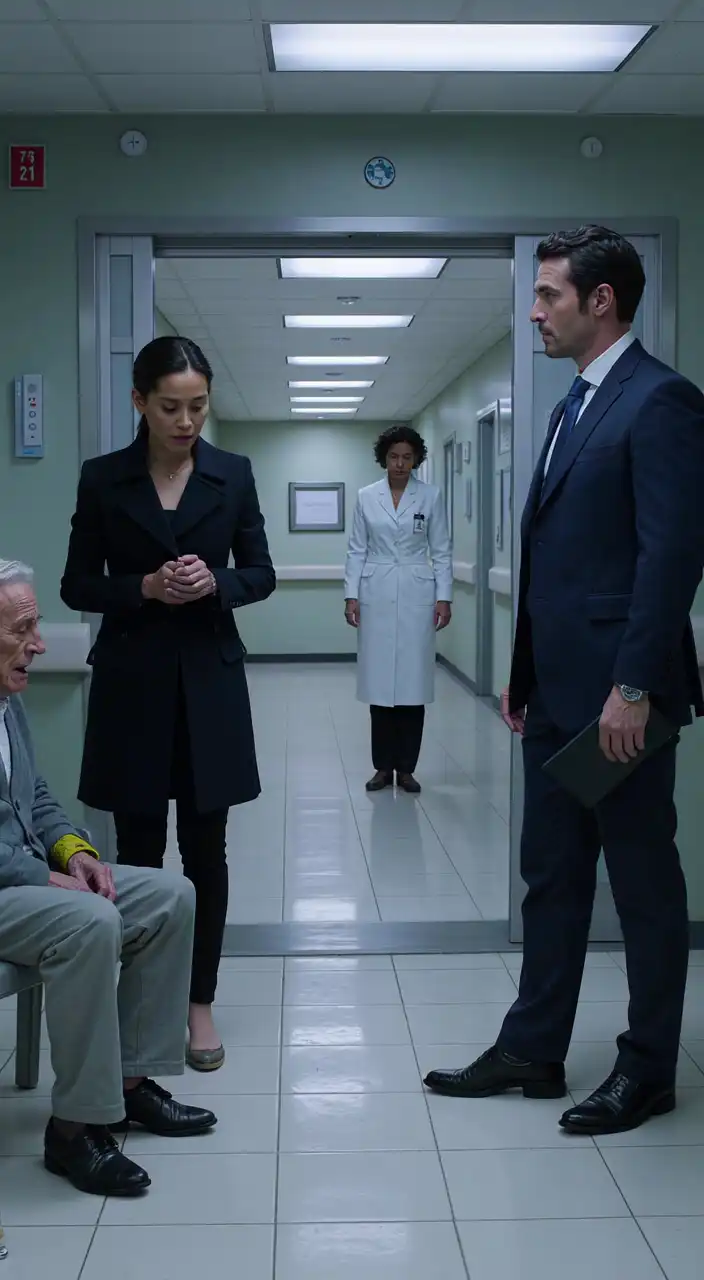
MY FATHER STARTED SHAKING OUTSIDE TRIAGE WHILE A CLINIC ADMINISTRATOR BLOCKED THE DOOR AND SAID HE NEEDED FAMILY PERMISSION FIRST.
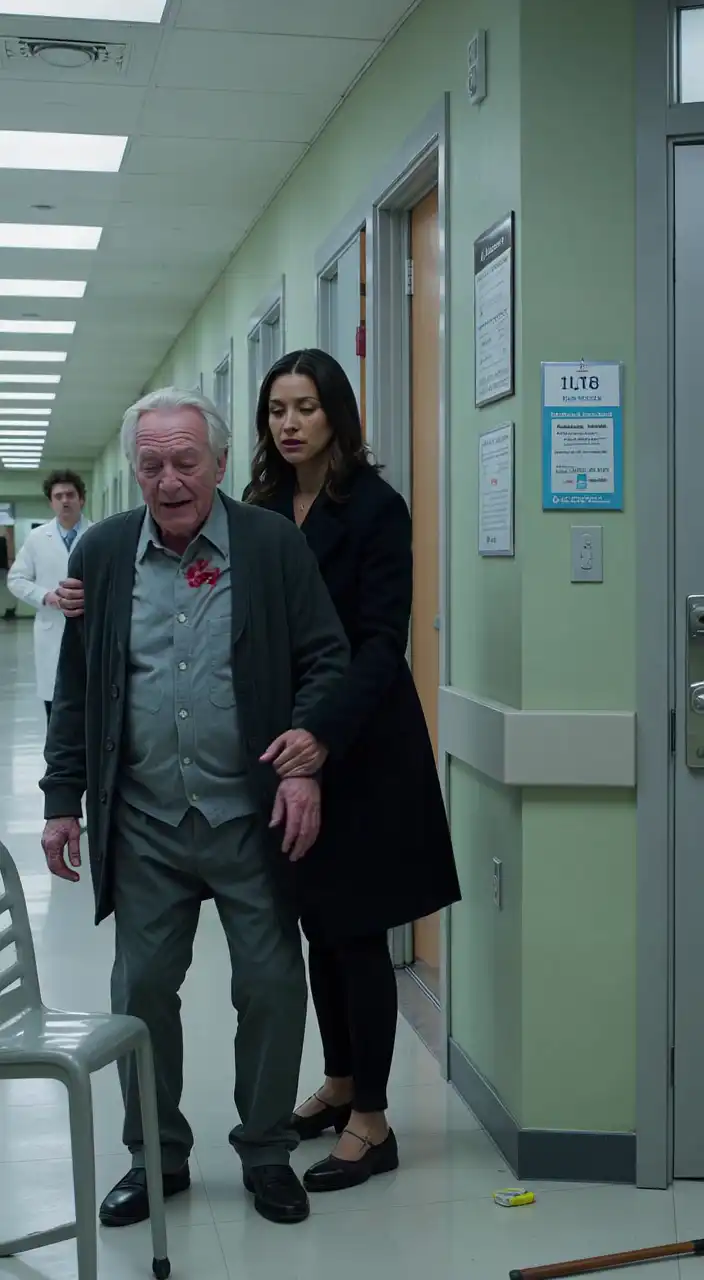
MY FATHER STARTED SHIVERING SO HARD HIS SURGICAL BANDAGE BLED THROUGH, AND THE CLINIC ADMINISTRATOR STILL BLOCKED THE TRIAGE DOOR.
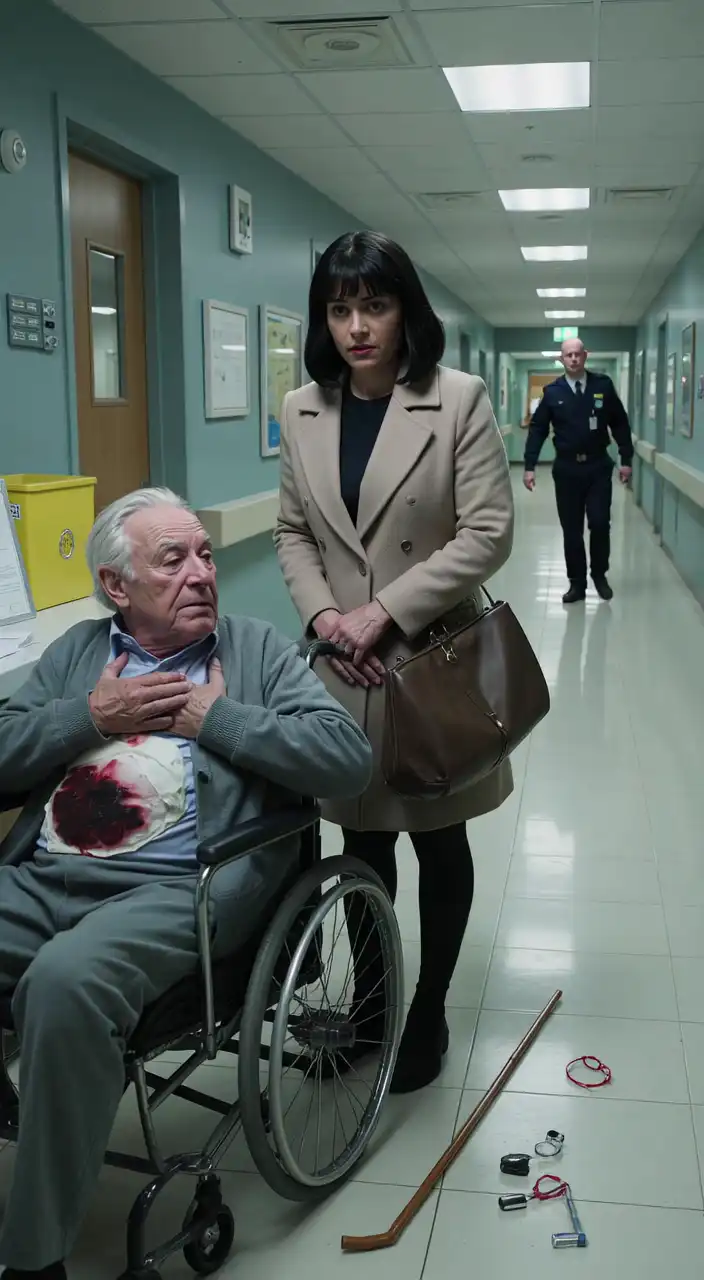
MY FATHER STARTED SHAKING IN THE HOSPITAL HALLWAY, AND THE WOMAN WHO CLAIMED TO BE HELPING HIM WOULD NOT LET TRIAGE TOUCH HIM.