
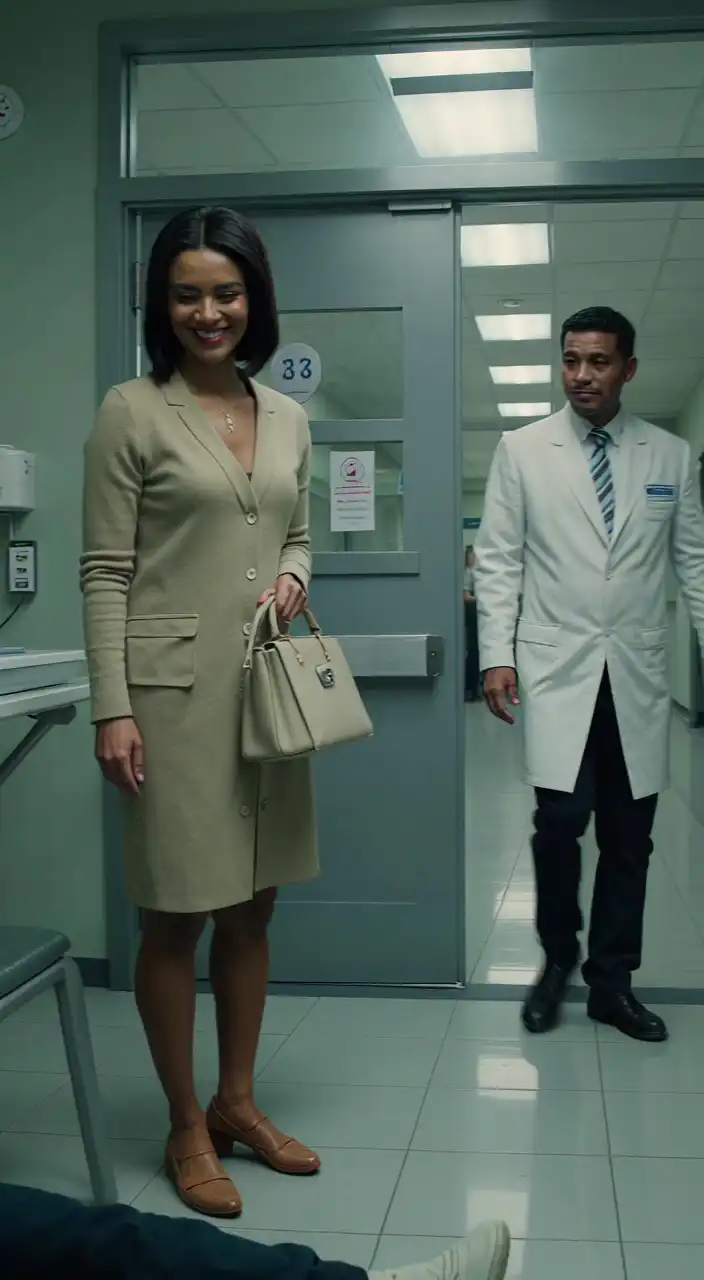
"Bring him in now," Dr. Emma said, loud enough that triage stopped moving.
Everything in the hallway shifted around that command. The nurse who had been calling names stepped aside and pushed the triage door open with her hip. One of the security officers changed direction immediately. The other moved to the far side of Grace, not touching her yet, but closing off the clean path to the exit.
Grace's smile dropped for half a second. It was a tiny change, but once it happened, it was impossible to unsee. "You are not taking him from me over a tantrum," she said. "He had a breathing treatment already. He just doesn't like rules."
James made a small sound that was not a cry, not even a word. It was the sound of a child trying to pull air through a throat that had started to tighten with fear. His eyes were on the handbag.
Dr. Emma crouched lower, bringing herself level with him. "James, can you tell me where your inhaler is?"
His lower lip trembled. He barely moved his mouth. "In there."
Grace snapped, "He lies when he's upset."
Dr. Emma did not look up at Grace. "James, did you use it today?"
He shook his head once.
That answer changed the urgency in the room. Dr. Emma stood and held out a gloved hand toward the bag. "Ma'am, I need the inhaler now."
Grace's chin lifted. "You need my permission."
"I need the rescue medication your child says is in that purse."
"He's not my child," Grace said too quickly, then corrected herself with a hard blink. "I mean, I am his guardian. And the inhaler is empty. The clinic said it was anxiety."
The clinic. There it was again, the vague clinic, the invisible treatment, the paper nobody had seen.
The nurse at triage had already grabbed a wheelchair, but James curled away from being moved and clawed weakly at his hoodie, like he was trying to keep something hidden or hold himself together. Dr. Emma looked at his shaking hand, his pale lips, and the yellow stain on his sleeve. Up close the stain wasn't random. It had dried tacky along the cuff, and it smelled sweet, medicinal, almost fruity under the sharp hospital disinfectant.
"Get peds respiratory to triage two," Dr. Emma said. "And call poison control standby."
Grace jerked back as if she had been slapped. "Poison control? That is insane."
Dr. Emma's eyes finally rose to hers. "Then hand me the inhaler and the treatment paperwork."
There was no paperwork. Everyone could tell now. Grace patted the outside of the bag anyway, buying a second with motion. "It's in the car."
"The inhaler is in the car?"
"The papers. He spilled medicine in the car. That's why his sleeve looks like that. He got into cough syrup on his own."
James's eyes squeezed shut.
It was a small thing, a child hearing the lie and bracing like it might hit him physically. But Dr. Emma saw it. So did the triage nurse.
"Sir," Dr. Emma said to the nearest security officer, "I need her separated from the patient while we assess him."
Grace took one step back and clutched the purse to her chest. "You cannot do that."
"I can when a child is struggling to breathe and the adult with him is refusing medication and giving contradictory history."
The words hit like cold water over overheated metal. Contradictory history. Refusing medication. Child.
Grace's voice rose. "You people always think-"
"Stop," Dr. Emma said. No anger. No heat. Just command. "This is not a discussion about you. This is about the boy on the floor."
For the first time, James looked directly at Dr. Emma. He looked startled, like he wasn't used to hearing an adult say that out loud.
The respiratory therapist came fast with a nebulizer setup, mask in hand. When she reached for James, he flinched at Grace before he flinched at the equipment. Another clue. Another quiet thing that made the room harder around Grace.
The second security officer, a woman with her hair pulled into a severe bun, stepped beside Grace and said, "Ma'am, come with me while the doctor evaluates him."
Grace's hand tightened around the purse strap. "My wallet is in here. My medications are in here. Nobody touches my property."
Dr. Emma held out her hand once more. "If his inhaler is inside and you delay me one more second, that delay becomes part of the chart."
That landed. Not emotionally. Practically. Grace understood records. Consequences. Written language she could not talk over later. She hesitated, then opened the bag just enough to prove a point.
Dr. Emma saw it immediately. Blue plastic. Child-size inhaler. New enough to still have the pharmacy sticker.
She didn't ask again. She took it.
Grace lunged forward. "It doesn't work right. That's why I kept it-"
But the respiratory therapist already had the spacer attached. The irony of that empty spacer from James's backpack was brutal now. He had carried the useless half of his own treatment while the medicine he needed sat locked in an adult's purse. The little planted object had told the truth before anyone else did.
James fought the first breath from the inhaler out of panic, then another, then another. The therapist coached him gently. "Good. Good, sweetheart. Slow in, hold it, slow out." His shoulders were tight, and every sound around him seemed too loud, but after the second round his chest loosened enough for a harsher cough to break loose.
The cough brought up a thin string of yellowish spit onto his sleeve.
Dr. Emma's head snapped toward it. Not because it was dramatic, but because it matched the stain too well.
"What medicine did he spill?" she asked again.
Grace folded in on herself just a little. "I told you. Cough syrup."
"What brand?"
Silence.
The security officer beside her repeated, "What brand, ma'am?"
Grace named a common children's cough medicine after a pause that was too long.
Dr. Emma glanced at the nurse. "Document the stated medication and time. Also check whether he was registered at any clinic today."
Grace's face changed again. "You think I'm poisoning him? Are you hearing yourself?"
Nobody answered that directly. Not yet. Because right now James was still the center.
He was moved into triage two, blanket over his legs, monitor clipped onto his finger. The pulse ox numbers came up slowly, then dipped when he saw Grace through the half-open curtain. She was trying to keep visual contact, like that was a right she would not surrender.
James whispered, "Please don't let her be mad."
Dr. Emma turned fully back to him. "You are not in trouble."
Children hear reassurance all the time and often don't believe it. James did not believe it either. But he stared at her face, searching for punishment there, and found none. That alone made his eyes fill.
The triage nurse murmured, "Registration says no visit under his name today. No clinic transfer, no same-day discharge from our network."
Grace started talking over the curtain. "Different system. We went across town."
Dr. Emma closed the curtain all the way.
The air in the room settled into a sharper kind of urgency. The respiratory therapist listened to James's lungs. Wheezing, yes, but not the whole picture. His tremor was too constant. His pupils looked off. His heart rate was elevated in a way that could be fear, breathing distress, medication, or something combined. Dr. Emma gently turned his stained sleeve back. There was sticky residue along the cuff and inside wrist, as if liquid had run there instead of being neatly swallowed. A child does not usually pour cough syrup down his own sleeve while clutching for an inhaler.
"James," she said quietly, "did someone make you take medicine?"
He pressed his lips together.
"Did you drink something that tasted bad?"
His eyes moved to the curtain.
The monitor beeped faster.
Dr. Emma changed approach. "I need to know what happened so I can help your body. If you tell me, you are not getting anyone in trouble for needing a doctor. You understand?"
A long pause.
Then, very faintly: "She said it would calm me down."
That was not enough for certainty, but it was enough for direction.
Dr. Emma ordered blood work, a urine sample, toxicology screening, and a rapid consult with pediatric social work. Grace heard parts of that through the curtain and started objecting louder, her voice carrying down the hallway. "He has anxiety attacks. He's dramatic. His mother used to say the same thing. You are making up a whole abuse case because a poor kid coughed in a waiting area."
That line hit the social worker as she arrived. Her badge read T. Alvarez, but she introduced herself to James simply as Tasha. She had the kind of face children sometimes trust because it isn't trying to perform calm. It is just there.
"Who is his mother?" Tasha asked through the curtain gap, not to James yet, but to the room.
No one answered immediately.
Because there was another problem now. Grace had said "used to say."
Tasha's eyes flicked to Dr. Emma. Dr. Emma gave a tiny nod toward the chart terminal where registration was still incomplete, where "guardian" had been entered by Grace verbally and not confirmed by documents. The contradiction was widening. If Grace was not the legal parent, why did she have the only medicine? Why did James fear her anger more than his own breathing? Why had she almost left when the doctor noticed the stain?
A lab tech arrived. James recoiled at the needle, and then, unexpectedly, held still when Dr. Emma said, "Squeeze my hand if you need to." He squeezed so hard his little knuckles went white. The blood draw finished. The therapist started another breathing treatment. Tasha sat where James could see her and asked simple, non-threatening questions: his age, his school, whether he knew his address, whether anyone else lived at home.
At home.
James answered some things and not others. He knew his teacher's name. He knew the bus number. He knew there was a little silver bracelet in a kitchen drawer with his real emergency contact on it, but Grace hated when he touched that drawer. He stopped there, eyes darting up in fear as soon as he said too much.
Bracelet. Emergency contact.
Tasha's pen paused.
Outside, Grace was no longer just protesting. She was asking to leave.
That was when Dr. Emma picked up the phone at the wall and told hospital security, "Do not allow the caregiver in bay two to leave the premises until law enforcement has spoken with her. We have a possible child medical neglect and possible toxic ingestion."
James heard only part of it. But he heard "leave" and "law enforcement," and his whole body stiffened under the blanket.
Then Tasha asked the question that made the next hour much more dangerous.
"James," she said softly, "where is your dad?"
He stared at the monitor light blinking against his finger and whispered, "He doesn't know she's here."
That sentence changed everything.
Because now there was no confused guardian making bad choices. There was a child in an ER saying the adult who brought him there was not acting with the knowledge of the parent who should have known. There was a missing inhaler taken from his reach. A false clinic story. A medicine stain. A locked purse. And somewhere outside the curtain, a woman who had already tried once to get him back out the door.
Dr. Emma looked at Tasha, and Tasha was already reaching for her own phone.
The first number they called did not go to voicemail.
A man answered on the second ring, breathless, as if he had been running or panicking for a while already.
"Hello? James? Baby, where are you?"
Tasha closed her eyes for one beat. Then she said, "Sir, this is pediatric social work at St. Catherine's. Your son is here, and you need to come now."
There was silence on the line.
Then the man asked, in a voice gone flat with shock, "Who took him to the hospital?"
The answer was standing twenty feet away, asking security if she was being detained.
By the time James's father arrived, Grace had constructed a better story.
That was what made her dangerous. She adapted fast. She had stopped shouting and started sounding wounded, reasonable, insulted. She told the responding deputy that James had an asthma history, behavioral problems, and a tendency to resist treatment. She said she was his aunt by marriage. She said his father, Malik, was "difficult" and often unreachable. She said she had only taken the inhaler because James overused it when anxious and that the yellow stain on his sleeve came from "vitamins and over-the-counter cold medicine" after he "knocked the cap loose in the car." She even produced a bottle from her purse once security had inventoried it in front of the deputy.
But she could not produce any prescription paperwork for the inhaler she had claimed was empty and in the car.
And she could not explain why James's backpack contained the spacer but no inhaler.
And she definitely could not explain why the bag was locked.
Dr. Emma stood at the workstation outside James's room, reviewing his first vitals trend and medication response while Tasha updated the deputy. The deputy, a broad-shouldered woman named Kerr, listened without interrupting. That by itself gave the hallway a new center of gravity. Grace kept trying to redirect things toward rights, offense, and misunderstandings. Deputy Kerr kept bringing it back to sequence.
"When did symptoms start?"
"Who prescribed the inhaler?"
"What clinic did you say you visited?"
"What relation are you to the child?"
"What is the child's date of birth?"
Grace missed the date by one day.
It was a tiny slip. In any other setting, maybe nothing. Here it turned into one more crack.
Inside the bay, James was breathing more evenly after the second nebulizer treatment, though he was still shaky and strangely sleepy between bursts of fear. The tox screen wouldn't be immediate, but the pediatric resident had already noted that his symptoms could fit a combination of uncontrolled asthma distress and sedation from an ingested medication. Dr. Emma did not say poisoning in front of him. She said, "Something in his system may not belong there."
James's father got there before the first lab callback. He came through the doors in a faded work shirt, one boot unlaced, face white with the kind of fear that makes grown men look suddenly much younger. Security moved toward him automatically until Tasha called his name and held up a hand.
"Malik?"
He nodded, already searching every doorway at once. "Where's my son?"
Grace's voice cut through the hall. "Finally."
Malik turned, saw her, and something raw opened in his face. Not surprise. Recognition with dread attached. "Why do you have him?"
Deputy Kerr stepped between them. "Sir, let's keep space."
"Why do you have him?" Malik repeated, louder now, and every word carried the pressure of hours. "I told you school only. Pickup from school and straight to your apartment till I got off shift. Not doctors. Not medicine."
That sentence did more than accuse. It established a normal arrangement. Shared care of some kind. Prior conflict over medicine. And enough tension that Deputy Kerr's notebook came back out.
Grace folded her arms. "He couldn't breathe."
"Then why didn't you call me?"
"You don't answer half the time."
"My phone died at work." He looked at the nurse station. "I checked with the school and they said you signed him out early for an appointment I never approved."
Another crack. Another planted line finding purpose.
Grace's voice sharpened. "Because he was sick."
Tasha touched Malik's arm lightly. "Your son is stable enough to see you. Before you go in, I need to ask: do you have custody paperwork, emergency contacts, anything on your phone that confirms your relationship and medical authority?"
He fumbled for his phone with shaking hands. Cracked screen. Low battery. He had pictures first, because parents do. James grinning with a missing front tooth. James asleep with a science fair ribbon. Then screenshots of school forms. Then a photo of his birth certificate. Then a court text message chain with James's mother from two years earlier, before she died, discussing temporary after-school help from "Grace" when shifts overlapped. Not permanent guardianship. Not medical authority.
The mother's death put a quiet heaviness over the station. Tasha's expression shifted. That was another piece of motive. A child whose main protector was gone. A father working shifts. A relative-adjacent caregiver filling the gaps.
Malik swallowed hard. "She was my ex's cousin. Not blood to James. We kept her around after the funeral because she said she wanted to help. Then she started telling everyone he was sick all the time, that I didn't understand his needs. Last month his pediatrician said his asthma wasn't severe enough to match how often she said he was struggling."
Dr. Emma looked up. "Who is his pediatrician?"
Malik named a clinic across town.
That mattered because Grace had named a different place.
The contradiction was now institutional, not just emotional.
Tasha asked, "Has James had unusual sleepiness, behavior changes, repeated breathing episodes, or medication gone missing at home?"
Malik pressed a hand over his mouth. "His rescue inhalers run out too fast. I thought maybe school was losing them. And two times I found him asleep in the middle of the day when she watched him. She said he was exhausted from attacks."
He looked toward the curtain where his son waited. "I believed her."
That sentence held guilt like broken glass.
Dr. Emma said the only useful thing there was to say. "Believing the adult in charge of your child is not a crime."
But the relief in Malik's face lasted less than a second. He looked at Grace again and found no confusion there, only calculation. "What did you give him?"
Grace gave a disbelieving laugh. "Oh my God. So now you're on board with this too? Maybe if you managed your own son's health better, nobody else would have to."
There it was: the independent motive layered under the crisis. Not random cruelty. Control. Access through helplessness. Moral superiority weaponized against an exhausted parent.
Deputy Kerr asked Grace for identification. She provided it with visible offense but no choice. While the deputy copied information, registration verified Malik's documents and updated James's chart. Tasha took Malik into the room.
James saw him and broke.
Not in a loud way. That was what made it hard to watch. He simply made one choked sound and reached with both hands like he had been holding himself still until the right person arrived. Malik was at the bedside in a second, bending over him, pressing his face into James's hair with one hand cupping the back of his head and the other rubbing his shoulder in quick circles.
"I'm here. I'm here. I got you."
James clutched his shirt. "I didn't do it."
Malik pulled back enough to see his face. "Do what?"
"I didn't take too much. I asked for my pump."
The room went quiet around them.
Dr. Emma had heard versions of that sentence before from children living under adult scripts. It was never just medical information. It was a defense prepared in advance.
Malik looked at Tasha, bewildered and devastated. "What does he mean?"
Tasha knelt by the bed. "James, can you tell your dad what happened today?"
Children rarely tell in clean timelines. James didn't. He told in fragments, sensory pieces. Grace picked him up from school before early release. She said they had a "special doctor trip." He asked to call Dad when the car smelled weird, sweet and sharp, from the travel cup Grace kept near the console. He started coughing. She gave him a spoon of red medicine, then another because he was "working himself up." He asked for his inhaler and she said no, not until he "acted right." At some point some medicine spilled on his sleeve when he tried to push the spoon away. At the hospital he reached for the purse because the inhaler was inside.
The travel cup. Sweet and sharp smell. Spoon. Refused rescue medication. Medicine on sleeve from resisting.
Three details locked together.
Grace, hearing pieces through the curtain gap as a nurse entered and exited, started objecting again. "He's suggestible. Kids repeat what they think adults want."
But James's story had one kind of truth hard to fake: the truth of sequence from a scared body. He remembered where his hand was. Where the purse was. The smell. The spoon scraping his teeth. The car vent blowing cold.
Deputy Kerr asked Malik, "Does he usually take cough medicine before school pickup?"
"No."
"Any prescribed sedating medications?"
"No."
Dr. Emma stepped out to take a call from the lab. The initial tox screen wasn't final and did not test every possible substance, but it was enough to sharpen concern: antihistamine present, level concerning in relation to his size and reported timing. Not proof of criminal intent, but entirely consistent with a child being given too much of something meant to make him drowsy, combined with delayed asthma treatment.
When Dr. Emma repeated only the medically necessary version to Tasha and Deputy Kerr, Grace changed tactics again.
She started crying.
Not messy crying. Controlled crying. "I was trying to calm him down. He spirals. His father doesn't see it because he isn't there. I am the one who sits with him when he can't breathe. I am the one who misses work. And now because I gave him over-the-counter medicine, everyone wants to make me a monster."
That line would have worked on some people. There are caregivers who make bad decisions from panic and pride. Hospitals see them every day. But those caregivers usually hand over the inhaler when asked. They usually produce some kind of paper, bottle, dose memory, apology, or fear. They do not invent clinic visits and lock rescue medication in a purse while trying to leave.
Deputy Kerr's questions narrowed. "Why did you tell staff he had been seen at a clinic today?"
"I thought we might stop there first."
"But you said he already had a breathing treatment."
"I meant last week."
"Why did you say the inhaler was empty?"
"I thought it was."
"Then why was it in your locked bag and not with the spacer in his backpack?"
Grace looked at the hallway wall and said nothing.
Silence became a form of evidence.
Dr. Emma returned to James's bedside to recheck his lungs. Better. Not good, but better. His oxygen saturation had stabilized. The tremor remained. So did the sleepiness. He needed observation, labs, and likely admission. The immediate threshold had been crossed; the danger of being turned away was over. But the deeper danger had just come into focus.
As Dr. Emma listened to his chest, James touched the cuff of his stained hoodie and asked, in a careful voice, "Am I gonna get in trouble for the yellow stuff?"
She looked at him. "No. But I need that hoodie for testing."
His hand stopped.
Tasha saw it too. For some children, clothing is not just clothing. It is cover, proof, routine, safety. Tasha said gently, "We'll keep it safe."
James nodded once and let the nurse help him out of it. On the inside pocket, sewn crookedly by hand, was a little strip of blue thread in the shape of a J. Malik made a sound halfway between a laugh and a sob.
"His mom did that," he said. "So school stuff wouldn't get mixed up."
Dr. Emma bagged the hoodie carefully. Another planted detail preserved. Another piece of this child's actual life set against Grace's version of him.
Then Tasha asked the question that brought the first true reversal.
"Malik, did James ever mention wearing a bracelet with an emergency number?"
Malik stared. "My mom gave him one after..." He couldn't finish the sentence about James's mother. He swallowed and tried again. "It was silver. Small. We stopped seeing it weeks ago. Grace said he lost it at the park."
James, eyes half-lidded with fatigue, whispered, "It's in the kitchen drawer. Under the towels."
Not lost.
Hidden.
The deputy and Tasha exchanged a look. A child emergency bracelet hidden in the caregiver's kitchen drawer was not just neglect. It suggested isolation by design. Removal of alternate contact.
Deputy Kerr asked Malik for Grace's address.
Grace tried to interrupt. "You are not searching my home over a bracelet."
Kerr didn't even look at her. "I didn't say I was. Yet."
The hallway had gone from tense to electric. Everyone could feel the direction now, even without formal words. There might be more at the apartment. More medications. More evidence of withheld care. More signs this was not one panicked mistake but a pattern.
Then a unit clerk came hurrying from the desk with James's outside records faxed from the pediatric clinic Malik named.
Dr. Emma scanned the first page and stopped.
The last refill date on James's rescue inhaler was not old. It had been filled four days ago.
And at the bottom of the physician note was a line that made every adult in that hallway go still:
Father reports concern that child appears overmedicated after visits with caregiver Grace M. Advised immediate ER if symptoms recur. Social work referral discussed.
Grace had known suspicion already existed.
She had known enough to lock the inhaler away, push a false clinic story, and try to get James back out before anyone connected the dots.
When Deputy Kerr stepped toward her again, this time with handcuffs visible at her belt, Grace's face did not show fear first.
It showed anger that the script had failed.
And before anyone could stop her, she reached into her bag one last time and threw the travel cup lid under the chairs near the wall.
It skidded into view with a wet, sweet smell still clinging to it.
Movement 3 began before anyone named it. The hidden things started trying to escape.
The lid hit the tile and spun in a widening circle before flattening under the fluorescent glare.
No one moved for one stunned second except Dr. Emma, who said sharply, "Don't touch that."
Deputy Kerr's hand closed over Grace's wrist before Grace could bend for it. Grace jerked once, then froze when the second officer stepped in on her other side.
"I was throwing away trash," Grace said. "Can I not throw away trash now?"
"You're done reaching into that bag," Kerr said.
The travel cup itself was still inside the purse, visible now because Grace had yanked the zipper wide in her sudden motion. White exterior. Pink silicone band. A crack near the bottom. Dr. Emma caught the same sweet medicinal smell she had noticed on James's sleeve and the spit on his cuff, only stronger now that the lid was off.
"Chain of custody," Kerr called to another deputy arriving from the front desk. "Bag and loose lid separate."
Grace's eyes flashed toward the pediatric bay. Not concern for James. Not worry. Measurement. Whether she could still control what happened next.
Tasha noticed it too.
Malik was halfway out of his chair, every muscle straining toward the hall. "What is in that cup?"
Grace looked at him and actually rolled her eyes. "You want to criminalize everything. It had juice in it."
"Then why did you throw the lid?"
"Because all of you are dramatic."
The new deputy, a younger man named Santos, began photographing the cup, the lid, the purse, and the immediate area before touching anything. Dr. Emma appreciated that without needing to say it. Hospitals often become accidental crime scenes not because people are careless but because they are trying to save a life first. Here, for a rare minute, both rescue and evidence were lining up.
Inside the bay, James heard enough to know the hall had turned dangerous. His breathing quickened again. The monitor chirped faster. Dr. Emma went back to him immediately.
"Eyes on me," she said, crouching beside the bed. "Not the hallway."
He tried. His small hand reached to where his hoodie had been and found only the blanket. Tasha caught the motion and folded the blanket edge into his palm, something to hold.
"What if she says I lied?" he asked.
It was the child question under every child statement. Not what if they don't believe me. What if the angry adult gets to rewrite reality first.
Dr. Emma answered with unusual directness. "The inhaler was in her bag. The clinic records are real. Your body is telling us enough. You are not alone in this."
He stared at her. The words were too big to absorb all at once, but one part landed: not alone.
Outside, Deputy Kerr advised Grace she was not free to leave and was being detained while child welfare and law enforcement sorted out the medical neglect concerns. Grace demanded a supervisor. Then a lawyer. Then said she felt dizzy and needed water. The sequence was so practiced it almost became impersonal. Santos stayed with the bag while Kerr kept Grace where she could be seen.
Tasha asked Malik quietly, "Has she ever worked in healthcare?"
"A nursing home for a while," he said. "Reception maybe. She buys cardigans like she works in a clinic. Likes people thinking she knows things."
That explained something about her language: enough medical vocabulary to sound credible, not enough consistency to survive questions.
The faxed pediatric records kept coming. A year of notes. Recurrent reports from Grace about nighttime breathing episodes no school nurse ever saw. Requests for stronger medications the doctor had not approved. A note from six months earlier: Child appears sleepy in office; caregiver reports poor sleep. Father arrived later, child alert and playful. Consider inconsistent history.
Dr. Emma read that line twice.
Inconsistent history was clinical code for a thousand possible concerns, most of them innocent enough not to trigger alarm alone. But layered with today, it looked different. Not one emergency. A pattern of symptom creation, exaggeration, or manipulation around access to the child.
Another reversal took shape, not fully formed yet: Grace may not have delayed care because she didn't care. She may have delayed it because timely evaluation would expose what she had caused.
That possibility made the room colder.
Malik sat heavily, elbows on knees, palms pressed together over his mouth. "I thought she wanted to help after Kendra died."
Kendra. James's mother. The name finally entered the air.
Tasha kept her voice level. "Tell me about that."
He looked at James first, making sure the boy had settled enough under the nebulizer to hear or not hear as he needed. James was drowsy now, eyelids fluttering but not asleep. Malik lowered his voice anyway.
"After the funeral, everybody had opinions about what I needed. More church. More family. More structure. Grace showed up with casseroles and school pickup offers and little charts for James's medicine. She said little boys get lost without women watching details. I was working doubles. I was trying not to drown. She made me feel guilty every time I said no."
A motive with moral costume. Control through usefulness.
"Did she ever try to separate him from you?" Tasha asked.
"Not obvious. Just..." He struggled. "She'd tell teachers I forgot forms. Tell doctors I minimized his breathing. Tell me he cried for her house because mine was too chaotic. Things like that. She kept saying he needed consistency."
James opened his eyes. "She said if I didn't take it, I'd have to go live somewhere else."
The room went still again.
Tasha turned to him slowly. "Take what, sweetheart?"
"The red stuff."
"How many times has that happened?"
He looked confused by the question. For a child, repeated abnormal things can become normal by erosion. "When I cough too much. Or when she says I make trouble."
Dr. Emma asked, "Do you ever get very sleepy after the red stuff?"
A tiny nod.
"Do you ever have your inhaler when that happens?"
"No. She says I breathe too loud when I want people to look."
Malik shut his eyes hard.
That sentence did what records couldn't. It gave the emotional logic of the abuse. Grace wasn't only controlling medication. She was controlling whether James was allowed to display need. Breathing too loud. Wanting people to look. Attention as accusation.
Tasha stood. "I need child protective services now, not callback. Immediate response."
The charge nurse, who had been listening from the threshold with the grim competence of someone who has seen too much and still chooses to care, picked up the desk phone before Tasha finished the sentence.
Out in the hall, Grace sensed the shift. "This is because he's Black and poor and I'm not crying right enough for your little team narrative."
Deputy Kerr did not flinch. "This is because you hid rescue medication and lied about treatment."
Grace leaned forward. "Then test the cup. You'll find children's medicine. That isn't a crime."
It was almost a dare, and that bothered Dr. Emma. Guilty people sometimes overplay certainty when they think common substances cannot hurt them. Over-the-counter didn't mean harmless, especially in dose or combination. But there was something else beneath Grace's confidence, as if she thought the cup would confuse more than convict.
Then Santos, working methodically through the bag inventory, lifted out a folded paper napkin stiff with dried yellow residue.
"Deputy."
Inside the napkin was a dosing syringe with numbers worn at the side. Not a spoon. A syringe.
Grace said immediately, "For measuring vitamins."
Santos set it in an evidence bag.
Dr. Emma did not need to speak for the implication to land. A syringe meant measured liquid. Repeated measured liquid. More precision than a panicked aunt improvising cough medicine in a car.
The charge nurse called from the workstation, "Poison control asking what antihistamine and whether there could be more than one agent."
Grace's head turned sharply toward that sound. Not random. Recognition.
Dr. Emma caught it. "What else did you give him?"
"Nothing."
"Why react to that question if it's nothing?"
"I reacted because this is insane."
The game now was no longer whether Grace had blocked care. It was whether anyone could identify enough, fast enough, to treat James safely and protect him if this had happened before. A child can survive one bad dose and still carry the danger of many hidden doses in his story.
Tasha sat back down by James. "Has anyone else ever known about the red medicine?"
He thought for a long time. "Miss Patel said my eyes looked sleepy."
"Who's Miss Patel?"
"My school nurse."
That mattered because school nurses document. They note inhaler use, drowsiness, patterns, parent contacts. Another outside authority seed lit up.
Tasha immediately asked the unit clerk to call the school district after-hours administrator and request nurse records. Malik blinked at her, surprised by the speed. She said, "If this has happened on school days, there may be a pattern there too."
Grace overheard enough to laugh once, sharp and ugly. "You're going to call a school nurse now? Over cough syrup?"
The laugh ended when Deputy Kerr replied, "Yes."
The school records did not come instantly, but the district administrator reached the nurse on her cell. Miss Patel called back from her own kitchen and remembered James before Tasha even finished the introduction.
"The little boy with the blue-thread hoodie pocket?" she said. "Quiet. Watches adults too much before answering."
That one description made Malik's face crumple.
Miss Patel confirmed three visits over the past two months when James came in unusually sleepy after being dropped off by Grace on mornings she had offered to help with transportation. On one of those days, he had asked for his rescue inhaler, but it wasn't in his backpack. Grace later arrived with it and said he had forgotten. Miss Patel had made a note because James had seemed frightened when Grace walked into the nurse's office.
Planted detail paid off again: the missing inhaler was not today only. It was a method.
Tasha requested copies of the notes. The district would fax them.
Dr. Emma then called James's pediatrician directly. This time the doctor himself answered. He did not hedge. He said he had been uneasy for months. He had hesitated to overcall because asthma in grieving children can be messy, because overworked parents can look disorganized, because accusing a caregiver of inducing symptoms is serious. But he had recently discussed a social work referral after Malik voiced concern that James became "not himself" after time with Grace. The pediatrician had also changed inhaler refill rules because rescue inhalers were being reported lost unusually often.
"Can you send all that?" Dr. Emma asked.
"I'm sending it now," he said. "And doctor? If the child is with that caregiver, do not discharge him to her."
"We won't."
That answer steadied him. It steadied her too.
For the first time since the hallway scene, Dr. Emma allowed herself half a breath of anger. Not the hot kind. The cold kind that sharpens work. James had almost been turned away as dramatic while the pattern sat all around him in little dismissible details: too many lost inhalers, school drowsiness, one hidden bracelet, one sticky cuff, one locked purse.
Grace still tried one last minor escape route. "Can I at least call my sister? James's people know me."
Kerr said, "You can make a call after we finish processing."
"Processing? You act like I've been arrested."
Kerr did not answer.
That silence was deliberate. It did not promise more than existed. It simply refused to soothe her.
Hours in hospitals stretch strangely. The next forty minutes contained no dramatic collapse, which in some ways was the greatest mercy. James remained stable on monitoring, though sleepy. The labs expanded concern without answering everything. Poison control recommended observation, supportive care, and preserving any liquid found for analysis. CPS advised that a caseworker was en route and that discharge would require a safe caregiver plan no matter what.
Then a nurse came back from the bathroom carrying something wrapped in a towel. "This was under the sink in bay two after the caregiver used it before security closed access."
Inside the towel was a blister pack with several tablets missing and no pharmacy label attached.
Grace stared at the towel and finally lost the composure she had been patching together all evening.
"I don't know where that came from."
Nobody had accused her yet. The denial arrived before the question. Another tell.
Dr. Emma asked for the pills to be secured with the other items and compared images through the poison control database. Sedating antihistamine. Adult strength.
It was not enough to prove she had given James those tablets. But together with the liquid antihistamine in his screen and the cup, it turned the concern from vague to dangerous.
Malik stood by his son's bed, one hand resting lightly on James's ankle through the blanket, as if touching any moving part would keep him anchored. He looked at Dr. Emma and asked, very quietly, "How long has this been happening under my nose?"
No doctor can answer that honestly. Dr. Emma said, "Long enough that he learned to whisper."
That was the sentence Tasha wrote down later because it described the whole case better than any code.
Then CPS caseworker Dana Rees arrived with a messenger bag, sensible shoes, and the exhausted alertness of someone dropping into a mess already in progress. She listened fast, asked clean questions, and did not waste time performing neutrality when neutrality would mean ignoring danger.
To Malik: "If the hospital clears him medically for a regular floor, can you stay with him overnight?"
"Yes."
"Is there any reason he would need to return to Grace's care for housing, transportation, or supervision?"
"No."
"Do you have family support not connected to her?"
"My mother. Two blocks from us."
"Good."
To James: "I am one of the people whose job is to make sure adults don't get to stop kids from seeing a doctor."
James looked at her for a second and asked, "Even if they get mad?"
Dana said, "Especially then."
That was the moral center of the room now, spoken simply.
The next hook came from an object nobody expected to matter so much: Grace's phone.
It buzzed repeatedly inside the property bag while Santos was logging items. He checked the screen only enough to record incoming activity and froze.
On the lock screen, visible without opening the phone, was a notification banner from a number saved as "M. Hall Pharmacy."
Message preview: Refill denied again. Need parent authorization for James Carter inhaler.
Santos called Kerr over. Kerr looked once, then at Malik.
"Did you authorize her to refill his medication?"
Malik's answer came out hoarse. "No."
Grace closed her eyes.
The hidden script had widened into attempted control of his prescriptions too.
And if she had been trying to refill the inhaler herself while also withholding it, there was only one reason that made sense.
She needed access to the symptom and the cure both.
By the time Dana finished her preliminary safety plan, the last obstacle before real protection was no longer James's lungs.
It was whether Grace had enough legal ambiguity around her role to keep inserting herself back into his life before the evidence fully landed.
That answer was waiting at her apartment.
And Deputy Kerr had just gotten approval to go there.
Movement 4 started in the apartment kitchen, where useful things had been arranged to look loving.
Deputy Kerr took Santos and one child welfare investigator to Grace's place while Dr. Emma stayed with James. Malik wanted to go. Dana did not let him. "Your job is here," she said. "Let ours be there."
So Malik stayed by the hospital bed while the search happened somewhere across town in a second-floor apartment above a laundromat, and every minute he spent waiting made him more ashamed of waiting. Tasha saw it. She pulled a chair close enough that he had to look at another adult and not just his sleeping son.
"You did not miss obvious bruises," she said. "You missed a pattern someone designed to be deniable."
He rubbed at his eyes. "That doesn't feel better."
"It isn't supposed to feel better. It's supposed to be true."
Sometimes truth is the only kindness available.
James slept in scraps. Wake, ask if his dad was there, drift, startle at hallway voices, drink a little water, sleep again. The toxicology was not final, but the attending pediatrician who came onto the case agreed with observation admission. Sedation plus delayed asthma rescue plus a concerning caregiver history meant no one was taking chances. The yellow-stained hoodie had been logged. The cup and dosing syringe were in evidence. The school nurse fax arrived. The pediatrician fax arrived. Piece by piece, the story stopped being one doctor's instinct and became a net.
But the apartment mattered because patterns live where children are watched.
Kerr called from the scene an hour later, putting Dr. Emma on speaker at Dana's request because some of what they found touched medical care directly.
"Kitchen drawer exactly where the child described," Kerr said. "Silver emergency bracelet under dish towels. Child's name engraved inside. Father's number and grandmother's number."
Malik bowed his head so fast his forehead nearly hit the bed rail.
Dana made a note.
Kerr continued. "Cupboard above the sink has multiple OTC liquid medications. Three opened bottles. Two not labeled for current child age range. One bottle mostly empty. Also found a notebook."
"What kind of notebook?" Dana asked.
A pause. Paper rustling. Then Kerr's voice changed just slightly, enough to tell everyone the answer before she gave it.
"Looks like symptom tracking. Dates, school pickup times, coughing episodes, doses given. But there are notes in the margin."
"Read one," Dana said.
Another pause.
"'If he sleeps by four, M won't fight bedtime.'"
Malik made a low sound from somewhere deep in his chest.
Kerr kept going. "'No inhaler until he stops making a scene.' Another says, 'ER would have worked if doctor hadn't interfered.'"
No one in the hospital room spoke for several seconds.
That was the larger moral reversal. Grace had not simply panicked and overmedicated. She had been curating James's body as a tool of household control. Keeping him subdued. Withholding treatment to enforce behavior. Turning symptoms into leverage against a tired father.
Dana said quietly, "Photograph every page."
Kerr added, "There's more. Pharmacy bag with James's name. Recent refill. And a pack of blank school excuse notes from an urgent care center."
Forgery-adjacent at minimum. Control of records. Control of access.
Dr. Emma looked at sleeping James and felt that cold anger again. The child had been close enough to care to see triage doors opening and shutting, and still the whole structure of delay had almost won because it wore a caregiver's face.
Malik gripped the bed rail until his knuckles whitened. "Can she take him back if she tells a judge I'm unstable? She says things. She sounds... official."
Dana's answer was immediate. "Not tonight."
It was not a final promise, but it was the right one. Tonight first. Survival first. Protection first.
When Kerr returned from the apartment later, she brought photographs printed at the station and uploaded to the secure case file. She did not show them to James, obviously. She showed Dana, Malik, and hospital social work. The notebook was as bad as described. It tracked doses of "red" and "night" medicine on days James had no fever. It noted whether "breathing got attention." It recorded one school nurse visit and whether staff called home. Most chilling of all, on two dates the note beside "inhaler withheld" had a check mark next to the words "quiet after."
Grace had written these things as if she were recording successful routines.
There was another item from the apartment: the silver bracelet. Kerr placed it in a sealed bag and asked Malik to verify it through the plastic. He did. The tiny engraving from James's grandmother was still there on the inside curve: If lost, call Daddy first.
A planted detail paid off with devastating force. Not just an emergency contact hidden. The order of love itself hidden.
Tasha asked gently, "Would James recognize it if we needed to help him feel safe?"
Malik nodded. "He used to rub the inside edge when he was scared."
Dr. Emma made a practical note. Familiar object could help with panic when he woke.
Grace, meanwhile, had stopped talking only because she had realized talking was making things worse. She sat in a separate interview room under observation, no longer indignant so much as intensely still. Dana later said those were often the moments she worried most, when a controlling adult stopped performing and started recalculating future moves.
The legal complexity Malik feared did exist. Grace was not a stranger. She had school pickup authorization on file from older forms. She had likely used that and routine dependence to gain legitimacy. But no custody paperwork supported medical decision-making. The school had released James based on an "appointment" Grace claimed was approved. That raised institutional questions too, but not enough to return him to her. The center was holding.
Then came the second major reversal, fair and ugly and rooted in the clues from the start.
Poison control called back after reviewing all documented symptoms, timing, and likely medications. The liquid in the cup and the adult antihistamine might explain sleepiness and tremor, yes. But James's initial breathing pattern and delayed response also suggested he may have been struggling before the sedative - and without his inhaler long enough to make that struggle visible. In other words, the poison clue and the withheld inhaler were not separate concerns. They worked together. Grace may have first denied the inhaler to force compliance, then dosed him when the distress escalated beyond her control.
The missing inhaler beside the clinic chart in the original hallway image had been the whole mechanism all along.
Dr. Emma sat with that for a moment. A child punished through access to breath is one of the clearest forms of domination there is. It stripped away every excuse about confusion, fussiness, overprotectiveness.
Malik asked the question nobody wanted answered. "Could he have died if she'd gotten him back in the car?"
Dr. Emma did not dramatize. "He could have gotten much sicker very fast. Especially if he was sedated and his breathing worsened without treatment."
Malik bent over and cried silently, shoulders shaking but no sound coming out. Tasha put a box of tissues within reach and did not speak. Sometimes comfort is not interruption.
James woke during that silence. His eyes went to his father first, then to Dr. Emma, then to the silver bracelet bag in Dana's hands. He stared.
Dana came closer. "Your grandma made this, right?"
He nodded.
"We found it."
He looked confused, then relieved, then confused again, because children do not automatically understand what it means when hidden things are found. Dana did not try to explain the whole legal landscape. She simply asked, "Do you want to hold it through the bag for now?"
He reached both hands out. His fingers found the shape through the plastic and rubbed the inner curve exactly as Malik had said he would. His heart rate on the monitor eased by several beats.
Planted detail, paid emotionally and physically.
James whispered, "I thought she threw it away."
Malik wiped his face and leaned in. "Nobody gets to throw away your people."
That line settled over the bed like something warm.
The room might have stayed there, briefly humane and still, except Grace managed one final attempt to re-enter the story. She requested to speak to Malik "for James's sake." Against Tasha's recommendation, and only with Kerr present at the doorway, Malik agreed to stand where she could see him from the interview room hall.
Dr. Emma did not like it, but she also knew some endings need witnesses.
Grace sat straight in the hard chair, cardigan still perfect except for one pulled thread near the cuff. She looked at Malik with tears in her eyes and control in every word.
"You know he spirals when you're emotional," she said. "If you keep feeding this, he'll believe he's a victim for the rest of his life."
Malik stared at her.
She went on, softer now, almost intimate. "You needed me. After Kendra died, you needed someone who could handle details. You still do. One bad day and these people will tear everything apart."
There it was in full: not remorse, not fear, but the promise that dependency should erase harm.
Kerr stepped forward. "Conversation's over."
But Malik finally answered before turning away.
"No," he said. "One bad day is when a child falls in a hallway and the person with his inhaler says he's dramatic. Everything else is what you built around it."
He walked back to his son without waiting for a reply.
Grace called after him once. "He will miss me."
James heard that through two doors and a curtain and curled inward so hard Dr. Emma worried his breathing would worsen again. Tasha leaned close and said, "Missing someone who hurt you is not the same as needing them." It was too complex for his age, maybe, but she said it because children often carry that confusion like guilt.
Dana finalized the emergency protective plan at the bedside. Temporary no-contact pending investigation. Hospital discharge only to Malik or grandmother. School notified that Grace's pickup authorization was revoked immediately. Pharmacy alerted not to release medication to anyone but Malik without direct verification. Pediatric follow-up flagged with social work.
Each step was procedural, yes, but each landed as story pressure relieved. Doors closing in the right direction.
Then the final obstacle of Movement 5 arrived from James himself.
At 2:14 a.m., after everyone thought the hardest part had passed, he developed increased wheezing again and vomited part of the medication in his stomach onto the blanket and floor.
The room snapped back into active medicine.
This was the edge.
Movement 5 always brings the threshold closest, and James found it in the quietest hour of the night.
The vomiting came after a stretch of deceptive calm. He had dozed against his father's arm, bracelet bag tucked in one hand, oxygen saturation holding. The admission bed upstairs was delayed because pediatric rooms were full. The ER had settled into that overnight rhythm where lights dim but no one relaxes. Dr. Emma was across the unit with another patient when James sat bolt upright and coughed hard enough to trigger retching.
The vomit was thin, reddish-yellow, and smelled unmistakably medicinal.
Malik panicked instantly. "James!"
The monitor alarmed as his oxygen dipped and his breathing turned ragged again. Tasha hit the call button while the bedside nurse rolled him onto his side and suctioned gently. James cried this time, not because of pain, but because crying takes air and he didn't have enough to spare.
Dr. Emma was back in seconds with respiratory. The room tightened around action: mask, suction, fresh nebulizer, pulse ox, blood pressure cuff, anti-nausea order, reassessment of airway. The fresh smell of medicine in the vomit sharpened suspicion that whatever he had been given in the car had not fully absorbed before and was still moving unpredictably through his system.
Poison control on speaker now recommended extended monitoring, repeat labs, and watch for aspiration or delayed sedation effects. The seriousness of the call changed Malik's face all over again. He had just begun to believe the edge was behind them. This was the cruel part of blocked care cases: delayed help means danger doesn't leave all at once.
James clung to Dr. Emma's sleeve during the treatment. "I can't do it right."
"You are doing it right," she said. "Your lungs are working hard. We are helping them."
The phrase mattered because children who have been blamed for symptoms often believe they can fail at being rescued too.
The nebulizer helped, but not instantly. His chest was tight enough that every minute stretched. Malik kept asking, "Do you need me to move?" and every time someone said no, stay, he looked both grateful and helpless. Dana had gone to make calls and came back just as James's saturation crawled upward again.
At almost the same moment, Deputy Kerr entered with one more critical piece from the apartment search. "Found this in the bathroom trash under coffee grounds."
She held up an evidence bag with a torn pharmacy label.
Dr. Emma took one look. The medication name was not for James. It was for Grace.
An adult prescription sedating syrup, stronger than the children's medicine bottle she had waved around.
The room absorbed that slowly.
Poison control asked Kerr to read the full label, dose concentration, and fill date. As the details came out, the likely picture sharpened: Grace may have mixed or alternated children's antihistamine and her own sedating liquid medication, perhaps assuming a child-sized amount would only make James sleepy. Combined with withholding his inhaler, it created the exact cascade they had seen.
This was not a total lab-confirmed conclusion yet. But it was enough to guide medicine and enough to harden law enforcement's view.
Malik turned away and braced himself against the wall.
Tasha, hearing his breath hitch, moved to him. "Stay with me. Sit down if you need to."
"I let her in my house," he said.
"You let help in your house. She weaponized that."
James heard enough to catch only one thing: "house." His eyes flew open wider. "Am I going back there?"
Three adults answered at once.
"No."
Dana leaned in closest so he could focus on one face. "You are going home with your dad when the doctor says your body is ready. Not with her."
He searched her face the way he had searched Dr. Emma's earlier, for punishment hidden under kindness. "Even if she says I'm lying?"
Dana said, "The adults saw enough with their own eyes."
That mattered. Children should not have to carry a whole case on testimony alone.
The repeat treatment gradually opened his lungs. The anti-nausea medicine settled his stomach. Labs would still take time. The medical threshold remained real for another hour, but it was no longer unattended. It was the opposite of the hallway now: hands ready, chart updated, truth moving faster than the lie.
At 3:07 a.m., the final immediate obstacle arrived from outside the room.
Grace's attorney had called the hospital demanding no one "interrogate" his client further and asserting she had acted in good faith as an emergency caregiver. It was a maneuver, not a resolution, but it threatened to re-complicate access to records and statements if the hospital grew timid. Dana and Kerr handled that pressure together. Hospital legal was notified, yes, but Dana framed it correctly: "The child is not a contested narrative. He is a patient under protective concern. Medical care continues."
That line held the boundary.
Dr. Emma appreciated Dana more with each passing hour.
The school district fax arrived complete during that same stretch. Attached to Miss Patel's notes was a photocopy of the school office sign-out sheet from earlier that day. Under reason for early pickup, Grace had written one phrase in neat block letters:
Follow-up after breathing treatment.
A lie made before the hospital lie. Planned in advance.
Kerr added it to the file. Intent. Sequence. Pretext.
The mini-hook at the end of the movement came from James himself, because wounded children often know where the deepest evidence is kept. After the second round of crisis settled and he had enough breath for full sentences again, he tugged weakly at Malik's sleeve.
"In the notebook," he whispered.
Malik bent close. "What notebook?"
"Purple one. She writes smiley faces when I sleep."
Dana and Kerr looked at each other.
The apartment search had found one symptom notebook. Not purple.
"There may be another," Dana said.
Kerr was already turning toward the door with her phone out.
If there was a second notebook, one not left openly in the kitchen, it might hold the clearest intent of all.
Only after that fifth rise in pressure, with James nearest the physical threshold and the evidence nearest full shape, could the story turn toward rescue in a way that felt earned.
The rescue did not arrive as one perfect moment.
It came in layered closures, each one taking something back from fear.
Deputy Kerr's second call to the apartment building superintendent woke a very angry man who nevertheless agreed to reopen the unit because law enforcement was still on scene and a child safety case was active. The purple notebook was found in the bedroom nightstand under folded scarves.
Dana read selected photographed pages in the hall outside James's room before deciding what, if anything, the father needed to hear immediately. Some of it was too ugly for the middle of the night. But the relevant parts confirmed everything. Dates matched school drowsiness notes. The words "quiet medicine" appeared multiple times. There were tally marks beside "pump denied" and "acted better after." One page contained a line that made Dana shut the folder and exhale through her teeth:
M only listens when James looks fragile.
That motive was not simple malice. It was warped competition with a dead mother and a living father, a need to own the child-shaped space created by grief. It made the case sickeningly coherent.
Kerr secured the notebook and, before dawn, formally arrested Grace on charges tied first to child endangerment, obstruction, and evidence in the medical neglect investigation, with additional charges pending toxicology and prosecutor review. Grace asked once whether James had asked for her. No one answered.
At 4:20 a.m., James was transferred upstairs to pediatrics. The hallway there was quieter, softer, less exposed than triage had been. No sliding doors opening and shutting just out of reach. No adult looming over him on cold tile. Malik walked beside the bed instead of behind someone else's pace. Tasha rode the elevator with them because some transitions matter enough to witness.
When they got to the room, the night nurse clipped his monitor back on, checked his lungs, and hung a new hospital gown on the hook just in case. James did not want the gown. He wanted his own clothes.
"The hoodie has to stay with the lab for now," Dr. Emma told him when she came up for one last check before shift end. "But your dad can bring you another one."
Malik nodded immediately. "The blue one from home. The thick one."
James whispered, "With the rocket pocket."
"I know the one."
Small things became repair.
Dr. Emma also handed Malik a written asthma action plan revised with the pediatric team, clear pharmacy lock notes, emergency contact updates, and direct numbers for follow-up. In another story, paperwork would feel bureaucratic. Here it felt like a shield being built. The hospital pharmacist came in person at sunrise to explain exactly who could pick up James's medications and how refill alerts could be locked down. Miss Patel from the school left a voicemail before first period promising the office would not release James to anyone but his father or grandmother and that she was "saving him a sticker" for when he felt better. Malik played that voicemail for James twice.
The tox confirmation took longer, but enough returned within the day to support what clinicians already suspected: sedating antihistamine in concerning amount and evidence consistent with additional sedating medication exposure. It was not one accidental spoonful. Poison control documented that the medical findings fit the reported delay of inhaler access and forced dosing.
CPS made the no-contact restrictions immediate pending family court review. Malik's mother arrived before noon with clean clothes, a phone charger, homemade soup nobody expected James to eat, and the particular authority of grandmothers who do not need the room's permission to begin restoring order. She cried when she saw the silver bracelet, then fastened it around James's wrist again while he watched her hands.
"There," she said. "Now your people are back where they belong."
He rubbed the inside edge and, for the first time, slept without jolting awake every ten minutes.
Later that afternoon, Dana sat with Malik to go over practical aftermath: temporary safety plan, school statement, pharmacy notifications, follow-up appointments, counseling referral for trauma, and documentation he might need if Grace or anyone connected to her tried to contact him. None of it was abstract. Every item tied directly to a future doorway where someone could try to rewrite the story. Dana's gift was making prevention feel like protection, not paperwork.
Malik listened, exhausted but focused. "I want everything in writing."
"You'll have it."
"I want nobody telling him he misunderstood."
"No one on our side will."
He nodded. "Good."
When James woke again, he asked the question children ask when danger has moved just far enough away to be seen.
"Why did she do it?"
No adult in the room wanted to answer with a lie or with a truth too heavy for his age.
Malik started, stopped, and looked at Tasha.
Tasha chose carefully. "Sometimes adults want control more than they want honesty. That is never the child's fault."
James considered that. It was not a full answer. It was enough for now.
He then asked if he had done "breathing too loud" in the hallway.
Dr. Emma, who happened to be there finishing her sign-out, said, "You breathed exactly loud enough for us to hear you."
He looked at her for a long second and gave the smallest tired smile.
That smile carried more release than any courtroom scene could have in that moment.
The wider reckoning came in pieces over the next weeks. Grace was charged. The notebooks, school records, pharmacy messages, apartment findings, and hospital documentation made it very hard for her to sell a good-faith caregiver story. The purple notebook in particular cut through every performance. Malik obtained a protective order. The school changed pickup procedures after reviewing how easily old authorization had been abused. James's pediatrician coordinated with a child trauma therapist who specialized in medical coercion and grief. Hospital administration used the case in staff training on contradictory caregiver history and withheld rescue medication signs, stripping names and identifying details but keeping the lessons.
That mattered to Dr. Emma. She had seen too many children nearly disappear inside a calm adult's explanation. Now this child might protect others.
But the real ending stayed smaller.
Two months later, on a rainy Tuesday, Malik brought James to a follow-up breathing appointment. James wore the rocket-pocket hoodie. His inhaler was clipped inside a transparent case on his backpack strap where everyone could see it and where he could reach it himself. Miss Patel's sticker was still on the zipper. His silver bracelet flashed when he pushed the office door open.
Dr. Emma saw them by accident in the pediatric clinic hallway while crossing to another consult. James recognized her first.
His whole face changed.
Not into fear this time. Into certainty.
He walked over, a little shy, and held up the backpack strap. "My dad says I carry it now."
Dr. Emma checked the inhaler clip and smiled. "Good system."
Malik stood beside him, less hollow than before, though tired in the ordinary parent way instead of the hunted one. "He also tells everybody if someone tries to hold his medicine, they have to talk to him first."
James corrected him solemnly. "And Daddy. And Grandma. And Miss Patel. And doctors."
The list kept growing because safety had become shareable again.
Dr. Emma crouched to his height. "That's a strong team."
He nodded, then glanced down at his bracelet and rubbed the inside edge once. "I still don't like hospital floors."
"No one should," she said.
That answer made him grin.
When they left, James did not look back over his shoulder to check whether an angry adult was watching. He just walked forward between his father and grandmother, backpack bouncing, inhaler visible, breathing heard.
That was the whole moral center restored in one ordinary hallway: blocked care becoming exposed care, then protected care, then simply care.
And this time the doors opened for him.
Disclaimer: Mention of any brand or trademark is for identification only and does not imply partnership or endorsement
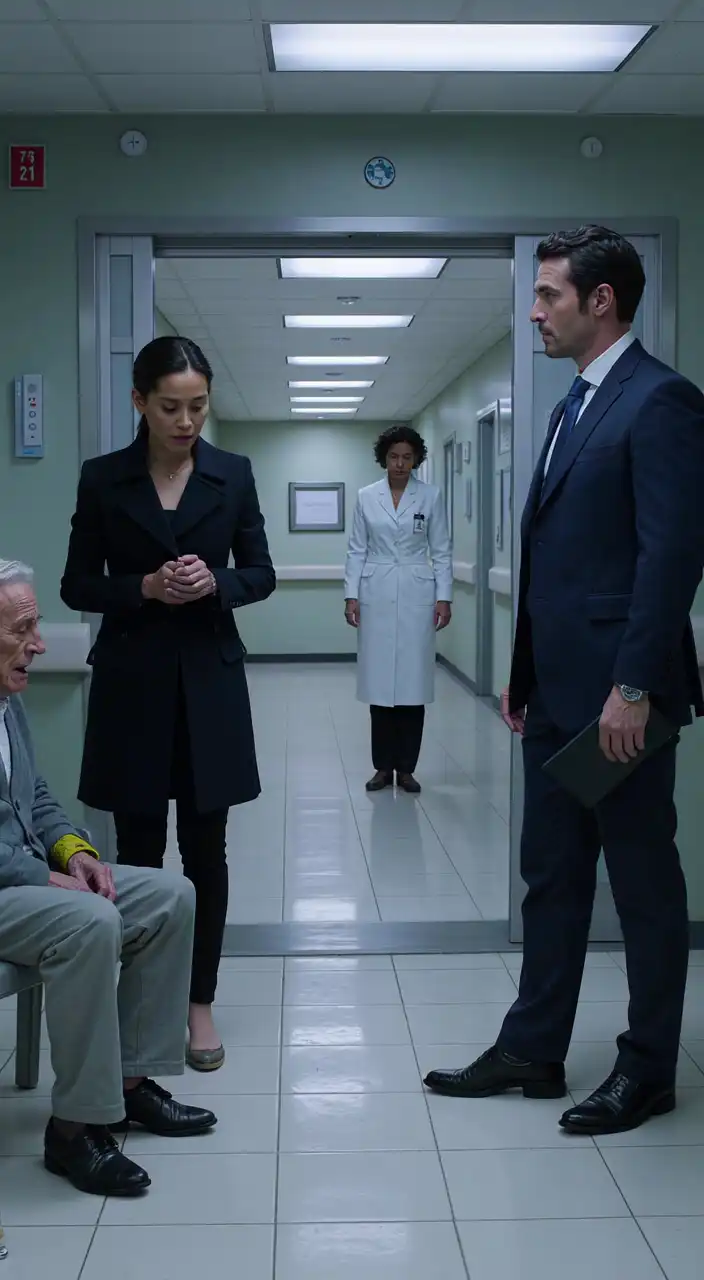
MY FATHER STARTED SHAKING OUTSIDE TRIAGE WHILE A CLINIC ADMINISTRATOR BLOCKED THE DOOR AND SAID HE NEEDED FAMILY PERMISSION FIRST.
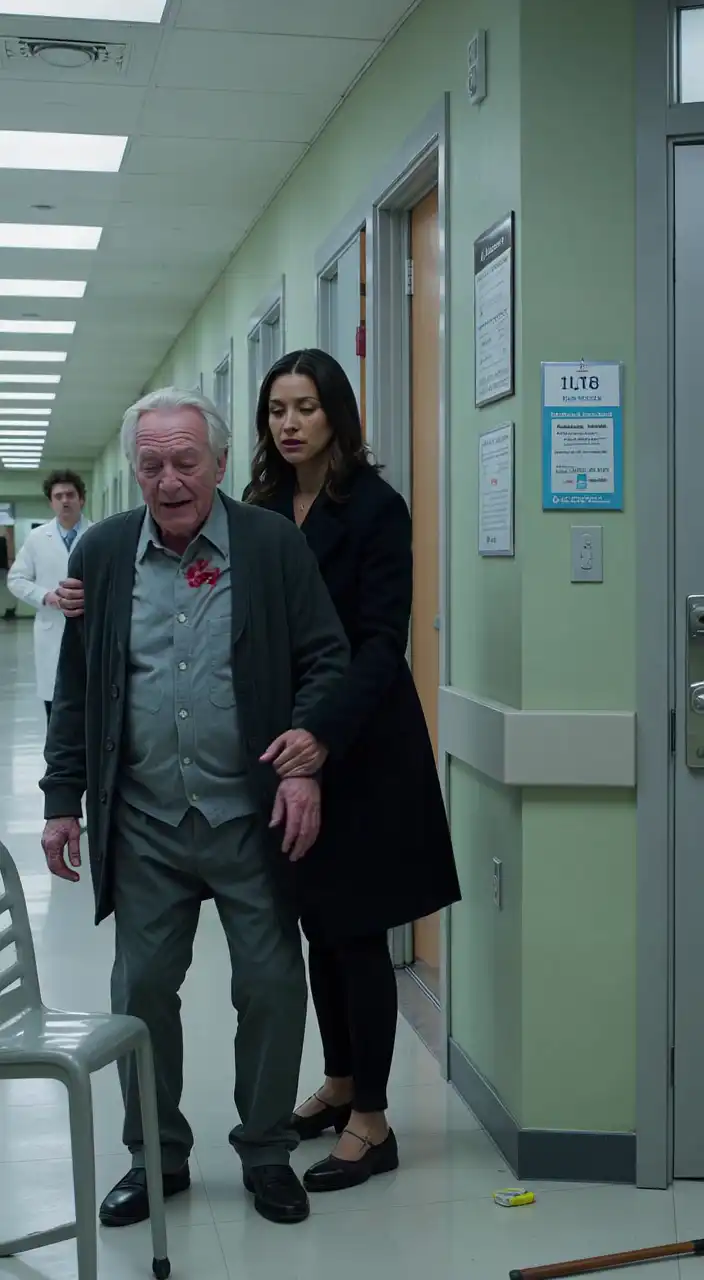
MY FATHER STARTED SHIVERING SO HARD HIS SURGICAL BANDAGE BLED THROUGH, AND THE CLINIC ADMINISTRATOR STILL BLOCKED THE TRIAGE DOOR.
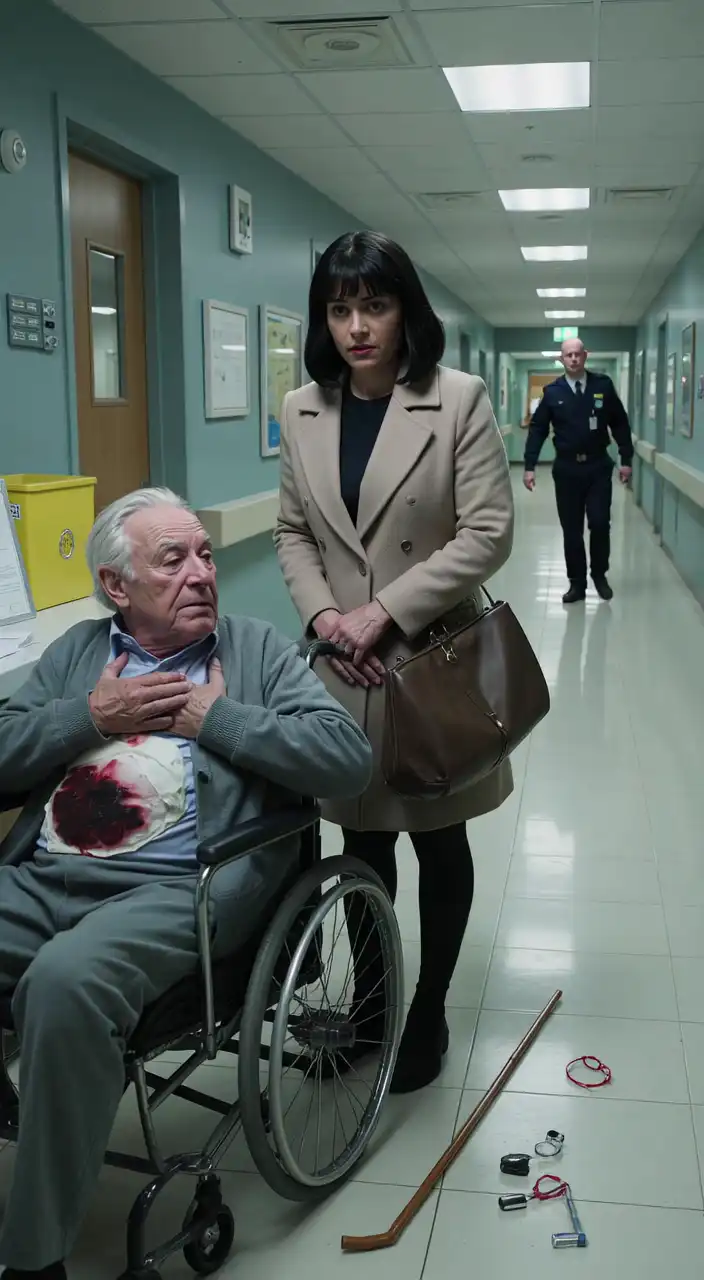
MY FATHER STARTED SHAKING IN THE HOSPITAL HALLWAY, AND THE WOMAN WHO CLAIMED TO BE HELPING HIM WOULD NOT LET TRIAGE TOUCH HIM.