
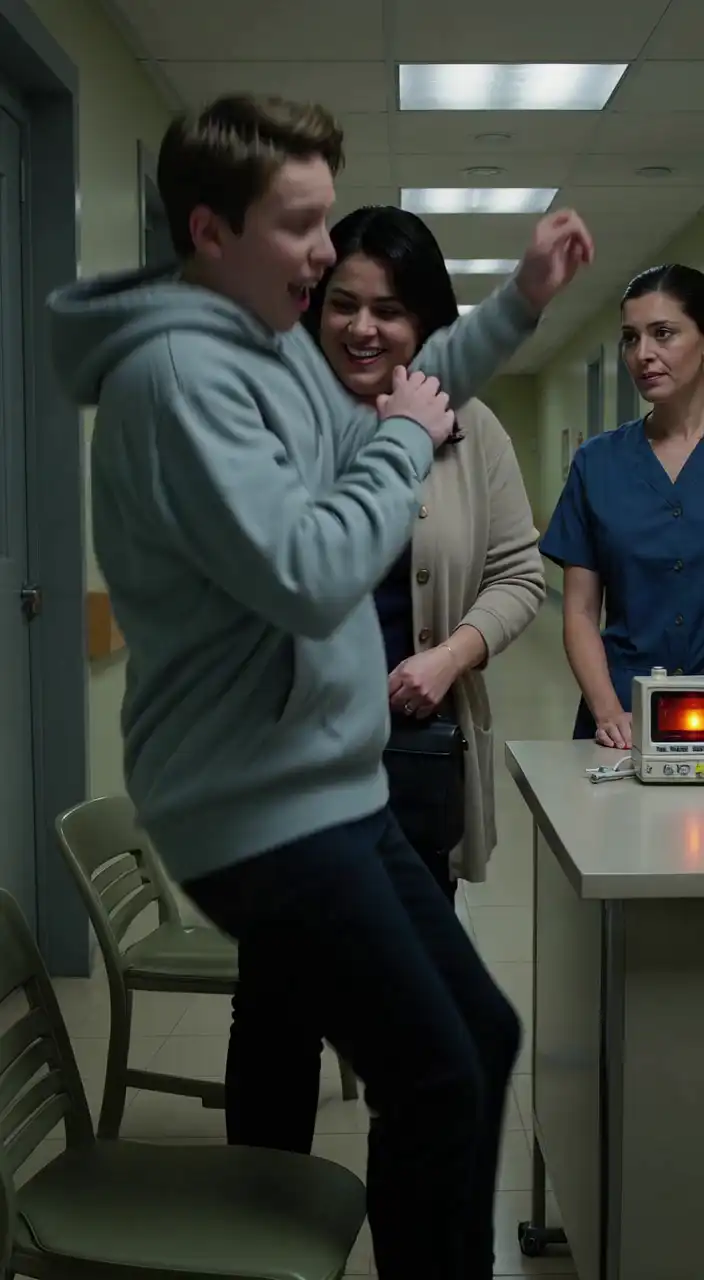
Jack moved first.
He did not raise his voice, but the hallway changed around him the way a room changes when one person decides everyone else is done pretending. He stepped between Victoria and the automatic triage doors, one palm out toward her purse, the other gesturing to the nurse crouching beside William.
"Ma'am, you are not taking him anywhere," he said. "Nurse, get him inside now."
Victoria's smile broke for half a second. "He is my child. You don't get to order me around because a machine beeped."
William was trying to pull air through a chest that seemed too tight to open. The little sensor on his finger blinked amber again, then red. The nurse looked up sharply. "I need a wheelchair. Now."
"No wheelchair," Victoria snapped. "He can walk."
William could not. When the nurse touched his shoulder and asked, "Sweetheart, can you stand for me?" his knees folded under him. He wasn't dramatic. He wasn't flailing. That made it worse. He just seemed to disappear into himself, like staying quiet had become more important than breathing.
Another nurse rushed over with a wheelchair, and Victoria shifted to block it with her hip. "He was just at Lakeside Family Clinic. They said he was fine. He had too much cough medicine, that's all."
Jack lowered his head slightly, eyes on her locked purse. "Then hand me the discharge papers and the inhaler."
"There is no inhaler in my purse."
The first nurse had already seen the empty spacer. So had Jack. So had I, from my plastic chair against the wall where I'd been waiting for my own brother's stitches to get checked. The spacer lay on the tile beside William's sneaker like a tiny clear witness nobody had planned for.
William's fingers twitched toward it.
The nurse took that in too. "What do you use the spacer with, baby?"
He swallowed hard. His eyes cut up to Victoria, then down again. "Blue one."
Victoria let out a little laugh, thin and irritated. "An old toy. He puts his mouth on everything."
Jack didn't even look at her. "Ma'am, if the inhaler exists and you're withholding it while he is in respiratory distress, this is now a medical safety issue."
Her voice sharpened. "You security people love making families look abusive because poor kids come in messy."
It was a good line. Clean. Angry. Built to make everyone step back and worry about being unfair. Jack didn't step back. The nurse didn't either. She and the other nurse lifted William together and settled him into the wheelchair while he whimpered at the movement and clutched the sleeve with the yellow stain. Up close, it wasn't just one spill. There were crusted streaks across the cuff and chest pocket, like syrup had been poured and wiped, poured and wiped.
The nurse noticed that too.
"Inside," she said.
Victoria lunged for the handles of the chair. Jack blocked her with a smooth practiced move that never quite looked like force unless you were watching closely. "You can come with us when registration clears you."
"I'm already his authorized caregiver."
"Then you'll have no problem answering questions."
For one dangerous moment I thought she might yank the purse open and make a scene, but instead she did something stranger. She looked at William with naked fury, the kind adults think children won't understand because no words are attached. William saw it. He flinched before she even spoke.
"Don't start lying now," she said.
The nurse pushing the chair stopped. "Excuse me?"
Victoria's expression reset so fast it was chilling. "He tells stories when he's scared."
William made a tiny sound then, not quite crying, not quite coughing. "I didn't mean to."
Those six words landed harder than the alarm.
Jack heard them. The nurses heard them. I heard them. Victoria heard them too, and the pulse in her neck jumped.
"Didn't mean to what?" the nurse asked gently.
William stared at the floor. His hand kept searching his hoodie pocket, then his other pocket, then the pocket again. Looking for the inhaler, I thought. Looking for the thing he had learned was his lifeline and finding nothing.
Victoria answered for him. "Didn't mean to spill the medicine. He's embarrassed."
The nurses rolled him through the triage doors anyway. Jack stayed with Victoria at the threshold while another staff member appeared from registration and asked for ID, insurance, and the clinic paperwork. Victoria made a performance of being offended, but she did hand over a card holder and her driver's license. Not the papers.
"I need all medical documents from today's visit," the staff member said.
"I left them in the car."
Jack nodded toward the red-stamped packet still peeking from beneath her handbag flap. "Then what is that?"
Her hand covered it at once. "School forms."
The registration staffer looked at Jack. Jack touched the earpiece at his collar and spoke quietly into it. "Code consult for possible pediatric neglect obstruction at triage. Need charge nurse and social work standby."
Victoria heard every word. Her face finally lost color.
"What are you doing?" she demanded. "You can't do that based on nothing."
Jack's voice stayed level. "Based on an unstable child, conflicting statements, visible medication evidence, and an empty spacer with no rescue inhaler available."
She took one step backward toward the hallway exit.
Jack matched it.
At almost the same second, from inside triage, a deeper alarm began to pulse. Not the small chirp from the finger monitor. This one was faster, urgent, and impossible to talk over. Nurses moved in the room beyond the swinging half-door. I could see only flashes: blue gloves, the amber reflection from a monitor, William's small sneaker hanging off the side of the bed before somebody lifted it up.
Victoria turned toward the sound before she could stop herself. Fear cracked through the polish on her face.
"He's overreacting," she said, but now she sounded like she needed someone else to believe it for her.
A respiratory therapist hurried past carrying a nebulizer setup. He asked Jack, "Family coming in?"
Jack said, "Not until the charge nurse clears it."
The therapist gave Victoria one fast look that was not friendly, then disappeared inside.
For the first time, she stopped performing for the room and went quiet. Her hand gripped the purse so hard her knuckles blanched. On the side pocket hung a cheap beaded bracelet, bright blue and green plastic letters spelling W-I-L-L. A child's bracelet. It bounced against the leather as her hand shook.
Jack saw it. "That his?"
She tucked the purse behind her leg. "He made it."
That tiny detail did something to me. A child had made her something. Probably handed it over with pride. And she had walked into a hospital with his inhaler hidden in that same bag.
The registration staffer tried again. "Ma'am, the clinic documents."
Victoria exhaled through her nose and slid out a folded packet, but she kept one page pinned under her thumb. Jack noticed. He was already reaching when she jerked the papers back.
"That page is private."
"If it's his medical treatment, it's not private from the staff trying to keep him breathing."
She clutched the packet to her chest. "You all do this. You hear one thing from a child and decide a Black woman with a purse is a criminal."
It was another good line, stronger than the first, and this time the registration staffer faltered. But Jack didn't answer the argument she wanted. He looked at the packet, then at the yellow stain on the cuff where William's fingers had clung.
"What was the exact medicine?" he asked.
"Cough syrup."
"Name."
"An over-the-counter kind."
"Name."
She hesitated.
That pause was worse than anything she'd said.
The charge nurse arrived then, older, broad-shouldered, badge clipped high, expression already set. She introduced herself to Victoria, asked for her relationship to William, and took the packet from the registration desk after Jack handed it over. Victoria opened her mouth to object, but the nurse was already reading. Her eyes moved once, then again, then hardened.
"This says he presented at the clinic with wheezing, lethargy, and pinpoint pupils." She looked up. "Why did you tell triage it was a dramatic asthma phase?"
Victoria crossed her arms. "Because if you say 'asthma' people actually pay attention."
The charge nurse tapped the page. "It also says possible ingestion or overmedication. Return to ER immediately if sedation continues. Why were you trying to leave?"
"I wasn't leaving. He hates hospitals. I was calming him down."
Jack spoke without taking his eyes off her. "Camera shows you pulling him away from triage when staff called his name."
Victoria's composure slipped again. "He panics. He needs me, and now you're keeping me from him."
Inside the room another alarm sounded, then cut off. That silence hit harder than the noise. Everyone in the hallway listened for the next sound.
It came as William's voice, faint but clear through the cracked door: "Don't let her be mad."
The charge nurse shut the packet and looked at Jack. They understood each other before either spoke. This was no longer just a difficult caregiver.
Then the nurse slid out the page Victoria had tried to keep covered.
The page was not private. It was the medication list.
And one line on it made Jack's whole posture change.
It wasn't cough syrup at all. It was promethazine with codeine, not prescribed to William, and the prescribing name at the top of the page wasn't Victoria's either.
It was his dead mother's.
The hallway went still enough to hear Victoria whisper, "That paper is wrong."
But Jack was already telling someone over his earpiece not to let her touch the purse.
Victoria took one quick breath and then reached for the packet.
Not for the top page. Not for the clinic note. Her fingers went straight for the medication list with the dead mother's name on it, pinching the edge hard enough to crumple it.
The charge nurse moved faster.
She pulled the packet back against her chest and stepped behind the registration counter, out of Victoria's reach. Jack shifted in at the same instant, not touching Victoria yet, just taking away the angle she needed. The effect was immediate. She had nowhere clean to move.
"Do not destroy that document," Jack said.
"It is a mistake," Victoria snapped. "His mama used to use that pharmacy. They print old information all the time."
The registration staffer had already gone pale. "That is not how e-scripts print."
Victoria swung on her. "You don't know what you're talking about."
From inside triage came a new burst of motion, not visible all at once but readable in fragments. A rolling pole. A respiratory therapist backing up with tubing. A nurse saying, "Hold still, baby, hold still." Then another voice, firmer: "Get peds on the line now."
The charge nurse was still reading.
"Medication reportedly found in home cabinet from prior family member," she read aloud. "Caregiver unsure quantity ingested. Child increasingly somnolent in clinic. Recommending emergency transport. Caregiver declined ambulance."
The last four words hit the hallway like a dropped tray.
Jack's jaw clenched. "You refused ambulance transport?"
Victoria's eyes flashed. "I drove him here, didn't I? He is here."
"After trying to pull him back out of triage," the charge nurse said.
Victoria pointed toward the doors. "Because all of you are turning this into something ugly in front of him. You hear one thing, you see a stain, and suddenly I'm a monster. Do you know what it's like trying to care for a child who fights medicine, who lies, who acts out every time somebody says doctor?"
"Enough," the charge nurse said, not loudly, but with enough weight that even I straightened in my chair. "A child in respiratory distress does not need his story replaced by yours every time he opens his mouth."
That landed. Victoria's face emptied for a beat, like she hadn't expected anyone to say it that plainly.
Then came the reversal.
She let her shoulders drop. Her voice changed. Softer. Trembling now. "I was trying to help him," she said. "You don't understand. He was coughing all night. I gave him a little. Then he wouldn't sleep, and he kept saying he couldn't breathe, and I thought he was panicking because he does that. I only gave him what was already in the house. I wasn't trying to hurt him."
The hallway hesitated around that. Not because anyone believed her fully, but because remorse always rearranges a room. The registration staffer looked uncertain again. A couple in the far seats stopped whispering. Even I felt the ugly pull of maybe, of wanting this to be ignorance instead of cruelty.
Then Jack looked down at the purse.
The blue and green bracelet was still bouncing slightly where her fingers trembled.
"Open the bag," he said.
She hugged it tighter. "No."
"Open it."
"You have no warrant."
The charge nurse kept her attention on the clinic packet. "This note says the clinic asked whether his rescue inhaler had been used and you stated it was lost weeks ago."
The empty spacer on the tile was still there. One of the nurses had nudged it aside with her shoe but not picked it up. It sat near the base of the wall, transparent and humiliating.
Jack pointed to it. "And yet he arrived with a spacer in his hoodie."
Victoria's lips parted, but nothing came out.
From inside, the sound changed again. The alarm that had stopped now restarted in a rapid pattern. Someone said, "Sats not recovering." Another voice: "He needs access now." Then William coughed, a thin weak sound that turned into a cry before cutting off.
Victoria's head whipped toward the door. Whatever was true about her, she loved control more than uncertainty, and losing sight of what they were doing to him was beginning to fray her.
"I need to be with him," she said.
The charge nurse answered without looking up. "No."
Jack spoke into his earpiece. "Need local PD and CPS notified. Possible medication poisoning, obstruction of emergency care, falsified treatment history. Also request footage retrieval from triage camera and entrance camera."
That changed Victoria more than any accusation had. Fear sharpened into calculation.
She moved in a blur.
Not toward the doors. Toward the trash can beside registration.
She yanked one folded paper free from the packet's outer sleeve and tried to shove it down into the half-full liner. The registration staffer gasped. Jack caught Victoria by the forearm before she could push it lower, and the charge nurse snatched the paper out of the can.
This time everyone saw it.
A printed after-visit summary from Lakeside Family Clinic. On the lower half, in large bold text, was another line Victoria had hoped nobody would read: BRING ALL CURRENT MEDICATIONS TO ER. CAREGIVER LEFT BEFORE TOX SCREEN COMPLETED.
There was a pen note under it in hurried block letters: possible repeat dosing. Child says medicine given "again because still noisy."
The charge nurse's eyes rose slowly to Victoria's face.
"You gave him more after the first dose?" she asked.
Victoria's mouth worked soundlessly for a second. "He was still coughing."
"With a medication not prescribed to him," Jack said, "after a clinic recommended emergency transport and tox evaluation."
Victoria jerked against his grip. "Let go of me."
He did not twist her arm or shove her. He simply changed his hold to a practiced restraint at the wrist and elbow, enough to stop her from reaching the bag or the papers.
"Until law enforcement gets here, you are being detained for patient safety," he said.
The words made the waiting area erupt in low startled noise. People craned their necks. Someone pulled out a phone before another staff member told them recording was prohibited. Victoria reacted to the public shame like a struck match.
"Detained?" she shouted. "For taking care of a child nobody else wanted? For not calling an ambulance I couldn't afford? You think any of you are helping him by making me the problem?"
It was the first thing she had said that rang with something messier than strategy. Maybe there was truth in it. Maybe not the truth that mattered most, but enough of it to sting. Poverty had taught her some of these lines because they had worked before. Systems did punish fear and confusion. But systems also recognized a poisoning child when one was right in front of them, and this time the script was collapsing.
Inside triage, a doctor I had not seen before stepped into view at the crack of the door, pulling on gloves as he talked to someone behind him. He was young, sharp-faced, already irritated in the focused way doctors get when every second has begun to count.
"Where's the med list?" he asked.
The charge nurse handed it over immediately.
His eyes scanned, then widened. "Codeine? In a child this size?" He looked straight at Victoria. "How much did he get?"
She stared at him.
"How much?" he repeated.
"I don't know."
"Teaspoon? Tablespoon? Bottle cap? Did he vomit? Did he pass out? Did he stop breathing in the car?"
"I said I don't know!"
The doctor stepped closer, voice clipped. "You need to decide whether you want to be angry or useful. If this is opioid exposure on top of respiratory compromise, every minute you hold back information matters."
That landed too, but not cleanly. Victoria blinked hard and for one moment looked genuinely lost. "He was making that whistling sound," she said. "And he wouldn't settle. So I gave him some before dawn. Then again in the morning because he kept coughing. At the clinic he got sleepy and they started acting like I poisoned him."
"How much was some?" the doctor pressed.
She shook her head. "A capful maybe. Then another. I don't know. Not full."
The doctor turned to the charge nurse. "Document stated amount uncertain, repeat dosing admitted. We need his weight from the clinic if ours isn't done yet."
Then he looked back at Victoria. "Where is the bottle?"
No answer.
"Where is the bottle?"
Her eyes flicked to the purse.
That was clue enough.
Jack said, "Bag stays closed until police witness, but we have probable evidence retention."
Victoria's chest began to rise and fall faster. "I didn't put it in there for that."
"For what?" Jack asked.
She said nothing.
The doctor was already backing toward the room. "If there's more than codeine involved, I need pharmacy and poison control notified now. Also if anyone finds the inhaler, bring it."
The charge nurse called after him, "Child said blue one."
He nodded once and disappeared.
The hallway seemed to tighten around that sentence. If anyone finds the inhaler. As if the thing was in the building, hidden in plain sight.
The nurse by registration looked at the purse again.
So did I.
It was a structured leather bag with a side zipper compartment bulging more than the others. Not much. Just enough that once you saw it, you could not unsee it. Victoria noticed where our eyes went and twisted the bag behind her hip again.
Then, from inside the room, a new voice rose above the others.
Not a clinician. William.
Small, frightened, but louder than before.
"Please don't put me to sleep. Please."
The words cut through everyone.
The doctor answered, audible because he was close to the door. "We are not putting you to sleep, buddy. We are helping you breathe."
"But she said if I tell, they do shots," William gasped.
A nurse murmured something soothing I could not make out.
Victoria went rigid.
The charge nurse's expression became something colder than anger. "He was coached."
Jack's earpiece crackled. He touched it, listened, and nodded. "PD is three minutes out."
That should have pinned the moment down. It did not. Because pressure never waits politely.
The triage doors shoved open and the young doctor came back out, faster this time. "I need the exact syrup concentration if anyone can get it. His pupils are tiny, his breathing is shallow, and the neb isn't fixing the pattern. We may need naloxone if this is opioid effect layered on asthma."
Victoria made a broken sound. "No. No, that's for addicts."
"It is for anybody with opioid suppression," he snapped. "Where is the bottle?"
She looked at him with naked terror now. "If you give him that, they'll say-"
The doctor cut her off. "I do not care what they say. I care whether he keeps breathing."
That should have broken her. Instead it triggered something fierce and desperate. She jerked hard against Jack's hold, swinging the purse upward with her free hand as if to keep it away from everyone. The zipper on the side pocket snagged against his sleeve and popped half open.
A blue plastic inhaler slid halfway out and hung there, jammed in the torn seam.
Every person in the hallway saw it.
For a split second nobody moved, as if the object had too much gravity.
Then the doctor snatched it free.
"Respiratory!" he shouted, already turning back through the doors. "Found the rescue inhaler. Unknown last use."
Victoria let out a strangled cry and lunged after him. Jack had to catch her fully this time, both arms controlling her as she twisted and kicked. The purse spilled onto the floor.
A brown bottle rolled out under the chair opposite me.
One of the caps had not been screwed on right. Thick red-gold syrup leaked across the tile, smelling sickly sweet and chemical. The pharmacy label flashed into view before it spun: promethazine-codeine. Prescribed to Marlene Harris. Date over a year old.
William's dead mother.
The registration staffer covered her mouth.
The charge nurse bent and picked up another item that had fallen from the purse. A folded pediatric prescription label, never filled. Albuterol inhaler. William Harris. Two months ago.
Never filled.
The emotional reversal in the hallway was violent. Until then, there had still been room for confusion, for defensive mistakes, for a caregiver in over her head. But the hidden inhaler and the unfilled prescription changed the shape of everything. This was not only a bad choice made this morning. It was a pattern.
Jack got Victoria turned against the wall without slamming her, pinning her wrists safely while she cried and cursed and then cried again. "You don't know what he is like," she said. "You don't know how he sounds all night. You don't know what I deal with. I needed him to sleep. I needed one night."
The charge nurse held the unfilled prescription with gloved fingers. "And when exactly were you planning to fill the medication that would have helped him breathe?"
Victoria squeezed her eyes shut.
No answer.
The doctor had vanished back into triage with the inhaler. Through the doors came a compressed rush of commands: "Mask off, spacer here, one puff, seal it. Again. Watch his chest. Draw up naloxone. Tiny dose. Ready."
I had never heard a child fight to breathe from so close before. It changed the air in my own lungs. In the waiting area, strangers had gone silent. Whatever stories they had arrived with, they were all gone now. There was only this hallway, this child, this sound.
A police officer arrived first, not Jack'spanic-sized cavalry but one patrol officer jogging in with another just behind him. Jack did not release Victoria until they were close enough to take over. He gave a clean, concise summary: pediatric emergency obstruction, concealed inhaler, suspected non-prescribed opioid cough syrup, attempted document disposal, attempt to remove patient from care, evidence on floor and in purse. The officers listened while one took hold of Victoria's wrists.
She shifted instantly again, dropping into hoarse pleading. "Please. Please don't handcuff me in front of him."
One of the officers, a woman with tired eyes and a controlled voice, said, "Then stop pulling away."
Victoria did not stop. The cuffs clicked anyway.
At that exact moment there was a sound from inside triage that was somehow more frightening than the alarms: a brief, hard silence, followed by the doctor saying, "Come on, William. Breathe with me. Good. Again. Good. Stay here."
Then the alarm tone changed.
Not off. Better.
Still urgent, but less sharp, less chaotic. A nurse at the door let out the tiniest visible exhale. The charge nurse heard it too and straightened a fraction.
Relief brushed the hallway and vanished at once, because better was not safe.
The female officer began reading Victoria her rights. Victoria was no longer listening. She craned toward the door as if she could drag herself through it by force of will.
"I need to see him," she said.
"No," the charge nurse replied.
"I said I need to see him."
"And I said no."
The officer guided her toward a chair away from the triage threshold. Victoria sat because the handcuffs and the failed lunges had taken more out of her than pride could replace. Her breathing had gone ragged. Mascara streaked under one eye. For the first time she looked less like a composed gatekeeper and more like a person who had built one bad decision on top of another until it became a wall.
The second officer crouched by the spilled purse items, photographing everything before touching it. He bagged the bottle. He bagged the empty spacer. He bagged the clinic papers, the unfilled prescription slip, even the child's beaded bracelet after asking the charge nurse if it was evidence or personal property. She hesitated on that one.
"Evidence first," Jack said quietly.
The bracelet disappeared into a clear bag.
There was something brutal about that. Something final.
Another hook came just as the scene threatened to settle.
The doctor pushed through the doors again, and this time his face had changed in a way that made everybody stand straighter.
"Does anyone here know if he had access to anything else?" he asked. "Sleeping pills, pain meds, alcohol, adult cold medicine, anything."
Victoria looked up too fast.
The doctor saw it. "What else?"
"Nothing," she said.
He looked at the brown bottle in the evidence bag. "This amount should not be giving me the level of sedation I'm seeing unless his dose was higher than stated or there's something else in him. His blood sugar is also low. We are drawing labs, but if there is another medication involved and you wait to tell us, he could seize or stop breathing before tox confirms anything."
The policewoman turned to Victoria. "Now is the time."
Victoria's lips trembled. "I don't know."
The doctor stepped closer. "Did he eat today?"
No answer.
"Did he vomit? Did he get into pills? Was there melatonin? Benadryl? Somebody else's prescription?"
Her silence stretched too long.
Then, very softly, from where she sat cuffed and bent over her lap, she said, "He wouldn't drink the syrup. So I put it in juice."
The doctor held still. "How much juice."
"A cup."
"Did he finish it."
"He spit some out."
"Did you add anything else."
She swallowed. "He was still wheezing. I crushed half of one of my uncle's pain pills because I thought maybe he was hurting in his chest and that's why he couldn't calm down."
The hallway exploded all over again.
The policewoman's expression shut hard. The charge nurse actually said, "My God."
The doctor did not waste a second on outrage. "What pain pill?"
"I don't know. White. From his bottle."
"Was it oxycodone? Hydrocodone? Tramadol?"
"I don't know."
"Where is that bottle?"
Victoria closed her eyes.
Jack answered for her, looking at the purse spill. "Keep searching."
The male officer found it in the inner compartment wrapped in a grocery receipt. Small orange prescription vial, label scratched but not gone. Hydrocodone-acetaminophen. Prescribed to someone named Leon Baxter.
The doctor took one look and pivoted back to triage at a run. "Naloxone now. Full tox workup. Notify PICU."
The words PICU hung in the hall like smoke.
Pediatric intensive care.
The policewoman stood and moved farther from the triage door with Victoria as if the syllables themselves required distance. Victoria had stopped crying. Shock had flattened her face. "I didn't mean..." she whispered, and then the sentence died because there was no version of it that mattered.
I realized my own hands were gripping the edge of my chair. Across from me, an elderly man waiting for x-rays made the sign of the cross. The registration staffer wiped at her eyes and kept typing because that was what the living do in hospitals while catastrophe unfolds: type, label, witness, continue.
Ten minutes can stretch into a private lifetime when alarms keep changing. Those next minutes were all fragments.
A pharmacy tech arriving breathless with a locked kit.
A social worker called from upstairs, hair still damp from the rain outside, already taking notes before she reached the desk.
Jack replaying the camera clip for the officers on a monitor turned partly away from the waiting area. I saw only enough to know it matched what he said: Victoria gripping William's arm when staff called his name, angling him toward the exit, bending to snatch the spacer before it rolled too far, missing it because he slid from the chair.
The charge nurse calling Lakeside Family Clinic for verbal report. "Yes, this is St. Agnes ER. We have the child now. Start from arrival. No, I need the exact timeline."
The clinic doctor, audible faintly through speaker for a second, saying, "He was drowsy on presentation and the caregiver kept insisting he just needed rest. The child told my nurse, 'She says I get medicine when I make noise.'"
The social worker looked up sharply at that.
Then another nurse emerging from triage with William's hoodie sealed in a clear belongings bag. The yellow and red-brown stains were more obvious under the plastic. She carried it like evidence, not laundry.
The social worker asked, "Did he say who she is to him exactly?"
"Caregiver, aunt by placement, I think," the charge nurse answered.
Placement.
That word shifted another panel in the story. Not biological mother. Not stepmother. A placement caregiver, maybe kinship care, maybe informal after his mother died. Whatever the exact structure, authority pressure was about to widen beyond the hospital and police into family court, child services, every bureaucratic machine that wakes slowly until a child nearly dies in a hallway.
The social worker glanced toward Victoria. "Then I need his caseworker. Right now."
That was the next clue moving into the open.
Because when the officer searched the remaining purse compartments under Victoria's glare, he found not only receipts and makeup and old tissues. He found a folded business card with a county seal. Child placement services. Caseworker: Dana Reeves. There were three missed-call notations scribbled on the back with dates from the previous week.
The social worker took the card. "She was already being contacted."
Jack heard that and looked at Victoria with renewed disgust. "You were dodging the caseworker."
Victoria snapped back to anger as if grateful for it. "Because they always threaten to move him. They never help."
The social worker did not soften. "And so your solution was what? Sedate him and hide his inhaler?"
"I hid it because he overuses it."
The charge nurse stared at her. "Children do not overuse rescue inhalers for fun when they are struggling to breathe."
"He thinks everything is an emergency!" Victoria shouted. "Every cough, every wheeze, every bad dream. He works himself up until the whole house is awake. I have two other kids. I have a job. I cannot spend every night in an emergency room because he gets scared."
The social worker's face changed then, but not into sympathy. Into recognition. She had heard a version of this before. Not the same facts, maybe, but the same logic: the child is inconvenient, the child is dramatic, the child creates the crisis that justifies his own punishment.
"How often?" the social worker asked.
Victoria faltered. "What."
"How often did you withhold the inhaler."
"I didn't withhold it."
Jack picked up the bagged unfilled prescription slip and held it where she could see. "Try again."
Victoria looked away.
The social worker asked, "How often."
Long pause.
"Only when he was acting up," Victoria muttered.
The words turned the hallway colder than any alarm had.
The social worker wrote something down. "What does acting up mean."
"Crying. Hyper. Running around. Coughing because he wants attention."
The charge nurse let out a stunned breath through her nose. "Coughing because he wants attention," she repeated, as if committing it to memory.
Inside triage a monitor chirped in a steadier rhythm. A small mercy. The doctor did not emerge this time. Instead the respiratory therapist came out carrying the blue inhaler and spacer in a clear bag after use.
"He's breathing better after the neb and puffs," he said to the charge nurse, "but he responded to naloxone too. Pupils opened some. He's more awake and scared, which honestly is an improvement. PICU still wants him if tox is positive or if he dips again."
The whole corridor took that in.
He responded to naloxone too.
There it was. Confirmation without waiting for the lab. Not all of it, not every detail, but enough to redraw everything in hard lines. He had not just been sleepy. He had been suppressed.
"Can I ask him some questions?" the social worker said.
The therapist shook his head. "Doctor wants minimal stimulation till we move him. But he did say something you should know."
Everyone looked at him.
The therapist glanced at Victoria, then back to the charge nurse. "He asked if he was in trouble because the bottle was empty."
The sentence dropped into the waiting area and did not bounce.
The social worker closed her eyes for half a second.
The policewoman wrote faster.
Victoria's mouth opened, but whatever defense had formed there died under the weight of that one child-sized fear.
The therapist continued. "He also said he tried to hide the spacer in his hoodie so she wouldn't take it."
No one spoke.
Because now the evidence was no longer only chemical, physical, administrative. It was behavioral. Learned concealment. A child protecting access to his own breathing medication from the adult responsible for him.
The social worker asked softly, "Did he identify her as the one taking it?"
The therapist nodded once. "He said, 'She locks it up when I am bad.'"
That was the point at which public opinion in the hallway hardened completely. Even the strangers who had looked uncertain earlier no longer wore that expression. It was over. Exposure had happened in full.
But rescue consequences were just beginning.
A county caseworker arrived twenty minutes later in rain-specked flats and a wrinkled blazer, carrying the exhaustion of somebody who has spent years running behind disasters. Dana Reeves, if the card was right. She barely made it through the automatic doors before the social worker met her with the summary. I watched the caseworker's face as she listened. It passed through disbelief, anger, professional caution, then a grief so practiced it was almost invisible.
"He missed two asthma follow-up appointments last month," she said quietly. "Victoria told me transportation was the problem."
Jack pointed toward the evidence bags. "Apparently not the only problem."
Dana nodded, swallowing hard. "His school nurse filed concerns too. Frequent wheeze, no inhaler sent, child sleepy in class. We were trying to verify medication compliance."
The charge nurse's eyes sharpened. "And he stayed in that home?"
Dana took the hit without flinching. "Because every visit he looked clean, fed, and she was articulate. And because our caseload is what it is, and because nobody had yet seen him on a hallway floor with an empty spacer and opioid exposure."
There was no defense in her tone. Just fact and shame.
The social worker said, "You have enough now."
Dana looked through the triage window where she could just barely glimpse movement around William's bed. "Yes," she said. "Now we do."
The police officers separated Victoria enough from the center of the hall that staff could move freely. She had gone quieter again, but not calmer. Every few minutes she would blurt out something as if trying on possible versions of herself.
"I was overwhelmed."
"He lies."
"I didn't know that medicine was that strong."
"My aunt used to give it to us when we were kids."
"He scares the other children when he can't breathe."
That last one made Dana turn.
"He scares the other children," Dana repeated. "Do you hear yourself?"
Victoria looked away.
Dana stepped closer, rain drying in dark spots on her blazer. "That little boy's mother died. He has asthma. He has been telling adults in small pieces that something is wrong. And you turned his symptoms into misbehavior because that was easier to live with."
Victoria's face crumpled, but Dana did not stop.
"If he had stopped breathing in your car, would you have told the truth then?"
The policewoman murmured, "Ma'am," trying to keep things controlled, but Dana was not yelling. The force was in the steadiness.
Victoria whispered, "I brought him here."
Dana answered, "And then you tried to leave."
That ended it. Victoria folded over herself in the chair, cuffed hands in her lap, and finally had nothing left to say.
The next conflict came from inside, because medicine does not care that the moral narrative has clarified.
A nurse burst through the doors with a portable monitor cable and called, "Need clear hall to elevator. PICU transport in two."
Instant movement followed. Chairs scraped. Staff pushed carts aside. Jack directed people against the walls. The officers shifted Victoria farther back so she could not even glimpse the path. I stood automatically, pressed near the vending machine, heart hammering as if I knew the child.
The bed came out fast.
William looked smaller on it than he had on the floor, swallowed by blankets and equipment. Oxygen cannula under his nose. Sticker leads across his chest. An IV taped to one hand. His eyes were half-open now, blinking against the lights, frightened but present. The respiratory therapist walked on one side, a pediatric nurse on the other, the young doctor at the head steering and watching the monitor. The blue inhaler and spacer rode bagged with his belongings. The stained hoodie was clipped to the chart rack in clear plastic. The evidence and the treatment had become one procession.
William turned his head weakly as they passed the waiting area.
For one terrible second his gaze found Victoria.
Everything in him changed. Not physically, not all at once, but in the way his shoulders curled inward and his mouth tried to vanish before any words came. Even semiconscious, he recognized where danger was.
The doctor saw it.
He stepped slightly between William's line of sight and the chair where Victoria sat.
"You are safe," he said clearly, for William and maybe for everyone else. "We are taking you upstairs now."
William's lips moved. The therapist bent close.
"What was that, buddy?"
William whispered, "Am I in trouble."
The therapist's voice broke on the answer. "No. Not at all."
The bed kept moving.
Then, another reversal, small and devastating. William lifted his free hand weakly off the blanket and made a searching motion, fingers opening and closing in the air the same way he had searched his hoodie pockets before.
Looking for the inhaler.
The respiratory therapist immediately put the bagged spacer where he could see it. "We got it," he said. "We got your blue one."
William's hand fell back. His eyes closed with what looked almost like relief.
The elevator doors swallowed them.
Only after they were gone did the waiting area breathe again.
Exposure has a strange aftersound. Not silence exactly. More like the room trying to decide what it becomes after witnessing the hidden thing in full light. Staff resumed motion, but no one with their old rhythm. The registration desk clicked and printed and stapled. The officers continued procedure. Dana made calls that would move other human beings like pieces on a board: emergency removal, temporary placement search, supervisor notification, judge on call if needed. The social worker coordinated bedside support because children do not come out of terror simply because adults finally believe them.
And still the clues kept arriving.
Lakeside Clinic faxed over the full chart.
The charge nurse read it standing up, one page after another, and every page made her expression grimmer. The clinic had documented Victoria interrupting when William tried to answer. They had documented his yellow sleeve stain. They had documented old bruising on the upper arm that Victoria called "playground stuff." They had documented that when the nurse asked where his inhaler was, William looked at the purse, then at the floor, and stopped talking.
There was also a note from six weeks earlier, imported from school health records: student reports "Aunt says I breathe loud on purpose."
Dana pressed her hand to her mouth when she read that one. "God."
Jack, who had maintained control all evening, finally muttered a curse under his breath.
The officers took the fax as supplemental evidence. More paper moving into authority channels. More weight. More exposure. You could almost feel the case assembling itself around Victoria while she sat there reduced and handcuffed, no longer the narrator of anything.
Then came a pressure from another direction.
A woman in scrubs from administrative risk management arrived with a tablet and questions for Jack. Not because the hospital doubted what had happened, but because institutions move to protect themselves too. She wanted exact timestamps: when William entered, when triage was initiated, when the alarm first sounded, when security intervened, when the caregiver was detained, when the physician identified opioid concern. Her presence brought another layer of authority, colder and more bureaucratic. This case would be audited. Every minute documented. Every camera angle preserved.
Jack answered precisely. "Time of first visual collapse on hallway feed, 18:14. First pulse oximeter alarm approximately 18:16. Security intervention at threshold, 18:16 and change. Charge nurse engaged 18:18. Concealed inhaler visualized 18:24. Additional opioid admission 18:31. PICU transfer 18:52."
The risk manager typed rapidly. "Need chain of custody on every physical item."
The male officer lifted the evidence bags. "Already logged."
The risk manager nodded. "And witness names from waiting area."
That included me.
So I gave mine. Told them what I had seen from three chairs away. The pale lips. The yellow stain. The empty spacer. William whispering, "She said not to tell." Victoria saying he was dramatic. Saying he could walk. Saying the inhaler was in the car. Trying to keep the papers. Trying to trash one.
As I spoke, I realized how much had depended on tiny things not being ignored. A rolling piece of plastic. A stamped instruction line. A child too frightened to say more than fragments. The threshold had really been the whole story: help close enough to see, blocked by somebody who knew how to stand in front of it.
When I finished, the risk manager thanked me and moved on.
Dana was still on the phone. "Yes, emergency removal. Yes, hospital hold if needed. No release to current caregiver under any circumstances. We may need temporary overnight medical foster if family cannot be cleared immediately."
That was rescue consequence too. Even if William stabilized, he would not be going back with the person who brought him.
Victoria heard enough to understand.
Her head snapped up. "You are not taking him from me."
Dana ended the call and faced her. "He has already been taken from your control. That happened when you hid the medication he needed and gave him medication he should never have had."
Victoria's eyes shone with fresh tears. "I was all he had."
Dana's answer was immediate. "Then you should have protected him."
For the first time all night, Victoria looked old. Not in years. In collapse. The scaffolding of excuses was gone, and what remained was a woman being looked at by institutions she could no longer charm, shame, or outtalk. Maybe she had once done real good for him. Maybe she had clothed him and packed lunches and braided routines around his grief. None of that erased this hallway.
A call came down from PICU.
The charge nurse answered, listened, then looked around for Dana and the social worker. "He is more alert," she said. "Initial response to naloxone confirmed. They think mixed respiratory suppression and uncontrolled asthma exacerbation. Tox pending, but they are treating as opioid exposure. He asked for juice and then asked if he was going to have to say who gave him the medicine."
Dana closed her eyes in visible relief and pain together. "Can I go up?"
"Yes, with social work. But keep it minimal. He is scared of getting someone in trouble."
Of course he was. Children at the center of abuse often are. Loyalty woven through fear. Shame attached to survival.
Dana nodded and headed for the elevator with the social worker.
Before the doors closed, the social worker turned back to the charge nurse. "Save every note. Every quote. This one will matter in court."
"It already does," the charge nurse said.
After they left, the waiting area thinned as some patients were called and others reassigned. Yet the hallway still felt marked. People stepped around the faint sticky residue where the syrup had leaked despite the hurried cleaning. The smell lingered.
The policewoman finally raised Victoria from the chair. "We are taking you down now."
Victoria stood on unsteady legs. As they guided her toward the exit hall, she twisted once toward triage, though William was long gone upstairs. "Tell him I didn't mean..." she began.
Jack cut in, not cruelly but with exhausted certainty. "What he needs now is not your message."
She stared at him, then at the cleared threshold she had tried to control, and something in her face folded inward. The officers led her away.
When the side door closed behind them, the hallway seemed lighter and worse at the same time.
Jack stayed a moment longer, collecting himself. The charge nurse handed him a copy request form for the footage and witness index. He signed where she pointed. Their professionalism had a kind of battered tenderness in it now, the shared look of people who know they caught something in time but not before damage was done.
"You saw it early," she told him.
He shook his head. "The kid did. We just listened before it was too late."
That line stayed with me.
An hour later, when my brother was finally discharged from his stitch check and came limping out with a comic sticker and no idea what had happened on the other side of the waiting room, I was still watching staff move through that corridor. The empty chair where William had first sat had been wiped down. The floor was clean. The spacer was gone into evidence. No physical sign remained except memory.
But consequences were climbing stairs.
Up in PICU, Dana and the social worker sat at William's bedside while he drifted in and out under brighter lights and kinder hands. The doctor later told them, and eventually everyone involved, that he was going to recover. His lungs had begun to open with appropriate treatment. His oxygen needs were easing. His mental status improved after naloxone and time. Lab work confirmed opioid exposure consistent with the medications found. There was no need for intubation after all.
Rescue, in the end, held.
Yet exposure kept widening over the next hours.
The school nurse faxed prior concerns.
The pharmacy confirmed the albuterol prescription had never been picked up.
The clinic submitted sworn addendum that Victoria attempted to leave before toxicology collection because she "did not want trouble with the state."
A neighbor, contacted through Dana's emergency file, reported hearing William coughing at night and being told through the wall to "shut that noise off."
The house, later searched with consent from another adult occupant, contained two more expired bottles of adult medication and no accessible pediatric asthma rescue supplies.
Every piece moved from private misery into official record. The hidden pattern became a documented chain.
By midnight, a judge had approved emergency protective custody from the hospital bed.
By one in the morning, PICU had arranged a sitter because William startled awake whenever footsteps paused at his doorway.
By two, he finally believed enough to ask the nurse a different kind of question.
Not "Am I in trouble."
But "Can I keep my blue one with me?"
The nurse, who had heard everything, brought the cleaned inhaler setup back after pharmacy checked it, and placed it in the bedside drawer where he could see it when he woke. She told him, "No one is taking it from you here."
He cried then, softly and without trying to hide it.
Dana cried in the hall after hearing that, where he could not see.
The next morning the story entered the harder daylight of formal consequence. Statements were typed. Charges were reviewed. Terms like child endangerment, criminal negligence, obstruction of medical care, unlawful administration of prescription narcotics attached themselves to Victoria's name. Maybe more would come depending on prior reports. Maybe some would be pled down later. That was beyond the hallway. But exposure had crossed the threshold where it could not be talked back into silence.
And for William, the reversal continued in smaller human ways that mattered just as much.
A respiratory nurse taught him how to use the spacer again without rushing him, this time as if his fear made sense.
A child life specialist brought markers and let him color while they explained each machine.
A PICU physician asked him direct questions and waited for his answers instead of letting adults overrun them.
When he said, almost apologetically, "Sometimes I get loud when I can't breathe," the doctor answered, "That is called struggling for air. It is not bad behavior."
He stared at her like the sentence was in another language.
Dana began working the phones for safe placement, and by afternoon they found a maternal great-aunt in another county willing to come immediately and known to the department for previous stable care. Cleared enough for supervised bedside visit once hospital staff agreed. Not perfect, not magic, but a door that did not lead back to the locked purse.
When the great-aunt arrived, gray in her braids and furious in the contained way of women who have already chosen action over spectacle, William looked at her for a long time before holding out his hand. She took it and did not ask him to say anything. She only said, "Baby, you breathe first. We can do the rest later."
Even the PICU nurse turned away for a second after that.
Days later, pieces of the hallway story would be repeated in offices and hearings and mandatory trainings. Jack's intervention would be cited in a safety review. The charge nurse would use the case in staff education about coached narratives and missing medication clues. The clinic would revise its escalation protocol when a caregiver declined transport after suspected ingestion. The school nurse's concerns would be reevaluated with more seriousness in district review. Institutional learning, born from one child nearly not making it through the doorway.
But in the immediate sense, the consequence that mattered was simpler.
A child who had been told he was dramatic, noisy, troublesome, manipulative, attention-seeking was now surrounded by adults documenting that he had been in danger and that his fear had been accurate. That kind of reversal does not heal everything. It does not erase the nights before. It does not stop the jump in his body every time a purse zipper opens too sharply. But it changes the official story around him, and official stories can become shelter when private ones were cages.
I thought about that as I left the hospital parking lot under the sodium lights, my brother half asleep in the passenger seat with his bandaged knee, talking about milkshakes. Behind us, on another floor, William was breathing because enough people finally refused to let a calm lie stand in front of a collapsing child.
And somewhere in evidence, tagged and sealed, lay the little clear spacer that rolled out at exactly the right moment, carrying a panic nobody could ignore anymore.
Disclaimer: Mention of any brand or trademark is for identification only and does not imply partnership or endorsement
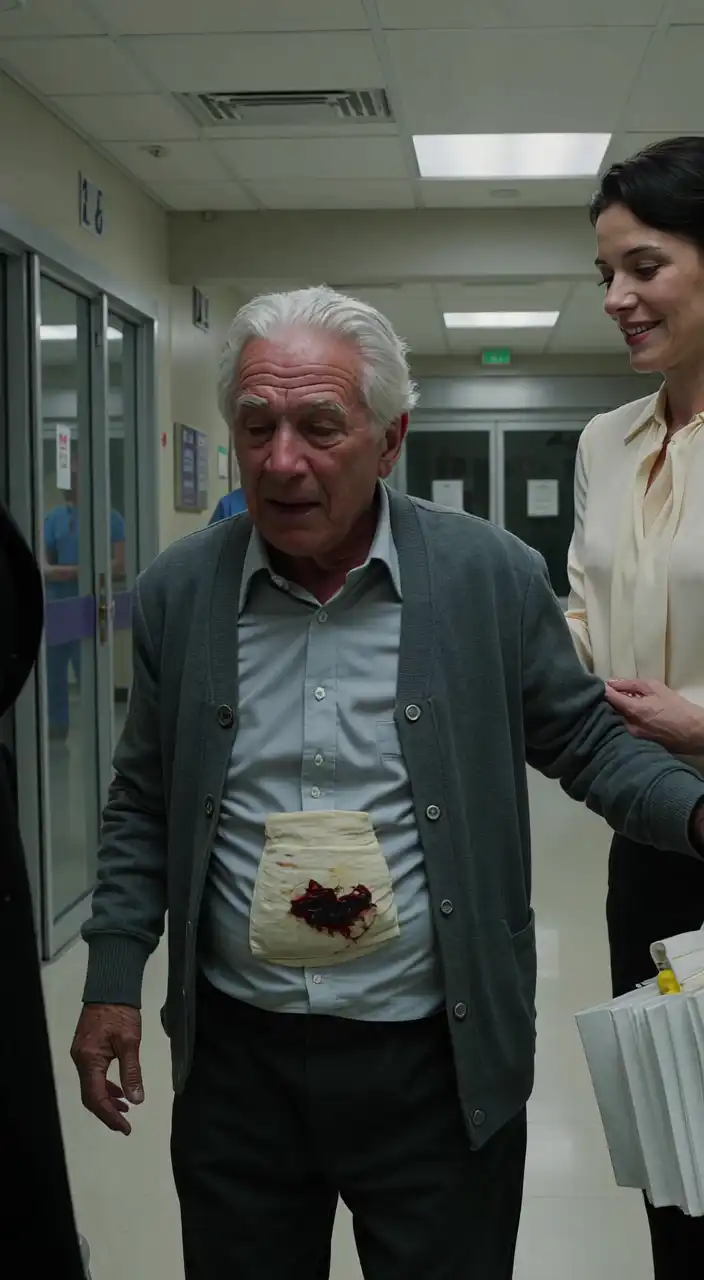
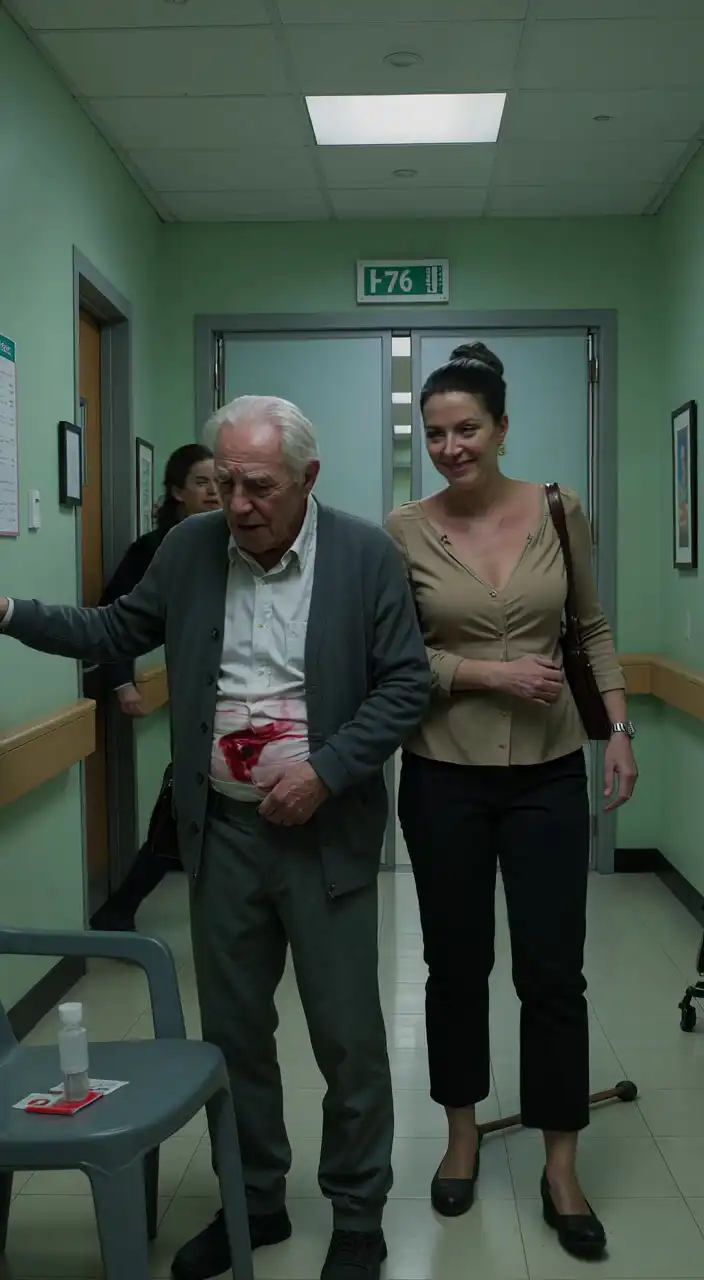
MY FATHER STARTED SHAKING OUTSIDE TRIAGE WHILE A CLINIC ADMINISTRATOR BLOCKED THE DOOR AND SAID HE NEEDED FAMILY PERMISSION FIRST.
MY FATHER STARTED SHIVERING SO HARD HIS SURGICAL BANDAGE BLED THROUGH, AND THE CLINIC ADMINISTRATOR STILL BLOCKED THE TRIAGE DOOR.
MY FATHER STARTED SHAKING IN THE HOSPITAL HALLWAY, AND THE WOMAN WHO CLAIMED TO BE HELPING HIM WOULD NOT LET TRIAGE TOUCH HIM.