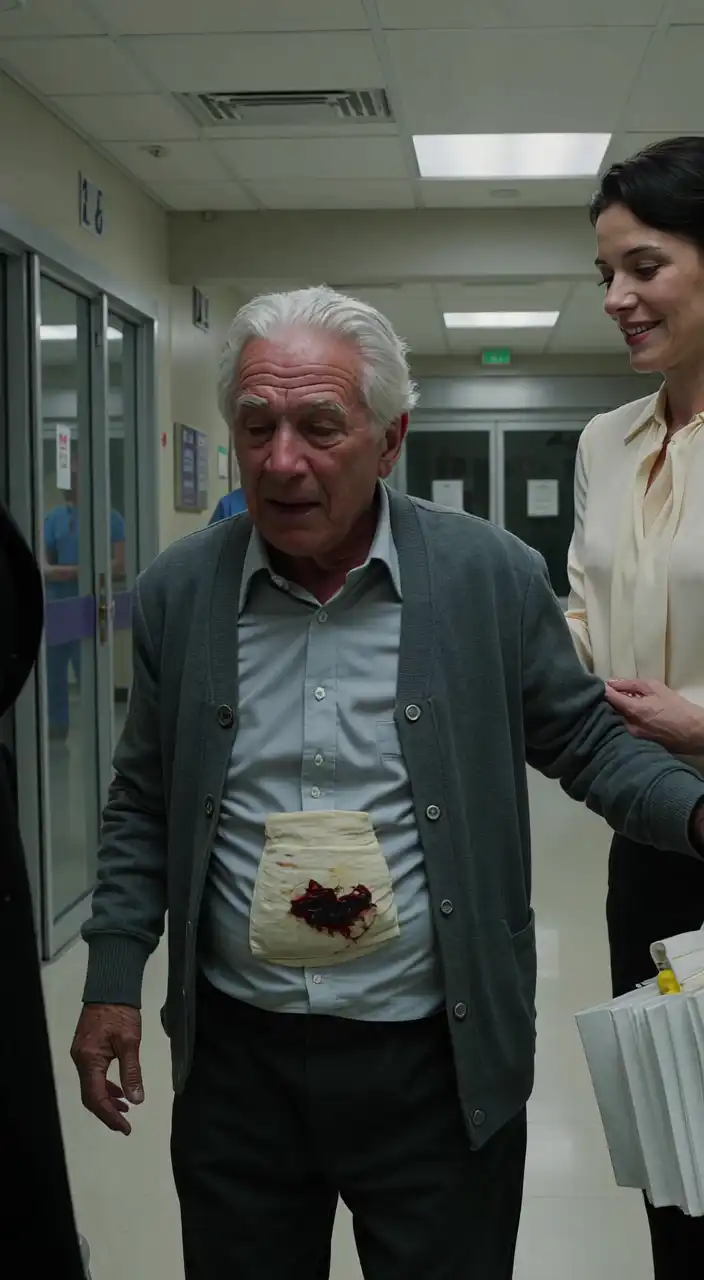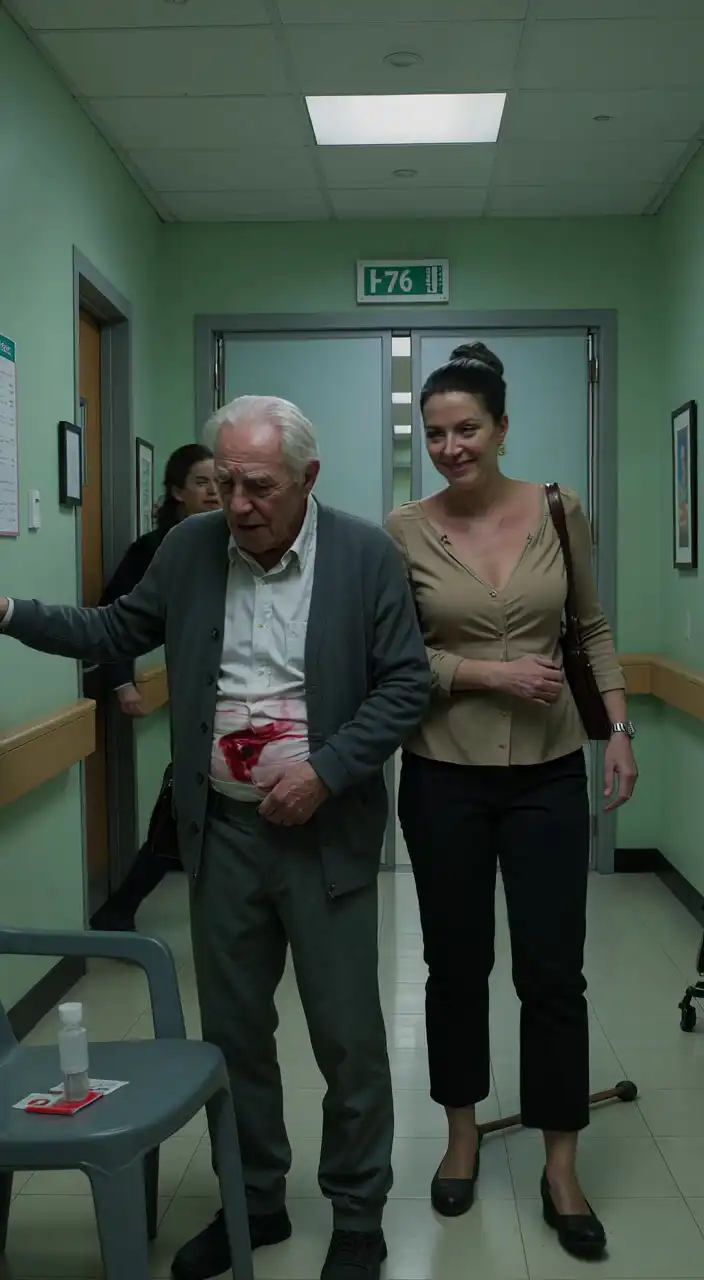
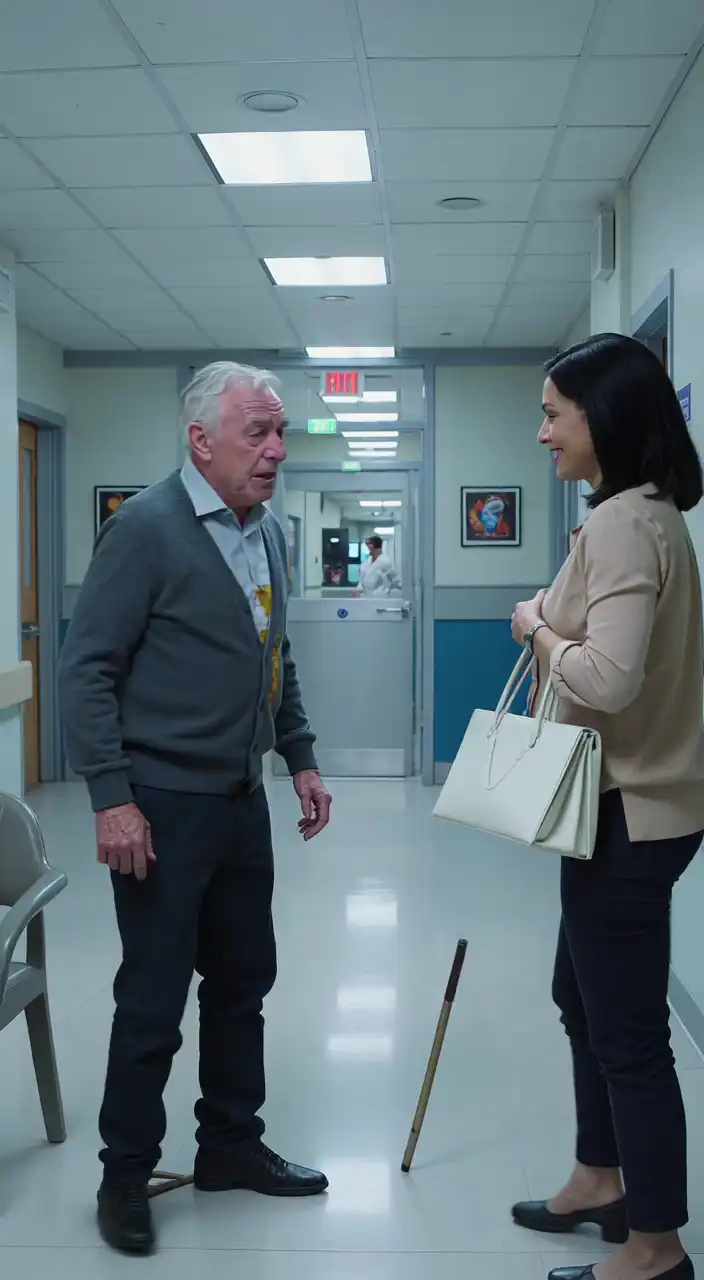
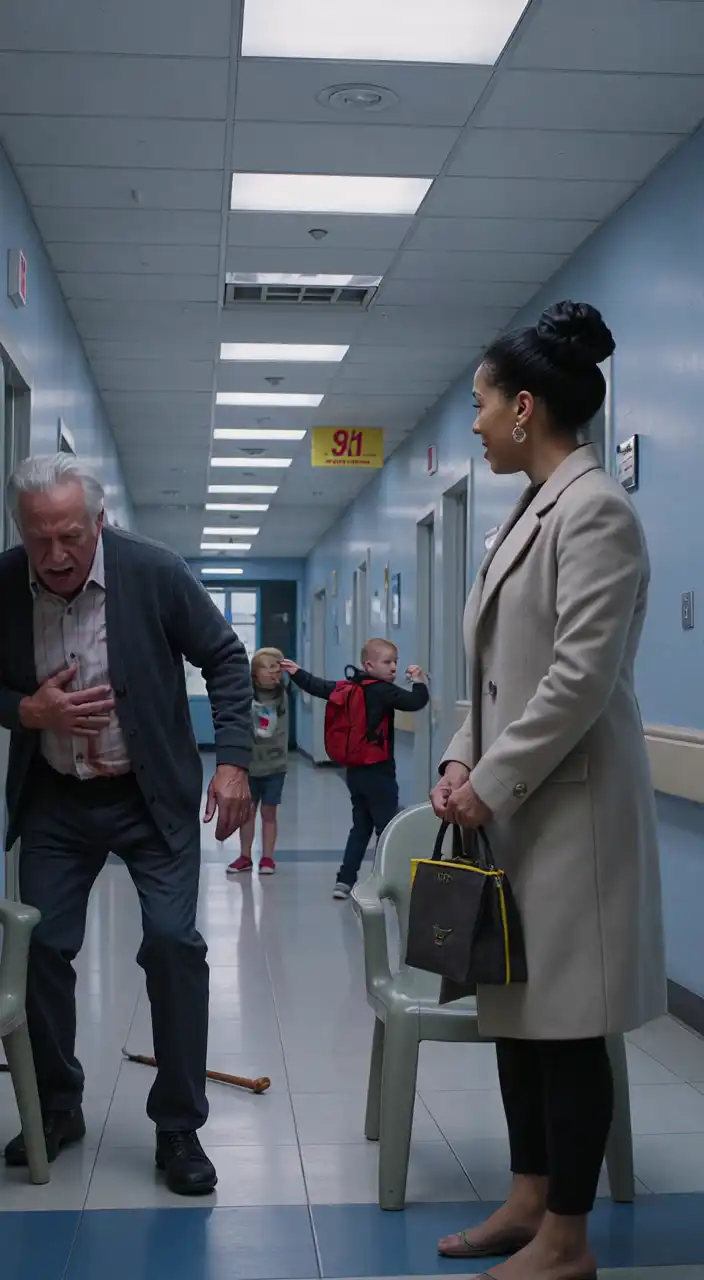

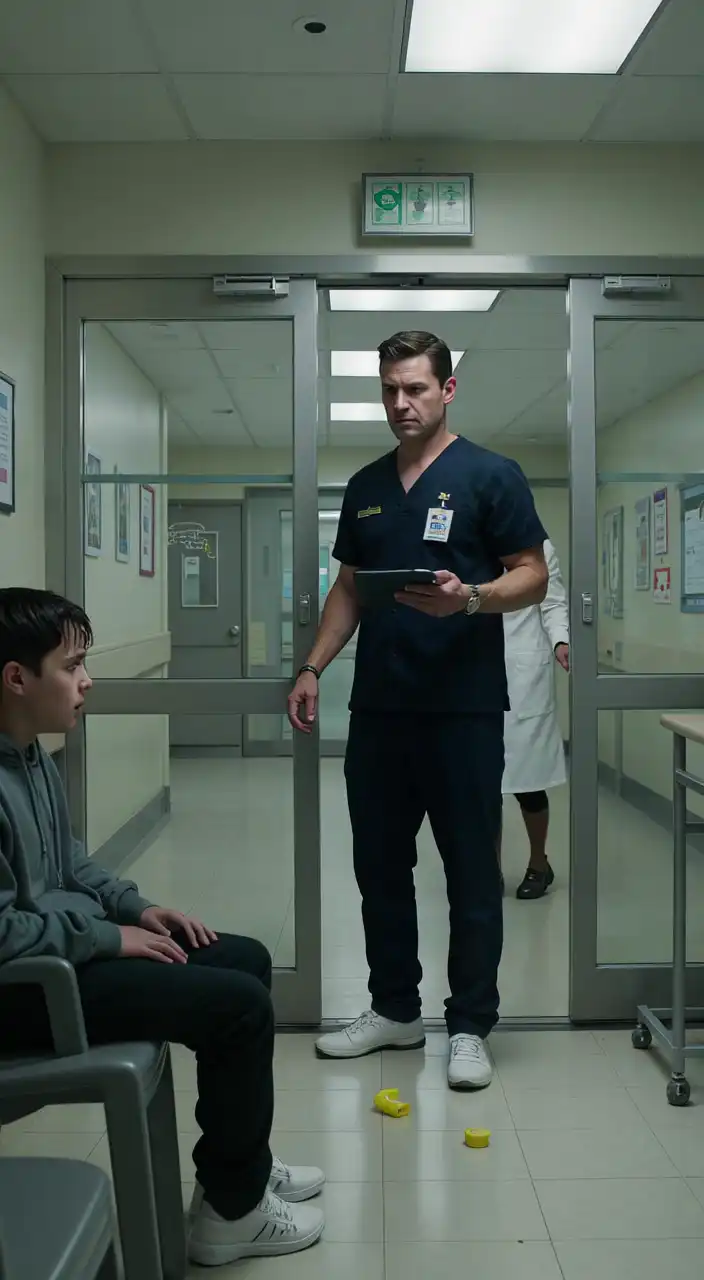
Dr. Julia Bennett did not slow down to ask permission.
She dropped to one knee in the hallway, one gloved hand already under Caleb's chin to lift his face toward the light. "Hey, Caleb. Look at me." Her voice was low and steady, the kind that cut through panic without adding to it. When his eyelids fluttered but did not fully focus, she turned her head sharply toward the triage desk. "Get me a wheelchair, point-of-care glucose, vitals, now. And page toxicology."
Thomas stepped between her and the boy so quickly his lanyard swung off his chest. "Doctor, this child is not checked in. There is no completed consent, no verified guardian authorization, and this is an administrative hold from--"
Julia stood in one motion that made him take half a step back without meaning to. "A child is altered and unstable on my floor. Move."
He tightened his jaw. "The family account associated with this minor has explicit instructions. No treatment until authorization is confirmed."
Julia did not look at him. She was looking at Caleb's right sleeve, where the yellow stain had soaked through one cuff and dried in darker rings. "What family account?" she asked.
Thomas hesitated. It was only a second, but it was enough to show he knew the answer sounded bad.
Behind him, the triage nurse came with a wheelchair and a tech carrying a glucose kit. I reached for Caleb's shoulder, and his whole body jerked as if even a gentle touch hurt. "It's okay," I said. "You're going in."
Thomas put his hand on the wheelchair handle before they could lower it. "I said no treatment."
Julia turned then, and the hallway changed around her. Her voice did not rise, but everyone heard it. "Security to triage hallway. Child welfare concern. Administrative interference with emergency evaluation."
A speaker overhead crackled her location before Thomas could recover. He pulled his hand back like the handle had burned him, then tried a different tone. Smoother. More professional. "Doctor Bennett, we all want what's best for the child. I am simply trying to avoid a liability issue. His caregiver reported possible attention-seeking behavior and repeated misuse of over-the-counter medicine."
Caleb's eyes opened wider at the words misuse and caregiver. Fear moved through him faster than the nausea. He grabbed weakly at Julia's coat sleeve and whispered, "Don't call her. Please don't call her."
That landed harder than any monitor alarm.
Julia looked down at him. "Nobody is calling anyone until you're safe."
The tech touched a strip to Caleb's finger. A beat later he frowned at the glucometer and checked the strip packet as if expecting a defect. "Repeat?" he asked.
"Read it," Julia said.
"Forty-eight."
Thomas exhaled through his nose. "Low blood sugar from poor eating is not an emergency admission basis without consent."
Julia cut him off. "He is hypoglycemic, tremulous, and altered, with a possible ingestion history and an unidentified substance on his clothing. This is not a billing conversation."
Caleb retched suddenly, a bitter yellow liquid spilling onto the tile and the front of his hoodie. The smell hit a second later: fake citrus layered over something medicinal and sharp. Julia leaned in, inhaled once, and her eyes narrowed. "That is not simple cough syrup."
The bottle cap near the baseboard mattered now. I pointed. "There."
Thomas pivoted, too late, trying to nudge it farther under the chair with his shoe. The nurse saw the motion. So did one of the security officers arriving at the end of the hall.
"Step away from the item," Julia said.
"It could be anything from the waiting room," Thomas replied, but his voice had lost its polish.
The officer, a broad-shouldered woman with silver hair pulled into a tight bun, moved between him and the wall. She crouched and used a pen to draw the cap into view. Sticky yellow residue glistened in the grooves. She looked up. "Nobody touch this until pharmacy or tox sees it."
Caleb sagged against the wheelchair as they lifted him. His hand caught on my wrist for one desperate second. "He said I'd get us both in trouble," he whispered.
"Who said that?" Julia asked.
But Caleb's eyes rolled back and his head tipped forward.
That broke the standoff. The tech and nurse got him seated, straps fastened, wheels moving. Julia walked backward beside him, watching his breathing. "Room three. IV access, dextrose, tox screen, CBC, CMP, acetaminophen, salicylate, urine if we can get it. And somebody find me social work now."
Thomas took out his tablet and started tapping fast with both thumbs. A reflex, maybe. Or a warning.
The security officer saw it too. "Sir, hands visible."
He froze, then lifted his eyes with offended disbelief, as if the very idea of being questioned in his own hospital was absurd. "I am an administrator."
"And right now," she said, "you are also part of the reason a sick child was on the floor outside triage."
The doors shut behind Julia and Caleb.
I thought that would be the moment the worst part was over. I was wrong. It was only the moment the lies had to change shape.
The social worker arrived before Julia was done hanging dextrose. Her name tag read Elena Ruiz, and she had the focused, gentle expression of someone who had learned to move fast without scaring children. She met me just outside room three while staff worked around Caleb.
"You came in with him?" she asked.
"I'm not family. I was in the waiting area. I saw what happened."
"Then I need your name and everything you saw, in order."
I gave it. Caleb on the tile. Thomas blocking the door. The line about a family account. The bottle cap under his shoe. The word again. Elena wrote fast without interrupting, except once.
"He said again?" she asked.
"Yes."
"Exact tone?"
"Like he knew what it meant and hated saying it."
She nodded grimly and glanced through the glass at Caleb. His blood sugar was climbing, but he still looked waxy and confused, small under the warm blanket. Julia was lifting the stained sleeve more carefully now, exposing the inside of his wrist. A thin plastic bracelet sat there, turned partly under the cuff. Not a hospital band. Not a child's toy. A cheap paper event bracelet, the kind you got at private venues or gated clubs.
Yellow. With black lettering.
Julia held it still and read it. Her jaw tightened.
Elena caught the look and went in.
Outside in the hall, Thomas was no longer alone. A tall woman in a cream coat had arrived with a leather handbag and the kind of controlled face people wore when they thought rules were for other people. Beside her stood a teenage girl in a school uniform blazer, maybe fifteen or sixteen, hugging herself hard with both arms. The woman walked directly to security.
"I am Adrienne Vale," she said. "My office received a frantic message that our family employee brought my nephew here without authorization. I am his legal contact. This misunderstanding needs to stop now."
There it was. Wealthy family account.
The officer with the silver bun didn't budge. "Doctor placed a child welfare hold. You can wait."
Adrienne's expression did not crack, but a flush crept up her neck. "This child has a history of dramatic episodes. His mother instructed our administrative liaison to avoid unnecessary hospital admissions because he panics for attention. If he took extra cold medicine again, that is a home discipline matter, not grounds for your staff to make accusations."
The teenage girl flinched at the phrase home discipline matter.
Elena stepped back into the hall in time to hear it. "Who are you to the patient?" she asked.
"I just said. His aunt."
The girl spoke so softly I almost missed it. "Not by blood."
Adrienne cut her a warning look. "Mina, be quiet."
That was the first independent position in the room, and it mattered.
Elena turned to the girl. "And you are?"
"Mina Vale."
"Would you like to tell me why you came with her?"
Mina stared at the closed triage door, then at the yellow stain still drying on the floor where Caleb had vomited. "Because if I didn't, she would've sent him away again."
Adrienne inhaled sharply. "That's enough."
Julia stepped out of room three before Elena could answer. In one gloved hand she held the paper wristband she had removed from Caleb. "This says Hawthorne Equestrian Gala. Yesterday's date. Why is a seven-year-old boy wearing event access under his sweatshirt?"
Adrienne's eyes flicked to it and away too fast. "Leftover from a family function."
Julia raised the sleeve with two fingers. "Then maybe you can explain why the stain on his cuff fluoresces like concentrated promethazine mixture, why he is hypoglycemic, and why he said this happened again."
The hallway went silent.
Thomas tried once more to seize control. "Doctor, toxicology is not back. You should not speculate in public."
Julia looked at him with open contempt now. "Then let's stay with facts. Fact: an unstable child was prevented from entering triage. Fact: a substance cap was hidden under your shoe. Fact: you cited a private family's wishes over emergency evaluation. Fact: this child begged us not to call his caregiver."
Mina's eyes filled instantly. She pressed her lips together, fighting herself. Adrienne noticed and took a step toward her, hand tightening on the girl's shoulder. Not enough to bruise. Enough to signal.
Elena saw it. "Hands off her."
Adrienne let go.
A lab runner pushed through the door with a sealed specimen bag containing the bottle cap. Julia took one look and said, "Send this to pharmacy and tox. Rush."
Thomas's tablet buzzed. He glanced down before he could stop himself. The officer held out her hand. "Give me the device."
"You have no right."
"I have every right while you're interfering in a child welfare emergency."
He looked to Adrienne for backup. She did not rescue him. That told me he served the family, but the family would cut him loose if needed.
He surrendered the tablet.
The screen was still lit.
At the top of the message thread was a contact labeled A. Vale. Under it, one fresh line visible in the preview: Keep him out until Nathan signs. No chart. Use policy.
The officer's eyes sharpened. She angled the tablet away from us and called for her supervisor.
Adrienne finally lost her perfect tone. "That message is privileged communication with hospital administration."
Elena said, "It's communication about delaying care for a child."
Mina whispered, "Nathan won't sign anything if he thinks Dr. Reed might find it."
Nobody had said Dr. Reed. Nobody had mentioned another doctor. All heads turned toward her.
Adrienne's face changed for one naked instant. Fear, not anger.
Mina saw that everyone had seen it. Then she did the bravest thing in the hall. She kept going.
"She made Caleb drink the yellow stuff before parties because he gets shaky and tells people things," Mina said. "And Uncle Nathan said no hospitals unless they call his friend first."
There was no taking that back.
Adrienne moved toward the girl, not fast enough to make contact before both security officers stepped in. "She is a child and she is confused."
Mina's voice shook so hard I thought it might fail. Instead it got clearer. "He isn't my cousin. He's Ms. Lorna's son. She works in the guesthouse. They said if she wanted to keep her room and his school money, she had to stop making trouble every time he got sick."
Elena's pen stopped moving. "Where is Lorna now?"
Adrienne said, "Unavailable."
Mina looked at the floor. "At the lake house. Her phone gets taken during events."
That one sentence cracked the whole structure wider. If Caleb's mother was isolated, then this was not just a bad decision at a hospital door. It was a system.
Julia went back into Caleb's room, and when she returned ten minutes later her face was harder. "His pupils, tremor, and blood pressure are not consistent with one accidental extra dose. Tox suspects repeated sedating antihistamine use, maybe combined with something else. He has bruising at old IV tape sites."
Old tape sites. Another planted detail, another quiet horror. Not random bruises. Prior medical contact, then concealment.
Elena's eyes flashed. "Someone treated and removed him before."
Julia nodded. "Or someone with access to medical supplies tried to."
The officer with the bun was already on her radio, calling county child protective services and law enforcement. Adrienne demanded a lawyer. Thomas demanded his supervisor. Mina stood frozen beside the chairs, staring at the yellow stain on the floor like it might swallow her.
I moved to her carefully. "You helped him."
She shook her head immediately. "Not enough."
"Enough to start this."
Tears spilled then, silent and furious. "I hid his inhaler in my backpack once so they couldn't say he lost it. I took pictures of the bottles because the labels were torn off. I thought if I had proof, I'd know what to do. But every time, Thomas fixed it. He'd call ahead. They'd say consent, billing, family approval." Her voice dropped. "I should've run with him sooner."
That was the emotional pressure point at the end of the first turn: Caleb was inside but not safe yet, and the child who knew the truth had finally spoken. The family had money, influence, and a private doctor nobody trusted. Somewhere off-site, Caleb's mother was cut off. And now that the lie had broken in public, the people protecting it would either fold or get dangerous.
They chose dangerous.
The county investigator arrived just before evening rounds, a blunt woman named Dana Pritchard with tired eyes and a jacket that looked slept in. She listened to Julia's summary, reviewed the visible messages from Thomas's tablet, took Elena's notes, then asked one question that made everyone still.
"Where is the mother's employer-provided housing contract?"
Adrienne folded her arms. "What does a housing arrangement have to do with this child's medical care?"
Dana didn't blink. "If a family's shelter depends on obedience, then consent is compromised before we start."
Thomas, pale now, said, "I don't manage private employee housing."
"No," Mina said, voice small but steady. "You just manage the clinic account and call when she asks."
Adrienne hissed, "Mina."
Dana pointed to the chairs. "Sit down. You don't get to coach her."
Mina sat. Adrienne did not.
Inside room three, Caleb was more awake after the dextrose, but waking made him frightened rather than calm. Julia tried to check his pupils again and he recoiled, arms flying up to cover his face. "No more yellow. I drank it. I drank it."
"You don't have to drink anything here," Julia said.
His hands trembled against the blanket. "If I say no, she cries."
"Who cries?" Elena asked from the doorway.
He pressed his lips shut so hard they whitened. Julia shifted. "Then tell me this instead. Does your stomach hurt now?"
He nodded.
"Did it hurt before you came in?"
A smaller nod.
"Did anyone tell you what the medicine was for?"
He whispered, "To help me be sweet."
The room went cold.
Children repeat the language used around them. They do not invent phrases like that in moments of crisis. Julia looked at Elena; Elena looked at Dana. No one needed that line explained.
Dana came to stand by the bed. "Caleb, my name is Dana. I'm here to help make sure no one keeps you from the doctor again." She spoke slowly. "Do you know your mom's phone number?"
He blinked at her. "I know the song."
"The song?"
He tapped one shaky finger against the blanket in a rhythm. Not a song exactly. A counting trick kids use to remember numbers. Julia grabbed a pen and wrote as he tapped. When they called, the line went straight to voicemail.
Dana called again. Same result.
Mina, from the doorway, said, "They take Ms. Lorna's phone when there are guests."
Dana turned. "Who is they?"
Mina swallowed. "My aunt. Sometimes Nate. Sometimes the house manager if she tells him."
"Nate" would matter later. A name wrapped in authority and fear.
Julia finished her exam and stepped into the hall. "He has mild wheezing too. Lungs aren't terrible, but he needs observation. We also found adhesive residue in the crook of both elbows. Someone put something in him recently."
Dana asked the question everyone was avoiding. "Could somebody have taken him to an outpatient office, given him fluids or meds, and kept it off the chart?"
"Not legally," Julia said.
"That wasn't my question."
Julia's silence answered.
A deputy from county sheriffs arrived next, followed by a second CPS worker and hospital risk management, who looked deeply unhappy to discover this wasn't going away quietly. The supervisor taking Thomas's statement came out of the security office with a pinched expression. "His tablet messages were manually deleting on a timer," he said to Dana. "We caught some previews on lock screen, but not all content."
Thomas looked straight ahead. "I follow data retention policy."
Mina laughed once, bitter and involuntary. "No. You follow my aunt."
That was the plausible but incomplete explanation beginning to form: wealthy family, vulnerable employee, sick child, improper pressure on a hospital administrator. But incomplete meant there was still something hidden.
It appeared in the form of a call from pharmacy.
Julia put the phone on speaker because Dana requested it. The pharmacist sounded tight. "The residue on the cap is from a promethazine syrup compounded with dye marker, but there's also trace hydroxyzine. More important, the cap doesn't match standard retail packaging. It's from a clinic sample bottle."
Julia's head came up. "A sample bottle from where?"
"Hard to say yet. There are no lot numbers, but the threading is consistent with physician office dispensers, not store-bought meds."
Mina whispered, "Dr. Reed."
Adrienne snapped, "You don't know what you're saying."
Mina's hands balled in her lap. "I know he keeps unmarked samples in the locked cabinet by the exam sink because he gave me mints from the top drawer and told me not to touch the lower one."
Dana fixed on her. "Who is Dr. Reed?"
Adrienne kept silent this time, which said plenty.
Mina answered. "He's our concierge doctor. He comes to the estate. He says hospitals overreact."
A private doctor who treated wealthy families at home. A doctor whose name caused visible fear. A doctor whose office might use sample bottles with no obvious retail labels. Now the earlier message from Adrienne - Keep him out until Nathan signs. No chart. Use policy. - had a shape behind it. They were not just afraid of cost or scandal. They were afraid of documentation.
Dana asked, "Who is Nathan?"
"My uncle," Mina said. "Nathan Vale."
The surname hung there. Even I recognized it. Real estate, charity galas, local board money. The kind of last name people softened around without realizing.
Elena sat beside Mina. "Why would Nathan need to sign before a hospital saw Caleb?"
Mina looked at her own knees. "Because if the real doctors saw him enough times, they'd report it."
Adrienne exploded. "This is outrageous. You are taking the word of a traumatized girl and a child employee's son over a respected family and hospital professional."
Julia said, "No. We're taking the word of labs, messages, a blocked emergency evaluation, and a boy with repeated unexplained sedation."
Adrienne's control slipped one inch further. "Repeated? You don't know repeated."
Julia answered by handing Dana the chart printout. Newly entered tonight, but based on Caleb's body: old tape residue, variable bruising, prior patterns. "He has evidence of multiple recent interventions."
Dana turned to the deputy. "I want welfare checks at the Vale estate and lake house. I want contact on the mother now. And if Dr. Reed has an office, I want preservation on records before they disappear."
Thomas finally spoke with something close to desperation. "You can't raid a physician over assumptions."
Dana looked at him. "Watch us get a warrant."
The mini-hook landed when Mina reached into her blazer pocket with trembling fingers and pulled out a folded napkin. For a second I thought she was about to wipe her eyes. Instead she opened it on her lap.
Inside were three tiny phone photos, printed from some cheap kiosk, cut unevenly by hand. Blurry but legible enough. A yellow bottle beside a silver horse-head tray. Caleb asleep on a guesthouse sofa in daylight, impossible to wake, his wristband from the equestrian gala still on. And the last one: a document on a desk with the heading "Temporary Educational Support Agreement" and Lorna's signature at the bottom.
Not school money. Leverage.
Dana picked up the photo with the document. "Where did you get this?"
Mina's mouth trembled. "From my aunt's study. I thought it was just for tuition." She looked at the signature again. "But the line above says occupancy contingent on cooperation."
Adrienne lunged for the photos.
The deputy caught her wrist before she reached them.
From that point on, every adult who had counted on quiet procedure had a new problem: a teenager had brought proof, and the proof connected medical suppression to housing control. Still, proof on napkins was not enough to secure Caleb and his mother if the estate had time to close ranks. Dana knew it. Julia knew it. Which was why they had to move before night ended.
By midnight, the hospital no longer felt like a place of simple treatment. It felt like a perimeter.
A sheriff's unit went to the lake house and found no Lorna. The gate attendant claimed the staff had all gone off-shift after the gala cleanup. The guesthouse on the main estate was locked. The family attorney was already calling county offices, asking sharp questions about defamation and unlawful detention of a minor from a "supportive host family."
Supportive. The language of clean abuse.
Dana spread the napkin photos, tablet screenshots, and initial lab notes across a consultation room table. Julia stood beside her in wrinkled scrubs, reading everything twice. Elena sat with Mina in the corner, keeping the girl anchored while two officers rotated outside Caleb's room. The deputy, Marcus Hale, came in from another phone call and shut the door with his heel.
"Judge signed the emergency protective order for the child," he said. "Temporary. But we still don't have the mother."
Dana rubbed her forehead. "And without the mother, the Vales will argue she placed the child in their care voluntarily and refused outside interference."
Mina lifted her head. "She never refuses. She freezes."
That mattered because motive mattered. Lorna was not absent out of indifference. She was trapped in dependence.
Julia pointed at the photo of Caleb asleep on the sofa. "This wristband places him at the gala yesterday. How many guests saw him?"
Mina answered, "Not many. He was supposed to stay in the guesthouse."
"Supposed to?" Dana asked.
Mina looked ashamed. "He wandered in when the fireworks started. He gets scared of loud sounds but also wants to see everything. Aunt Adrienne was furious because donors were there. Dr. Reed took him into the den and brought him back sleepy."
The room turned to her.
"Did you see him give Caleb anything?" Julia asked.
"No. But Caleb's sleeve got stained then. The yellow was fresh."
Payoff. The wristband, the stain, the earlier phrase again. Not a random accident. A repeat event with witnesses.
Marcus said, "Can anyone place Dr. Reed at the estate yesterday besides Mina?"
Thomas, who was being held in a separate office, refused to answer further without counsel. Adrienne denied everything beyond routine social contact. But hospital security had already pulled vehicle footage from the staff lot entrance, and a black SUV registered to Reed Concierge Medical had arrived at 4:12 p.m. and left at 6:03.
Dana smiled without humor. "Good. So if his office records disappear tonight, that becomes interesting."
Julia glanced through the glass at Caleb. He was sleeping now, but uneasily, small chest rising too fast. "He may wake combative again when the sedating agent clears. We need his mother's voice if possible."
Mina spoke up. "He knows her church song."
Dana looked over. "The phone number song didn't reach her."
"No," Mina said. "I mean he calms when she sings."
Elena asked softly, "Can you sing it?"
Mina nodded once, embarrassed.
In the room, when Caleb woke twenty minutes later disoriented and reaching for the blanket edge like it was a ledge, Mina stood by the bed and sang under her breath. A simple church hymn in a child's key, unsteady but true. Caleb's breathing slowed enough for Julia to listen to his lungs again. One more planted detail paying off: not just a song for numbers, but the way care sounds when it's real.
He looked at Mina with confusion, then recognition. "You came."
"Yeah," she said, swallowing tears. "I came."
He stared at the officer by the door. "Will they take me back?"
Dana stepped into view. "No."
Children can hear when adults lie from kindness. Caleb watched her for a long second, measuring. Then he asked, "What about Mama?"
That question became the new threshold.
Mina knew something she had not said because she had been afraid it would make things worse. You could see the battle in her face before the words came out. "Aunt Adrienne said if Ms. Lorna ever ran to the hospital, they'd tell everyone she was stealing meds from the estate. They keep old bottles in the laundry room. She said there was security video."
Dana went still. "Security video of what?"
Mina shook her head. "I don't know if it's real. But she said they could make it look real enough."
There was the new lie or desperate action: not just blocking care, but preparing a theft story to bury the mother if she resisted.
Marcus leaned over the table. "Then we don't just need Lorna. We need the estate cameras before they edit."
A second team was dispatched with the order. At 2:15 a.m., they met the family's private security supervisor, who insisted the system was cloud-managed by an outside vendor and inaccessible without corporate approval. Convenient. Too convenient.
At the hospital, another reversal hit. Toxicology called back with serum levels suggesting more than one dose over time. Not enough to kill, but enough to sedate, disorient, and create recurrent weakness. Julia explained it plainly in the consultation room.
"Whoever gave this to him wasn't trying a one-time punishment," she said. "This pattern looks like behavior control."
Nobody spoke for a moment.
Then Mina did. "He tells the truth when he's scared."
The phrase unlocked everything emotionally. Caleb was not drugged because he was sick and difficult. He was drugged because he talked.
Dana asked, "Talked about what?"
Mina's eyes moved to Adrienne's seized phone on the evidence bag. "About the baby."
Everyone stared.
"There is no baby in this case file," Marcus said.
"Not now," Mina whispered. "Before."
This was the larger contradiction entering the story. Caleb had seen something else, something the family believed needed suppressing. The reason for the drugs might be broader than public behavior at parties.
Mina explained in halting pieces. One of the estate housekeepers had been pregnant last year. She left suddenly. Caleb had once asked, loudly, at brunch why "the crying room" in the carriage house was empty now. Adrienne had gone white. After that, whenever guests visited, Caleb was kept away or made sleepy.
A missing pregnant worker. A crying room. A child witness. Possibly nothing. Possibly everything.
Dana lifted a hand. "We do not spiral theories at three in the morning. We secure what we can prove."
But Julia looked unsettled, and rightly. Because if Caleb had been repeatedly sedated to stop him from speaking, the underlying secret might make the adults more desperate before dawn, not less.
At 3:07 a.m., hospital IT brought in one more piece. Thomas had used his badge earlier that afternoon to open an unused outpatient procedure room. Camera stills showed him entering alone with a brown paper bag and leaving twelve minutes later without it.
"He stashed something," Marcus said.
Security opened the room with Dana present. Inside a cabinet beneath the sink sat the brown bag. In it were three clinic sample bottles with labels peeled off, a roll of paper patient wristbands, and a folded form bearing the header of Reed Concierge Medical. The form was partially completed for "home observation after antiemetic administration." Patient name left blank.
Julia stared at it. "Blank prefilled discharge language."
Dana bagged it. "So they could medicate a child and backfill a story later."
When they returned to the consultation room, Caleb's monitor alarm was sounding. Not shrill, but urgent enough.
He was coughing hard, wheezing now, trying to pull his oxygen tubing off. Julia moved in fast. "Caleb, stay with me."
He clawed weakly at his chest. "My inhaler."
Mina looked sick. "I told you. I hid it once."
"Where is it now?" Julia asked.
Mina covered her mouth. "Aunt Adrienne took my backpack in the car."
Adrienne, under supervision in a nearby office, had arrived with a designer handbag and no visible backpack. Which meant the bag was still in her vehicle or with the driver who had left.
Julia started a nebulizer and ordered another bronchodilator. Caleb's oxygen dipped, then steadied. But the emotional edge sharpened: even now, things he needed were still being withheld.
Dana watched through the glass and made a call. "Impound the Vale vehicle. Full inventory. Now."
The moral reversal deepened at dawn when the judge extended protective custody based on imminent medical danger and probable coercive control. For the first time, the Vales' status no longer ran ahead of the facts. But status does not vanish cleanly. It fights on the way down.
At 6:40 a.m., Dr. Nathan Reed himself walked into the hospital in a navy cashmere coat carrying the confidence of a man unused to being stopped. He smiled at the front desk, then at security, then at Dana. "I've been told my name is being tossed around in a highly irresponsible way. I am the child's physician by informal family arrangement. If he has had a paradoxical reaction to an over-the-counter antihistamine, I can clarify dosage history."
Julia, who had been waiting for exactly this kind of entrance, stepped from the hall with the evidence bag containing the sample bottle cap. "Perfect. Then you can explain why your office uses these."
He looked once. Too long.
That was enough.
Reed recovered instantly. "Many offices receive samples."
"Do many offices also prefill blank home-observation forms for unnamed pediatric patients?" Dana asked.
His smile thinned. "I will not dignify stolen paperwork."
Mina, seated near Elena with a blanket around her shoulders, lifted her head. "You told Aunt Adrienne hospitals overreport and ruin families."
He turned toward the voice, and for the first time his composure wavered. He had expected adults, lawyers, administrators. He had not expected the teenage witness to still be there.
"You are upset," he said gently, trying to pull rank through softness. "This environment can make children say frightening things."
Mina looked straight at him. "You said Caleb needed to sleep through the guests."
Julia's eyes went hard. "Get him out of my hall."
Dana held up a hand. "Not yet. I want to hear him deny he was at the estate yesterday."
Reed said nothing.
Marcus spoke from the doorway. "Vehicle footage places you there."
Silence again.
Then Reed chose his line. "House-call medicine is often misrepresented by people who don't understand it. Families request discretion."
"There it is," Julia said. "Discretion over documentation."
Dana leaned closer. "Tell me where Lorna is."
"I have no idea who that is."
Mina answered for him. "Ms. Lorna. Caleb's mom."
Reed looked at Caleb through the glass and made the mistake that gave away motive. Not sympathy. Calculation. Measuring how much the child could say once fully alert.
Dana saw it. So did Julia.
"You're done here," Dana said.
Reed turned to leave, and security moved with him.
The obstacle at the end of this movement was clear and sharp: the medical pattern was established, but the mother was still missing, the inhaler and possibly other proof were in a seized vehicle not yet searched, and the adults responsible were beginning to lawyer up in earnest. Worse, Caleb was waking more, which meant memory might return before the system could protect what he said.
The final threshold before rescue was no longer just treatment. It was whether the truth could reach daylight before wealth and procedure buried it again.
The search of Adrienne Vale's car should have been simple. It wasn't.
By the time the impound authorization cleared, the black SUV had been moved from valet staging to a private garage tied to the Vale foundation offices. Someone had tried to outrun the paperwork by using ownership layers. Marcus and another deputy drove there with the order while Dana stayed at the hospital. Julia wanted to go with them, but Caleb's condition kept her anchored. His glucose had stabilized, yet he swung between exhausted sleep and bursts of panicked wakefulness, and the wheezing returned whenever he cried hard.
Around nine in the morning, after a nebulizer treatment and another failed attempt to sip juice, Caleb looked at the pulse ox on his finger and whispered, "Is that red light recording me?"
Julia pulled up a chair. "It's just checking your oxygen."
He stared at the glowing number. "If I say bad things, do I still have to go home?"
There are questions no child should know to ask.
"No," Julia said. "You don't have to go home with anyone who hurt you."
He thought about that. "Even if they paid?"
Julia's throat worked once. "Especially then."
He nodded as if some private equation had finally balanced, but relief did not come. He kept looking toward the door, waiting for someone.
Mina remained nearby, doing homework someone from the hospital school liaison had brought, though she barely touched the pages. Elena stayed with her, rotating breaks with another social worker. Every time Mina's phone buzzed with a family call from an unknown number, she handed it over unopened. Dana collected them all.
The car inventory team called first with the easy finding: Mina's backpack was in the rear cargo area. Inside was a blue rescue inhaler wrapped in a pair of socks, two granola bars, and a cheap prepaid phone with a dead battery.
"She was preparing to run," Elena said softly.
Mina's face turned bright red. "I didn't know where. I just knew if he got bad again, I couldn't wait."
The harder finding came minutes later. Hidden in a side pocket of Adrienne's handbag, deputies found a key card for the foundation garage office and a flash drive on a silver horse-head keychain that matched the tray in Mina's photo. Another planted detail returning with teeth.
Dana asked for the drive to be brought straight to hospital security rather than county intake so she could review it with chain of custody witnesses. "If this is what I think it is, I want no delay."
While they waited, Reed's attorney filed an emergency demand for return of seized medical materials, arguing patient privacy. Thomas, placed on administrative leave, suddenly requested to revise his statement. Adrienne stopped speaking altogether. Pressure was working on one weak point but hardening the others.
Then Caleb asked for the bathroom and refused everyone except Mina to walk him to the door.
Julia allowed it with the officer right outside. Caleb moved slowly, one hand on the wall. Halfway there he stopped under the hand sanitizer dispenser and stared at its clear contents with visible dread.
"It smells like his office," he said.
"Dr. Reed's?" Mina asked.
He nodded.
That sensory link mattered. Julia swabbed the yellow stain residue from the inside cuff again and sent another note to tox about matching fragrances and excipients. Not enough for court by itself, but another thread.
When Caleb came back to bed, more awake than before, he began talking in fragments. Not a full disclosure. Children rarely hand you a neat timeline. They hand you islands.
"The den had horses on the walls."
"The room with the sink was cold."
"He said sweet first, then sleepy."
"Mama said no guests if my chest was bad."
"Thomas said not to make forms."
Julia wrote each phrase exactly as spoken.
Dana listened, then crouched beside the bed. "Caleb, when you said again in the hallway, did you mean the yellow medicine?"
He nodded.
"Again from who?"
He looked at Mina, then at Julia, then down at his own blanket. "Lady A if company came. Doctor man if I threw up."
Lady A. Adrienne. Doctor man. Reed.
That was enough for a criminal referral, but Dana still wanted the mother. Without Lorna, the defense would call everything coached by outsiders. Caleb's word mattered enormously, but protecting him meant protecting the person who had the longest history with him.
At 10:22, the flash drive arrived.
Hospital security imaged it in front of Dana, Marcus, risk management, and one grim-faced assistant county attorney who had shown up after hearing the Vale name. The drive held exported clips from the estate camera system, most with neat date labels. Several had been deleted recently but were recoverable.
The first recovered clip showed nothing dramatic: guesthouse kitchen, Lorna cleaning, Caleb coloring at the table, Adrienne entering and speaking sharply. No audio. In the corner of the frame sat a plastic medication caddy.
The second clip hit harder. Carriage house hallway. Late evening. Lorna carrying a half-asleep Caleb while Reed followed with a bag. Lorna stopped outside a small room, shaking her head. Reed said something. Adrienne stepped into frame and handed Lorna a paper. Lorna looked at it, shoulders collapsing. Then she went inside.
"Pause," Dana said.
Marcus zoomed.
The paper's heading was blurry but recognizable enough to everyone who had seen Mina's photo. Temporary Educational Support Agreement.
Leverage used in motion.
The third clip was why the drive had been hidden. It showed the guesthouse porch from two nights before the gala. Lorna, crying, trying to get past Nathan Vale toward a parked car. Caleb stood in pajamas on the top step holding an inhaler. Nathan took the inhaler from his hand, gave it to Adrienne, and pointed back toward the door. Reed arrived moments later, speaking calmly, ushering everyone inside. The clip ended.
Mina made a choking sound beside Elena. "I knew there was video."
Dana's voice hardened to steel. "Now we know why they wanted the cloud inaccessible."
The assistant county attorney was already texting. "Preservation order for all estate footage, foundation servers, and Reed office records. Today."
Then came the major reversal no one expected: in one of the deleted clips, not yet fully restored, Thomas appeared at the estate in plain clothes, carrying medical supply boxes into the guesthouse. Not just a hospital administrator helping with phone calls. He had been physically involved.
Julia stared at the frame. "Tape residue. Supplies. Home interventions."
Thomas had not merely blocked care at the hospital. He had helped create a substitute medical channel off the books.
Dana exhaled slowly. "That makes him a witness and participant."
For a moment, everyone in that room felt the shift. This was no longer one influential family minimizing a sick child. This was organized concealment of repeated sedation and blocked emergency care.
At 11:15, another call came from deputies at the estate. A groundskeeper had finally admitted that Lorna had not gone to the lake house. She had been sent that morning to a disused caretaker cabin near the old riding trail "to rest." Translation: isolated.
Marcus left immediately with two units and the protective order. Mina wanted to go; Dana refused. Caleb, overhearing the word Mama from his bed, went rigid with hope so sharp it looked painful.
"Bring her," he whispered.
"We're trying," Julia said.
The wait for that retrieval was the longest hour in the story.
Reed was formally detained for questioning after records staff from his office could not produce lawful documentation for pediatric administrations to Caleb. Adrienne's lawyer arrived and demanded private conversation; Dana denied access to Mina pending forensic interview arrangements. Thomas's revised statement finally came in through counsel, attempting to recast himself as someone who "accommodated family requests in good faith to prevent unnecessary pediatric trauma." But the recovered footage undercut that instantly.
Caleb's condition teetered emotionally more than medically now, which can be its own emergency. He asked every few minutes if his mother knew where he was. He refused pudding because it was yellow. He stared at his own event wristband, now bagged in evidence, and cried when Mina said she had taken it off for him. "That means party day is real," he said. "I wanted it not real."
Julia sat with him through the sobbing until he could breathe again. "Real things can still end," she told him.
At 12:07, Marcus called from the road.
"We found Lorna," he said.
Dana closed her eyes for one second before asking, "Condition?"
"Exhausted. Dehydrated. Bruising on one wrist. No major acute injury. She's terrified we'll take Caleb because she signed papers."
Dana said, "Tell her the papers don't beat emergency law."
There was silence, muffled conversation on his end, then his voice softer. "She wants proof he's alive before she gets in the car."
Dana handed the phone to Julia, who angled it so the camera caught Caleb propped in bed with oxygen off now, blanket to his chest. "Lorna? This is Dr. Bennett. Your son is safe."
The sound that came through the speaker was not quite speech at first. Then a woman's broken voice: "Baby?"
Caleb sat up so fast the monitor leads tugged. "Mama?"
No one in that room forgot what that did to the air.
Lorna cried openly, and Caleb cried with her, and every official boundary between evidence review and family relief had to coexist for those thirty seconds. Then Lorna said the sentence that raised the final obstacle even as rescue came into view.
"I told them no this time," she said. "So Nathan said if I ran, he'd show the police the medicine in my laundry and say I poisoned my own child."
The backup narrative was live. They had staged her as the culprit.
Dana took the phone back. "Then we meet that head on. Come here. We already have their bottles, their messages, and their videos."
But staged evidence in a worker's housing could still muddy things fast. The rescue was not complete until Lorna was inside, safe, and able to identify what had happened before the Vales' story reached local channels or sympathetic officials.
Marcus gave an ETA of thirty-five minutes.
In those thirty-five minutes, Adrienne made her last play.
She requested to use the restroom near the family waiting alcove. A deputy accompanied her, but in the narrow hall she feigned dizziness and slumped just enough to create a scramble. In that moment she grabbed a volunteer's unattended phone from the counter and sent one text before being stopped.
To whom? They found out quickly.
The message went to the foundation communications director: Prepare statement. Employee stole sedatives. Child medically fragile. Family assisted.
Dana swore under her breath when she saw it. "They are going to try to get in front of this before the mother arrives."
The assistant county attorney was already moving. "I'll call the prosecutor's office and lock media comment."
Julia looked at the time, then at Caleb. "Just get Lorna here."
The entire story compressed into that need.
When Lorna finally stepped onto the pediatric floor, wearing borrowed scrubs pants and a sheriff's windbreaker over a wrinkled housekeeper polo, she looked both younger and older than I expected. Younger in how quickly her face broke when she saw him. Older in the way fear had settled permanently around her eyes.
She did not run. People who have been punished for sudden movement learn not to. She walked fast, then stopped at the threshold like she needed permission to believe.
Caleb held out both arms.
That was the line rescue crossed.
Lorna reached him in three steps and folded over him, careful of the IV, careful of the monitor, careful of the little body that had been treated like a problem instead of a child. He buried his face in her neck and sobbed so hard he hiccuped. She kept saying, "I'm here, I'm here, I'm here," like she was stitching each second back into him.
Julia turned away to give them the room. Elena cried silently. Even Dana's eyes went glassy before she reset into work mode.
Because work still had to happen.
Lorna gave her statement in fragments at first, then with force once she understood she was not being set up. She had worked for the Vales for three years. Housing for the guesthouse and Caleb's school fees were bundled into employment agreements she never fully had time or money to review. After Caleb developed intermittent wheezing and anxiety around loud events, Adrienne began calling him disruptive. Dr. Reed offered "calming syrup" and occasional "home hydration" when he became weak or agitated. Lorna objected repeatedly. Nathan reminded her of the contract and the debt they had "covered" for her move. Once, when she threatened to take Caleb to urgent care on her own, Thomas called ahead and told intake there was a consent issue tied to an employer dispute. She waited three hours and left after being told legal authorization had to be clarified.
Blocked care as a system. Not one hallway. Multiple thresholds.
She had hidden the inhaler once in a cereal box after noticing it disappeared before donor weekends. Mina had found it and later hidden it in her own backpack when she realized Adrienne was searching the guesthouse. Another planted detail fully repaid.
The "crying room" Caleb mentioned turned out to be a nursery prepared for a pregnant staff member Nathan had pressured into a hush arrangement after a relationship scandal. When she left abruptly, the room remained locked, and Caleb had innocently asked about the baby in front of guests. After that, his tendency to "say the wrong thing" became, in Adrienne's mind, a social threat. Reed's sedating syrup gave them a way to keep him quiet without visible force.
That was the second major reversal: the original motive was broader than simple child annoyance. Caleb had become dangerous because he noticed truths adults wanted buried, and the same coercive system trapping his mother had likely trapped others.
Dana moved immediately. With Lorna's statement, the recovered footage, tox results, and the hidden sample bottles, warrants expanded. Reed's office was searched that afternoon. Investigators found unlabeled pediatric sample containers, blank observation forms, and cash ledger notations tied to "estate visits." Thomas's role became explicit through badge logs and supply orders. Adrienne and Nathan could no longer hide behind polished language.
But the story's moral center stayed where it belonged: at the hospital bed where blocked care became exposed care.
By evening, Caleb had color back in his face. He was still weak, still clingy, still refusing anything yellow, but he could sit up and hold a cup of apple juice by himself. Mina was allowed a supervised visit after her parents arrived from out of state and a separate guardian advocate was assigned. She stood awkwardly by the bed until Caleb lifted the blanket edge in invitation. She sat, and he leaned against her side like siblings of circumstance.
"I kept your inhaler," she said.
"I know."
"I should've done more."
He thought about that with the brutal seriousness children bring to fairness. "You came."
For her, that was enough to break open the guilt she had been carrying. She cried into her hands. Lorna reached over and covered one of them. Not as employer family, not as hierarchy, just as one frightened person thanking another for refusing silence.
Julia returned near shift change with the update everyone had earned. "Social work has emergency placement lined up that's not connected to the estate. Temporary, private, and secure. Caleb stays overnight for observation. Lorna, you'll stay here with him. No one from the Vales gets access."
Lorna closed her eyes in relief so pure it looked like pain leaving the body.
Dana added the last practical promise. "And before anyone says otherwise: no paper you signed takes away your right to emergency care for your child. What they did is on them."
In the hallway where Caleb had first been blocked, environmental services had already scrubbed the floor. The yellow vomit stain was gone. The bottle cap was in evidence. Thomas's access badge had been deactivated. Triage doors still slid open and shut, but now when the nurse called the next patient, no one stood there using status as a barricade.
A week later, after the first hearings, after headlines finally used the right words instead of the family's preferred ones, Caleb came back to the hospital for follow-up. He wore a clean hoodie, carried his inhaler in a little zip case clipped to his belt loop, and walked beside Lorna instead of behind anyone. Mina met them in the lobby with Elena's permission and a paper bag of crayons from the pediatric volunteer cart.
Caleb looked up at the triage doors, then at Julia, who had come down from the ER for exactly this reason.
"Do I have to wait outside?" he asked.
Julia smiled and crouched to his level. "Not ever again."
He nodded like he was filing that promise someplace permanent.
The rescue did not erase what happened. There would be interviews, court dates, therapy, probably nightmares, maybe years of sorting what fear had taught each of them. But the threshold had changed. A boy who had been called dramatic was believed. A mother threatened with homelessness was seen as a parent, not a liability. A teenager who had been told to stay quiet discovered that evidence in a pocket could become a door opening.
And the details the adults tried to control were the details that undid them: a yellow stain on a sleeve, a bottle cap under a chair, an event wristband hidden under a cuff, an inhaler tucked in a backpack, a line in a message that said no chart.
Quiet proof waiting for a trained eye.
That was what saved Caleb in the end. Not one miracle. Not one speech. A doctor who looked down, a witness who spoke up, a girl who kept pictures, a mother who kept saying no even when fear made her shake, and a child who whispered again at exactly the wrong moment for the people who depended on silence.
The next morning, when Lorna signed the hospital discharge papers, she read every line. Julia waited while she did. At the bottom, where the parent signature went, Lorna's hand trembled only once.
Then she took Caleb's hand in one of hers, Mina's in the other, and walked out through the front doors instead of any side exit at all.
Disclaimer: Mention of any brand or trademark is for identification only and does not imply partnership or endorsement
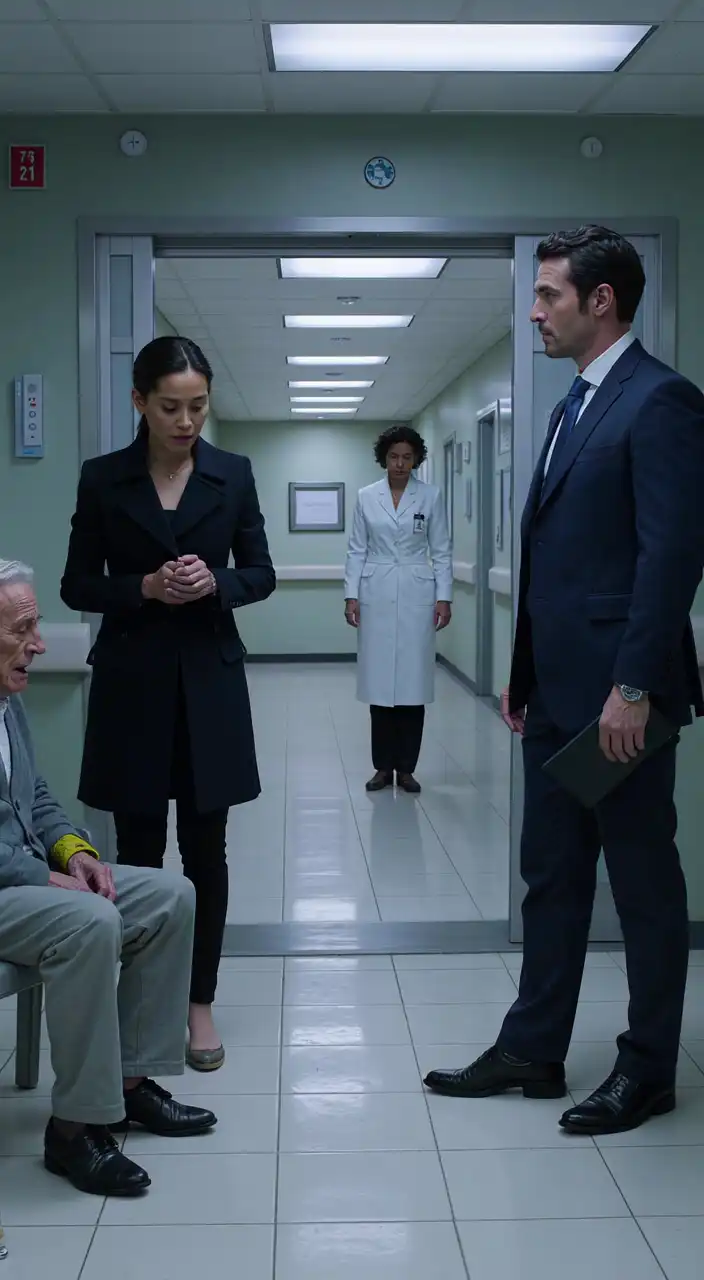
MY FATHER STARTED SHAKING OUTSIDE TRIAGE WHILE A CLINIC ADMINISTRATOR BLOCKED THE DOOR AND SAID HE NEEDED FAMILY PERMISSION FIRST.
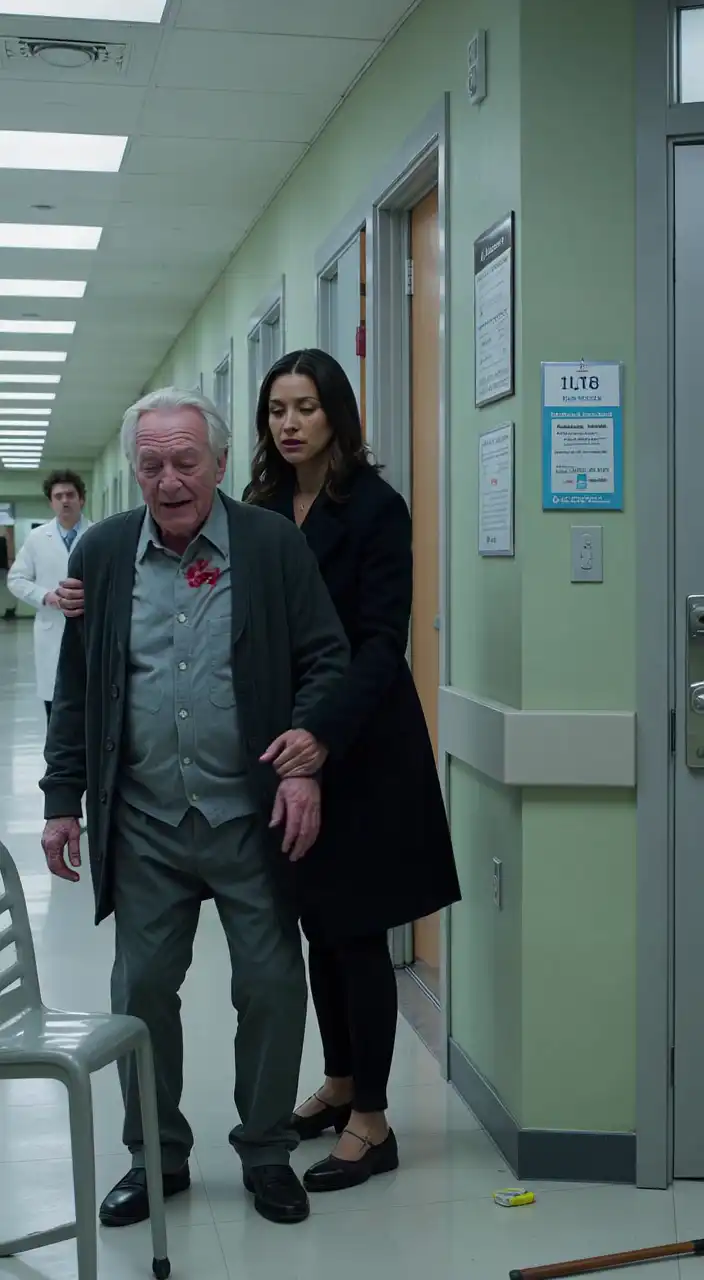
MY FATHER STARTED SHIVERING SO HARD HIS SURGICAL BANDAGE BLED THROUGH, AND THE CLINIC ADMINISTRATOR STILL BLOCKED THE TRIAGE DOOR.
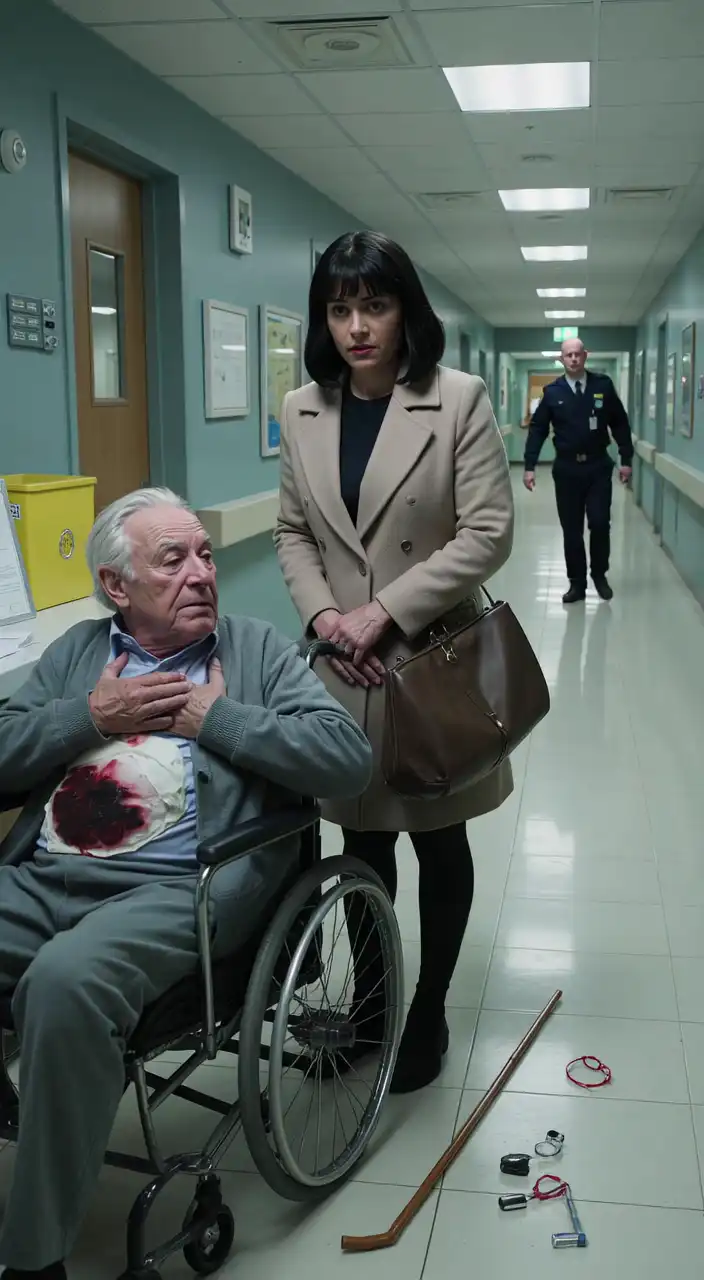
MY FATHER STARTED SHAKING IN THE HOSPITAL HALLWAY, AND THE WOMAN WHO CLAIMED TO BE HELPING HIM WOULD NOT LET TRIAGE TOUCH HIM.