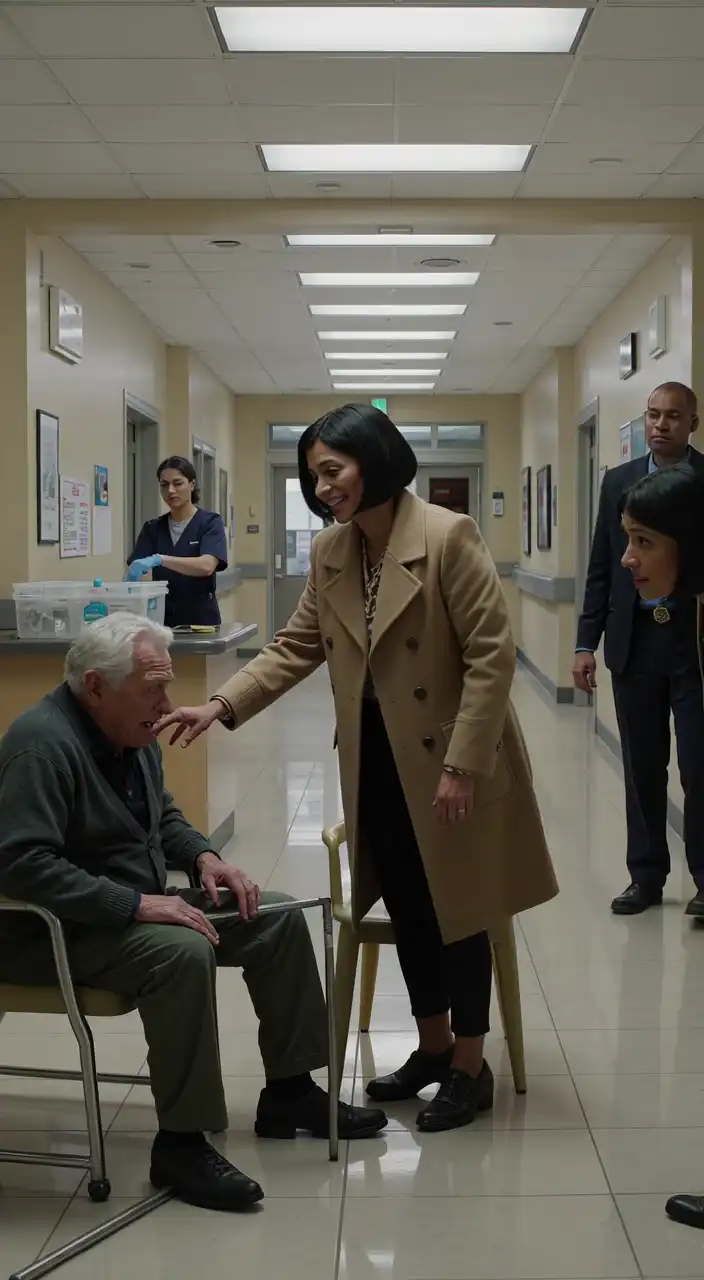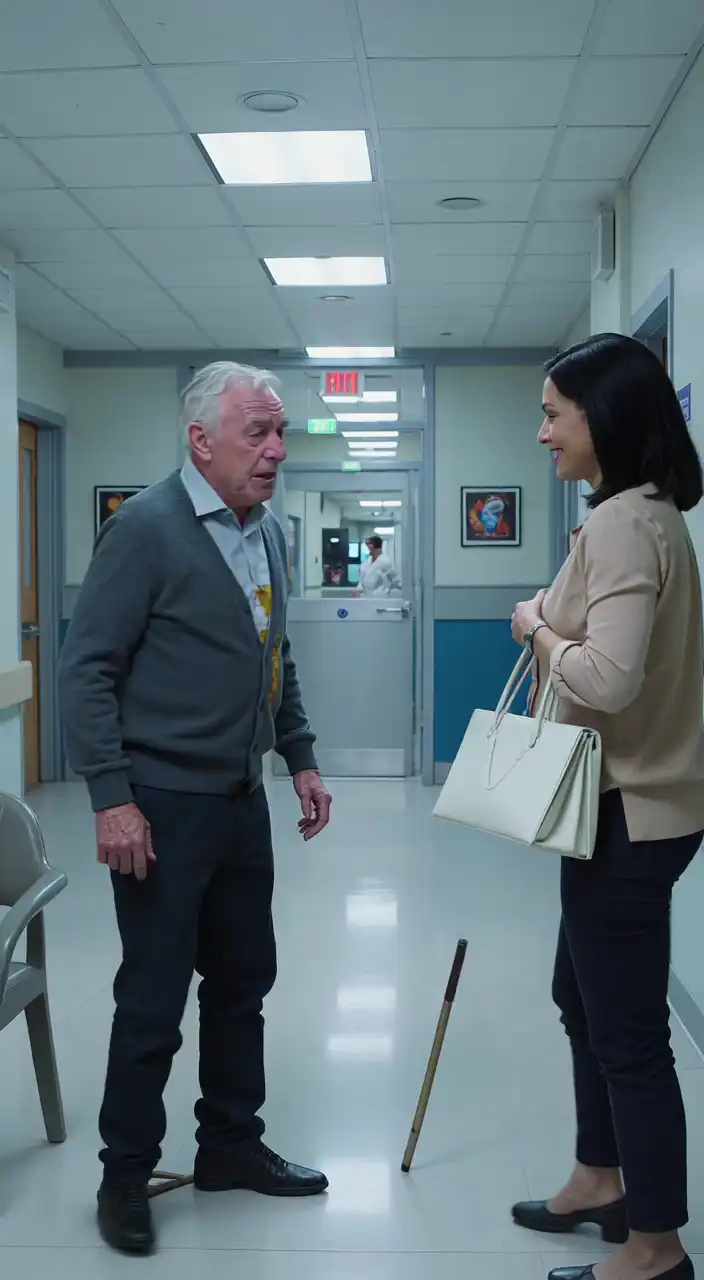
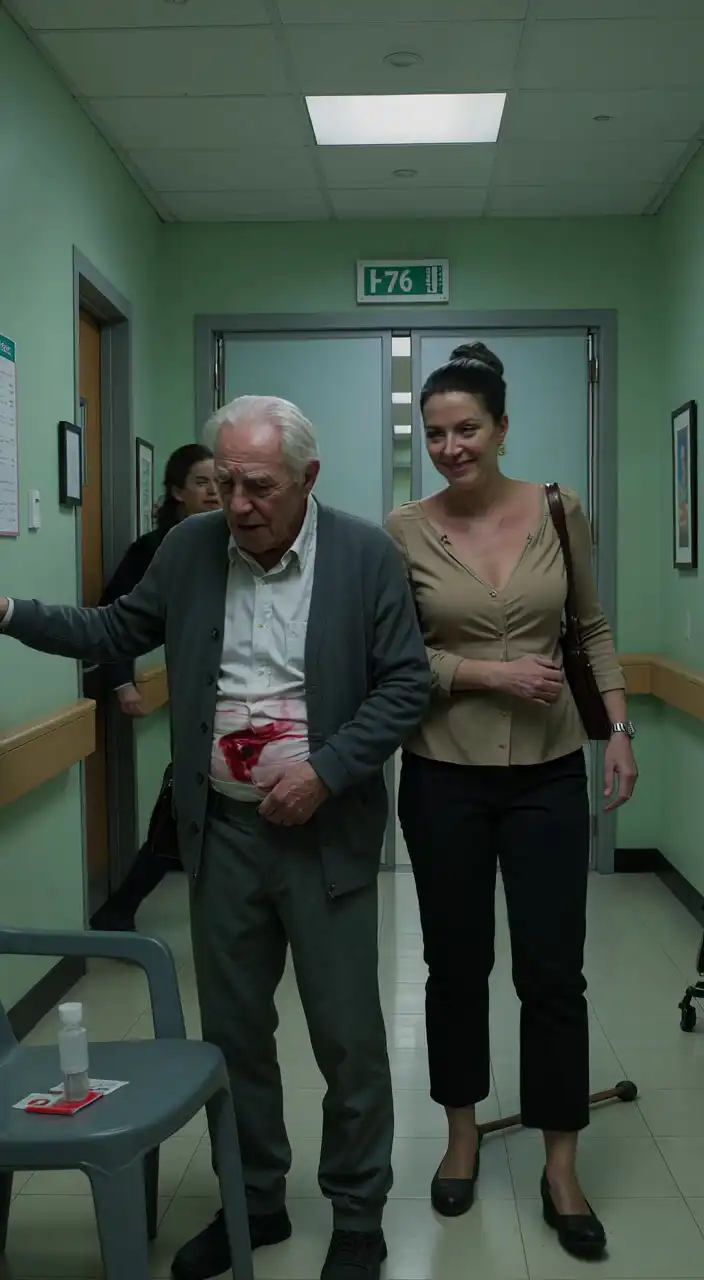
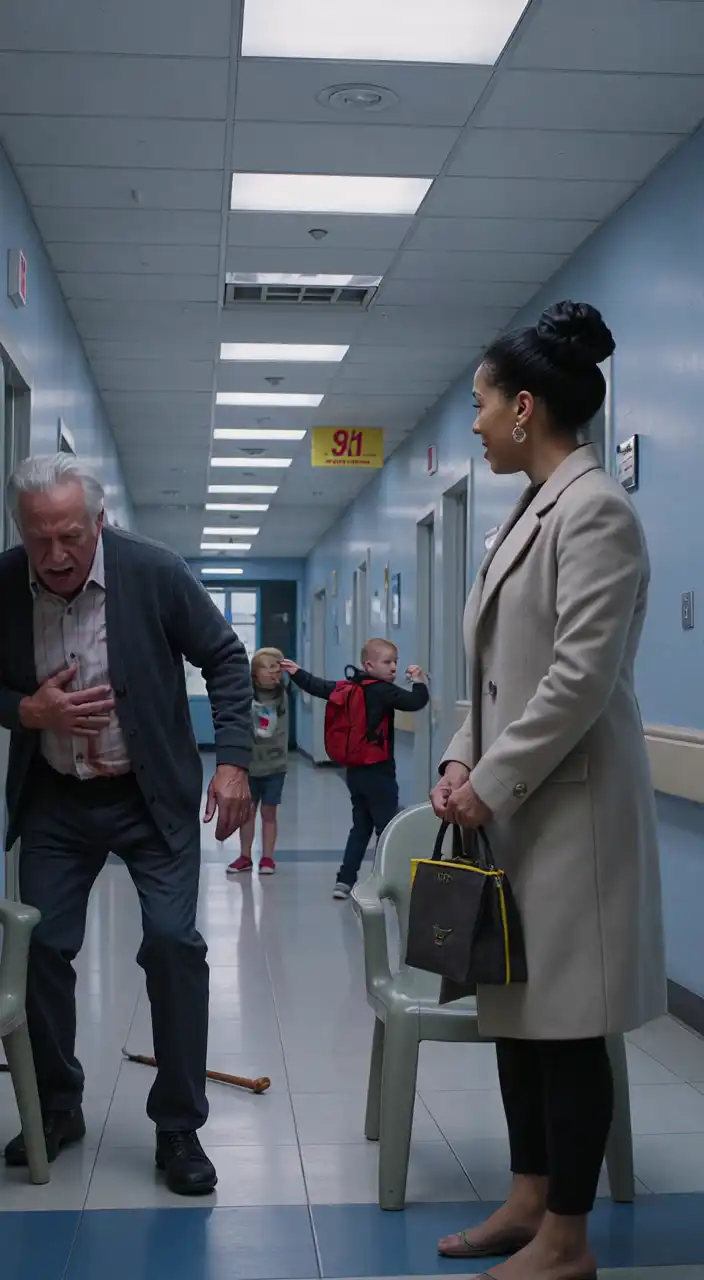

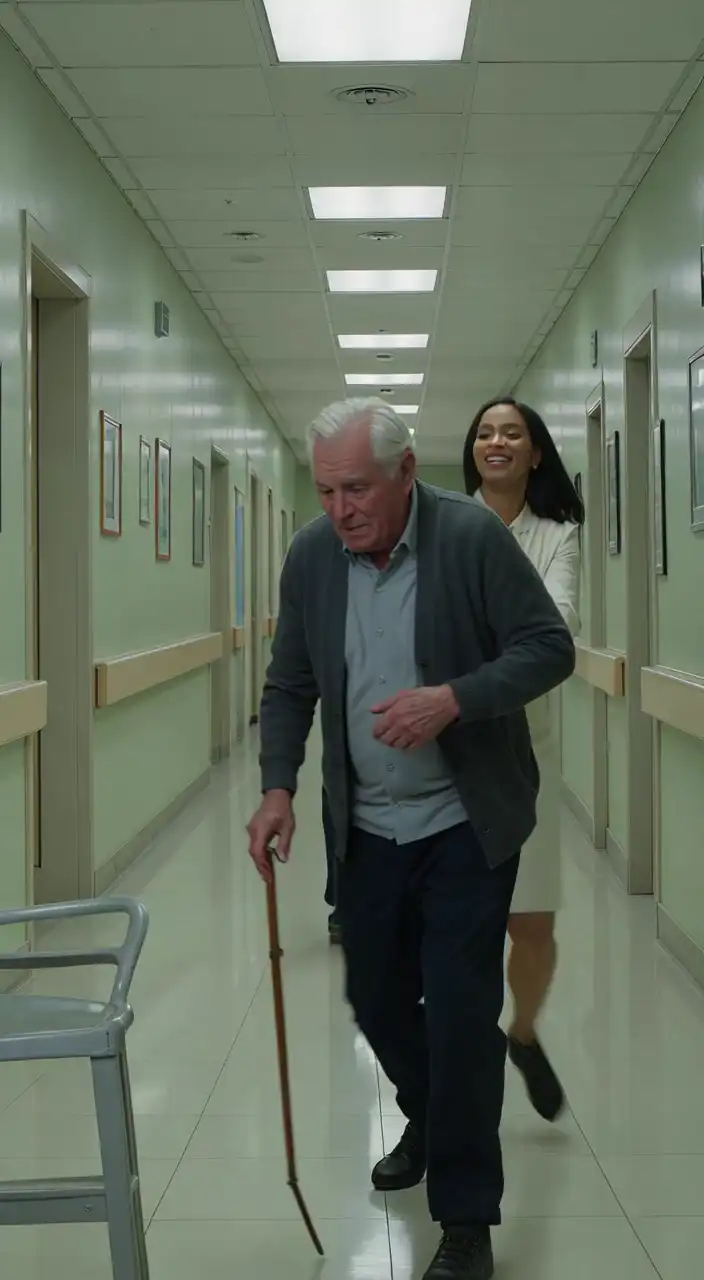
Sofia's hand went to her handbag so fast it was almost a reflex, not a choice. Dr. Amelia saw it too. She did not raise her voice. She only shifted her body between Sebastian and the exit and said to the triage nurse, "Wheelchair now. Full vitals. Bring him in."
People obeyed the calm command faster than they would have obeyed a shout.
Sofia let out a brittle laugh. "This is ridiculous. He was discharged this morning. He has post-op pain, that's all. You can't just detain family because an old man spilled medicine on himself."
Sebastian's eyes flicked toward her handbag, then toward the triage doors opening and closing two yards away, close enough for him to smell antiseptic and hear monitors beeping inside. He looked like a man stranded on the wrong side of a border. He tried to push himself up, but his hand slipped. The shaking had spread from his fingers into his shoulders.
"I said wheelchair," Amelia repeated.
A tech rolled one over. When the tech bent toward Sebastian, Sofia stepped sideways and blocked the footrests with her own legs. "He doesn't consent," she said. "Dad, tell them. Tell them we're going home."
Sebastian swallowed hard. His voice came out thin and embarrassed. "I... I need..." He broke off and pressed his palm over the bandage at his side. Through the edge of the dressing, a wet amber smear had spread into the gauze.
Amelia's eyes caught it. "Sir, are you having increased drainage from your incision?"
"He pulled at it in the car," Sofia snapped. "I told him not to."
That was the first lie Amelia challenged directly. "I didn't ask you."
The hallway changed then. Until that moment Sofia had been running the scene with speed and confidence, filling every pause before Sebastian could use it. But a doctor looking only at the patient creates a different kind of gravity. The nurse stopped pretending this was just a family disagreement. The tech put a hand on the wheelchair handle and waited. Two people down the hall turned their heads.
Sofia felt the room shifting away from her and tightened her grip on the handbag. "Dad," she said in the falsely patient tone adults use on difficult toddlers, "you wanted to leave because they made you sit for hours. Remember? You said you were done."
Sebastian was staring at the yellow bottle cap in Amelia's gloved hand. His mouth worked twice before words came. "That's not mine."
Amelia turned the cap over. No label. Sticky residue around the rim. Yellow suspension, maybe antibiotic, maybe something else. Pediatric-style cap on an old man's hospital floor. Strange enough by itself. Paired with the stain and the tremor, stranger.
"Bring him in now," she said. "If family interferes, security escorts family to consult room."
The nurse had already clipped a pulse ox onto Sebastian's finger. "Heart rate one twenty-eight," she said. "Temp one-oh-one point nine."
Sebastian gave a small sound halfway between a moan and an apology, as if his body was creating inconvenience.
Sofia's smile disappeared. "He gets fevers. That's why they gave him medicine. You're overreacting."
Amelia held Sebastian's wrist a moment longer, feeling the tremor. "Sir, do you know where you are?"
"St. Catherine's." His answer was immediate.
"What surgery did you have?"
"Hernia repair. Three days ago."
"Did they tell you to come back if you had fever, shaking, or drainage?"
He shut his eyes. A flush of shame passed over his face before he nodded.
The folded papers in Sofia's handbag suddenly mattered more than the stain.
Amelia looked up at the nurse. "Page charge. Tell security this may become an elopement prevention issue." Then back to Sebastian: "Sir, I need you to answer me, not anyone else. Did someone tell you not to come back?"
For one second Sofia and Sebastian looked at each other without speaking, and in that silent exchange there was an entire private history: dependence, guilt, fear of causing trouble, the exhaustion of a man who needed help from the very person controlling him.
Sofia broke first. "He gets confused under pressure. He mixes things up. I manage his meds because after anesthesia he says all kinds of things."
That line might have worked if Sebastian had looked confused. He did not. He looked scared.
He also looked at the handbag again.
Security arrived before the argument could broaden. Not uniforms bursting in, not dramatic. Just two hospital officers walking with the measured pace of people trained not to escalate until necessary. Amelia gave them a short, clean summary. "Post-op patient with fever, tremors, drainage, possible concealed meds, family attempting to remove before evaluation. He needs immediate assessment."
One officer nodded and stayed by the hall entrance. The other positioned himself near Sofia, not touching her, simply closing her easiest path to the door.
Sofia's voice sharpened. "This is discrimination. You see a Black woman advocating for her father and suddenly I'm suspicious?"
Amelia did not flinch. "You can advocate in a consult room after he's safe."
It was a fair answer, but it hit Sofia like a door closing.
As the tech and nurse lifted Sebastian into the wheelchair, a folded sheet slipped from under the lining of the handbag Sofia had clutched too loosely. It slid onto the tile between her shoes. Sebastian noticed it first. His face changed in a way that made Amelia stoop immediately and pick it up before Sofia could.
It was a discharge instruction packet, creased and damp at the corners. Across the top in thick black type: Return to ER immediately for fever over 100.4, increasing pain, shaking, confusion, redness, or drainage.
Amelia looked once at the page, once at Sofia.
Sofia said, "He didn't understand it. I was going to call his surgeon tomorrow."
Sebastian's voice came out hoarse but stronger than before. "She said if I came back they'd keep me. She said Medicare wouldn't cover another night."
That landed in the hallway with an ugly silence around it.
Sofia pivoted at once. "Because that's what the discharge clerk said. I was protecting him from a bill."
It was plausible enough to slow judgment for a second. Families do panic over bills. Families do delay care out of fear. Amelia had seen worse logic lead to terrible choices. But the yellow cap still sat in her glove, and the stain still brightened Sebastian's sleeve, and his tremor still was not explained.
"Let's keep him alive first," Amelia said.
They rolled him through the triage doors. The opening and closing threshold he had been staring at for the last twenty minutes finally gave way, but the relief was only partial. Sofia tried to follow immediately. One officer stepped with her.
"You'll wait right here until the physician says otherwise."
"He's my father."
"And he's a patient."
That distinction shook her more than the security presence had.
Inside triage, the bright efficiency of emergency care closed around Sebastian. Blood pressure. Temp confirmation. O2 sat. Questions. Amelia cut away part of the stained dressing and frowned. The drainage around the incision was not just blood. It had a thin yellowish seep mixed with pink, enough to suggest infection or contamination. He winced when she palpated near the surgical site.
"Pain?" she asked.
"Eight," he whispered.
"Nausea?"
He hesitated, then nodded.
"Any vomiting?"
"Not yet."
"Any meds after discharge? Antibiotics? Pain pills? Anything liquid?"
His eyelids fluttered. "She gave me something from a spoon. Said it was for inflammation."
Amelia held up the cap. "This?"
His pupils tracked to it and widened. "Maybe. I couldn't see the bottle."
That was the second thing that changed the case. Not proof. But a shape.
Amelia looked at the nurse. "Blood cultures, CBC, CMP, lactate. Start fluids. Get surgery consult. And tox screen if lab can run it off blood and urine." Then lower, for the charge nurse: "Document exact patient statement about hidden medication and delayed return."
The charge nurse nodded. In hospitals, there is a moment when concern turns into record. Once it enters the chart with names and timing, it becomes harder to smooth over later.
Sebastian reached weakly toward Amelia's sleeve as she stepped back. "Please don't let her be mad."
The sentence hit harder than any accusation could have. Amelia looked down at his trembling hand on her white coat and understood that whatever Sofia had done, Sebastian still feared the consequences of displeasing her more than he trusted his own right to care.
"Right now," she said, "your job is to stay awake and tell the truth."
Outside the curtain, Sofia was arguing with security in a voice that rose and fell like someone trying out different stories to see which one would open the right door. Bill fear. Misunderstanding. Overworked daughter. Confused old man. Racial bias. Any one of them might hold some piece of truth, but Amelia had already learned enough to know they did not add up.
Then the triage nurse checked the chart from Sebastian's earlier discharge and said quietly, "Doctor, you need to see this. The surgeon prescribed tablets only. No liquid meds at all."
Amelia looked at the yellow cap in her palm again, and for the first time she stopped thinking only infection and started thinking something else had been put into him after he left.
Sebastian's blood pressure dropped while she was still reading.
The room snapped into a faster gear. Fluids were opened wide. Another nurse called for a room instead of hallway hold. Surgery was repaged stat. Sebastian tried to focus on Amelia but his eyes drifted, then jerked back.
Outside the curtain, Sofia suddenly stopped arguing.
When Amelia looked up, one of the security officers had reached into Sofia's open handbag during a visual safety check and pulled out a small pharmacy bottle wrapped in a grocery receipt.
The liquid inside was bright yellow.
Sofia said, in a whisper so strained it barely sounded human, "That's not what you think."
Amelia took one step toward the curtain as the officer read the label and his face changed.
"Doctor," he said, "this bottle has somebody else's name on it."
Sebastian heard him, and the expression on his face was not confusion.
It was recognition.
Amelia went out from behind the curtain. The officer held the bottle carefully by the neck. The printed label was half-peeled, but enough remained to read: prednisone oral solution, pediatric concentration, prescribed two months earlier to a child named Malik Turner.
Not Sebastian. Not post-op medication. Not anything he should have been spoon-fed without explanation.
Sofia lunged once, not to attack, but to snatch the bottle back on pure reflex. The second officer intercepted her wrist. She froze immediately, then started crying in a way that sounded partly real and partly strategic.
"Please," she said. "Please don't do this out here."
Security guided her backward toward a consultation alcove while Amelia took the bottle. The grocery receipt around it was stained at the bottom in the same yellow that marked Sebastian's sleeve. A planted detail had just become a bridge: stain, cap, hidden bottle. Not random. Not spill. A track.
She stepped back behind the curtain where Sebastian lay with his eyes open but unfixed. "Mr. Ruiz, can you tell me if this is what she gave you?"
He stared at the bottle. His throat moved. "Maybe. I saw yellow."
"Did she tell you what it was called?"
"No."
"Did she say why?"
He drew a painful breath. "Said my body was rejecting the surgery. Said it would keep me from swelling. Said if I told the hospital they would blame me for not following instructions."
That explanation had just enough medical language to scare and confuse an older patient. Enough to make him compliant. Enough to hide the fact that it was not prescribed to him.
But why use a child's leftover steroid? Convenience? Desperation? Something worse? Amelia forced herself not to leap ahead. The immediate problem was still the body in front of her.
Sebastian shivered so hard the monitor leads shook. His pressure dipped again. Labs were still pending. The surgery resident arrived, glanced at the incision, and agreed at once that Sebastian needed imaging and likely admission. While they assessed him, Amelia kept circling the medication question because the wrong medicine alone did not explain the whole behavior.
People make dangerous mistakes and still call for help once they see fever and drainage. Sofia had not called. She had tried to leave. She had hidden the discharge instructions. She had spoken over him. She had used someone else's medication. The pattern was control before it was negligence.
The charge nurse returned with Sebastian's earlier chart. "There is a note from discharge teaching," she said. "Patient asked twice whether his daughter had to know everything. Nurse documented daughter remained in room and answered most questions despite redirection."
Amelia felt a small cold click in her chest. Earlier warning. Missed in the rush of discharge. Not enough then to trigger anything. More than enough now to matter.
She asked the nurse, "Any listed next of kin besides the daughter?"
The nurse scanned. "One son in Arizona, estranged. No spouse. Emergency contact only Sofia."
Sebastian heard that and whispered, "Daniel." Then, almost ashamed of wanting someone else, "I haven't spoken to him in years."
"Do you want us to call him?" Amelia asked.
He shut his eyes for a long moment. "If she hears... she gets upset."
There it was again. Fear of emotional punishment.
Amelia crouched so he did not have to look up at her. "Mr. Ruiz, I need you to hear me clearly. You are allowed to receive care. You are allowed to talk without her present. You are allowed to tell us if someone gave you medication that was not yours or stopped you from coming back."
His eyes filled at that, not with dramatic tears, just the weary breaking of someone who had not expected permission to exist separately from the person managing him. "I didn't want trouble," he said.
"Trouble is already here," she said gently. "Truth helps me treat you."
He gave one tiny nod.
Lab results began populating in the chart. Elevated white count. Lactate mildly high. Signs consistent with infection, dehydration, and systemic stress. Not definitive poisoning, but enough to confirm he was genuinely sick and getting sicker. The surgery resident ordered broad-spectrum antibiotics and a CT scan. Amelia approved transfer to a monitored bed.
Then tox called back with an early note: no obvious common sedatives detected on rapid screen, but steroids would not explain the tremor and fever. Which meant the yellow medicine may have been dangerous and foolish, but still not the whole answer. Another contradiction.
As they prepped to move him, Sebastian grabbed the edge of the blanket. "My papers," he said.
"We have them," Amelia assured him.
"No." His voice sharpened with sudden urgency. "The other paper. In her bag. The one from rehab."
Amelia leaned in. "What rehab?"
He looked toward the curtain, terrified Sofia might hear even from the alcove. "The place she wanted to send me. I didn't sign."
That changed the emotional geometry all over again. Hidden discharge papers were one thing. Another paper suggested motive.
Amelia stepped out to the alcove where Sofia sat between two officers, tissues in hand, eyes calculating despite the tears. On the small side table lay the handbag contents security had asked her to remove: wallet, keys, lipstick, folded receipts, the pharmacy bottle, and a manila envelope.
Amelia tapped the envelope. "What's this?"
Sofia stared at it a beat too long. "Facility paperwork. For after he recovered. I was planning ahead."
Amelia opened the flap and slid out admission forms for a long-term care facility across town. Several lines were prefilled. Financial responsibility section complete. Insurance notes attached. One signature line empty. Another line carried Sebastian's shaky initials in the wrong place, crossed out.
Along with the forms was a photocopy of a bank statement.
Amelia understood then that the medical crisis and the paper crisis were braided together. Still, she did not yet know how tightly.
Security contacted hospital social work and, because medication not prescribed to the patient had been administered, risk management. That would have been enough institutional pressure for one family on one day. But the larger reversal arrived from a source no one expected.
The triage clerk, who had been quietly working the line while all this unfolded, came over with a puzzled expression and a desk phone in her hand. "Doctor, dispatch is asking if the patient named Sebastian Ruiz is here. They got a partial 911 call from this number twenty minutes ago. Open line, male voice saying 'hospital' and 'she won't let me.' Caller disconnected before address confirmation, but phone pinged on campus."
Amelia looked at Sofia.
Sofia looked back with naked alarm.
The clerk continued, "Dispatch says because it sounded like a medical access issue, they documented it and called our security desk when they saw the ping."
One of the officers turned to Sofia. "Did you take his phone?"
Sofia said nothing.
Amelia asked for Sebastian's belongings. In the side pocket of the wheelchair blanket, a phone was found with the screen cracked and the recent-call display still lit. At the top of the list: 911, duration 00:18.
Planted detail number three had just entered the room in full.
When Amelia brought the phone to Sebastian, his hand trembled over it. "I thought it didn't go through," he said.
"It did enough," she replied.
The existence of the call changed more than evidence. It changed Sebastian's own memory of himself. He had not simply endured. At some point, before Sofia got control again, he had tried to save himself. That matters to people. Sometimes it is the first thread they can grab on the way back to dignity.
Sofia's lawyerly calm fell apart after that. "He panics," she said too quickly. "He gets dramatic and calls people. He doesn't mean things. He wanted me to help him and then he changed his mind because waiting rooms make him anxious."
"Then why hide the discharge papers?" Amelia asked.
"I didn't hide them."
"Why give him someone else's medication?"
"It was just anti-inflammatory. I was trying to help."
"Why bring rehab forms?"
Her mouth opened, closed.
The officer asked the cleaner question. "Why did he call 911 and say you wouldn't let him?"
For the first time, Sofia had no ready answer.
Social worker Janine arrived with the patient advocate, and together they did what good professionals do in ugly family situations: they separated urgency from noise. Janine sat with Sofia. The advocate sat with Sebastian. Amelia moved with the medical team, because his scan could not wait.
As they rolled him toward CT, Sebastian caught Amelia's wrist again. "She'll say I forget things," he whispered. "Sometimes I do. But I knew this was wrong."
"I know," Amelia said.
The CT suite was cold and bright. He shivered through positioning. The scan itself was quick. Waiting for the read was not. In the gap, every minute became a moral pressure point. If there was an abscess or leak from surgery, delay had made it worse. If there was not, then the medical emergency still remained but the social pattern would become harder to pin down cleanly.
The read came back: post-op fluid collection with concern for infection at the surgical site. Not catastrophic rupture, but serious enough to require admission, IV antibiotics, and probable interventional drainage or return to surgery depending on progression.
The rescue had just become medically undeniable.
When Amelia returned to the consult area to inform social work, she found Janine with a new expression: not just concern, but anger held under professional control.
"What?" Amelia asked.
Janine lowered her voice. "Sofia says she was only trying to avoid a readmission because his money was getting drained and she can't keep missing work. But while she was talking, I asked routine caregiver questions. She let slip that his pension auto-deposits into a joint account she manages. She also says rehab would 'solve the house issue' because she needs his room for her son. Then she insisted he had already agreed to transfer title of the house after surgery."
Amelia looked at the manila forms in Janine's hand.
"It gets worse," Janine said. "These rehab forms were not for after recovery. The admission date was today's date."
So that was the incomplete explanation turning into contradiction. Bill fear had some truth in it, maybe. Caregiver strain too. But under it sat something uglier and more active: if Sebastian went back into the system confused, sick, and isolated, signatures could be nudged, stories shaped, property shifted.
Amelia asked, "Capacity concerns?"
"Not enough to assume incapacity," Janine said. "Enough vulnerability to require protection."
The next step should have been straightforward: admit him, restrict unsupervised access, document, notify adult protective services, perhaps law enforcement depending on medication and financial exploitation. But rescue stories do not stay straightforward for long.
Because while they were discussing protection orders, one of the officers came in grim-faced and said, "We have a problem. The woman is gone."
Sofia had asked to use the restroom with escort. In the handoff between security and registration traffic, she had slipped through a side door into the parking structure.
And with her she had taken the only thing everyone had not yet realized was missing.
Sebastian's wallet, ID, and insurance card.
By the time Janine and security pieced together what was gone, admission had hit an immediate snag. The hospital would still treat him, of course. Emergencies do not stop for cards. But the theft was not just logistical. It was strategic. Without his ID, without his phone unlocked, without his daughter in custody and with surgery wanting rapid consent for possible intervention, Sofia had created one more layer of control from a distance.
Then Sebastian's blood pressure dropped again, and the resident said if the abscess worsened overnight, they might need a procedure sooner than anyone wanted.
Amelia looked toward the parking cameras and said, "Find her before she gets farther than the garage."
The officer answered, "Already pulling footage. But if she knows where the blind ramp is, she may be off campus."
And in the bed down the hall, the man she had delayed all day was about to be admitted without the documents needed to protect the rest of his life.
The patient advocate, a middle-aged woman named Carla with a voice like warm gravel, brought Sebastian a cup with a swab to wet his lips. He looked smaller in the monitored room than he had in the hallway, not because the room was large but because he no longer had to make himself broad enough to defend his own reality.
"Do you know your Social Security number?" Carla asked gently.
He nodded, then gave it without hesitation.
"Birth date?"
He answered.
"Any photo ID besides the wallet?"
He winced. "Driver's license was in there. Medicare card. One credit card. House key."
The last item made Carla and Janine exchange a glance. Sofia had not just fled with documentation. She had left with access.
Janine moved immediately. "We need to lock down the home. Any neighbors? Friends? Anybody with a spare key?"
Sebastian looked panicked all over again, not from fever this time. "The blue tin by the kitchen phone." Then his face changed. "No. She knows. She knows where I keep things."
Amelia had just finished updating surgery when she heard that. She walked in to find Sebastian trying to sit up against orders. The monitor alarmed. "My papers," he said. "She'll take the papers from the desk."
"What papers?" Janine asked.
"In the roll-top desk in the den. Deed. Daniel's letters. My will." He shut his eyes, struggling for breath. "She said after surgery I should put everything where she could reach it in case... in case."
The room filled with the sound of consequence.
Janine crouched by the bed. "Mr. Ruiz, listen to me. We can help protect your house and documents, but I need names and permissions."
He hesitated. Years of family loyalty do not evaporate because one doctor believes you. Then he whispered, "Call my son."
That was not a small thing. It was the first clear choice he had made for himself all day.
Carla found the number in the chart from an old emergency contact field. No answer the first time. The second time, a man picked up with the guarded tone of someone expecting bad news from an unknown hospital number.
"This is St. Catherine's Medical Center. I'm with your father."
Silence, then, "Is he alive?"
"Yes. He needs care, and he asked us to contact you."
The man exhaled like he had been punched. "Put him on if he can talk."
Sebastian gripped the phone with both trembling hands. "Danny?"
The answer came rough and immediate. "Dad. What happened?"
Sebastian looked around the room as if ashamed of being heard. "She didn't let me come back. I should've called you before."
There are family rifts built from decades of stubbornness, and there are moments when emergency cuts through all the old furniture. Daniel did not ask for a history lesson. He asked for what mattered now. Fever? Surgery? Who was with him? Was he safe? Janine listened, taking notes as Sebastian spoke in fragments.
Then Daniel said something that made Janine raise her head sharply. "If Sofia took his wallet, check his online banking. She got him to add her last winter after she said she was helping with bills."
Sebastian closed his eyes. "I thought it was for groceries."
Daniel was in Arizona but moving in his mind at full speed. He had a copy of the deed from a prior refinance. He knew the neighbor across the street, Mr. Halpern, still had a key from years ago. He knew the bank branch manager because he had once helped his father after a fraud scare. Most importantly, he did not waste time debating whether his sister had "meant well." He accepted Sebastian's statement as a starting fact and worked the problem.
Janine called Adult Protective Services from the room so Sebastian could hear the report being made. That mattered too. "Elderly post-op patient. Medically unstable. Delayed emergency return. Caregiver administered non-prescribed medication. Concealed discharge instructions. Potential financial exploitation. Potential document removal from residence." Every phrase was a brick in a wall Sofia would now have to climb.
Security got preliminary parking footage. Sofia had not exited the garage immediately. She had spent seven minutes on the fourth level beside her car, on the phone, trunk open. Then she drove out. The delay suggested sorting, hiding, or calling someone.
"Can police stop her?" Sebastian asked.
Janine answered carefully. "We have enough to make a report. Because medication not prescribed to you was given and property may have been taken, law enforcement can be notified. But right now our first goal is your safety and preserving what's at your house."
His face tightened. "I don't want her arrested if-"
The old instinct to protect her returned even now.
Amelia interrupted, not unkindly. "You don't have to decide everything tonight."
The surgery team returned with a plan: admit to a monitored floor, continue IV antibiotics, reassess after repeat labs, and likely have interventional radiology evaluate the fluid collection in the morning unless he worsened sooner. It was a solid plan medically, but it assumed a stable social perimeter. They did not have one.
Within the hour, a deputy arrived to take an initial statement, because the 911 call and medication issue triggered enough concern. He was patient, older, and clearly familiar with the way abused elders minimize. He did not press too hard at first. He established timeline, surgery date, discharge, onset of fever, return to hospital, hidden papers, yellow liquid.
Then he asked a question no one else had yet asked plainly. "Mr. Ruiz, has Sofia prevented you from seeing your own mail, money, or doctors before today?"
Sebastian stared at the blanket. "She said she was helping."
"That wasn't my question."
Long pause. Then: "Sometimes."
"Has she ever told people you were confused when you weren't?"
Another pause. "Yes."
"Has she threatened to put you in a home if you didn't agree with her?"
This time the answer came immediately. "Yes."
The deputy wrote without visible reaction, but the room felt different after that. A pattern was taking official form.
Meanwhile Daniel was booking the first overnight flight he could get. He called back with the neighbor on the line. Mr. Halpern, breathless and indignant in equal measure, agreed to go to the house with local police if they could authorize a welfare check around potential document theft. Janine coordinated, the deputy made calls, and within forty minutes the house had become a second scene in the same story.
Sebastian drifted in and out under fluids and fever. Each time he woke, he asked either "Did Daniel call?" or "Did she go to the house?" The body and the life around the body were fighting on two fronts.
Near midnight, a nurse named Priya came to change his dressing. When she peeled back the tape, the smell of infection was clearer. The drainage had deepened. "We may not wait until morning," the resident said after seeing it.
Sebastian gripped the rails. "Am I dying?"
"No," Amelia said, because at that moment she believed it. "But this got worse because you weren't brought back when you should have been."
He turned his face away, and she knew the sentence had landed as accusation against himself. She corrected it immediately. "That delay was not your fault."
He did not answer, but his shoulders dropped a fraction.
Then Janine got the first call from the house.
Police had arrived with Mr. Halpern. The front door was unlocked. In the den, the roll-top desk had been opened and rifled. A file box sat overturned on the rug. Several framed photos were face-down. The blue tin by the kitchen phone was empty.
But Sofia had either rushed or panicked, because she had not found everything.
Mr. Halpern, who knew the house from years of Sunday coffee, pointed officers to an old cedar chest in the hall closet where Sebastian used to stash "important papers where nobody sensible would look." Inside, beneath winter blankets, police found a second envelope containing a notarized copy of the deed, an advance directive, and three handwritten letters from Daniel. They also found a small spiral notebook.
The notebook mattered more than anyone knew yet.
When Janine told Sebastian they had found the backup documents, he cried for the first time, silent tears slipping into his hairline while he stared at the ceiling. It was not just relief at paper. It was proof that some earlier version of himself had anticipated danger and hidden a path out.
"What notebook?" he asked when Janine mentioned it.
"Looks like expenses or reminders," she said. "Police are bringing a photo."
The photos came by secure text to the deputy. Amelia and Janine stood behind him while he scrolled. Grocery entries. Utility reminders. Surgery dates. Then, on several pages across the last six months, short notations in shaky handwriting:
Sofia said don't answer Daniel.
Moved bank mail to her room.
She says doctor bill was 4800. Need to ask.
Yellow medicine from Malik left in fridge. Not mine.
The room went still.
The yellow medicine had been planted in his own memory long before it stained his sleeve.
"Who's Malik?" the deputy asked.
Sebastian looked dazed. "Her grandson."
So the child's prescription was not random from a street source or old clinic mix-up. It had come from inside Sofia's home.
Another page:
If fever after surgery, paper says go back right away. She said no because of cost.
He had written the warning to himself.
That notebook was not only evidence; it was a reversal of the story Sofia had built around his supposed confusion. A man who records contradictions is not necessarily impaired. He may be surviving.
The deputy photographed every page. "This helps," he said quietly.
Then his radio crackled. Officers near Sebastian's neighborhood had located Sofia's car at a gas station six miles away. She was still inside the convenience store parking lot, not driving farther. They were making contact.
Sebastian's hand tightened on the blanket. "Please don't let her say I imagined this."
Nobody in the room said "we won't." They did something better. They kept documenting.
At 1:15 a.m., his blood pressure dipped again and his heart rate climbed despite fluids. The resident decided to move him toward a higher-acuity bed and call interventional radiology's on-call team. The abscess might need drainage overnight, not morning. Medical urgency surged back to the front where it belonged.
As Priya adjusted his monitor leads, Sebastian's bracelet snagged on the sheet. He looked at it with a strange intensity. "Don't take that off," he said.
"We won't unless procedure requires it," she replied.
"My wife put a saint medal on the old one before she died," he said vaguely, fever-worn. "Sofia hated hospitals after that."
Amelia looked up. This was the first hint of motive that was not money or convenience. Human motives are rarely single-strand. Fear can coexist with greed. Trauma can harden into control. None of it excuses harm, but understanding can explain why someone keeps doubling down.
The deputy stepped out to take another call, then came back in with his jaw set. "They found your wallet in her glove compartment," he told Sebastian. "And a folder of bank papers in the trunk. She says she was taking them somewhere safe because she thought the hospital would lose them."
Sebastian gave a bitter half-laugh that dissolved into pain. It may have been the strongest sign yet that he was no longer entirely under her narrative. "She always says she's keeping things safe."
Then the deputy added the part that made Janine's face harden. "She also had a portable scanner and two unsigned transfer forms for the property."
Sofia had not just fled. She had prepared.
The pressure point at the end of the third movement arrived all at once: the abscess was worsening, the daughter had been located with documents and forms, and yet even with evidence growing around him, Sebastian still might need a procedure within the hour while sedated, febrile, and emotionally torn about speaking against his own child.
He looked at Amelia as they wheeled him toward interventional radiology and asked the question children ask, not fathers.
"If I tell everything, will they make me go home with her after?"
Amelia put her hand over his medicine-stained sleeve, now cut open and bagged as evidence, and said, "No. That part is over."
Interventional radiology's overnight team was a skeleton crew with tired eyes and efficient hands. The attending on call, Dr. Feldman, studied the scan and shook his head. "Localized collection. We can drain. Might spare him a return to the OR if he's lucky." Then, glancing at Amelia's notes, "Unlucky timing with the social mess."
Amelia almost corrected him. The social mess had not landed by chance. It had shaped the timing.
Consent became the next pressure point. Sebastian was lucid enough, feverish but oriented, and could consent for himself. Carla stayed at his shoulder while Dr. Feldman explained the procedure in plain English: needle guided by CT, catheter placement to drain the infected pocket, antibiotics continued, risks reviewed. Sebastian listened hard, as if he had learned in one night that every spoken instruction mattered.
"Will she be there when I wake up?" he asked.
"No," Janine answered before anyone else could soften it. "We are flagging your chart. No unsupervised access. You can choose who sees you."
He looked relieved and devastated by the same sentence.
As they prepped him, the deputy returned with another update from the stop. Sofia had not been arrested on scene yet, but she was detained for questioning because of the medication bottle, wallet, and documents. She kept insisting she had legal authority as caregiver and that Sebastian "needed structure." She also claimed Daniel was manipulating the hospital against her.
"Did she say why she gave him Malik's medicine?" Amelia asked.
The deputy checked notes. "She says it was leftover prednisone and she thought it would help inflammation because the surgeon wasn't doing enough for his pain."
"That's reckless, but not enough to explain the hiding and the rehab forms," Janine said.
"No," the deputy agreed. "And when they asked why she had the transfer forms, she asked for a lawyer."
There it was. A line crossed from frantic caregiving into self-protective strategy.
The drain procedure went smoothly enough medically. Purulent fluid confirmed the abscess. Cultures were sent. Sebastian came back groggy but steadier. The relief in his face once the pressure was relieved was immediate and heartbreaking. Physical pain can trap people in silence; when it loosens, truth often moves more easily.
At 3:00 a.m., with monitors humming and the first wave of crisis stabilized, Carla sat with him while Janine completed the restricted visitor documentation. She asked a quieter question than the deputy's. "What were you most afraid would happen if you disobeyed her and came back sooner?"
Sebastian stared at his hands. "She'd say I couldn't manage on my own. She'd say they'd see me weak and put me somewhere. She said if I kept needing help, I'd lose the house anyway."
"Did you believe her?"
"Some days." He swallowed. "After my wife died, I got bad with the mail and pills and all those calls. Sofia moved in and took over. At first it was a gift."
That was the larger emotional reversal taking shape. Sofia had probably not begun as a villain. She had stepped into a real caregiving vacuum. Then power accumulated around her. The more she controlled, the more necessary she could claim to be. When Sebastian needed surgery, his dependence spiked and so did her opportunity.
He told it in fragments through fatigue. She started by sorting his medications. Then screening calls. Then insisting Daniel upset him too much. Then redirecting bank statements "to keep scams away." When Sebastian questioned a charge or wanted to read something himself, she would sigh and say he was exhausting himself, or tell him the doctor had warned stress could "make his confusion worse." He had no formal dementia diagnosis. Just age, grief, occasional forgetfulness, and the creeping humiliation of needing help with enough tasks that resistance felt ungrateful.
Carla did not interrupt except to anchor dates and details. She knew how to listen for coercion without forcing a victim into a script.
The phone on the bedside table lit with an unknown FaceTime request. Security had already taken Sofia's personal phone information from the traffic stop, but this was from a different number. Carla declined it. It rang again. Then a text came through Sebastian's number:
Dad tell them this is all a misunderstanding. If APS gets involved they will take your rights away.
Sebastian went white.
Janine photographed the message immediately. "Do not respond."
Another text arrived:
Daniel wants your house. I am the only one who stayed.
That sentence cut because it held some truth and weaponized it. Caregiving history can become emotional blackmail exactly because it is not wholly invented.
Sebastian whispered, "She did stay."
Janine answered firmly. "And tonight she blocked emergency care. Both can be true. One does not erase the other."
That was the moral reversal the story needed. The caring years, if they existed, did not excuse the threshold where she chose control over rescue.
By dawn, the culture stain from the drained fluid suggested bacterial infection consistent with post-op abscess. The broad-spectrum antibiotics were appropriate. Toxicology still did not show a dramatic poisoning profile, which narrowed the yellow medicine issue: prednisone had likely muddied symptoms and delayed proper care, but the primary crisis remained the untreated surgical infection. That did not make Sofia safer. It made her more culpable in a very ordinary, very real way: not a melodramatic poisoner, but a controlling caregiver whose reckless home dosing and deliberate delay nearly tipped a treatable complication into sepsis.
Daniel landed just after sunrise and came straight from the airport, eyes red, shirt wrinkled, carrying nothing but a backpack and a folder. Security confirmed his identity and Janine got Sebastian's permission before letting him in.
The reunion was not cinematic. It was better. Daniel stopped in the doorway as if afraid his father would reject the help after all these years. Sebastian looked at him, then at the folder in his hand, and said the smallest sentence in the room.
"You came."
Daniel crossed to the bed and took his father's hand carefully around the IV lines. "Of course I came."
Sebastian cried again, openly this time.
Daniel had brought printed bank login recovery info, contact numbers, and an old copy of a durable power of attorney their mother had once discussed but never executed. He was practical because practicality was love at that moment. He also had perspective no one else in the hospital did.
"Sofia got worse after Mom died," he told Janine outside the room. "Not evil overnight. Just... she couldn't stand uncertainty. She'd decide something was best and bulldoze anyone who disagreed. She did it with schools, jobs, her ex. Dad was lonely enough to call it help."
"Did she need money?" Janine asked.
Daniel gave a humorless smile. "Always. But mostly she needed control. Money just proved she had it."
While they were talking, the deputy returned with a final development before the ending phase could begin. At the gas station stop, officers had found not just the wallet and forms but a stack of unopened mail from Sebastian's address, including a notice from the bank about unusual transfer attempts requiring in-person verification. There was also a letter from the surgeon's office reminding patients in bold print to seek immediate care for fever and drainage after discharge. Sofia had all of it in her trunk.
The evidence seed had become a larger moral shape: this was not a single panicked mistake in a hallway. It was a system of filtered information.
Then the last obstacle rose.
Sofia, now with counsel on the phone, demanded to see her father before any formal report was filed. She told officers and hospital administration that he was vulnerable to manipulation by his estranged son and that she needed to "clarify his wishes." If administration mishandled access, the hospital could face a complaint. If they denied a family member improperly, they could be accused of overreach. Institutions fear those gray zones.
Sebastian was exhausted, febrile, post-procedure, and emotionally fragile. Letting Sofia in risked renewed coercion. Blocking her completely without his explicit statement risked challenge. The hospital needed a clean patient-centered decision while he was alert enough to make it.
Carla sat by his bed. "Mr. Ruiz, this part matters. Do you want Sofia to visit or speak with you right now?"
He looked at Daniel, then away, as if even deciding this felt like betrayal. "If I say no, she'll hate me."
Daniel's voice shook. "Dad, she can be angry. You can still say no."
That was easier said by a son who had already left the blast radius. Sebastian was the one who had lived in it.
His fingers found the edge of his wristband again. The hospital bracelet. The thing that proved he was a patient before he was anyone's dependent. Amelia had seen people anchor themselves to stranger symbols than plastic bands.
He took one breath, then another. "No," he said.
Carla did not ask him to repeat it louder. She simply documented it and had him sign the restricted communication form with a hand still unsteady from fever. Daniel witnessed. Priya witnessed. The deputy noted the time.
A minute later, from the hallway, Sofia's raised voice carried through the closed door anyway.
"I took care of him when nobody else did! He wouldn't survive a week without me!"
Sebastian flinched as if struck.
Then, unexpectedly, he straightened.
He turned to Daniel and said, almost with wonder, "I think I would."
That tiny line was the edge of the threshold. Not full rescue yet. But the first internal crossing.
The ending began with systems finally moving in the same direction as the truth.
Hospital administration backed the restricted contact order based on Sebastian's explicit request, social work concerns, the 911 record, and ongoing law enforcement review. APS opened an emergency case. The deputy took Daniel's statement and coordinated with officers at the house to secure documents and change locks once Sebastian consented. The bank fraud line was called from the bedside so Sebastian could verbally freeze the joint account and flag suspicious transfers. Hearing his own voice answer security questions steadied him more than medication did.
"Yes, I want the account restricted."
"Yes, I want paper statements redirected."
"No, I did not authorize property transfer."
Each answer restored a small piece of selfhood.
Sofia was not brought to his room. She was informed through officers that the patient had declined contact and that any future communication should go through appropriate channels. She reportedly cried, then raged, then shifted back to claiming she had only tried to save him from bills. The deputy did not promise what charges would or would not come. Real cases take time. But the immediate power she wielded over the threshold was gone.
Sebastian spent three more days in the hospital. The drain worked. His fever broke the second night. Culture results confirmed a post-op infection responsive to the antibiotics he was receiving. Every physician who rounded on him reinforced the same fact without drama: he had done the right thing by coming back, and the dangerous part was the delay, not his need for care.
Amelia visited between shifts even after he was no longer under ER care. On the second day he was clearer, less gray, and more embarrassed.
"I made you all so much trouble," he said.
She pulled the tray table closer and set his water within reach. "You came to the hospital while sick, called 911 when blocked, and told the truth when asked. Those are not troublesome behaviors."
He smiled at that, faintly. Then: "I wrote things down because she kept telling me I forgot."
"The notebook helped."
He looked surprised by how much. "I almost threw it away. Thought it made me look foolish."
"It made you look careful."
That landed.
Daniel handled the practical avalanche with Janine's help. Temporary lock change. Mail hold. New wallet replacement. Consultation with an elder-law attorney. APS home safety planning. They did not solve a lifetime in a weekend, but they built rails. Mr. Halpern watered Sebastian's porch plants and mailed him a photo of the cedar chest "still guarding the kingdom," which made him laugh for the first time.
Sofia's shadow remained. She left voicemails through unknown numbers until the deputy advised preserving them. In one she sounded furious. In another she sounded broken. In a third she said, "I never meant for him to get that sick." Daniel listened to none of them with Sebastian present.
The most meaningful scene happened on discharge day, when discharge was finally done right.
This time a nurse reviewed every instruction with Sebastian alone first, then invited Daniel in with his permission. The red-flag symptoms were circled in marker. Follow-up appointments were set before he left. Medications were bagged and labeled one by one. Priya placed the packet directly into Sebastian's hands, then asked, "Who do you want to keep these?"
He looked down at the papers. The question itself was medicine.
"I do," he said.
When he stood to leave, his new discharge bracelet caught on the blanket just as the old one had. He glanced at it, then at Amelia, who had stopped by the doorway.
"In that hallway," he said quietly, "I thought being this close to triage and still not getting in was the worst part."
Amelia nodded.
"But it wasn't." He held up the papers in his own hand. "It was thinking I didn't have the right to insist."
He walked out slowly with his cane, Daniel on one side but not steering him, only ready if needed. At the hallway junction near triage, he stopped by the plastic chairs where it had started. Housekeeping had cleaned the baseboard. No yellow cap remained. The floor looked ordinary again.
Sebastian stared at the spot a second too long. Then he said, half to himself, "I did call."
"You did," Daniel answered.
That mattered because stories of coercion often erase the victim's own efforts. The open 911 line, the notebook entry, the hidden backup deed, the glance toward the desk - all of it formed a trail not just of harm, but of resistance.
Weeks later, Janine got permission to check in. Sebastian was recovering at Daniel's rental nearby while they arranged safer longer-term living on Sebastian's terms, not under threat. APS had substantiated neglect and exploitation concerns sufficient to continue oversight. The bank was investigating attempted transfers. Whether criminal charges would stick was still unfolding, as real life often does, but the emergency threshold had been crossed in the right direction: blocked care had become protected care.
He asked Janine to pass a message to Dr. Amelia if she saw her.
The message was simple.
"Tell her I kept the bracelet."
Amelia laughed when she heard that, then unexpectedly felt her eyes sting. In emergency medicine, you do not always get neat endings. You get interrupted truths, partial protections, people who go back to the same door that hurt them. This time, the threshold held.
Sebastian later taped the old bracelet inside the cover of the spiral notebook. Under the last shaky entry, he wrote one more sentence in steadier hand:
When they said come in, I did.
Disclaimer: Mention of any brand or trademark is for identification only and does not imply partnership or endorsement
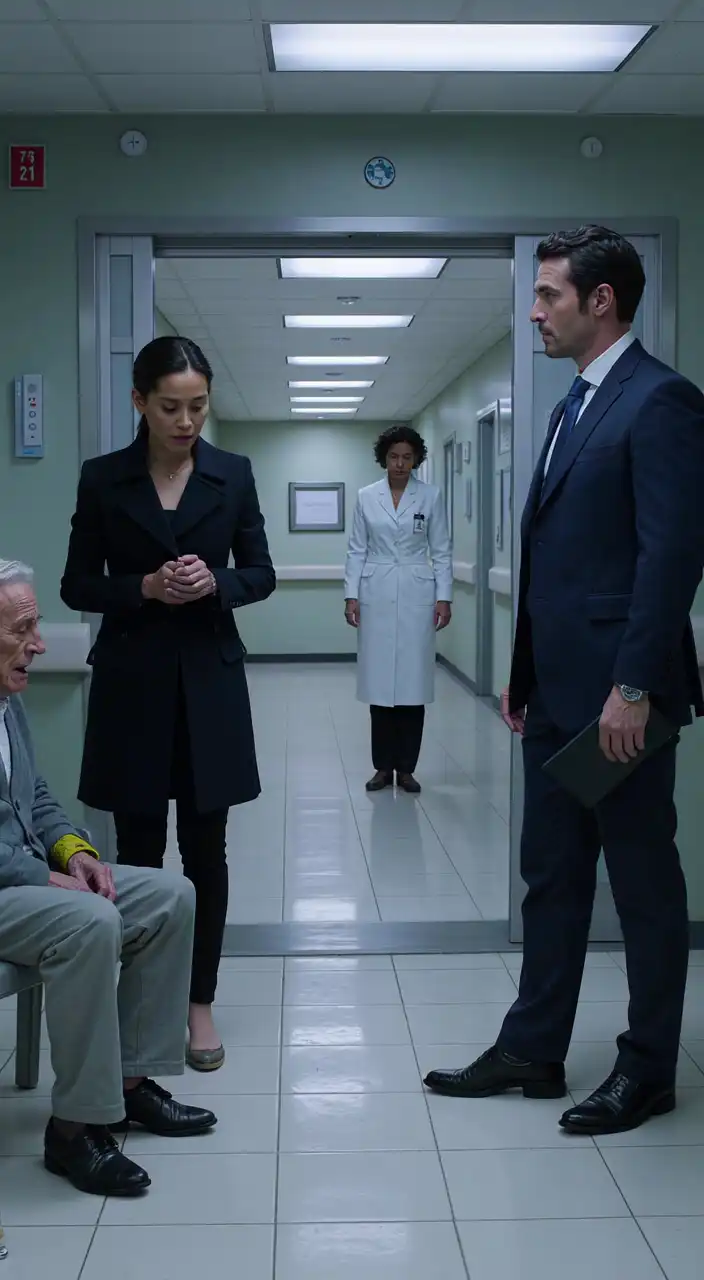
MY FATHER STARTED SHAKING OUTSIDE TRIAGE WHILE A CLINIC ADMINISTRATOR BLOCKED THE DOOR AND SAID HE NEEDED FAMILY PERMISSION FIRST.
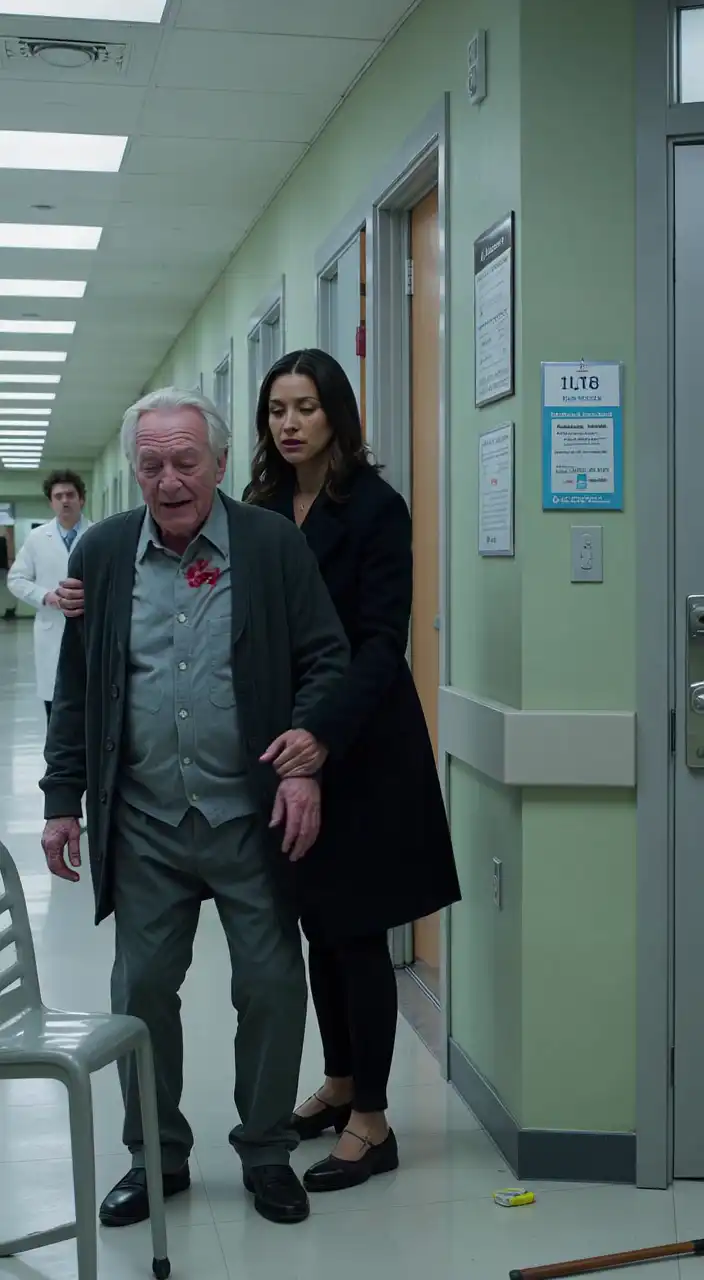
MY FATHER STARTED SHIVERING SO HARD HIS SURGICAL BANDAGE BLED THROUGH, AND THE CLINIC ADMINISTRATOR STILL BLOCKED THE TRIAGE DOOR.
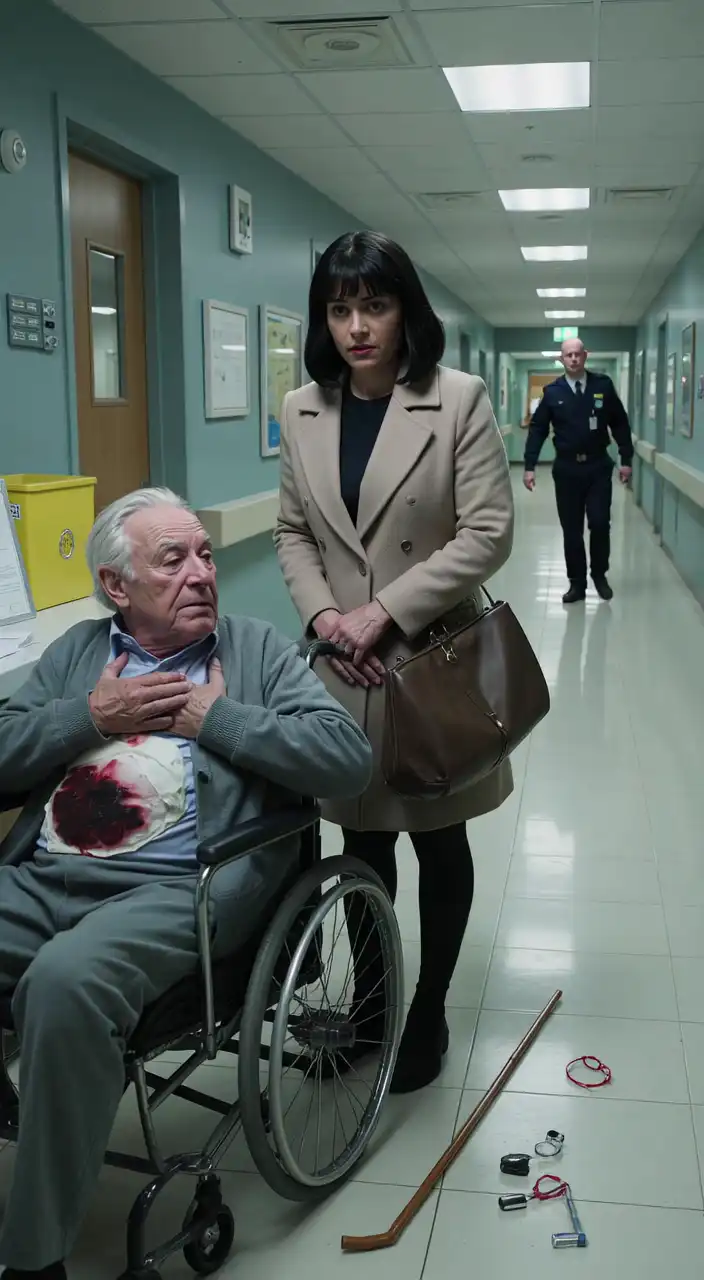
MY FATHER STARTED SHAKING IN THE HOSPITAL HALLWAY, AND THE WOMAN WHO CLAIMED TO BE HELPING HIM WOULD NOT LET TRIAGE TOUCH HIM.