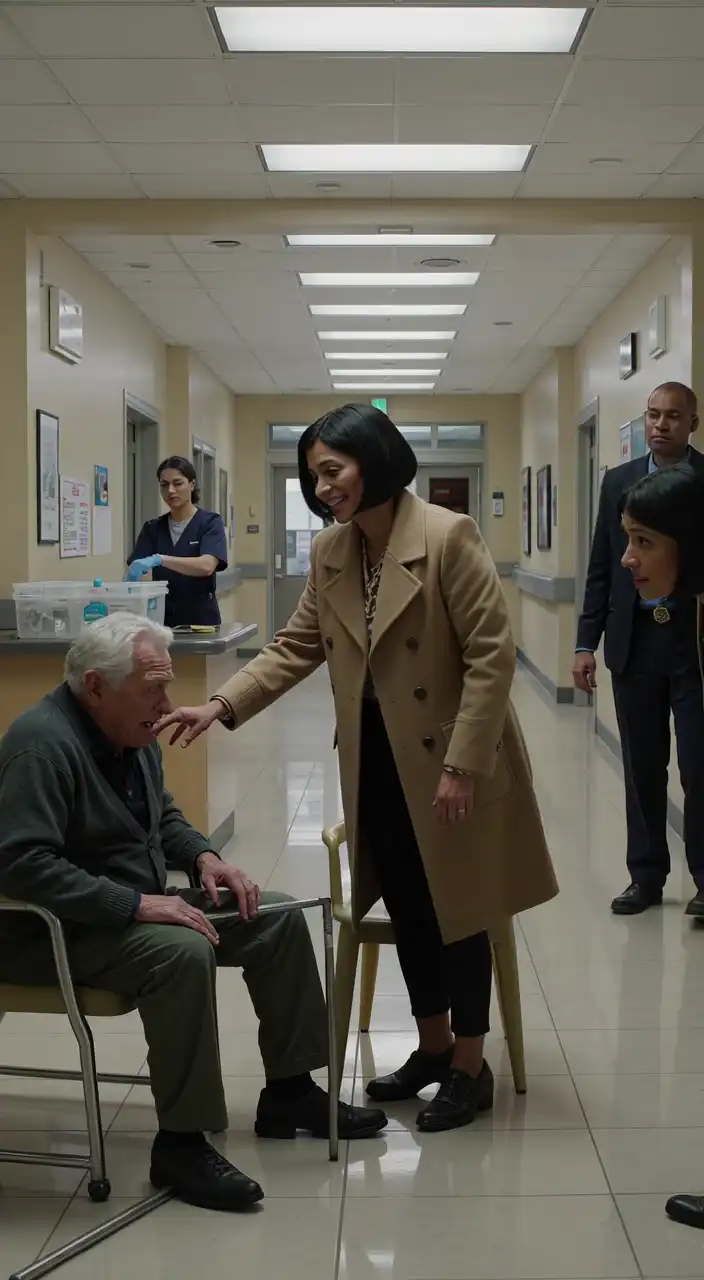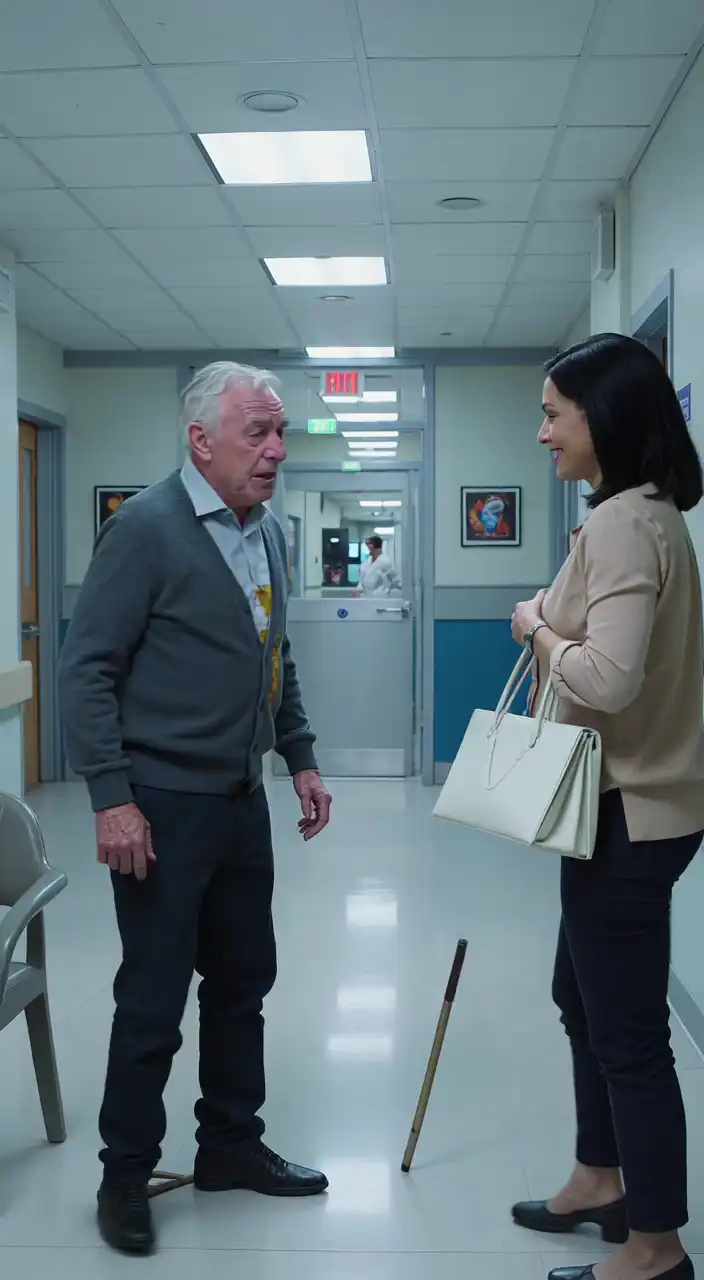
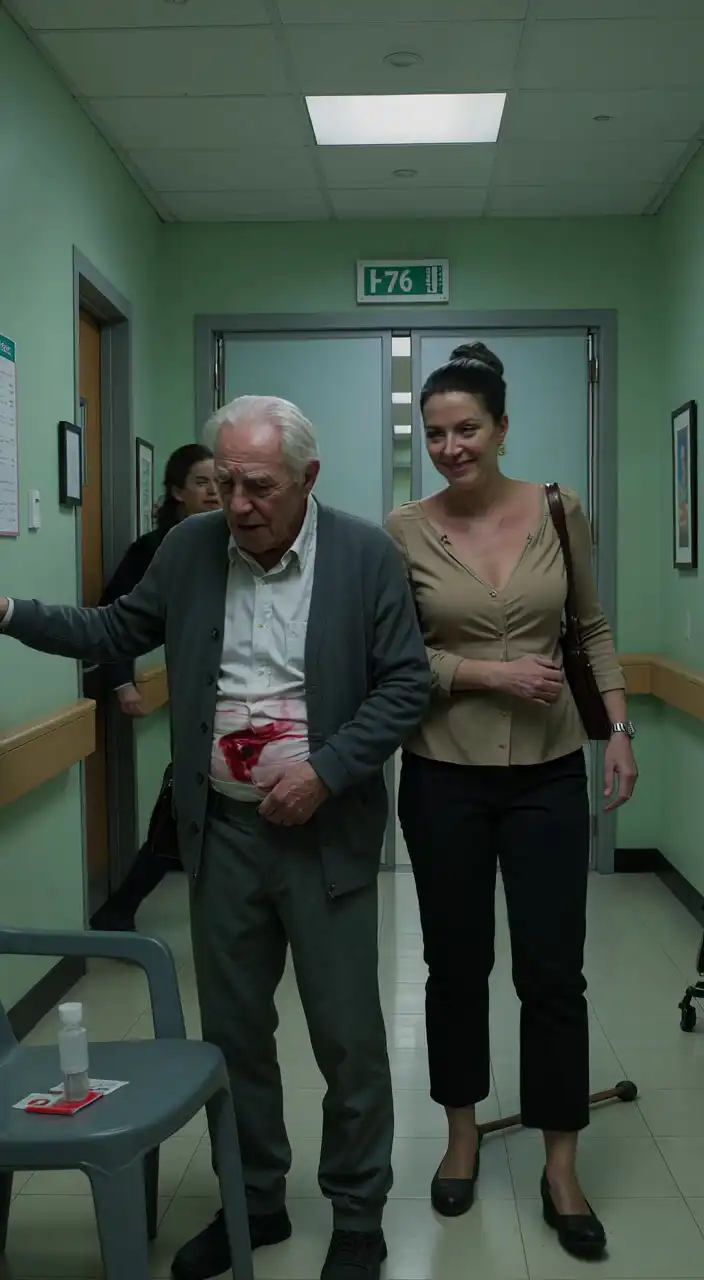
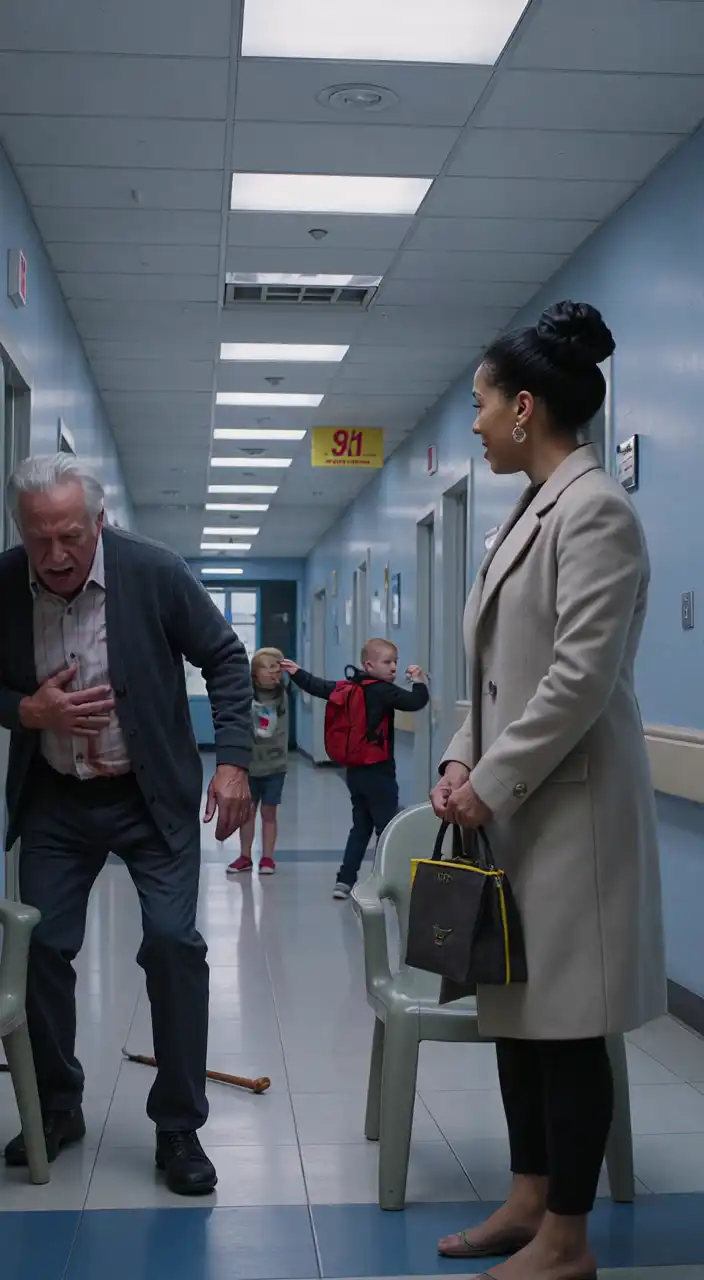

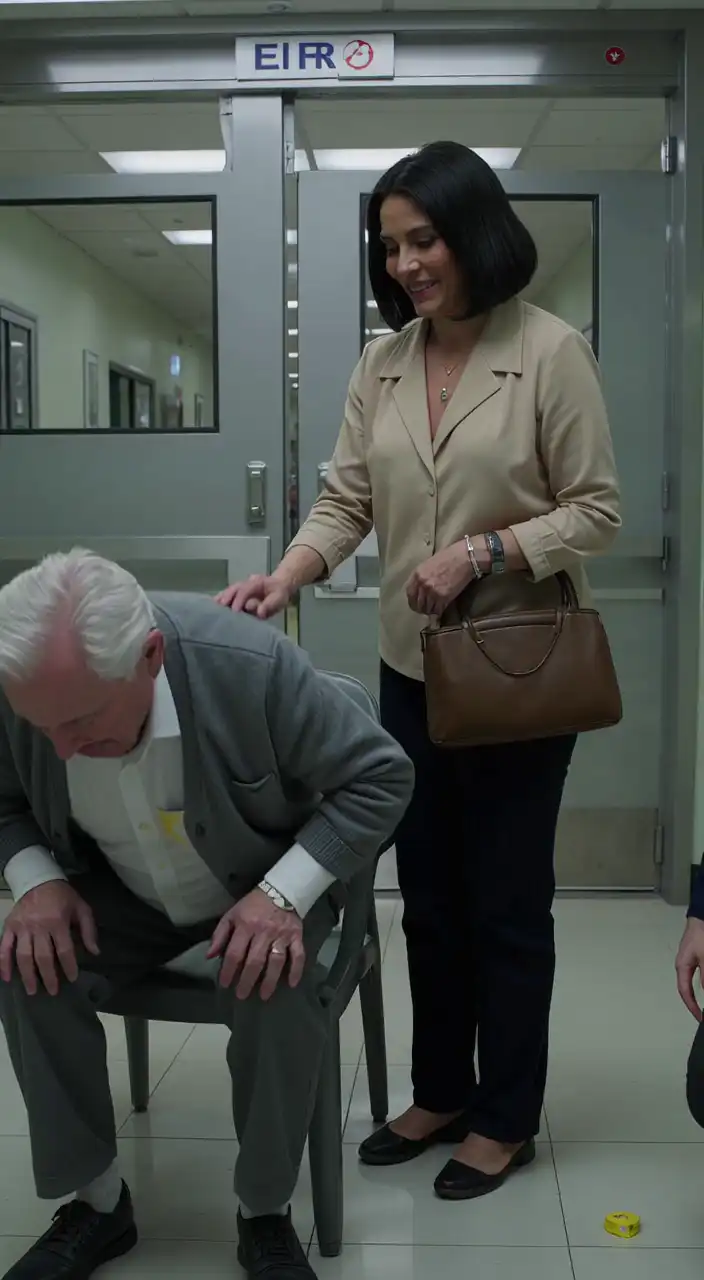
Maria's heel clipped the cap, and the tiny piece of yellow plastic shot under the chair instead of out the door.
Dr. Elena moved faster than she had a second earlier. One gloved hand stayed on my father's wrist. The other came up between Maria and the exit like a stop sign. "Do not leave," she said, flat and loud enough to cut through the hallway noise.
My father's knees buckled. The triage nurse lunged for a wheelchair, but he was already folding in on himself, trembling so violently his teeth knocked together. I caught one shoulder. Elena caught the other. Maria reached in too, all sudden concern now. "See?" she said. "He just overexerts himself. He needs to sit down."
"He needs a room," Elena said.
The amber monitor alarm from the doorway kept chirping. A tech rolled a portable monitor toward us while the triage nurse snapped, "Name and DOB." Maria opened her mouth before I could answer, and Elena cut her off without turning. "Family can wait. Ask the patient if he can answer. If not, ask the son."
That was the first crack in Maria's control. Her face didn't change much, but her eyes did. I had lived around that look long enough to know it: the quick calculation, the search for a new script.
My father tried to speak and coughed instead. His breath had a bitter medicinal smell, and there was sweat running into the deep lines beside his mouth. Elena touched the damp dressing through his shirt and then looked at the yellow stain again. "How long ago did he take anything?" she asked.
"I told you, he hasn't taken anything since the discharge dose," Maria said.
My father squeezed my wrist once, then again, like he was trying to send Morse code through my skin. "No," he whispered.
That one word changed the room more than the alarm had. The nurse clipped an oxygen sensor to his finger. Low. Another nurse appeared from inside triage with a blood pressure cuff already in hand. Security had not arrived yet, but the ER had shifted toward him. People who'd been moving around us started moving for us.
"Sir, I'm Dr. Elena Brooks," she said, lowering her face to his level. "I need yes or no if you can manage it. Did someone give you medicine after you left the hospital?"
His lips trembled. He looked at Maria first.
That hurt more than it should have. Even then, even shaking on the floor, he looked at the person who'd been controlling the day, measuring whether he was allowed to answer.
Maria folded her arms and gave a little laugh that didn't land. "He's confused. He always gets frightened in hospitals."
"He was discharged from one this morning," I said. "He wasn't frightened enough to hide his own paperwork."
Her head turned toward me slowly. "You weren't there."
"No," I said. "Because you told me he was sleeping."
The nurse and tech got him into the wheelchair. As they wheeled him toward the triage bay, Maria moved with them automatically, but Elena stepped sideways and blocked her cleanly. "Not until I know what's going on."
"I'm his caregiver."
"I'm his physician now."
The simple force of that sentence made Maria blink. For a second I thought she might start shouting. Instead she lowered her voice, trying for injured dignity. "Doctor, this is a misunderstanding. He had pain medicine. He didn't eat enough. He gets dramatic around his son because there are family issues."
That phrase landed like bait. Family issues. As if everything could be redirected into old conflict and away from the man shaking under a damp surgical dressing. Elena didn't bite. She crouched and reached under the chair, finding the yellow cap. She held it up between two gloved fingers. "Does this belong to his discharge medication?"
Maria's answer came too fast. "Yes."
My father made a dry, ugly sound that might have been a laugh if it hadn't turned into another cough. He pushed out three words. "Not from hospital."
Elena's eyes sharpened. "Good. Keep talking if you can."
Security finally arrived: one older guard with reading glasses on a lanyard and a younger woman with her hair in a hard bun. Maria straightened immediately, her smile returning as if they were the audience she wanted. "Thank God," she said. "This doctor is escalating because my stepfather is disoriented."
Stepfather. She almost never used that word in public. At home she said Dad. In front of authority, she chose whatever role sounded most responsible.
The older guard looked at Elena. "Problem?"
"Possible concealed medication administration post-discharge," Elena said. "Possible complication from surgery. Patient attempting to disclose obstruction of care. She was preparing to leave. I need him evaluated now and her separated until we know what he ingested."
Separated. The word sliced right through Maria's composure.
"You can't do that," she said. "I'm the one who manages everything. He can't even keep his meds straight."
"I can and I just did," Elena said. "Ma'am, step to the wall and keep your hands visible."
The younger guard moved beside Maria. Not rough. Not dramatic. Just close enough to make it real.
I followed the wheelchair into triage while Maria's voice rose behind me. "This is unbelievable. Ask him who forgot his appointments last month. Ask the son where he was when bills were due. Ask-"
The curtains closed, cutting her off.
Inside, everything became fluorescent, fast, and tightly controlled. My father was transferred to a bed. Oxygen. Telemetry. A nurse cut away the stained sleeve, exposing the hospital bracelet Maria had tried to hide beneath the cuff. Another nurse peeled back the dressing. There was fresh seepage, not a lot of blood but enough to show this was no simple overreaction. His temperature was 102.1. Blood pressure low. Heart rate high. The monitor alarm settled into a less frantic rhythm once the oxygen took hold, but the amber light kept pulsing at the corner of the screen like a warning no one could ignore.
Elena pointed at the stain. "Bag that sleeve. And the cap."
The nurse did it without asking why.
My father finally found a little steadier breath. "She said... don't embarrass her."
Elena looked at me. "I need the timeline from when he left the hospital."
I gave it as cleanly as I could. Surgery two days earlier. Planned discharge this morning. Maria insisted she'd handle pickup because she "understood medical things." She had some home health aide training from years before and wore that nurse-style cardigan like a credential. She texted me at noon that Dad was tired but okay. At four she said he was sleeping. At six she said he'd vomited once but "that's normal after anesthesia." At seven-thirty she called and said she was bringing him back because he "wanted reassurance." She didn't say he was trembling, feverish, or leaking through the dressing. She definitely didn't say he was trying to tell people she hid the discharge papers.
"Where are his meds now?" Elena asked.
"She had her bag clutched like it was a life raft," I said.
One of the nurses glanced at Elena. "Do we notify charge?"
"We already are the charge on this," Elena said. "And call the surgeon on call. I want the original discharge list, not whatever anyone says he took."
My father's hand fumbled at the blanket. I took it. His skin was hot and dry. He looked at me with a kind of shame that made me want to break something. "I told her... call you."
"You did," I said. "I'm here."
He swallowed. "She said not to."
The nurse paused while spiking an IV bag. You hear things in hospitals, but a sentence like that still changes the air.
Elena leaned closer. "Did she give you pills, liquid, or both?"
His eyes drifted shut and then opened again. "Cup. Bitter."
The nurse at the computer asked, "Any known allergies? Current prescriptions?" I answered what I knew. Blood pressure medication. Antibiotic planned after discharge? Maybe. Pain medicine, yes. But all of it was supposed to be in the papers I had never seen.
The contradiction opened wider by the minute. If Maria had simply made a mistake, why hide the documents? Why answer every question before he could speak? Why button the cuff over the bracelet? Why try to leave the second a doctor noticed the stain?
A surgical resident hurried in, read the vitals, examined the dressing, pressed gently around my father's abdomen, and ordered labs, cultures, imaging. He didn't waste words. Good sign and bad sign at once. Serious enough to move.
Then the younger security guard stepped inside the curtain. "Doctor? We need to know whether to hold her property. She keeps asking for her bag."
Elena didn't even look away from my father's monitor. "Yes. Chain of custody on the contents if possible. Especially medications. Have a nurse witness the search. If she refuses, law enforcement can take over. Tell her she is not free to interfere with care."
My father's fingers tightened around mine again at the word medications.
The guard nodded and left.
For one hopeful second I thought we had the path now: test him, find out what he took, confront her, done. But crises don't move in clean lines. Ten minutes later a nurse came in with a frown and said, "Doctor, the registration system doesn't show his discharge summary attached yet. There's a placeholder, but the medication reconciliation is blank."
Elena looked up sharply. "Blank how?"
"As in uploaded and then removed, maybe? Or incomplete. I need records."
The surgeon's resident swore under his breath.
My father turned his face toward me and whispered something so faint I nearly missed it. I leaned close.
"Blue folder."
"Where?"
He shut his eyes, gathering strength. "Not car. Laundry room."
I stared at him. He opened his eyes again, full of effort and fear.
"She knew," he whispered. "She knew I'd look in the car."
That was the moment I realized this wasn't just one bad decision in a stressful evening. Maria had planned where the papers would be found, and where they would not.
And outside the curtain, her voice rose in sudden panic as if someone had finally opened the handbag.
The nurse who had witnessed the search came back with the bag sealed in a clear evidence sack and a face that had gone hard.
"Doctor," she said, setting it on the counter, "there are three unlabeled pill organizers, a prescription bottle with the pharmacy sticker peeled off, and a folded note with dosing times that don't match any discharge schedule I've ever seen."
Elena looked at the bag, then at my father.
"Sir," she said quietly, "I need you to stay with me. Because whatever she gave you, I don't think it was an accident."
My father stared at the amber monitor light blinking beside him, and for the first time he didn't look confused.
He looked guilty.
That was the second crack, and somehow it frightened me more than Maria's lies.
Because guilty meant he knew something I didn't.
The resident sent him for a stat CT and more bloodwork while Elena stayed in the bay long enough to force a few more clear answers out of the chaos.
My father was exhausted, but not as confused as Maria had claimed. Between shivers he could follow simple questions, and when people spoke to him directly instead of over him, his answers tracked. Name, date, surgery type, pain level. He missed the exact day of the week, but not by much. His thinking came and went in waves with the fever and whatever else was in his system. Elena noticed that too. Confusion from infection or bad dosing could blur a person, but it did not explain the rehearsed wall Maria had built around him.
As transport rolled his bed toward imaging, I stepped out to the hall and found security posted near the nurses' station. Maria stood by the wall with her handbag now in evidence custody, arms folded, chin lifted. She looked like the wrong person had been inconvenienced. The younger guard stayed close while the older one spoke quietly to a hospital supervisor on the phone.
When Maria saw me, she changed expressions instantly. Outrage softened into wounded affection. "There you are," she said. "Finally. Tell them they're being ridiculous."
I did not move closer. "What did you give him?"
Her eyelids fluttered once. "His medication."
"Which one?"
"The one the doctor sent home."
"Then why peel the label off the bottle?"
She glanced toward the evidence bag before catching herself. "Because old labels confuse him."
"So you made it anonymous?"
"Don't start."
There it was. The voice she used at home whenever she wanted to push blame back into my chest. Sharp enough to make me feel twelve years old for one stupid second.
"I am starting," I said. "Why were the discharge papers hidden?"
"I did not hide anything. I put them somewhere safe because your father loses important documents every other day."
"He said laundry room."
She actually smiled. A tiny thing, almost pitying. "And now a man with fever is your courtroom witness?"
The hospital supervisor arrived then, along with a social worker in navy scrubs carrying a tablet. The social worker introduced herself as Denise and asked me to step aside for a separate statement. Maria immediately started objecting. "This is family. You don't need statements. He had surgery. He got overheated. You're all acting like this is abuse because he's old."
Denise did not flinch. "A patient attempted to disclose that care was blocked and records were concealed. We take that seriously."
"I am the one who cared for him when nobody else would."
"That may be true," Denise said. "It may also not answer the question."
Something in that reply landed. Maria's mouth tightened. The old guard asked her for identification. She produced it with an offended sigh and then looked directly at me. "You know he begged me not to call you every time he had a setback. He said you overreact."
My stomach dropped because that was plausible enough to hurt. Dad hated being dependent. He hated me seeing him weak. Maria had always wrapped herself around that shame and turned it into access. She handled appointments, grocery orders, insurance calls. After his surgery she all but moved into his house, saying he needed a steady hand. I had pushed back, but not hard enough. I told myself I was respecting his pride.
Denise saw my face and stepped in. "Let's keep to tonight."
I gave my timeline again, this time slower, with the texts. Denise asked if I still had them. I did. She asked me to screenshot everything from noon forward and email them to a secure address. One message from Maria stood out now in a way it had not earlier: "Don't rush over. They said stimulation makes post-op confusion worse." There had been no "they." She had already started assigning her decisions to invisible professionals.
Inside imaging took longer than I wanted. Longer than my breathing liked. While I waited, Denise asked about household dynamics. Was Maria on the lease? No, Dad owned the house. Did she have power of attorney? Not that I knew of. Did she control his prescriptions? Recently, yes. Did he have a history of substance misuse? Never. Cognitive decline? Some forgetfulness, normal aging, no diagnosis. Had there been prior incidents of delayed care? I opened my mouth to say no, and then a memory rose so fast I stopped.
Three months earlier Dad had missed a follow-up for chest pain. Maria told me the office rescheduled because "the doctor wasn't worried." Two weeks after that he had a dizzy spell and she said urgent care told them to "watch fluids." I had accepted both explanations because every time I challenged her, Dad grew embarrassed and withdrew. Denise watched my face. "You remembered something."
"Maybe," I said. "Maybe more than one thing."
"Tell me."
As I spoke, the pattern assembled in ugly pieces. Delays explained away. Calls filtered through Maria. Appointment cards gone missing. Medication changes I heard about secondhand. She always sounded competent, mildly burdened, and deeply offended by any question. It was the perfect disguise because it used care as cover.
Denise typed quickly. "Has money been a stressor?"
"Always," I said. "For her more than for him."
That earned a glance. "How so?"
Maria had debts. Small loans from cousins, late utility notices, one repossessed car a few years back. Dad had helped her more than once because he was decent and because she knew how to make gratitude sound like need. She was not some movie villain. She did cook for him. Drove him places. Sat with him after appointments. That's what made this so hard to see. Real help had been braided with control.
Denise asked if Dad had changed any beneficiaries, titles, or account access recently. I didn't know. But I remembered seeing Maria with his checkbook two weeks earlier, saying she was "organizing autopay." At the time Dad nodded like it was practical.
Before I could say more, Elena came out of imaging in motion, reading something on a portable screen. The resident walked beside her, jaw set. That was enough to send my pulse into my throat.
"What is it?"
Elena stopped. "We have signs of infection and dehydration, but that isn't the whole picture. His blood pressure response and level of sedation don't match the discharge medications listed by the surgeon."
"The discharge list exists now?" Denise asked.
"Records found the surgeon's signed version in a scan queue," Elena said. "It includes an antibiotic, a low-dose opioid for breakthrough pain, and explicit instructions to return for fever, worsening pain, drainage, or vomiting. No sedating antihistamine. No extra benzodiazepine. Nothing yellow."
Maria, hearing enough from across the hall, raised her voice. "This is absurd. You're talking in code to make me look guilty."
Elena turned. "No, ma'am. I'm talking in medicine."
The room went still around that sentence.
Elena continued, not to Maria but to the supervisor. "Until we identify what he ingested, I want this treated as possible medication misadministration at minimum. And because he disclosed hidden records, involve Adult Protective Services."
Maria barked a laugh. "APS? For helping someone take a pill?"
"For obstructing care," Denise said.
Maria's eyes snapped to mine. "You did this."
"No," I said. "You did."
For the first time her control cracked visibly. "You think you can swoop in because a doctor got dramatic? You have no idea what it takes to deal with him. He calls at 2 a.m. because a sock feels wrong. He forgets he ate and accuses people of stealing. He says one thing to one person and another thing to the next. You weren't there when he was screaming in pain this afternoon."
That hit because I could picture it. Dad in pain, stubborn, ashamed, resistant. Caregivers do get exhausted. They do make mistakes. Denise knew that too. Her tone softened by half a degree. "If he was screaming in pain, why not bring him back sooner?"
Maria opened her mouth, and nothing clean came out.
"I was handling it," she said at last.
"With what?" Elena asked.
No answer.
The nurse who had bagged the stained sleeve appeared with lab stickers and spoke quietly to Elena, but I caught two words: tox screen. Elena nodded. "Good."
Maria heard them too. "A tox screen? On a post-op patient? Of course he's got meds in his system."
Elena folded her arms. "Not unlabeled ones."
That should have been the end of Maria's confidence. Instead she changed tactics again, and this was the first reversal none of us were ready for.
She looked straight at Denise and said, in a smaller, shakier voice than I'd ever heard from her, "He asked me to do it."
Every head turned.
She put a hand to her chest, as if she'd been resisting this terrible truth for everyone's comfort. "Not poison. Just enough to make him sleep. He was begging. He said he couldn't take the pain and didn't want to come back because he couldn't afford another admission. He said his son would be angry if the bills got worse."
I felt heat blast through my face. It was a smart lie because it borrowed from real facts. Dad did hate bills. He did fear burdening me. And if she could recast this as misguided mercy instead of obstruction, she could blur everything.
Denise did not accept it, but she wrote it down.
Elena asked one question. "What exactly did you give him?"
Maria held her ground for three long seconds.
"Benadryl," she said.
The resident snorted before he could stop himself. "Benadryl doesn't explain this pattern."
"Then maybe his infection does."
"Maybe," Elena said. "And maybe the peeled label in your bag explains more."
The younger guard stepped closer as Maria's breathing changed. She was cornered now, and cornered people do strange arithmetic. I saw her eyes cut toward the ambulance bay door behind the station, then toward me, then toward the unattended visitor chairs where she had first stood with Dad. Looking for angle, witness, escape, sympathy, anything.
Denise touched my elbow. "Go with your father when he's back. We'll keep taking this."
I nodded, but before I turned away, Maria said my name.
Not loud. Not pleading. Just precise enough to stop me.
"You should ask him about the money," she said.
I looked at her.
Her expression was suddenly almost calm. "Ask him why he didn't want the discharge papers seen."
Then she sat down in the plastic chair as if she had finally decided to conserve energy, and the old guard placed himself between her and the hallway while inside the imaging corridor the transport team began rolling my father back toward us.
That one sentence lodged in me like a splinter.
Because if it was another lie, it was aimed with care.
And if it wasn't, then my father's guilt beside the blinking amber monitor meant something far worse than shame about being helpless.
He came back from imaging weaker, sweat on his temples, lips pale, but more awake than before. The IV fluids had started to help, and whatever had been dragging his thoughts sideways was easing enough for him to track faces. Elena ordered him into a monitored room deeper in the ER instead of keeping him in triage. That alone told me they were no longer treating this like a simple post-op setback.
As the bed rolled, he caught sight of Maria over my shoulder. His body tensed so sharply the monitor fluttered. He wasn't looking with love or dependence now. He was looking with dread.
"Not with me," he rasped.
"I know," I said. "She's not coming in."
Once the room door shut and the nurse dimmed the overhead light a notch, the noise of the hallway became a muffled wash. The monitor still blinked amber at the edge, not as frantic as before, but persistent. Elena had the tox screen pending, blood cultures sent, and the surgical service involved. A broad-spectrum antibiotic dripped into his line. The room smelled like alcohol wipes, saline, and fear.
He kept touching his gown cuff where the bracelet used to sit under the cardigan. That little motion mattered. Maria had buttoned the sleeve over it for a reason. People notice bracelets. Bracelets prove timelines. He knew that now too.
I sat close. "Dad, listen to me. Whatever this is, if you know something, now is the time."
He closed his eyes.
"When Maria said ask about the money," I continued, "what was she talking about?"
He did not answer immediately. Shame moved across his face before words did. "I signed things."
My chest tightened. "What things?"
"After surgery consult. Before. Week before, maybe." His voice was rough and broken by fatigue. "She said if I was under anesthesia somebody needed access. Bills. Pharmacy. Electric. In case..."
"In case you died?"
His eyes filled. He gave the smallest nod.
That should have made me angry at him, and maybe some part of me was. But mostly it made me furious at how perfectly she'd aimed at his fear. Older man, major surgery, house to manage, pride already frayed. Tell him practical help is love. Tell him paperwork is protection. Then become the gatekeeper.
"Power of attorney?" I asked.
"I don't know. Forms." He swallowed. "She hurried me."
The resident stepped in then, reviewed his abdomen again, checked the dressing, and asked him to rate his pain. Dad managed a seven. The resident looked at me after hearing about the paperwork. "If there are legal documents at home, don't confront her yourself. Let social work and APS handle it."
"Are the surgery complications bad?" I asked.
He chose his words carefully. "He has a postoperative infection concern and signs of medication exposure we did not prescribe. We can treat both, but I need him stable and I need an honest history."
After he left, Dad tugged weakly at my sleeve. "Blue folder," he said again. "Top shelf. Laundry room. Behind detergent."
The planted image was so absurdly domestic it made me sick. Important forms hidden behind detergent.
"Okay."
"Don't go alone."
"I won't."
A little later Denise returned with an APS intake coordinator on speakerphone and asked Dad directly whether he felt safe going home with Maria. He opened his eyes and said, clearly enough this time, "No."
That word changed his case from concerning to actionable. Denise's posture shifted. "Thank you, Mr. Hale. Has anyone kept you from calling your son, seeing your records, or getting medical care?"
"Yes."
"Who?"
He looked at the blanket for a long second. "Maria."
There it was. Not whispered in confusion. Not torn out under pressure. Said plainly.
Denise documented every word. APS wanted an emergency note in the chart and requested law enforcement be notified because medication tampering was possible. Elena already had hospital security involved, but now the line widened beyond internal procedure.
The emotional pressure in the room should have eased with that clarity. It didn't, because truth always drags consequences behind it. Dad began shaking again, not from the same collapse as before but from the release of finally saying it. "I let her," he whispered.
"You got manipulated," I said.
"I signed things."
"We'll deal with the papers."
He turned his head away. "Not just papers."
That brought me up short.
Before I could press, a nurse arrived with preliminary lab updates. The infection markers were high. The tox screen was still incomplete, but one result had come back suggestive of a sedating agent not on the discharge list. Not final, not enough to name yet, but enough to deepen the concern. Elena heard it, nodded once, and ordered a formal medication review through the hospital pharmacist.
Then she asked for the peeled-label bottle from security.
The pharmacist, a tired-looking man named Chen with a clipped voice and absurdly gentle hands, came in twenty minutes later carrying the evidence bag and a tablet. He set the bottle on the counter under bright task light. The pharmacy sticker had been peeled, but not perfectly. Adhesive residue remained. A partial lot code. Tiny imprints on the tablets visible through amber plastic.
He looked at the yellow stain bagged from my father's sleeve and then at the bottle. "This liquid residue may not be from the same medication as the pills," he said. "The color is suggestive but not conclusive. However..." He held the bottle up. "These tablets are not from the antibiotic listed and not from the prescribed opioid. I need magnification to confirm, but I strongly suspect this is an older sedative."
Dad stared at the bottle as if it might speak.
"Whose?" I asked.
"Could be anyone's if labels were removed," Chen said. "But if she thought she could just peel and erase, she underestimated pharmacy stock coding."
That tiny practical sentence steadied me more than any comfort could have. Coding. Adhesive. Imprints. Facts that didn't care about Maria's performance.
Chen also looked at the note found in her bag. Dosing times: 1 p.m., 4 p.m., 6 p.m. All handwritten in neat block letters. Next to one line was a phrase underlined twice: keep him resting. Elena showed it to Dad.
"Did you write this?"
He gave an immediate no.
"Did any doctor say these words to you?"
Another no. Then, after a pause: "She did."
There was one planted detail from the post coming due now: the phrase "don't embarrass her." Maria had framed everything around appearances, and "keep him resting" fit that same logic. Sedation as silence. Sleep as control.
Denise asked permission to photograph the note and his hidden bracelet before it was cut off for replacement. He agreed. The bracelet mattered because it proved he was still fresh from discharge when she buttoned the cuff over it and tried to present him as merely dramatic. She had wanted the authority of the hospital when it suited her and hidden it when it threatened her.
Hours stretched strangely in the ER. Dad dozed, woke, answered, drifted. I gave statements twice more, once to a sheriff's deputy who arrived after APS and once to the surgical attending who wanted a clean chronology. Through the glass panel in the door I saw Maria only once after that. She was seated beside Denise and the deputy, hands still, posture perfect. She looked less panicked now than strategic.
That frightened me.
When the deputy came into Dad's room afterward, his face was unreadable. "She's claiming Mr. Hale personally asked her not to bring him back because he was afraid of costs and didn't want his son involved."
Dad looked at him. "No."
"She also says the forms he signed gave her permission to manage his medication."
Dad shut his eyes. "Maybe paper. Not poison."
The deputy wrote that down.
Then came the first major reversal built from all the details we had been collecting. The surgeon's office faxed over not only the discharge summary but the pre-op consent packet. Denise spread the pages on the counter. Standard surgical consents. Billing forms. Contact sheet. Then one non-hospital document tucked among them by mistake when they were scanned: a limited financial authorization form from a bank branch, witnessed but not notarized, naming Maria as temporary account helper during recovery.
My stomach dropped.
"It's not power of attorney," Denise said quickly. "But it's access."
"To what?"
"Likely checking. Maybe online management."
Dad covered his face with his hand.
The deputy asked, "Mr. Hale, did you intend to authorize her to alter beneficiaries, titles, or larger transfers?"
"No," he said. "Just bills."
"Did she explain the form clearly?"
"She said hospital needed it."
Denise and I exchanged a look. There was the motive broadening from control into money. Maybe not inheritance, not dramatic hidden millions, just enough access to make an exhausted man valuable. If he became too alert, if I got involved, if the discharge papers showed return precautions that proved she delayed care, her position could collapse. Sedate him. Keep him compliant. Control the records. Bring him back only when collapse forced it.
But there was still a contradiction. If she wanted access to his money, why risk a hospital where professionals would ask questions? Why not continue at home?
Elena answered that without meaning to when she reviewed his latest vitals. "His infection was worsening fast," she said. "At some point she may not have been able to keep him upright, and that made hallway presentation safer for her than a death at home."
The sentence hit like ice water. Maria had not necessarily planned a killing. She may have planned a managed decline, just enough weakness to deepen dependence. But by evening she had run out of control. A man leaking through his dressing and trembling with fever leaves evidence all over a floor.
I left the room only once more that night, to call my wife and then to stand by the vending machines long enough to breathe. Denise found me there and told me the deputy wanted one more detail: was there any recording, voicemail, or witness showing Maria blocked communication?
I thought of the texts, of her voice in the hallway, and then suddenly of Dad's old kitchen speaker device. He used it badly, always activating calls by accident. Sometimes it logged snippets. "Maybe," I said. "At his house."
Denise's eyes sharpened. "Can anyone trusted access the home tonight?"
"My neighbor has a key."
"Do not send them inside if Maria might have legal standing to object. But ask them one thing: whether the blue folder is visible where your father said."
I called Mr. Rivas next door. He answered on the second ring, sleepy but concerned. Yes, he had seen Maria leave with Dad earlier. Yes, her car was still not back. Could he check through the laundry room window from the side path? He could.
I waited while he walked.
His whisper came back through the phone. "Top shelf behind detergent... I see blue. Looks like folder."
I closed my eyes.
A simple household detail had turned into proof.
Denise had me text him not to touch it and to wait for law enforcement if requested. The deputy arranged for a patrol unit to meet him there, preserving the scene because now the hidden records might matter beyond family conflict. As Denise ended that call, another nurse entered with a fresh update from toxicology.
Not final, she warned. Preliminary. But enough.
Sedative present. More than one dose likely over several hours.
Elena exhaled once through her nose and looked at me, then at Dad. "That matches his pattern better."
Dad stared at the blanket again. "I thought... she said it would help the nausea."
"What did the liquid look like?" Elena asked.
"Yellow cup. Bitter." He hesitated. "She poured from small bottle."
The yellow stain. The yellow cap. Not just random contamination. A dosing clue with a color trail.
Elena wrote it down and then said quietly, "Mr. Hale, this may be hard to hear, but you need to know: if she gave repeated sedation while you had return precautions for fever and drainage, she increased the risk of serious harm."
He nodded once, eyes wet.
The monitor's amber light blinked beside him. The room was still. And then he whispered the thing that made movement four turn into something larger than one caregiver lying.
"She said if I went back, they'd find out."
"Find out what?" I asked.
His fingers curled into the blanket. "That the pills were gone."
The deputy looked up. Denise looked up. So did I.
"What pills?" Elena said.
"The real ones," my father answered. "The pain medicine. Bottle was light when she gave it to me. She said pharmacy shorted it. Said not to mention because they'd blame me."
And there it was: the moral reversal inside the medical one. This was not only blocked care to hide neglect. It was blocked care to hide theft from a fresh surgical patient.
The hallway noise returned in my ears all at once, louder than before.
Because if she had taken his real medication, substituted sedation, and delayed return precautions, then every neat answer she gave had been built over a theft that turned dangerous the minute his body started failing.
The deputy left immediately to speak with Maria again and to coordinate with the patrol officer at the house.
And through the glass in the door, I saw Maria finally lose her stillness.
She had realized, somehow, that the story was moving beyond her script.
By the time dawn started thinning the black windows above the ambulance bay, my father had been admitted from the ER to a monitored surgical floor, but the transfer did not feel like relief yet. It felt like moving the center of the storm upstairs.
He had enough fluid in him now to stop the worst of the trembling. The antibiotics were running. The dressing had been changed, cultured, and documented. His fever was still there, but he could keep his eyes open longer. He looked old in a new, frightening way, as if the effort of surviving the night had peeled him down to essentials.
Denise met us on the floor with coffee I didn't want and a folder I did. "The patrol officer recovered the blue folder from the laundry room exactly where your neighbor saw it," she said. "Deputy logged it. It contains the discharge papers, prescription printouts, and two unsigned insurance forms."
"Unsigned?" I said.
"Unsigned by your father. One has Maria's handwriting on sticky notes attached."
Dad turned his head on the pillow. "What sticky notes?"
Denise opened the folder carefully. The first page was the discharge instruction sheet, highlighted in pink on one section: Return immediately for fever over 100.4, worsening drainage, vomiting, severe pain, confusion, inability to keep fluids down. Every symptom he'd developed. Every reason she should have brought him back hours earlier. Attached to that page with a yellow sticky note were the words: He gets anxious reading this. Better if I explain.
No one said anything for a moment.
Another sticky note on the pharmacy printout read: Space these out. Keep him resting so he does not ask for extras. That sentence sat in my chest like a stone. Because maybe on its own it could still be interpreted as clumsy caregiving. But not with peeled labels. Not with repeated sedation. Not with hidden papers. Not with a patient saying he was told not to call his son.
Denise laid out the bank authorization form next. There was Dad's signature. Real. Shaky but real. There was Maria's too. Witness line signed by a bank employee from three days before surgery. It did not give her broad legal power, but it gave her enough temporary access to online bill pay and account inquiries to be dangerous if nobody watched.
"Has there been activity?" I asked.
"Your bank fraud department flagged two attempted external transfers overnight after law enforcement contacted them," Denise said. "Both failed because the account was locked."
I actually sat down because my knees suddenly felt unreliable.
Dad stared at the ceiling. His mouth opened and closed once. "She tried tonight?"
Denise nodded.
That was the second major reversal paying off the guilt in his eyes. He had not only felt ashamed for signing papers. He had realized, before collapsing, that Maria's panic was not just about being embarrassed in front of doctors. It was about losing immediate access the moment professionals looked too closely. She had likely thought she still had time. Then Elena saw the stain and everything accelerated.
The sheriff's deputy arrived half an hour later with more specifics. Maria had first denied any bank paperwork. Then, when shown a photo of the signed authorization, she changed again and said Dad had "promised compensation" for caregiving and she was only securing repayment before "the son froze her out." She also insisted she had used no one else's medication, only an over-the-counter sleep aid and anti-nausea syrup. Toxicology would settle part of that later, but her story was already splintering under its own revisions.
"Was she arrested?" I asked.
"Detained and released pending toxicology confirmation and prosecutor review on the medication angle," he said. "But she has been trespassed from the hospital and instructed not to contact the patient directly. APS emergency restrictions are being pursued."
The words should have felt like victory. Instead they introduced the fifth movement's last obstacle: she was still out there, not in custody, and she knew the house, the documents, the neighbors, the routines. Dad heard the same thing in the deputy's careful tone. His pulse rose on the monitor.
"She'll go to the house," he whispered.
"It's locked down," I said.
But even as I said it, my phone buzzed.
Mr. Rivas.
I answered immediately.
"There's a woman here," he said in a low, urgent voice. "Not Maria. Younger. Says she's Maria's niece and needs clothes for her aunt because the hospital 'made a mistake.' She keeps knocking."
The deputy held out his hand for the phone. He spoke briefly, instructing Mr. Rivas not to open the door and telling him a unit was on the way. When he hung up, his expression hardened. "Pressure test. Seeing what she can still retrieve."
Denise looked at Dad. "Is there anything else in the house that could be used to control access? Spare checks? IDs? medication samples?"
Dad swallowed. "Desk drawer. Old passport. Checkbook. And..." He winced. "Kitchen tin."
"What kitchen tin?"
He looked at me, embarrassed all over again. "Cash."
Of course. Older generation emergency money in a kitchen tin. Every family thinks their hiding place is original. Every manipulator eventually learns where it is.
I stood. "I'm going there."
"No," the deputy said immediately. "Not alone. Not until officers clear it."
"I can't just sit here while she sends people."
"You can if you want your father protected instead of escalated."
He was right, and I hated him for being right. This is how crisis works when authority enters for good reasons. Action feels like love. Procedure feels like delay. But bad actors count on families jumping ahead of safe process.
So I stayed, and staying was one of the hardest things I'd done all night.
The surgeon came in then with fresh results. No immediate return to the OR, thank God. The infection looked manageable with IV antibiotics if Dad kept responding. The concerning drainage would be watched closely. The sedative exposure had complicated his presentation, masking the severity at times and deepening his weakness. "Another delay at home could have gone badly," he said, not dramatizing, just stating.
Dad turned his face toward the wall.
After the surgeon left, I asked the question I had been avoiding. "Why didn't you call me anyway? Even once she started controlling things."
His eyes stayed on the wall. "Because at first it looked like help."
That answer was simple enough to break me.
He kept going. "Then it looked like my fault."
There it was, the emotional center of this kind of abuse. Control arriving dressed as rescue, then turning the victim's confusion into self-blame. Denise heard it too. She gently asked if Maria had ever threatened to leave him alone if he disagreed. He nodded. Had she ever said his son resented the burden? Another nod. Had she ever made him feel too embarrassed to tell the doctor things? Tears slid into his hairline. Yes.
Around noon the patrol unit called from the house. The younger woman at the door had left before officers arrived, but they recovered security camera footage from a neighbor's porch. Denise asked if Dad had any home devices with recordings. He remembered the old kitchen speaker after all. The deputy wrote that down, and with Dad's consent they collected it later.
That planted detail became the movement's hook. Midafternoon, while Dad slept under a light blanket and the amber monitor finally stayed quiet for more than ten minutes at a time, the deputy returned with an evidence tech and a clipped note of excitement.
"The kitchen speaker stored short voice activations locally," he said. "Mostly accidental. We have one from yesterday at 6:12 p.m."
He didn't play it immediately. He asked Dad if he wanted us present. Dad nodded, frightened.
The audio was tinny and brief. A clatter. Dad's voice weak and slurred: "Call Ben." Then Maria's voice, sharp and close: "No. You're resting. If you go back, they'll find out what you already took." Then another sound, like a cup set down hard. Then the recording ended.
No cinematic confession. No full explanation. Just enough.
Enough to prove blocked care. Enough to prove she stopped him from calling me. Enough to prove she tied his return to being "found out."
Dad covered his mouth and wept soundlessly.
The deputy shut off the recording and said, "That helps a lot."
It helped legally. It helped medically. But emotionally it did something harsher. It stripped away the last safe lie that this had been misunderstanding. A machine in the kitchen had heard what the family had not.
The final obstacle was not just Maria's freedom outside the hospital. It was what had to happen next inside Dad: he would need to survive both the infection and the collapse of trust. He had let her in because he feared being alone, being a burden, dying without order. Now every practical thing - bills, prescriptions, rides, meals - was contaminated by that betrayal.
He woke near evening in a panic after a dream and grabbed my arm. "Don't let them send me home."
"I won't."
"Not to that house by myself."
"You won't be alone."
He searched my face like he needed to hear the logistics, not comfort. Where would he go? Who would manage meds? Could Maria come back with papers? Could she empty accounts? Could she tell people he was senile? Every question had teeth.
Denise and the case manager came in together and turned those fears into a plan, but even planning had pressure. To lock down the bank, we needed signatures and fraud statements while he was still tired and shaky. To block Maria from records, we needed updated contact restrictions. To keep him safe after discharge, we needed either in-home nursing with approved oversight or temporary rehab placement. Each form stirred his shame because forms were how this had started.
He balked at the first signature.
I understood. His hand hovered over the line and trembled. "What if I'm signing another trap?"
Denise slid the papers away. "Then we slow down."
That small respect mattered. She read each form aloud. Why it existed. What it did not do. Who could see it. What rights he kept. No rushing. No stacked signature pages. No "just sign here." For the first time in days, paper became protection instead of camouflage.
When he finally signed, his shoulders dropped half an inch.
That night, after the deputies left and the unit quieted, the monitor gave one soft alert when he tried to stand too fast. The amber light flashed, and for a second we both jumped like it was the hallway all over again. Then the nurse steadied him, reset the leads, and smiled. "You're not falling on my shift, Mr. Hale."
He gave the ghost of a laugh.
Outside his room window, evening folded blue over the parking lot. Inside, the blue folder sat on the chair beside me, no longer hidden behind detergent, no longer in Maria's control. The bracelet photo was in the chart. The yellow cap was in evidence. The stain had been tested. The kitchen speaker had spoken. Every little detail she thought was too small to matter had turned into a path out.
But she was still making calls from somewhere, and tomorrow would bring more decisions, more statements, more attempts to salvage a life she had wrapped around his.
Dad drifted toward sleep and said one more thing, barely audible.
"She wasn't always like this."
Maybe not. Maybe desperation had a timeline. Maybe entitlement did. Maybe care and exploitation had been mixed from the start. It almost didn't matter now. What mattered was that the threshold had finally been crossed in the right direction.
He had made it back inside the doors.
And Maria's story was no longer the only one in the room.
The rescue did not arrive as one dramatic moment. It arrived in layers over the next four days, each one ordinary enough to be missed if you were expecting sirens.
First came stabilization. Dad's fever broke late the next morning. Not all at once. It lowered by degrees until the sweat on his forehead felt like healing instead of collapse. The surgical team confirmed the infection was responding to IV antibiotics. He would not need another operation unless the drainage worsened, and by afternoon it hadn't. The monitor stayed quiet long enough for the room to sound less like an emergency and more like a place where people recover.
Second came protection. The bank locked every account and reversed the two attempted transfers. Their fraud investigator visited in person because the hospital social work note had flagged elder financial exploitation tied to medical obstruction. He sat with Dad and explained each account in plain English. No rushing. No hidden toggles. Dad revoked Maria's temporary access and added me only for limited bill pay, with Denise and the investigator both making sure he understood the difference. When the investigator asked if he wanted new checks, new debit cards, and a verbal password added, Dad surprised me by saying yes to all of it.
Third came evidence. Toxicology finalized enough to support what Elena had suspected: sedating medication in his system inconsistent with the prescribed discharge list, likely given in repeated doses. Not a full poison-drama answer with flashing labels and instant handcuffs. Real life is slower. But it was enough for the deputy and APS to deepen their case. The pharmacy traced the peeled-label bottle to an old prescription originally filled months earlier for someone else in Maria's household. Chen, the pharmacist, was almost grimly satisfied when he explained how lot coding and tablet imprinting made the match possible. "People think removing a label removes history," he said. "It doesn't."
Fourth came the human part, the part that mattered most. Dad stopped flinching every time a form appeared. He let nurses explain medications to him directly. He asked questions. He told the surgeon he wanted all discharge instructions read aloud in front of me and placed in a clear folder that would stay with him, not in someone else's bag. He asked for his own phone back and kept it charging by the bed. The first time it rang and he answered without looking toward the door for permission, I had to turn away for a second.
Maria did try to reach him. Through cousins. Through a voicemail left on the unit desk claiming she had "urgent dietary information." Through one long text sent to my phone from an unfamiliar number saying, "You are destroying a family over a misunderstanding and he will regret letting strangers turn him against me." Denise saved it for the file. I blocked the number. The hospital kept the trespass order in place. APS obtained an emergency recommendation that she not act as caregiver pending investigation. The deputy said the prosecutor was reviewing potential charges tied to medication misuse, obstruction, and attempted financial exploitation.
On the third day, Mr. Rivas brought over a small paper bag from the house after officers cleared him to collect a few approved items: Dad's glasses case, his hearing aid charger, a clean cardigan. Folded on top was the old kitchen tin. Empty now because officers had already documented and secured the cash inside, but seeing it made Dad shake his head with a sad little smile. "Thought I was clever," he said.
"You were from 1978 to 1994," I told him.
He laughed for real then, weak but honest, and Dr. Elena, passing the doorway, smiled like she had been waiting to hear that sound.
She came in later before her shift ended, no white-coat authority speech this time, just one doctor checking on a patient who had almost slipped past the threshold. Dad thanked her awkwardly. He said, "You saw the stain."
She shrugged one shoulder. "I saw a story that didn't fit."
Then she pointed at the new clear folder on his tray table. "Keep your papers where you can reach them."
"I will."
She looked at me too. "And if someone keeps answering for him, interrupt sooner."
There was no blame in it. Just truth. I nodded.
Discharge planning became its own kind of rescue. Dad did not go back to the house alone. He agreed to a short rehab stay attached to the hospital system, partly for wound care and strength, partly because he finally admitted he was afraid. That admission was not weakness. It was the strongest thing he had done in months. The case manager helped arrange home health for after rehab, but with a vetted agency, documented med administration, and every nurse instructed to call me if anyone attempted to redirect access. Denise also connected us to an elder law clinic to review every paper Dad had signed in the previous month.
At the rehab transfer, they cut a new bracelet for him. He looked at it, then at me. "Leave this one visible."
So we did.
A week later, with antibiotics switched to oral and his color back where it belonged, we sat in a legal aid office reviewing the stack. Most of the damage had been attempted, not completed. That was the mercy in all of this. The bank form had been real but limited. No deed transfer. No new will. No broad power of attorney. Maria had moved fast but not fast enough. Her strongest tool had not been paperwork after all. It had been isolation.
The lawyer said something I'll keep forever: "Predators love ambiguity. Clear systems are a kindness."
So we built clear systems. Shared calendar. Medication lockbox. Copies of records in one place. Neighbor check-ins. Direct physician portals Dad could access with me beside him. We even labeled the laundry room shelf as a joke one afternoon when I was helping clean the house after APS approved reentry: NO IMPORTANT DOCUMENTS BEHIND DETERGENT. Dad laughed, then cried, then laughed again.
As for Maria, the ending wasn't cinematic. It was real. Her version kept changing, and every change made the earlier recording, the hidden papers, the peeled bottle, and the attempted transfers look worse. Some relatives defended her at first because they had only seen the caregiving surface. Then the facts spread. Not gossip. Facts. The ER doctor. The tox results. The bank alerts. The kitchen speaker recording. Quietly, support shifted away from her. Not because public shame was the goal, but because blocked care had become exposed care, and people could no longer pretend the line had not been crossed.
Months later Dad still got embarrassed sometimes when we reviewed meds together. He still apologized too much. But he no longer lowered his voice when asking to see his own paperwork. He no longer treated help as something he had to earn by staying silent. The house changed too. We put a small tray by the door for discharge papers, appointment cards, and pharmacy receipts. We replaced the old speaker that had accidentally captured the truth with a new one Dad actually knew how to use. He mostly used it to ask about weather and baseball scores, but once in a while he would say, "Call Ben," just because he could.
The yellow stain never fully came out of the cardigan sleeve, even after the hospital returned it from evidence. Dad wanted to throw it away. I asked to keep it. Not as a trophy. As a reminder of how close urgent care can be and still be blocked by one calm lie, one hidden folder, one person speaking over the patient. It hangs in my hall closet now, and whenever I see that faint smear near the cuff, I think of the moment Dr. Elena stopped in the fluorescent hallway and chose not to accept the easy story.
That choice gave my father back more than treatment.
It gave him his voice at the exact moment someone else was trying to erase it.
Disclaimer: Mention of any brand or trademark is for identification only and does not imply partnership or endorsement
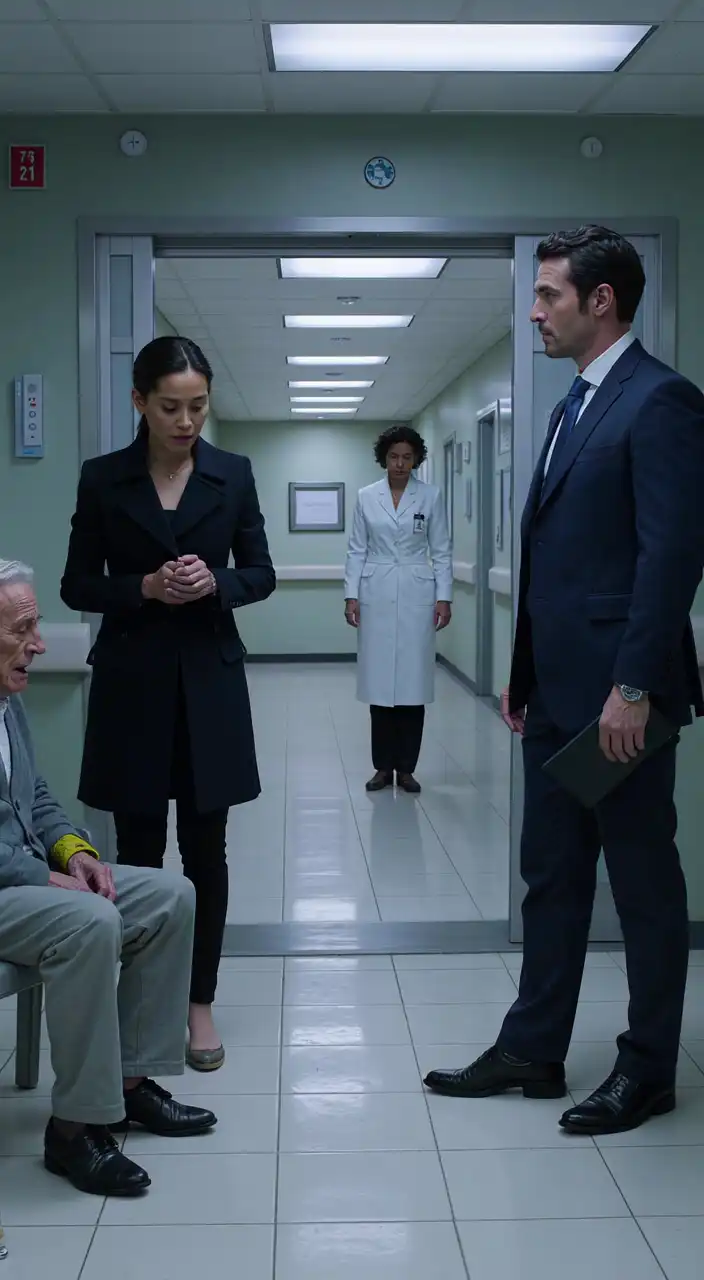
MY FATHER STARTED SHAKING OUTSIDE TRIAGE WHILE A CLINIC ADMINISTRATOR BLOCKED THE DOOR AND SAID HE NEEDED FAMILY PERMISSION FIRST.
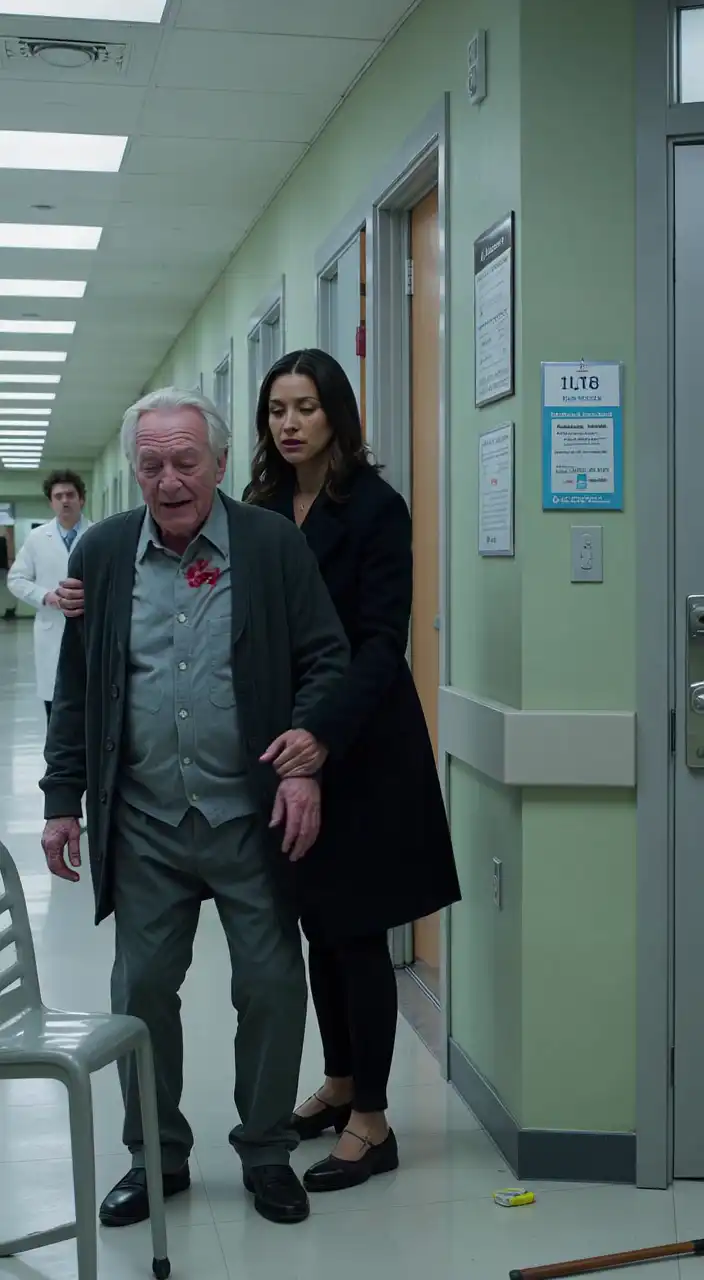
MY FATHER STARTED SHIVERING SO HARD HIS SURGICAL BANDAGE BLED THROUGH, AND THE CLINIC ADMINISTRATOR STILL BLOCKED THE TRIAGE DOOR.
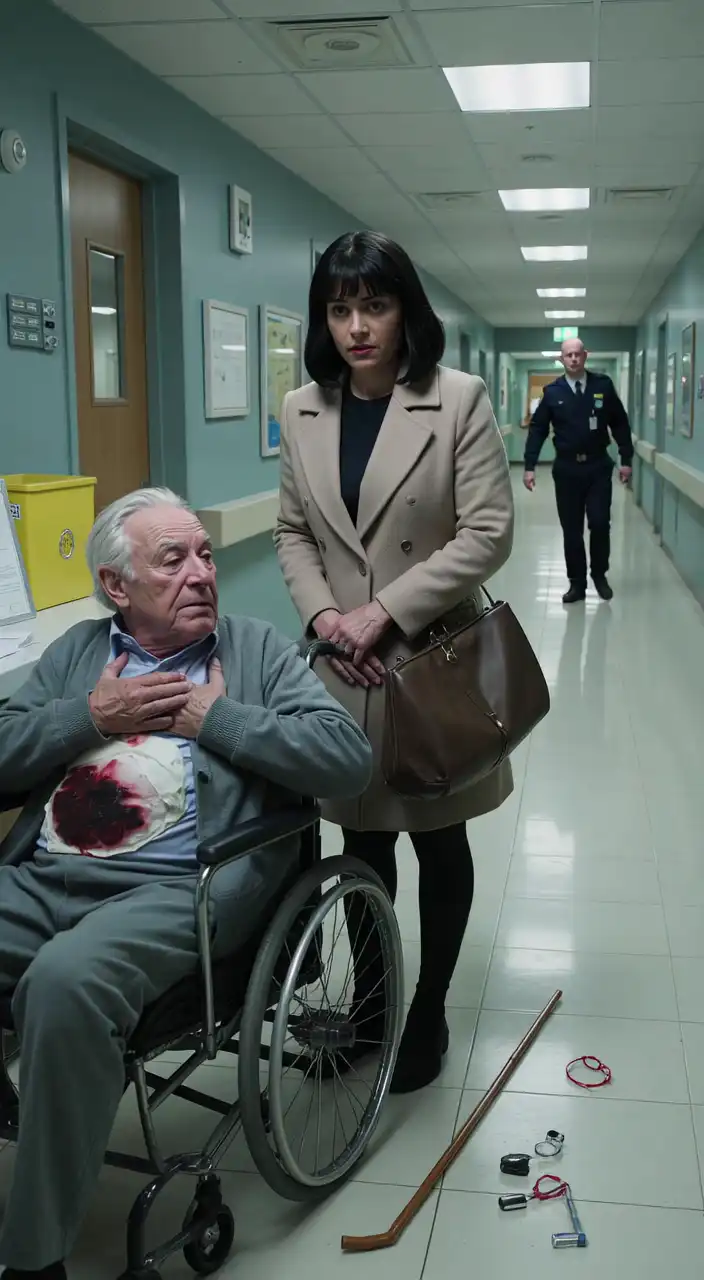
MY FATHER STARTED SHAKING IN THE HOSPITAL HALLWAY, AND THE WOMAN WHO CLAIMED TO BE HELPING HIM WOULD NOT LET TRIAGE TOUCH HIM.